swansont
Moderators
-
Joined
-
Last visited
Everything posted by swansont
-
What does that have to do with its temperature? (which is CoM motion) Depends on what you mean by "lined up" There will always be motion, and some spatial extent. But if you want more confinement, you should use a linear ion trap, which has a stronger restoring force, coupled with laser cooling. At this point I have to wonder if you are doing this deliberately. (after it's been brought to your attention twice in the last few days) A 2-D MOT uses both magnetic fields and lasers. Magnetic traps are not very deep, so they will only confine atoms that are already cold. It would not have a "wider coverage"
-
Precession won't cool the atom. Laser cooling by itself doesn't cause confinement. No, the 500 MHz is a feature of the atoms (owing to their innate width and thermal motion), not the laser. The laser is at 780 nm, which is ~ 4 x 10^14 Hz Again: MRI and laser cooling are not the same thing. You can't mix and match them. You're still doing this? The confinement is from the light, but the presence of a particular magnetic field gradient (a quadrupole field) makes the force position-dependent, so the atoms will be at rest at the zero point of the magnetic field. You can do that with the proper magnetic field gradient. It's a 2-D magneto-optic trap, sometimes called an atomic funnel.
-
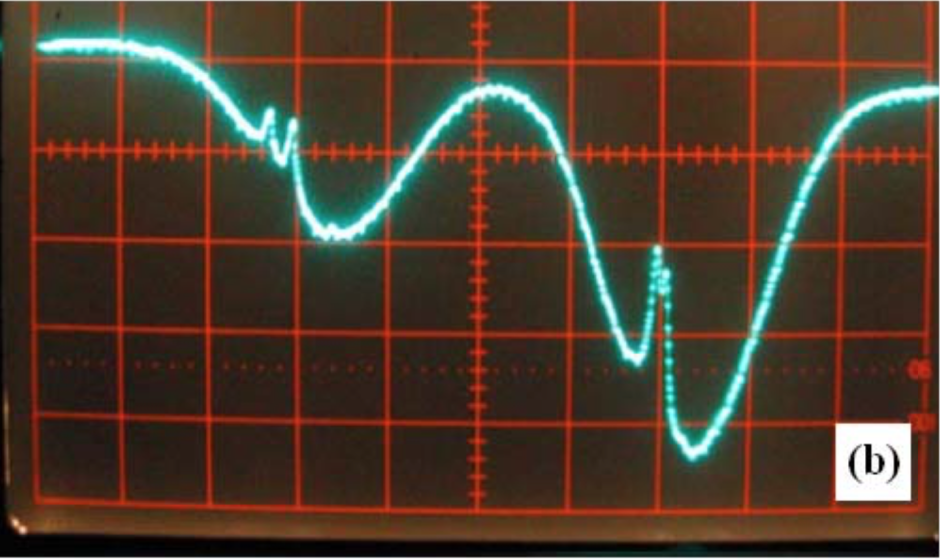
The transition that you use in MRI is not the same as you use in laser cooling. In MRI you cause Larmor precession at a frequency that's resonant because you have put on a magnetic field to match the frequency of the RF. The emission pattern of the radiation is laser cooling is isotropic, which is why the force from emission averages out to zero. As far as I know this is not the case for MRI interactions. If the incoming and outgoing photon are in opposite direction, so net momentum change occurs — the atom doesn't slow down. Cooling and trapping requires that you scatter enough photons before the atom has passed through the interaction region. If you don't do this, the atom will not be trapped. If it passes through it then hots the vacuum chamber wall or, since the "dark vacuum" still has background gas, some other atom, and re-thermalizes. Even if you managed to trap an atom or two, these collisions will liberate them from the trap. You use the optical frequency of the D2 transition (which minimizes the optical pumping I mentioned earlier) which for Rb is at ~780 nm The 500 MHz they mention in the wikipedia article is ∆w, which is the Doppler-broadened width (FWHM = full width at half-maximum) of the transition, not the transition frequency. IOW, the laser has to be within about 500 MHz of the center to be resonant with one of the atoms in the thermal distribution (the Maxwell-Boltzmann distribution that is mentioned). They mention the natural line width of 6 MHz, which is true for any Rb atom at rest. That's how closely you have to tune the 780 nm light to be most likely to be absorbed by a particular atom. Here is a trace from this paper https://advancedlab.physics.gatech.edu/labs/SaturationSpectroscopy/SatSpecManual.pdf It shows the saturated absorption signal of the D2 transitions in Rb for both isotopes (around 500 MHz FWHM) and the individual structure because they are doing Doppler-free saturated absorption, which can show the transitions for the atoms with v=0 in the ensemble. Those are nominally 6 MHz wide, but broadened by other effects, like laser power.
-
I'm not sure why that matters in general, or to the applicability of Ockham's razor.Whether they typical human being understands some bit of science is not why we pursue the science. I think the concept applies to more than science, and is not anywhere near a full description of the motivation of new science. Yes, you might do science to find a simpler explanation, but people also do new science because current science is incomplete, or possibly wrong, and to realize experiments of theory where the technology has caught up, or to push the limit of what experiment can do. Those have nothing to do with having the simplest explanation. There are places where it has been applied. We had some data suggesting superluminal neutrinos some years back, but the simplest explanation was experimental bias/error, and that's precisely what it turned out to be. The more complex explanation - that there was new physics - was not going to be adopted without a whole lot of confirmation, because of another adage: extraordinary claims require extraordinary evidence. Which, if you think about it, is just another version of Ockham's razor (much like we have multiple ways of stating the second law of thermodynamics)
-
I was referring to the magnetic field for MRI, to point out that it’s not what you need for cooling. For Rb? I expect the photon transition rate would be lower, and the photon momentum is smaller, as compared to laser cooling. I doubt you get significant cooling.
-
In MRI the water is confined because it’s in an organ. Magnetic trapping isn’t involved. I’ve been doing laser cooling for almost 30 years. I like physicsgirl and veritasium videos (I met Derek once, several years ago) but I’m not going to learn any experimental details from watching this. In laser cooling you tune below the resonance, so the doppler shift moves you closer to resonance. Laser cooling works because the light slows the atom down - the absorption is from one direction, so there’s always a momentum “kick” from that direction. The momentum kick from the emissions cancel, because it’s isotropic. You don’t have this arrangement in MRI. Or the same magnetic field arrangement (and we haven’t discussed the problem of optical pumping yet) You can suspend an atom in a vacuum system with laser cooling because there’s more than enough force (you can easily get 100 g’s of acceleration). How much of a force can you get with microwaves?
-
No, not really. The confining force in a magneto-optic trap comes because photons have momentum. You put lasers along all six directions (+/- for x, y and z) The magnetic field means the light causing confinement is closer to resonance. so you get more light being absorbed that gives a force toward the trap center. The recoil of a visible photon changes the speed of an atom of order 1 cm/sec. MRI uses photons perhaps a million times less energetic.
-
All vapor BECs are in vacuum; there’s nothing special about that (and one reason why you can’t do this on the cheap). Moving around isn’t why it’s at a uniform temperature. What did I just say about a pop-sci article? The physics is not explained. You can’t extrapolate from the information that’s been filtered through the reporter. They rarely explain if something is generally true or specific to the situation they’re reporting on.
-
! Moderator Note The sandbox is for things like testing LateX formatting. Not for discussion.
-
But we do spend money on research. It’s not like cancer research isn’t happening, or auto safety isn’t being improved. And you point out the time factor. Additional money can’t speed up things that need time.
-
I hope it’s clear that it does emit photons, but it’s not a resonant process Even journal articles don’t aways contain all of the relevant information to do an experiment. Pop-sci articles contain far less, and tend to avoid precise language. You are free to ask questions about such articles. Extrapolation from them is the problem.
-
Why would people be protesting any of this? I think part of the fear has to do with things we have some control over. And, as Phi noted, immediate vs off in the remote future
-
Yes, sort of. They’ve done it without a BEC, IIRC. It’s a matter of maintaining the photon’s information. The photon is not confined, as such. It’s absorbed, but a photon with identical properties is later emitted. No energy loss is a required part of doing this. I think scaling it up has insurmountable problems and even it didn’t, a prohibitive cost.
-
Ask pertinent questions and I will try to answer them I didn’t say sci-fi, I said pop-sci. Pop-sci doesn’t teach science, it teaches about science. Like I said, it’s a veneer, discussing results, in general terms. No nuts-and-bolts science. You get a result (we slowed light down to 10 m/s or whatever) but what about the person-years of work it took to get there? That’s what needs to be discussed, and what you need to know if you wanted to do a similar experiment. You need to know how the experiment works - and what doesn’t work - in order to do that. That kind of knowledge doesn’t lend itself to a post or two. You’re better off reading the journal papers on the topic. And since you likely don’t have a sincere desire to do this (the >$50k price tag being one indication), I don’t see what the motivation would be.
-
No, this doesn’t settle it. Stop with the videos already. They don’t give the details necessary to discuss this. There is no science here, it’s pop-sci; the veneer of the results without getting into the scientific details, where most of the science is.
-
And having universal health care means you can get by with a lower wage than someone who doesn’t have it. Because this is largely driven by the federal government, and we have one party dead-set against doing these things. US state and local governments can’t have deficit spending the way the federal government does, so they can’t fund certain initiatives. How do you ensure these jobs are not minimum-wage jobs?
-
I wasn’t talking about applications, I was talking about scaling up the experiment itself. A regular BEC experiment would cost $50k, minimum. More if you’re not able to build up the lasers and electronics yourself. I would discuss why scaling it up would be problematic, but you haven’t shown you know what’s involved in making a BEC in the first place. It appears you are leaping past all the technical details to discuss the pipe dream of making a 1 meter BEC. The first question to ask is why nobody who knows what they are doing has done this already. The BEC is the medium. It is, under certain conditions, in the right medium. https://en.wikipedia.org/wiki/Faraday_effect
-
7 years at $7.25 puts that data at 2016. That was the year California and New York started raising their minimum wages. Both are now at or above $12, along with Connecticut and perhaps other states. Both data sets could be correct.
-
Yes, that’s what I’m wondering - if you have any idea what’s involved in scaling this up, or the limitations involved.
-
That’s not what your link says. The number would be under 28 million, based on that information.
-
Up top, leftmost tab is Browse. Choose “guidelines” and read, along with the links. Many subforums have pinned tweets and links near the top of the page, relevant to that section.
-
But you admit these are different moments. How is that an illusion?
-
How do you propose to do this?
-
! Moderator Note It’s a science forum. I’ve moved it to speculations, since what little science is here is not mainstream
-
Right; E=mc^2 applies to particles at rest. If you add energy (while remaining at rest) the mass increases.