studiot
Senior Members
-
Joined
-
Last visited
Everything posted by studiot
-
Do you realise that each line of the table is independent of any other line ? So you fill it in line by line. There are 7 base quantities in SI units and, (by coincidence ?), 7 lines in the table. Look here https://sciencenotes.org/si-base-units/ 😀 So, starting with the first line how are you getting on with time ?
-
Calculating percentage 'accuracies' can be very misleading which is why it is a pity you did not answer my post. The questions I asked were designed to help us to help you since you have asked the same question twice now, this is the one I was am still concentrating on. The answer to this is that industry standards have grown up on the basis of calculating the error. But the analysis depends upon the circumstances and the formulae you are using which I why I asked about calculus. You really need a good understanding of the meaning of the words, error, significant figures, decimal places, accuracy, precision. Your example of the area of a circle is more difficult and less versatile than one using the circumference since it only contains multiplication. If you would like to work through the following question, which also contains addition, and its implications please let us know. It is a much more useful question to start with. A man who is 2 metres tall walks all the way round the Earth at the equator. Given that the radius of the Earth is 6378137.3472 metres, how much further does his head travel than his feet ? This question is about what is known as 'the difference of two large numbers' and the loss of accuracy that can arise if it is handled in the wrong way. The answer is also quite suprising. If you want to proceed further, please let us know.
-
Good Morning Axel, I see you are new here so welcome. 😀 You are correct in thinking that the value used for π affects the end result in calculations. There is indeed considerable theory which is used in Science and Engineering to select the appropriate number of decimal places to use. In order to explain this further perhaps you would like to tell us a little about you maths background since calculus is needed for this. Do you know any calculus or anything about 'significant figures' ? In the meantime a couple of rules of thumb. Firstly it is often good enough to adopt the value that π = √10 Which can make a calculation easier as this will often cancel. [math]r = \sqrt {\frac{{78.5}}{\pi }} \simeq \sqrt {\frac{{78.5}}{{\sqrt {10} }}} = \sqrt {\frac{{7.85*10}}{{\sqrt {10} }}} = \sqrt {7.85*\sqrt {10} } = 4.98[/math] This example is trivial but shows the principle. Secondly it is common practice to emplou one or two 'guard digits'[ So if you are expecting the result to be accurate to 3 significant figures (3SF) you would work to 4 or 5 sf and round at the end. Better theory would give you a better answer.
-
Pull-backs are defined for smooth (differentiable) transformations only; for example the pull-back of a Jacobian (which acts on columns from the left) is another matrix of partial derivatives acting on rows from the right.
-
https://math.stackexchange.com/questions/1812391/relation-between-the-dual-space-transpose-matrices-and-rank-nullity-theorem No more time tonight sorry.
-
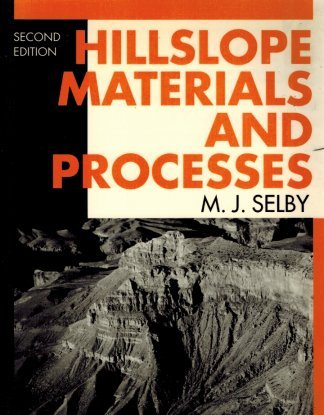
Good on you for your choice of subject. Perhaps your lecturers are trying to make their students think ? At third level you need self directed learning (reading around the subject) more than ever. You learn almost as much from your fellow students as from your lecturers, especially in a subject that devotees are passionate about. Also this subject requires a wide ranging scientific background, so much of the first year is spent bring students from disparate backgrounds up to a required common level. The pace and standard ramps up after that. From the times of your posting I deduce that you are probably in OZ or NZ. This book, from Oxford University Press has most of the examples set in this continent. He also wrote a smaller first year university textbook about the subject. Sadly Prof Selby passed in 2018. But remember ScienceForums when you want to discuss something. You can post more generally in the Earth Science section, the Homework section has special rules so we are not allowed to answer set work directly.
-
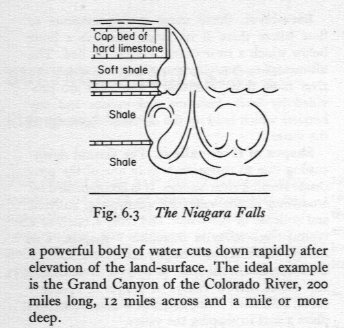
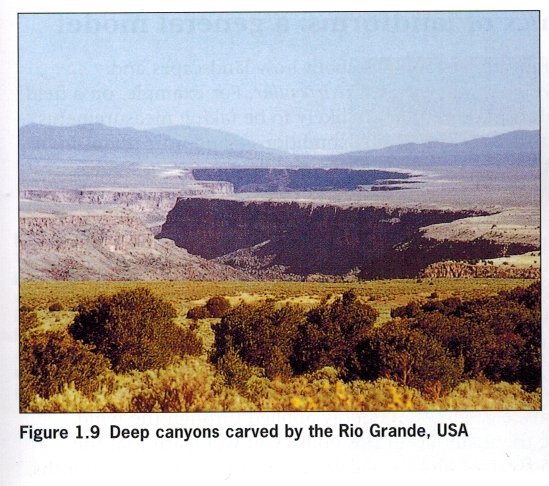
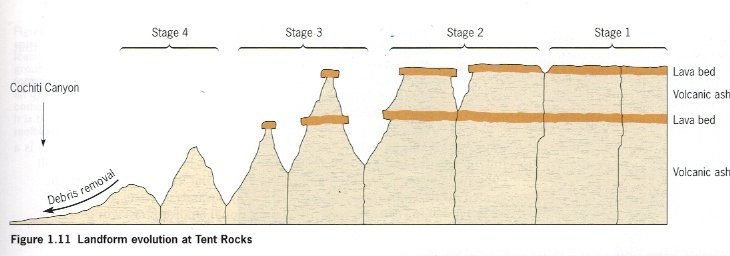
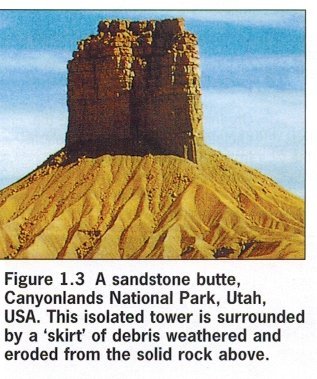
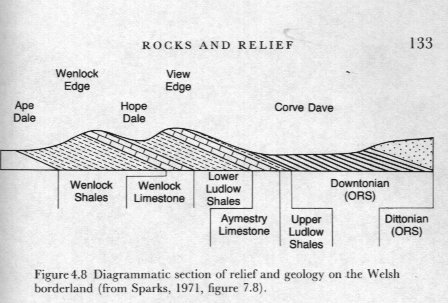
Hello Ed, You are clearly near the beginning of your studies here, but it would be useful if you were to indicate your interest in physical geography / physical geology / geomorphology is. Especially if you are going to post more questions for clarification. It really is a fascinating subject. The three diagrams you posted were from an older era and the subject has moved on since. In those days the view was rather narrow and static. Today we try to look at such questions in a wider sense, both in how the particular landforms developed and fit in both with their surrounding areas on the ground and our best theoretical work on the subject. I note that the three diagrams (which could easily have been drawn by Arthur Holmes a very famous pioneer) have been carefully edited to avoid showing any explanation, for the purpose of making them into a question. I take it you are aware that all the rocks on Earth can be classified into sedimentary or igneous (volcanic). All three diagrams could be formed from either types of rock by 'denudation processes'. Denudation is the overall term for the general process by which earth and rock is detached from the main body of material and transported away from the site to somewhere else. Swansont has suggested that the waterfall might be formed like the ones on the Colorado river in the Grand Canyon. These layers here are mostly volcanic and look like the ones in the Rio Grande picture. Here, as with the Grand Canyon there is a large scale upper plateaux or mesa, heavily dissected by a major river in an arid area. More can be seen here https://www.nps.gov/grca/learn/nature/grca-geology.htm The whole area has been uplifted and is a bit like the simplified diagram below. Note the timeline goes from right to left. The final stages of this process, which have not yet happened, look like this butte in Utah. Note here the pile of debris at the bottom, which has not yet been transported away. This could also be as the first diagram of your question. The waterfall diagram shows nor canyon sidewalls , more like Niagara, which is forming on sedimentary rock. In your middle diagram the resisant layers could be part of an anticline, with the top worn away, as with this section of the Welsh Borders.
-
Hello and welcome. We have another member with similar interests so look at their thread.
-
I think you are clear what is being eroded or weathered, but did you think about my question ? In each of the three pictures what agent is dong the eroding. Note it is probably different in each case.
-
well done for spotting the first day post limit. Most new members don't. As regards your question, The Sun and stars are balls of firey gas. In fact they are in what we now recognise as the fourth state of matter ie plasma, which is similar to a gas but hotter. Anyway it is a fluid. I wondered if you were thinking that balls of fluid should change shape when they are translating (moving along) like they do on Earth ? They certainly change shape because of the resistance to movement provided by whatever they are moving in. for instance raindrops become pear shaped as they fall through the air resistance. However in space there is no resisting medium to cause this.
-
When thinking about swansont's comment ask yourself "resistant against what ?" Hint the last of your pictures rather gives the game away.
-
Of course I answered. In point of fact I have been trying very hard to hold a discussion with you. But sadly you don't appear to want to discuss. If you read properly the basis of UK law you would have noted that you have the right to do anything that is not specifically forbiddden by law. Buying a house. Specifically if you are a minor, in prison, a bankrupt, not living in the council house you wish to buy, mentally incapacitated, and probably a few more reasons I can't think of because I am not a lawyer, you are forbidden from buying that house. As I said a significant proportion of the population. On the other hand if you live in a council house Mrs Thatcher introduced a law specifically granting the right to buy that council house. I will let the americans tell you about constitution and its legal significance.
-
What right? Maybe a legal permission? No, I'm not agree. I do not know where in the world you are, but I can see that English is not your first language, nor is understanding of English culture your background. Consequently I think you are missing many of the comments made here, since the language of this site is English. The study of rights and restrictions and how they can arise is indeed an interesting philosophical exercise. Since you want simplicity, let us start by considering Robinson Crusoe, who was marooned on a deserted island. What rights does he have or need ? Let us also think about a densely populated country and the manyfold interactions of its population. Two views of rights and restrictions that form converses of eacfh other are. 1) A citizen has the right to do anything they want uless it is specifically forbiden by the law or constitution. No actual rights are detailed. 2) A citizen has the right to do anyhting specifically set out in the constitution as a right. 1) Is the basis of the UK constitution 2) is the basis of the US constitution But like pretty well every other country, reality is a mix of both extremes. As regards buying a house in the UK, a significant proportion of the population has no right to buy the house they live in for a variety of possible reasons. Equally the UK is actually a Union of 4 separaate countries. In three of them there is a specific 'right to roam' set out in their respective constitutions. In England ,however no such right is set out or exists. If that is not complicated, I don't know what would be.
-
-
-
-
-
This is not such a wacky idea as some responses suggest, as we already do use electrostatics for a similar purpose to gravity. However I have to tell you that this is not appropriate or suitable for your use. Think about muddy water. What happens if you stand it in a jar ? The mude settles under gravity. You get a layer of sediment in the bottom with clear(er) water above. This was and still is used for gold panning for instance. In modern times we have electrostatic dust precipitators (or collectors).
-
thanks. I have an icon on the bottom task bar for firefox. Try this, accessible by right clicking on the fox icon.

-
this is part of the problem with this thread. It is too open ended. You need to clarify what yoy mean by 'rights'. Starting from the observation that in the natural world there are no rights you need to set the scene (context) for your question. Do you mean legal rights ? or Do you mean Human rights ? or what ? Include, please in your scene setting, since you mentioned 'civilised' the society you are setting this in. Slaves in ancient civilised societies had no rights.
-
Frankly I don't approve of that 'principle' since it is of the 'all or nothing' variety and the situation is nothing like that ie non binary. Since we all live together in the same world a far better principle IMHO is 'With every right come the duty to exercise it properly' This way you don't end up with the contradictions you have identified.
-
I have discovered that the 'In private browsing mode' of Firefox seems to cut out all the unwanted overlay crap. Now SF moves snappily from page to page. 😀
-
I agree, we are supposed to be discussing scientific aspects of religion. Archaeology is a science as is geological history. Leonard Woolley set out to find such evidence in Mesopotamia and found both archaeological and geological evidence of a great flood about 6000 years ago. Geologists have found plenty of evidence of a great flood in North Americal 13000 to 15000 years ago when Lake Missoula burst the ice dam.

-
It also include birds; don't know if you include them in animals ? Don't think it was seasonal. The excavations of Sir Leonard Woolley established that there was a significant one off flood extending the northwestern end of the Persian Gulf by some 400 miles in length and 100 miles in width. This was derived from the discovery of a layer of clay deposit, separating two civilisations, wiping out the older underneath.
-
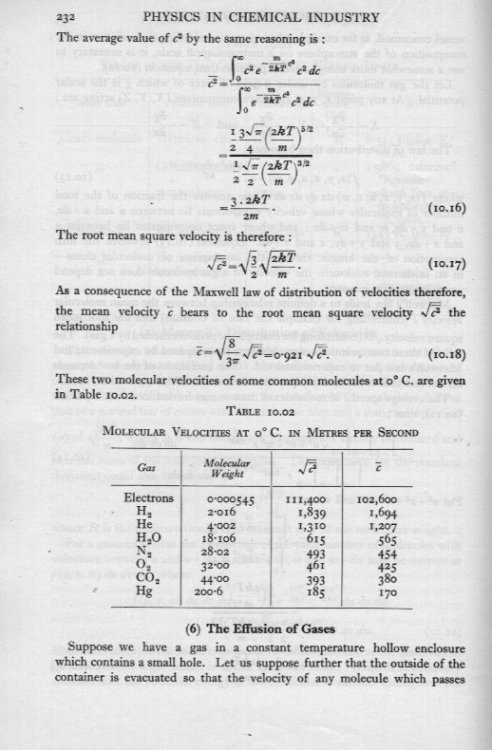
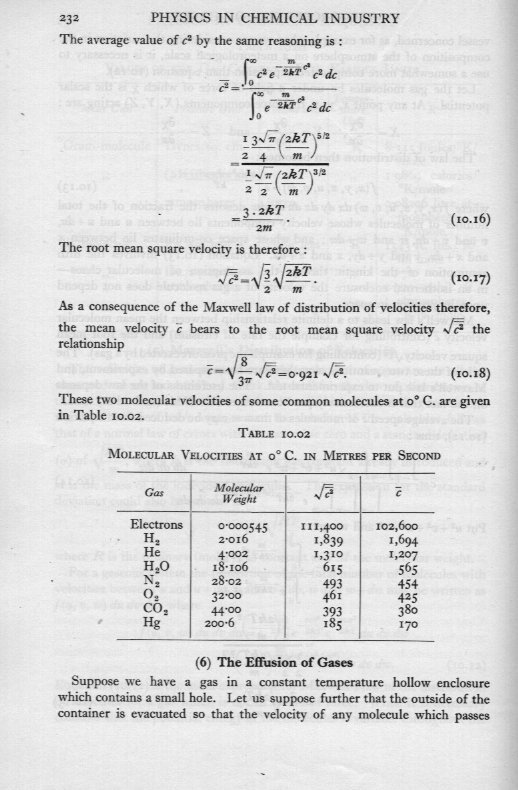
I don't believe that there is only a single misconception here. Apart from mixing up the frames of reference, there is there plainly incorrect statement @M S La Moreaux claiming this is equivalent to saying that if a stream of spaceships ply between Earth and Alpha Centauri, the distance from Earth to AC (as viewed from Earth) magically changes because of the spaceships. It doesn't change for the Earth observer, but does for the shipborne observer. However the shipborne observer also 'sees' himself as stationary and AC rushing towards him. Then there is the simple issue should SR be applied at all. As I have noted the actual electron velocities in copper are such a tiny fraction of the speed of light. Further there is the failure to appreciate the difference between the velocities as a result of an electric field, the random velocities of the electrons in the absence of an electric field, the random velocities of the electrons and the velocities of an electric signal or disturbance in the copper or other medium. The electric signal is actually quite fast, faster than any electron can travel, But is not steady state. I have already worked out the velocity due to an electric field, so Here are some interesting facts and figures about the random walk velocities of an electron gas and other gases. Note the electron gas is a truly free gas, the electrons in copper or other medium are often called 'free electrons' but that is not really the case. They are better named unbound electrons, they are not free as they are confined to a giant molecular orbital called a band. We all make mistakes so a correction to this is in order. Apologies The voltage should be should be 108 not 1011 V