studiot
Senior Members
-
Joined
-
Last visited
Everything posted by studiot
-
Did you ever meet a farmer that wasn't always moaning about the weather ?
-
My apologies that poor Author is Henry Gee, not just Henry.
-
There's lots of help available here, but it would be a good idea to tell us where you are coming from since Engineering Science is a very large subject. Do you have any specific questions in mind?
-
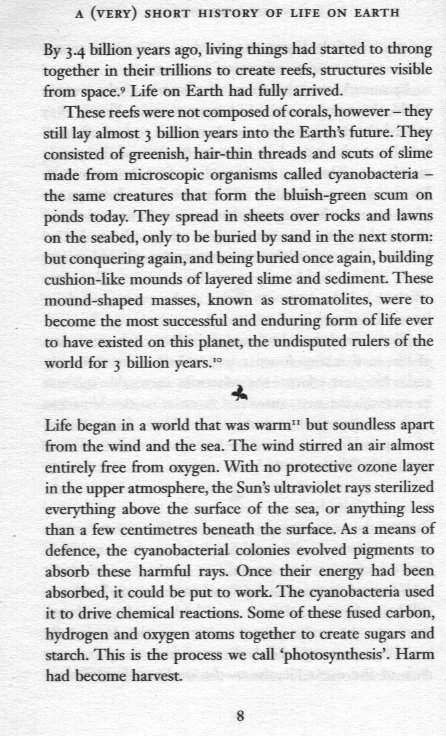
Here is a plug for cyanobacteria and stromatolites as they have spanned the entire geolical epochs from the biginning of life to the present day. Source Henry (Ed nature) A (very) Short History of Life on Earth
-
Sure that's true it just depends upon your simulation algorithm
-
I think it is worthlooking more deeply into the words superposition, entanglement ,collapse and measurement The key to this is understanding how these work and the fact that the maths contains solutions that are always there but are not or can never be implemented. Comparison with non quantum superposition is also helpful.
-
Unfortunately that is not a good answer. Blaming a phenomenon on 'the big bang' is really no different from saying God did it, or that our model doesn't explain it or simply we don't know. If you are going to propose gravity as an emergent phenomenon you need to offer the mechanism (and maths) to say how this conversion occurs. You can't just pull in myhtical event ant woo because you hypothesis doesn't work without them.
-
If the energy is not gravitational, where does it come from ?
-
Interesting POV. +1
-
Agrreed in that there is a self reinforcing aspect. The LLM returns something as an answer Others then quote the LLM So the next time a similar question is asked the LLM weighs into account a quote of its previous statement. Und So Weiter.
-
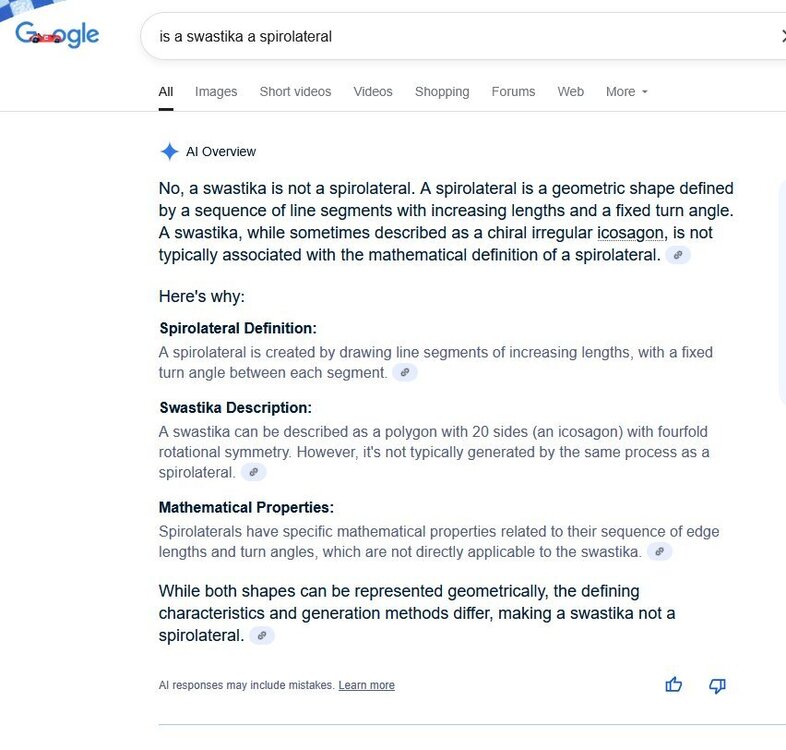
LLM's are hopelessy bottom of the class in Mathematics. One problem with this is if you ask a mathematical question in words it has no way of discerning what the actual maths is. I think this is because it trawls more respectable sites (such as Wikipedia) for the words, without the mathematical understanding. Here is an example of an utterly incorrect declaration from Google AI The moral of this is do not use a language based construct to do or check your maths homework. ( in this case Wiki also has it wrong)
-
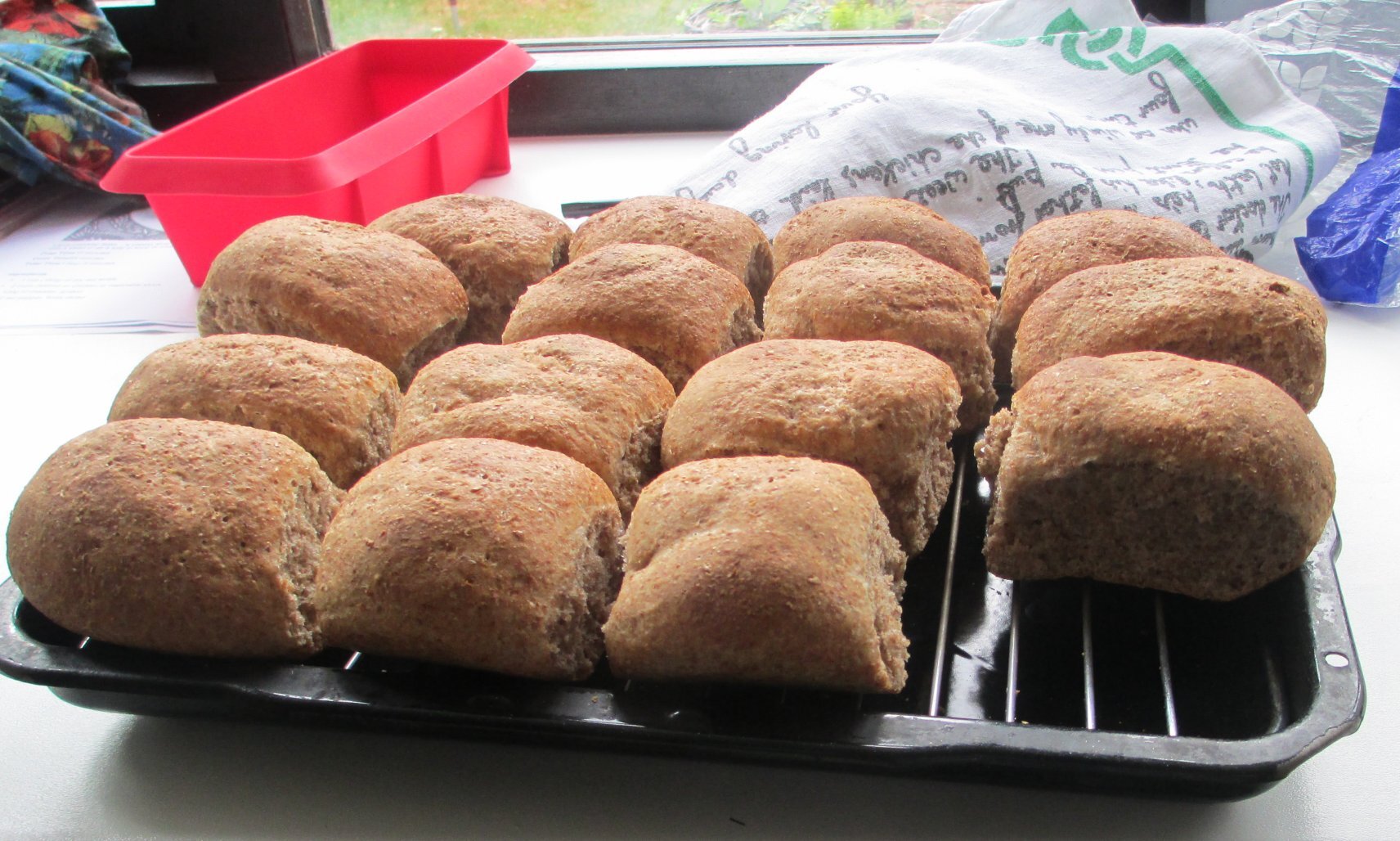
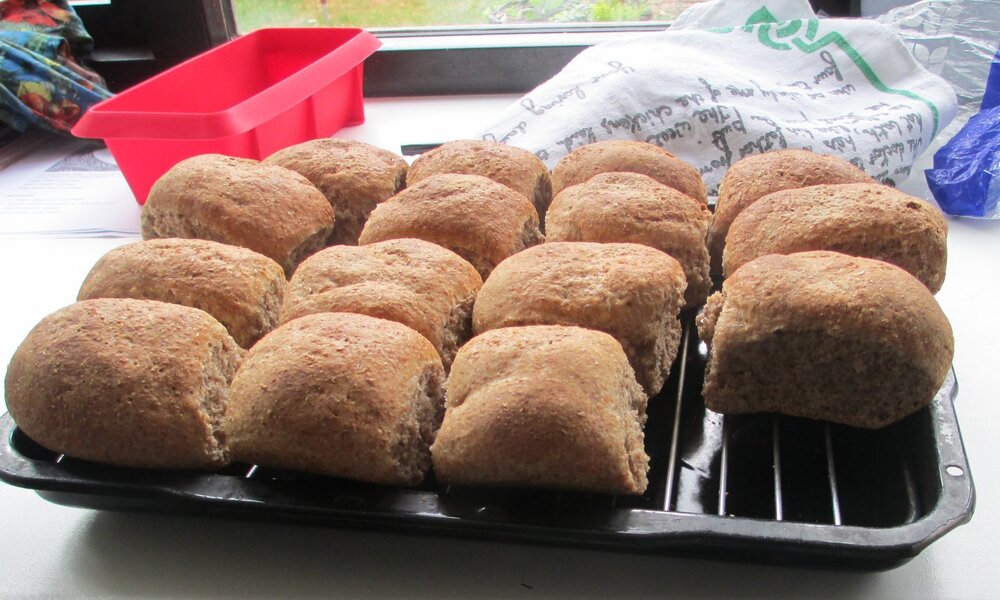
This morning's bake
-
Yeah I forgot to mention that. +1
-
There are many sorts of 'pastry' Some are deliberately crumbly which also means a bit crunchy as in apple or other fuit crumble. Some are 'flaky' as in strudel, creamash, etc Some indeed crumble to fine(ish) powder as in shortcrust od shortbread. Some 'puff up' on baking. and so on. Part of the difference is the amount of liquid, part is the way the shortening (oil or fat) is mixed with the dry ingredients.
-
I'm sorry I have had enough of Wonderland, Alice. You have started with space 'filled' with 'microparticles', then grudgingly added with perhaps some empty space left over. the 'microparticles' can apparantly vary in size and perhaps other properties. We do not yet have a proper definition of microparticles. How would i recognise one If I met it in the street ? Further these microparticles are being pushed about by forces unnamed created by agents unknown. Since all space is filled with microparticles ( or perhaps nothing) where do the force generating agents reside ? Then, all of a sudden, out of the blue, red rings appear round the 'microparticles' and we are told these are electrons. Suddenly atoms appear. Where do the come from and where do they and the electrons reside ? Added to these suddenly electronmagnetic forces are involved. Again where do the come from and how are they distributed ? What new wonders will appear next in this universe of no spare space and no source of energy or agents of force ? I will leave you to ponder these questions and suggest you wait until you have solved them before proceeding further with your fairy tale.
-
I explained to you almost a year ago that your story is historically completely wrong Indeed so but it is presented as a work of fiction and like most, if not all fiction, there is good, bad and indifferent within the alternative histories category. For instance I liked the Philip Pulman Dark Materials trilogy. I can't imagine anyone confusing the various 'histories' of Oxford portrayed.
-
You seem to have answered me twice, so did you miss my reply ? anyway in response to your caveat - if that is correct - How big is the Koh-i-Noor diamond? Because technically is is one single molecule created by natural causes.
-
So what % would you put it at and why ? Bear in mind what I said about every living thing, past and present having to be the overall base to estimate this %.
-
You have one post left in the next 23.5 hours. My advice to you is to not engage in personal slanging matches with other members or you might not survive your first encounter with a moderator. As regards content I would be very happy to explain why our modern appreciation of logig has progressed far beyond this aristotelian view.
-
Quite simply these two sentences, as they stand, imply that that you think purpose applies to every evolutionary change. My point is quite simply that purpose and any other mechanisms at work account for a very small % of such changes.
-
Your graphic states "and are then converted into nitriles". This could well be the case, but the formation of nitrile and further carbon-nitogen compounds requires a catalyst, normally a copper salt on earth but UV light will also do. Bearing in mind the weakness of the UV light on Titan, I wonder what the convertion rate is ? A few % perhaps. Sorry I have no further information at the moment, you will need to look it up. Perhaps @exchemist or @sethoflagos or @chenbeier might add more.
-
I am growing tired of only half my posts being replied and especially as the helpful comments are ignored. I think I might just join the other members driven away by exhaustion, in the bar.
-
But since we are not supposed to judge people, should we not just simply kill all judges ? 😄
-
So let's recap. Underlying all the wrapping you have an idea that has been extensively worked out in mainstream physical science and technology. I know nothing of your technical background, but you seem to have rolled in some extremely dodgy popsci or science fiction notions into that wrapping which devalues what you are trying to achieve and causes you to introduce ad hoc 'cures' as and when you find out something you haven't come across or thought of. We all do this, some many times over, before an idea is hammered out into something workable. Even then there are often a few unanswered questions left over. That is why I have tried to point you at connections to minstream, especially to try and save you from 'reinventing the wheel'.
-
But I have never accepted that "Evolutionists" - whatever they may be - are neglecting anything. Perhaps a few are. Perhaps a few more are not working directly in those specific fields. But we should consider the following fact. Every species now or previously on Earth (and presumably elsewhere if there is life elsewhere) has been subject to some form of evolution, albeit some more than others. For instance I understand from geologists that stromatolites have seen very little change since their appearance over 3 billion years ago. In all of that massive spread of evolution many different factors and events have resulted in a diverse range of responses. (Remember evolution is about the interplay between a species and its environment) When we survey that vast array of responses and put it on one side of scale compared to a small quantity of unusual responses ( we should statistically expect some unusual ones) I do not find it at all suprising that the mainstream body of the theory is becoming a bit slow and ponderous. After all most of the evidence continues to pile up on one side of that scale. But it would be quite wrong to suggest that evolutionary has not responded or changed since its inception.