Everything posted by studiot
-
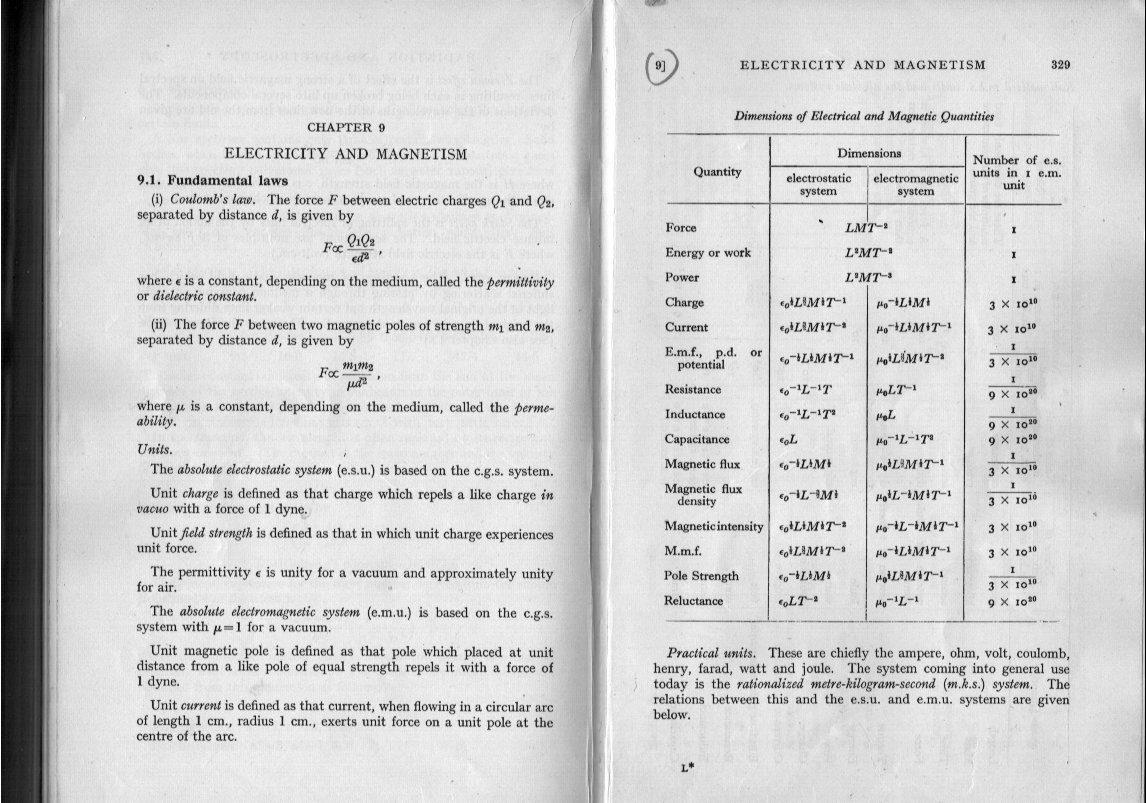
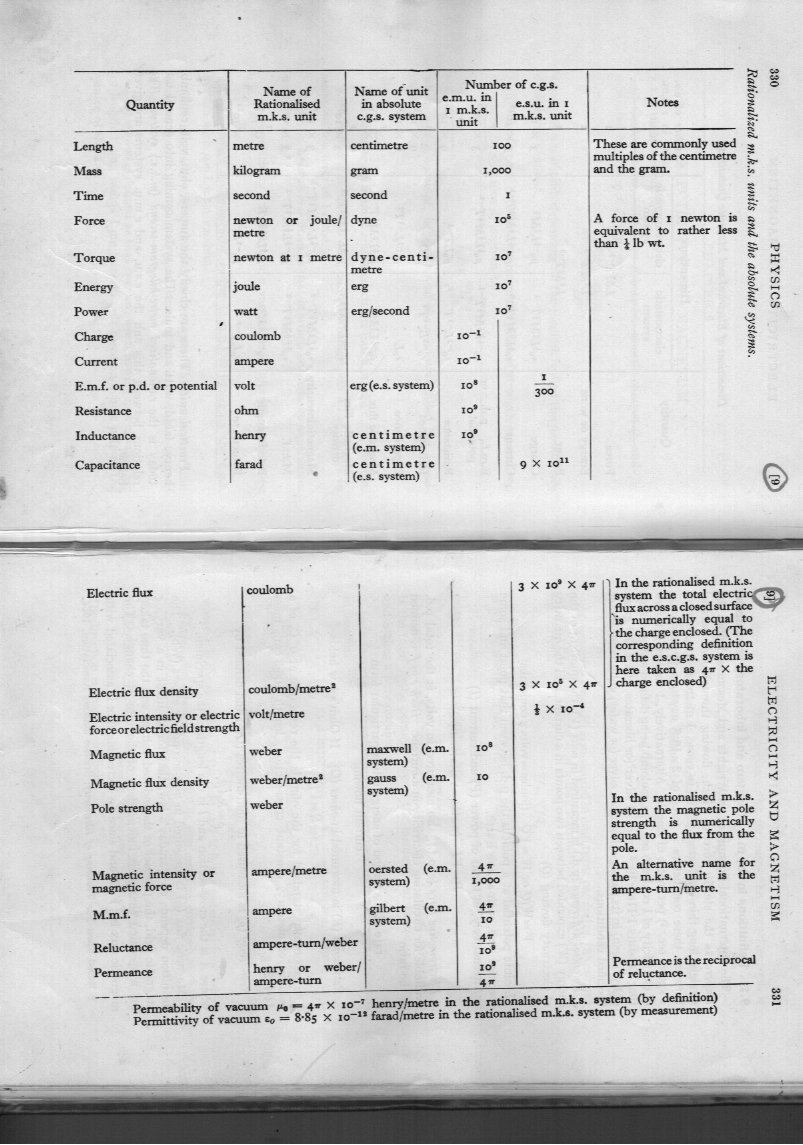
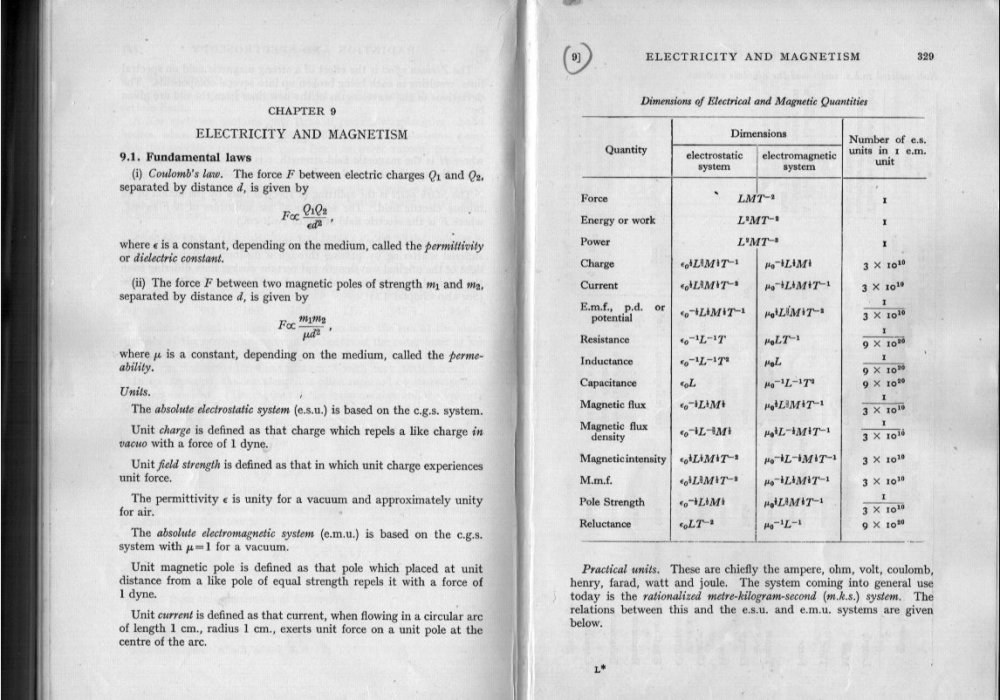
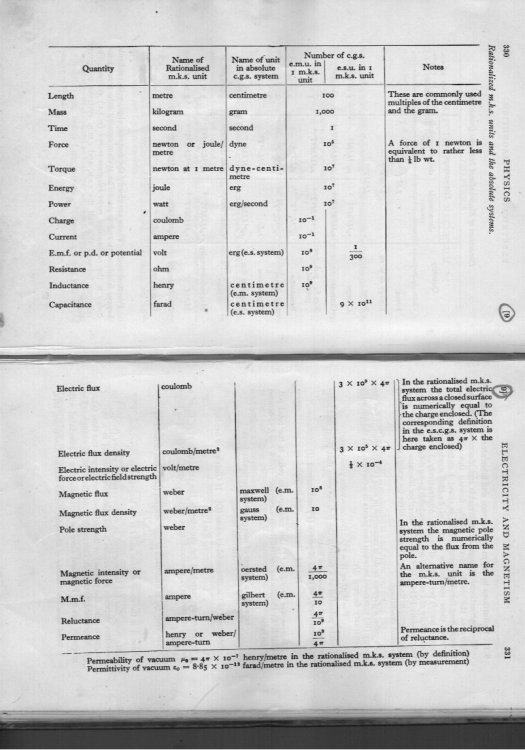
Well I have a problem with this definition of the coulomb, which is surely independent of mass. Faraday showed that the amount (ie number) of ions liberated in an electrolysis is proportional to the strength of current flowing and the time for whixh it flows. From this we may draw the connclusion that the number of ions liberated is proportional to the amount od electricity which has passed throught the elecrrolyte since the current is the rate of flow of charge. But each different ion has a different mass hence the proportionality is independent of the mass liberated. Nowadays we use current density as easier to tie in with EM theory as the base electric unit, but you cannot do without one. Here are some comparison tables and definitions from older systems and Si. Not this was SI before 'count' or number was admitted as a valid dimension.
-
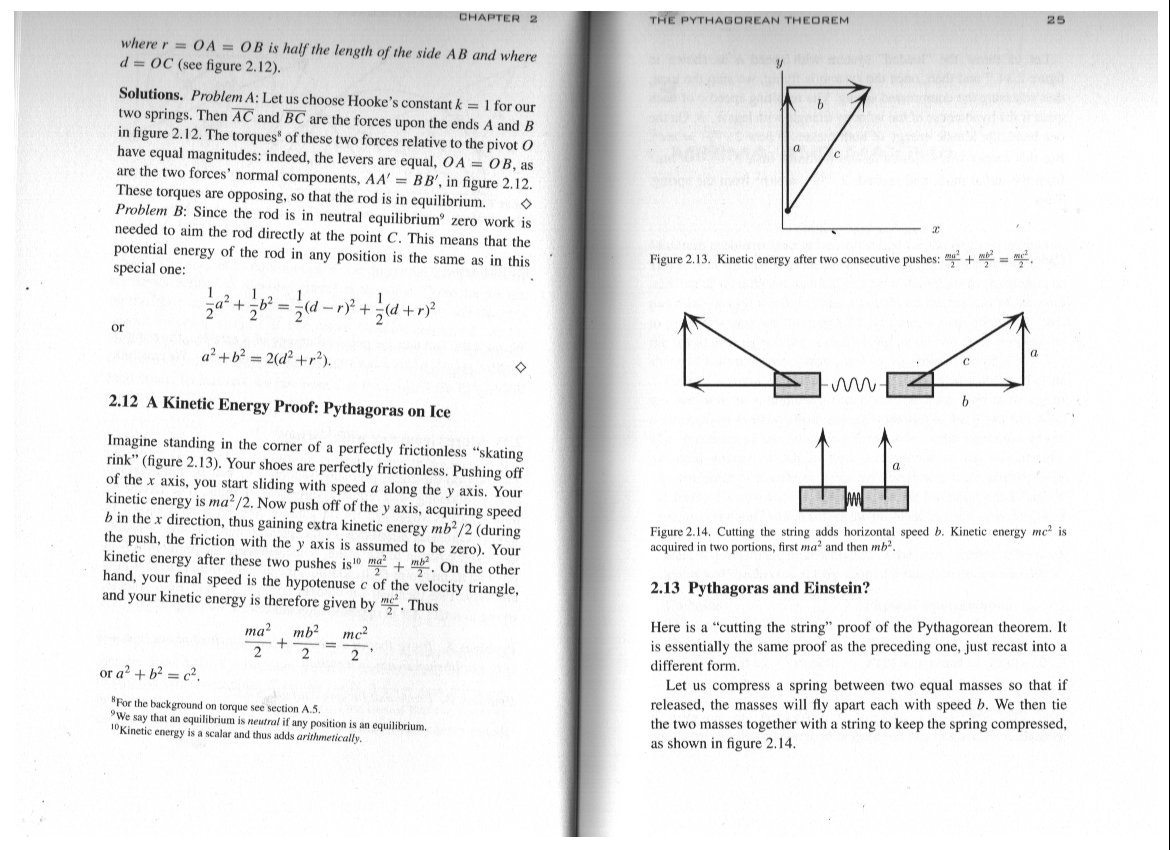
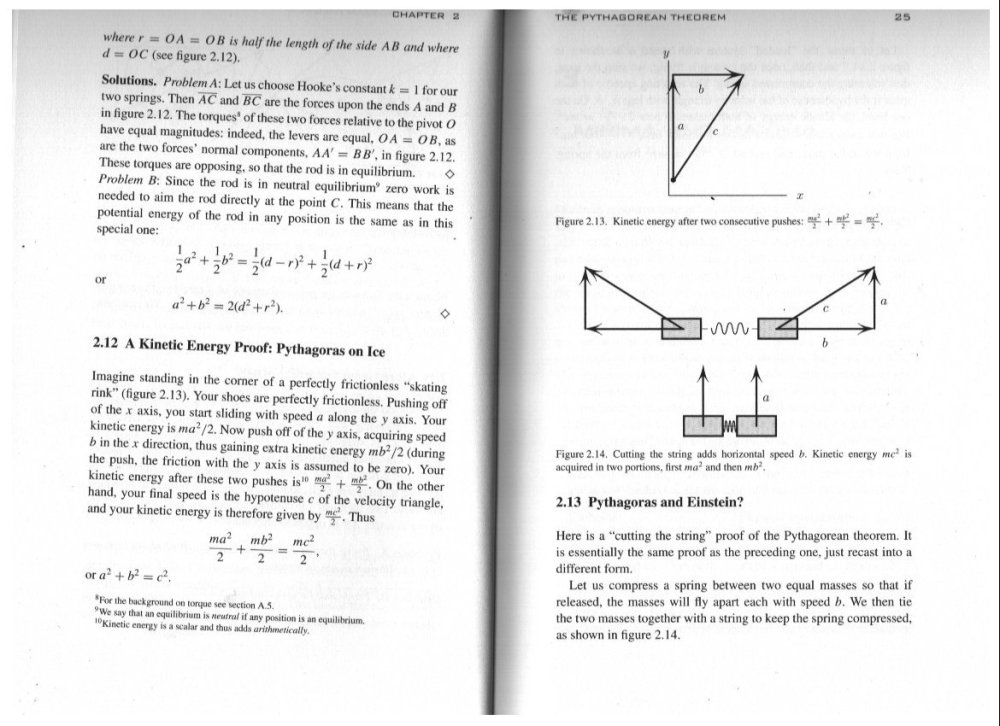
Alternatively from the guy that likes proving mathematical theorems by physical means.
-
Exactly so' It is very common to confuse subsets and elements (members). To make it more confusing a set may also be divided up in other ways - one such is a 'partition'.
-
This is a very roundabout way to say Creat a set that only contains those elements that are in both A and in B. - Which has another name. create a set which is the union of the set of all those elements that are in A but not in B with the set of all those elements which are in B but not in A. I note you website uses both the term elements and members. Have you lost interest in your previous set theory thread or were you just not going to answer me ?
-
You can't prove a definition. And there are many alternative axiomatic systems of set theory, but none are complete because of the underlying tensions identified by Godel and others.
-
Why not ? Thing is a perfectly acceptable general noun. I also think that if you wish to continue this side discussion it would be better done in another thread, so as not to confuse a beginner in set theory. In my view the standard introductory approach leaves much to be desired as it avoids introducing concepts that make set theory useful in so many other disciplines.
-
Yes my wording was a bit slack. But the set of every thing is most definitely an infinite set. So if you restrict things to those without a square root, that set does not have a square root and must be a member of itself. That is exactly why Russell introduced 'type' theory. also originally called category theory, but category theory now refers to a different subject.
-
The set of everything that is not a square root ?
-
Who are we ? Cantor's original word in German was indeed Elemente (plural). German, like English received the word element via Latin from Greek, and the word has has many different meanings through the millenia. Workers after Cantor discovered philosophical difficulties underlying basic set theory, which is possibly why Russell used the translation 'members' to distinguish aggregates (the English word for set at that time) which sets which contain other sets as members and sets which do not. Whether you chose to use the word elements or members, the important point is to distinguish between subsets, which are neither elements nor members, and the elements/members themselves of the set. Subsets are entites that are formed from the elements/members but are not generally members, which is why HbWhi5F has counted too many 'elements'. That way the definitions are self consistent.
-
Didn't most other large organisations make the same decision/mistake ?
-
Since you have set out your working I will answer this question for you, using you definition. Your example set is defined by the list {1,2,3,4} that is 4 members so n = 4 and 2n = 16 Note 1,2,3,4 are numbers not sets or subsets, but these are the members of your set. I very much doubt it. What it should say if written properly is that ∅ is a subset of every set - not a member. It should also say that the Power set is the number of subsets that can be formed from the members, including the whole set itself. So let us count up , remembering that ∅ is a subset, but not a member and that {3,4} and {4,3} refer to the same subset - order of members doesn't matter. There is 1 subset with zero members - ∅ There is 1 subset with 4 members {1,2,3,4} There are 4 subsets with 1 member There are 4 subsets with 3 members There are 6 subsets with 2 members. Since this is posted in Homework help I will leave you to list the subsets I did not. They are easy to check if you wish to post them.
-
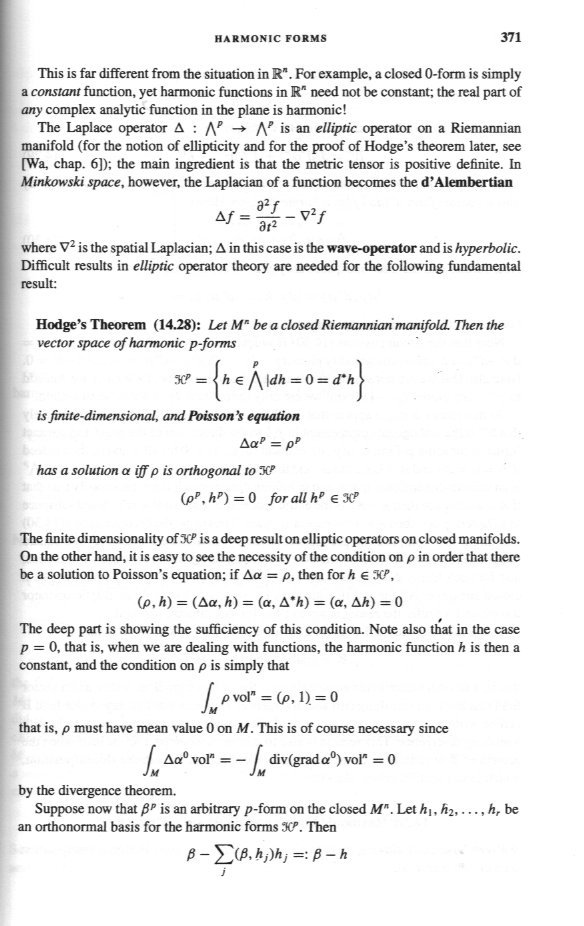
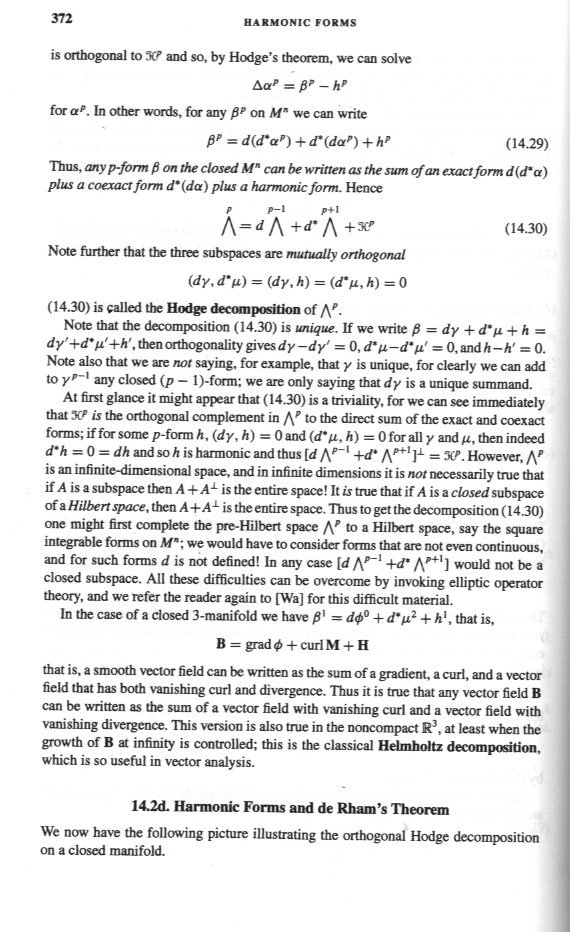
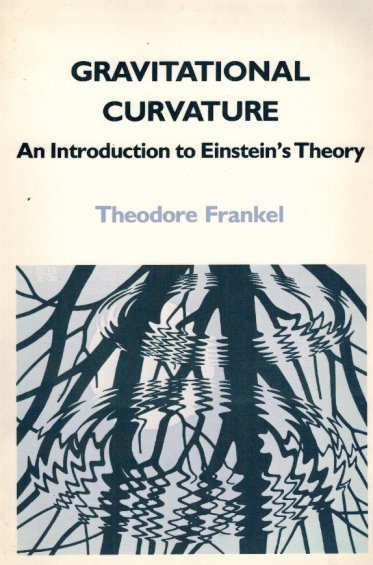
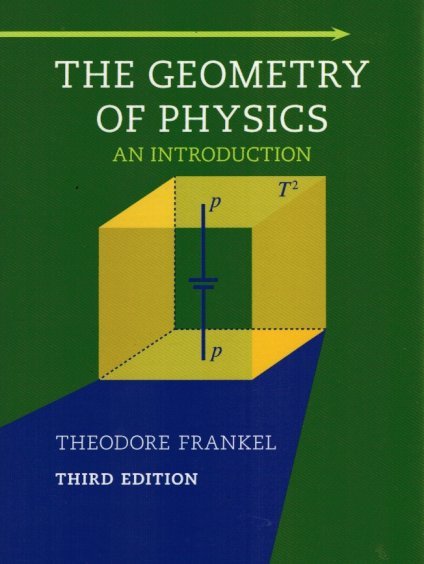
Frankel is also the author of a much slimmer volume, published by Freeman. I would also like to add a warning for other members about sign and symbol conventions The convention to use del or nabla squared to represent second order derivatives is fairly universal. Some authors copy this for the box operator and call the D'Alambertian operator box squared. However others simply use the unadorned box. Of course the author referred above uses yet another convention that is explained in the text. I am experiencing some computer problems at the moment, but if anyone want some examples I will try to produce them.
-
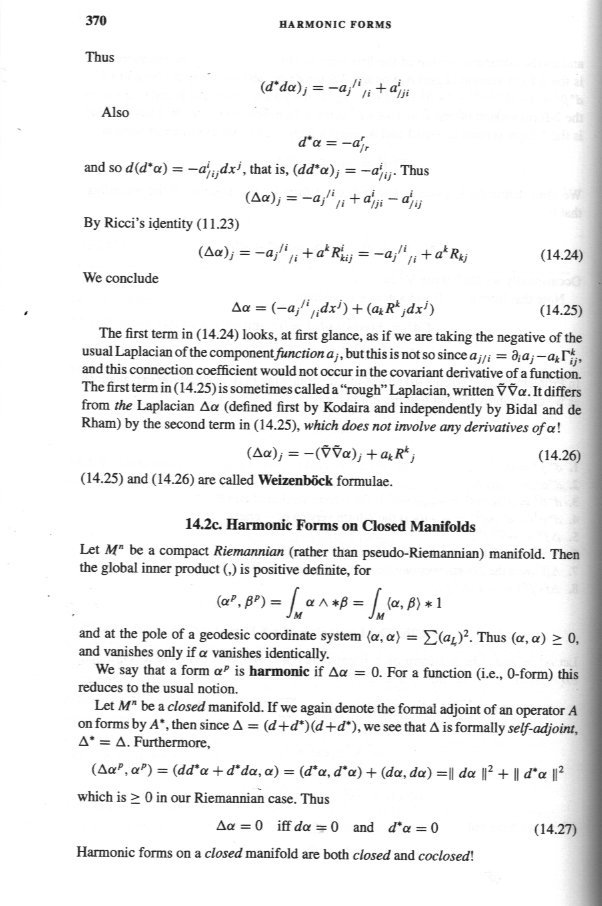
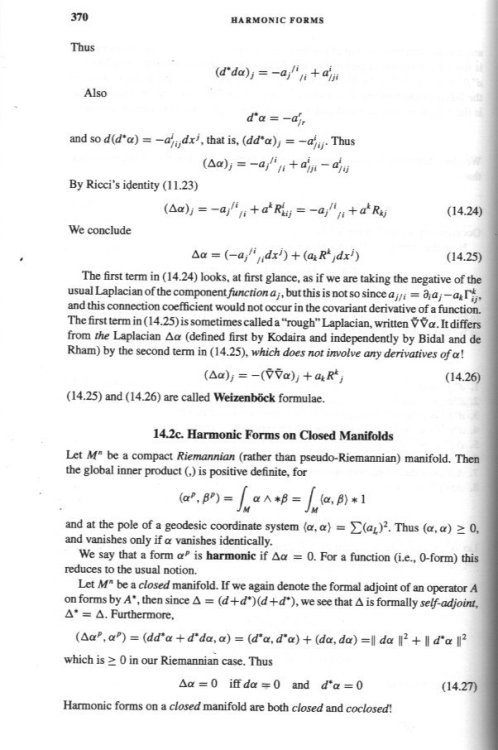
The thing about asking for a geometrical interpretation these days is that Geometry to a mathematician tends to be largely algebraic, and you have to be versed in the terminology as this extract from Professor Frankel's comprehensive treatise (Cambridge University Press) shows. It does however explain Modred's comments in more detail.
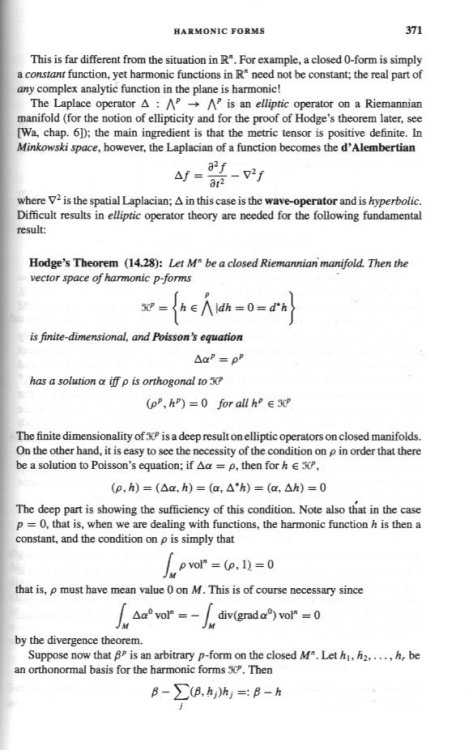
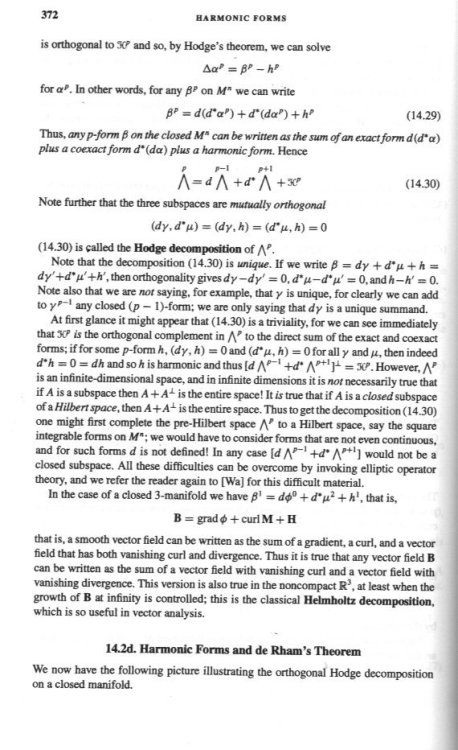
-
To further expand on what I hastily dashed off (and +1 to KJW for expanding on the arbitrary function aspect) We should consider the (geometric) nature of the functions we want f and g to be. First and foremost they must be bounded at all points of interest. f(x) = x2 for instance is not good for our purposes as it increases without bound as x increases / decreases. Secondly it must be at least twice differentiable everywhere. Thirdly we need it to have identifiable points where it vanishes or is identically zero. These points correspond to the nodes in standing waves and lead to quantum energy levels and the principal quantum number. Formally this comes from boundary/initial conditions as noted by KJW. Fourthly we would like a function that, unlike x2, dies away to zero at infinity.
-
Thank you for bringing this discussion back to its topic in your inimitable way. +1 For the record this thread is not about global warming/ climate change. Nor does the spent energy in tungsten lightbulbs make any significant difference to room temperature. It is a poorly known fact of Physics that hot air rises. Nor is this thread an exercise in AI bashing. I can actually see a use for the offered service in the right circumstances, but Adobe has also provided a buttion to access this for those that actually need it. The popup in the screenshot is unwanted/unneeded push advertising, and somewhat patronising and offensive IMHO. But thank you all for your input anyway.
-
I was reading a pdf paper about protons when this little fella popped up Save time be dammed. How will anyone ever learn anything serious ?

-
Very quickly since I'm on my way out, The Darlambertian or box operator is the four dimensional equivalent of the 3D nabla or del operator. As such it is a partial differential operator. The solution to ordinary differential equations involvesarbitrary constants of integration to be added or accounted for. The solution to partial differential equations involves arbitrary functions, not constants to be added or accounted for. A differential equation connecting space and time is an equation of motion and may also be an equation of something else such as energy. Schroedinger's equation is an example of this. Some, but not all, solutions to such equations are wave equations. A wave equation is an equation of motion - wave motion. Sorry it's only partially (pun intended) geometric, I will try to add more when time permits. Hope this helps
-
Quite a lot has happened in the world since the OP stopped posting in June 2009, a few years before I joined It would be nice to know how he/she got on. I note that all the advice offered involves thinking in the abstract; some people are better with tangible hands on approaches. If anyone is still interested we could look further into this, the subject used to be called practical mathematics.
-
1) Avoid large heavy type in capital letters. I annoys many people, who think you are shouting. 2) As a student you should be thinking for yourself. But search engines are very useful to obtain factual information eg "what is the radius of the earth in metres?" , "what is the composition of the atmosphere of Mars?". In other words it is Ok to use it to find factual data, you intend to use but you must be in charge of the calculation or other use.
-
What exactly do you mean by using the word emergent ? For instance do you consider the result of 1 + 1 = ? emergent and if so in what way ?
-
It is worth pointing out that there is a big difference between the meaning of closed in mathematics and in engineering physics.
-
You already have a thread about this that you seem to have abandoned ? Don't waste your (and other's ) time on a false concept of 'time'. Time and change are independent variables that are sometimes related, but not always. When they are you can sometimes deduce a subsidiary variable the time time rate of change. But you can also deduce a rate of change with regard to other non time variables. These are basic mathematical definitions and procedures. They are independent because you can have one without the other.
-
This 1887 presidential address (to the ICE) about renewable electricity might interest by George Barclay Bruce might interest some
-
Well it is said that everybody in the world is linked to everybody else by no more than 6 links Jordan Ellenberg "Shape"
-
A pumped storage system has two reservoirs, the ocean could be the second one. Alternatively California already has a dozen desalination plants, so the spent seawater could be desalinated. https://www.waterboards.ca.gov/water_issues/programs/ocean/desalination/docs/170105_desal_map_existing.pdf