studiot
Senior Members
-
Joined
-
Last visited
Everything posted by studiot
-
Here is a very clear demonstration of how working with infinite sets / sequences is non intuitive. The top line is just a list zero plus the positive integers. The matching line underneath is a list of the squares of the line above. You can clearly see that because every integer has a square, there is one to one correspondence between the upper and lower set / sequence. That is every number in the upper sequence corresponds to one and only one number in the lower sequence uniquely. So both sets have the same count of members. Yet the upper sequence contains every number in the lower sequence plus as many more as you choose. [math]\begin{array}{*{20}{c}} 0 \hfill & 1 \hfill & 2 \hfill & 3 \hfill & 4 \hfill \\ 0 \hfill & 1 \hfill & 4 \hfill & 9 \hfill & {16} \hfill \\ \end{array}[/math] So the upper set has numbers, not in the bottom set, yet it has the same count of numbers.
-
I claim precedence on answers to wild unsupported claims, as I am still waiting for even an attempt at justification of the claim that wires can be scalars.
-
I can't seem to see a response/discussion to my answer to your thread question. I'll take your shilling. The most unfortunate water privitisation is about the only one the Uk government does not subsidise. Perhaps it is because they stole the resources in the first place, these were not the government's to sell off.
-
Advice in here might help. https://www.goodreads.com/en/book/show/1198665.Tired_or_Toxic_A_Blueprint_for_Health 🙂
-
Has my answer offended you ?
-
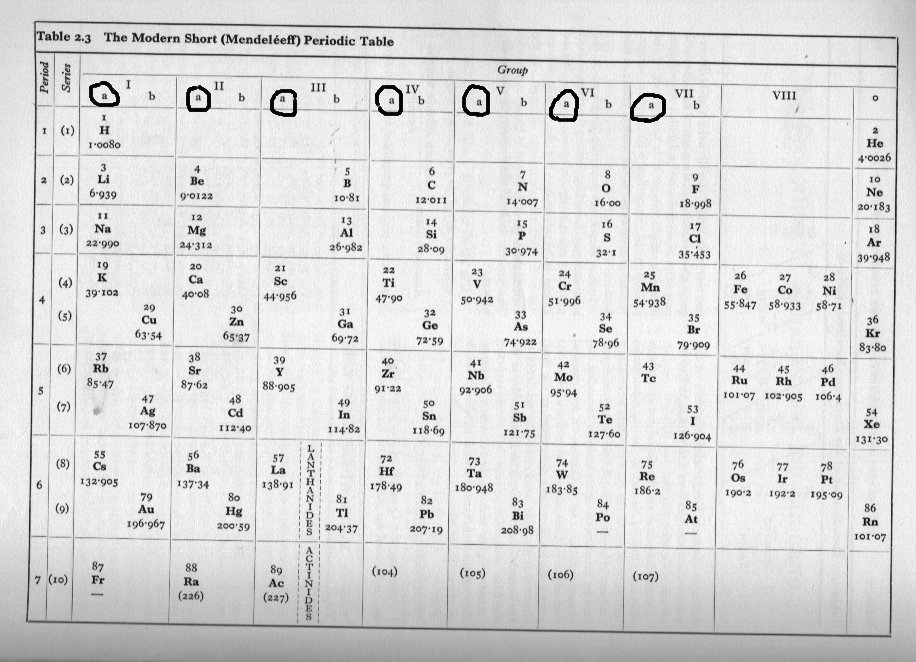
The representative elements are those identified in Mendelev's original tables 169 to 1871 as fitting into the 'a' groups, in each column. The orginal tables did not look anything like our modern version so here is a modernised version of Mendelev showing the classification scheme. This was to use Roman numerals to show originally six columns, later increase to eight and then nine. Each column was further divided into two sub columns, labelled a and b. I have ringed the a in my attachment. Elements in the a column were called 'representative elements' (my translation has 'the typical elements'). Mendelev classified by chemical compounds and reactions. It was not until 1913 that the modern atomic number listing was established by Mosely's square root law. As exchemist says, the classification is obsolete today.
-
You got it exactly. +1 There is a 'process' involving time which is the difficulty Einstein realised in talking about the relativity of simultaneity. That is why he talks about a physical rod or line of them and introduces the idea of all being in the same frame. He then goes on to derive the fact that any measurement of length will depend upon the frame of measurement.
-
Another entertaining sciencefiction short story I remember was one about a race of space conquering monkeys who arrived on Earth. The monkeys eventually had to admit that humans were smarter than they were and their best scientists/academics wrote papers entitled "Why the lop-tails do not have space travel."
-
It would be helpful if you were to provide a precise reference to the particular case you are referring to. In his book Relativity, which I believe you have, Einstien 'talks about' measuring rods in several different circumstances. Are you perhaps referring to chapter XII ?
-
The French have a saying Le plus ca change, Le plus c'est la meme chose. I remember a science fiction short story during the 1960 whose title was a good translation into English Business as usual during alterations
-
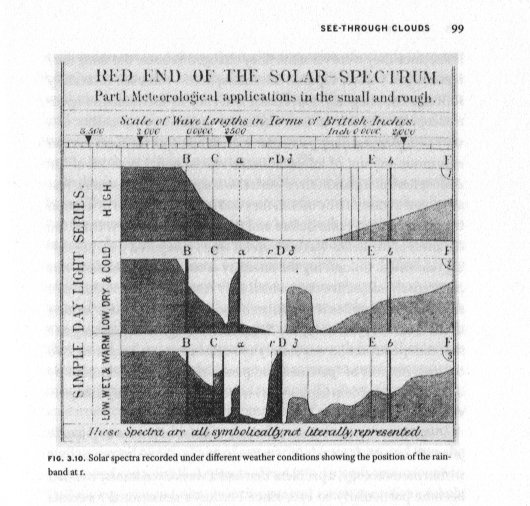
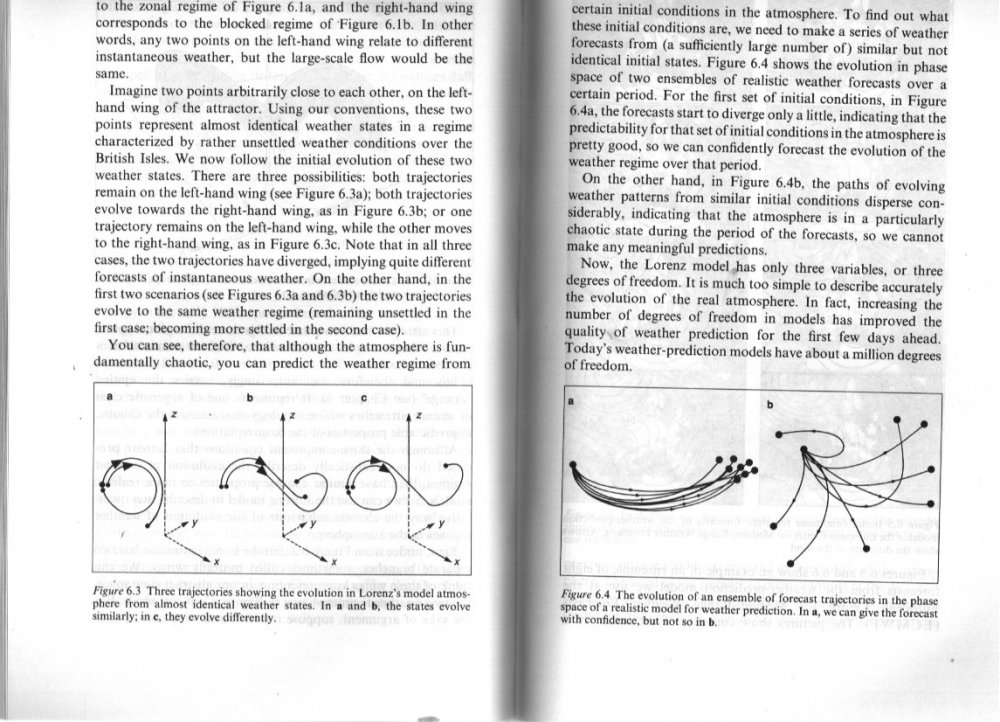
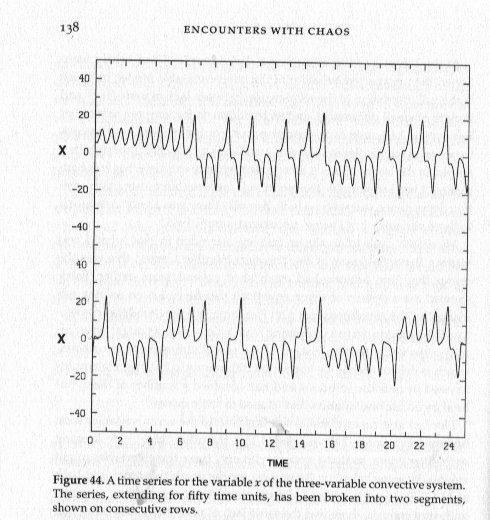
I don't think gaussian(bell) curves are appropriate for the study of freak weather, for two main reasons. Firstly whilst there is a periodic aspect to the weather it is also chaotic, in particular the large sudden variations are Cchaotic. For the periodicity I would expect to see cyclic graphs of some sort. For the chaos I would expect to see large spike irregularly spaced along the cycles. Here is an example from Lorenz (see later in the post) Secondly your character would be extending known Physical Science, for which the spectrum examples I give are again not bell shaped. OK so the study is everyday weather patterns. Statistically (mathematically) because they are everyday, there will not be extreme heatwaves everyday. In fact the events you refer to are certainly not everyday. China had around 100 times the daily average rainfall, in the recent floods for instance. So statistically those models are already known to be wrong. Unfortunately the correct Mathematics is less well known and so less widely and instantly recognisable. The man who introduced chaos theory was Edward Lorenz (not the victorian scientist associated with relativity) In his book he describes a very simple three variable weather model that usually follows the 'trajctory' (in time) where all three variables combine and point in the same direction. Occasionally however they all wander off in different directions with a chaotic result. On to the physical issues. Here is the the record of a vital discovery which changed meteorological science, due to Smythe. I only wish I had that quality of handwriting. It shows the sunlight spectrum under different cloud conditions and pressures. This lead to the sidcovery that high pressure does not necessarily lead to fine weather, of great importance to the annual monsoon in Asia.
-
I understand what you are saying, but As I stated when I introduced the empty set into this thread, I am talking strictly mathematically. I think I implied, if not actually stated, that there are other points of view. Philosophers, Mathematicians and Logicians have long debated the meaning of nothing and the role of the empty set. So strictly mathematically, the empty set has no boundaries. (It is not the only set with no boundaries for which therefore Venn diagrams are inappropriate. The most densely packed set available - the real numbers, R, also has no boundaries) I will leave you with this bit of logic about nothings. Nothing is better than eternal happiness. A ham sandwich is better than nothing. Therefore, a ham sandwich is better than eternal happiness.
-
Since the empty set has no boundary points you can't draw a Venn diagram for it. Since the empty set also has no interior points you can't position your green square, "relative to other points in the set".
-
I wish they did. I'd be richer than Bezos, Branson and Pinchai put together. I have already showed how to move a 'box' containing nothing so the same nothing is still inside after the move. In other words you agree there is more than one 'nothing'.
-
This thread is about 'nothing'. One Planck unit can't be 'nothing' since it can be measured in metres, albeit a very small number of them.
-
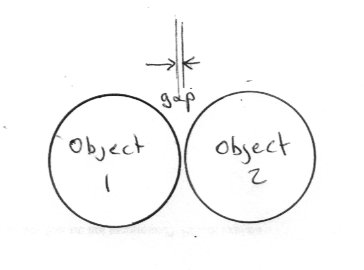
Perhaps a sketch will help. Take tow of the smallest objects available - two atoms. Two objects (atoms) separated by a small gap. The relative size of each object to the size of the proposed gap is roughly the same as the relative size of the whole universe to a one metre ruler. And you have two of them. No one really knows what goes on at the Planck scale.
-
No it is graduated. I have already noted that the equations run out to infinity from the nucleus of any atom. When we are talking about QM for atoms and molecules we are really talking about chemical bonding. Sub atomic QM is a whole different ball game (I always wanted to make that pun). The point is not to mix your metaphors (models). Here is Buggs Bunny on this Sorry I noticed a small error in my last post.. It should of course read So the atom is some 1025 times a big as the Planck length.
-
The size of the atom is of the order of 10-10 metres. The Planck length is of the order of 10-35 metres. So the distance from the centre of the atom to the edge is of the order of 1025 metres. As a comparison the distance from Earth the the observable horizon is of the order of 1026 metres, or not much further comparatively speaking. Now the surfaces of the electrodes is rough at the order of 10-7 metres, so there will be mutual interpenetratration of the 'touching' surfaces long before the atomic scale is reached, let alone the Plank scale. As an aside, you should not be talking of obits in relation to quantum theory and Plank scales. Remember also that the purpose of this part of the discussion is to establsih that the 'nothing' between touching electrodes is different from the 'nothing' between separated ones. One obvious difference is that touching electrodes supprt electrical continuity, separated ones do not.
-
Fair question. What does touching mean, particularly at the quantum level ? Well in one sense, from a quantum point of view, everything in the universe is touching everything else in the universe, since the quantum integrals extend over all space. But is that a useful point of view in this case ? I submit that it is not. Instead, I offer the notion that includes the ability to exert a direct force on the object being touched, or to exchange momentum with it. That is how gas molecules exert a pressure on their container, tables support objects placed on them and so on. Back to the spark plug and its gap. Say there is 25thou between the bendy electrode and the fixed central pin one. That is 25thou of space. Can the bendy electrode exert any force on the pin electrode ? No there is space between them. Now slowly tap the gap closed. As the gap closes can the bendy electrode exert (transmit) any force to the pin electrode ? No, there is still space between them. Finally the gap closes and the bendy electrode touches the pin electrode. Can it now transmit the force of the tapping to the pin electrode ? Yes. Yet there is nothing between them.
-
Instead of being so contemptuous of the thoughts of others, perhaps you might like to discuss the Physics of how this might or might not happen. That is consider mechanisms of transmission.
-
So why would you want to 'clone' it ? I hope you realise that clone is the wrong word. It is a biological term involving the use of biological processes. The chemical term is synthesise, which involve chemical processes.
-
When I first saw the OP I thought it was a deep question. On second thought I realise that it is actually much deeper than I first thought. TheVat made a worthwhile distinction between concrete and abstract nouns This is one of the advantages English has over Mathematics. So to discuss your question, let us consider two well defined sets. 1) The set of people born on or after 1950. 2) The set of people born on or after 2050. The first set has a specific finite number of members. This number is given (measured) by the natural or counting numbers, otherwise known as the positive integers. Note these does not include zero. We show these in set notation by listing between curly brackets (braces) thus {1,2,3,...}. The three dots at the end (ellipsis) denotes indefinite continuation. The second set has no members and is called the empty set or the null set. Thus we denote the empty set {}. This is very important to show that there are no members. Note also that it is not the number zero. Create as many copies of the null set as we need. Then collect them together, grouped in sets within a larger container set. { {{}}, {{},{}}, {{},{},{}},...} Which corresponds to our set of natural numbers {1,2,3,...} So we have constructed as many counting numbers as we wsih for nothing ! That is almost enough set theory for our purposes but there are two theorems we need that I will state but not prove. 1) There is only one empty set. 2) The empty set is an (honorary) member of all sets. The first theorems comes into play with the issue of moving the box. Suppose I form my box from the curly braces with nothing inside and send it to you over the net. I have moved an empty abstract box and, so long as there is no data corruption along the way, it is still empty at your end. Mathematically the question of what is in your box is answered by theorem 1 which says that it must be the same nothing as there is only one empty set. In case you think this is rather arbitrary, smart ass even, there is a definite application in Engineering and Physics in Fluid Mechanics and other places. In Fluid Mechanics there are two formulations of the equations of fluid motion depending upon your viewpoint. An abstract box with abstact walls is constructed in the imagination and suprimposed within the flow. View 1 considers the flow flowing through the box, which is fixed in position, size and shape, in and out through the walls. It is known as an Eulerian analysis. The flow into / out of the box brings with it physical variables such as momentum, energy, mass, force on the walls and so on. This causes changes in other properties such as density etc. https://alldifferences.net/difference-between-lagrangian-and-eulerian-approach/ View 2 considers the box to move with the flow and is called a 'with the flow analysis', or Lagrangian analysis In some flow patterns the flow can actually be at a standstill ie there is no flow. These are called stagnation points. They appear directly in front of obstructions to the flow and other places. If the box is located at such a stagnation point it enclose zero momentum since there is zero motion. Don't forget that the spark plug gap can actully be zero (nothing) if the electrodes are touching. This is a different nothing from the what is in the space between them, since there is not even space between them. Time is not the same as space and considering the quantity of space within the box must involve a relativistic calculation, due to the problem of defining simultaneity.
-
How can you reassure us we are not helping to bust a patent or copyright ?
-
I agree. Most of the 10 pages of this thread have involved (sometimes overheated) semantic arguments over definitions. The actual OP question was answered quite quickly and simply several times. +1
-
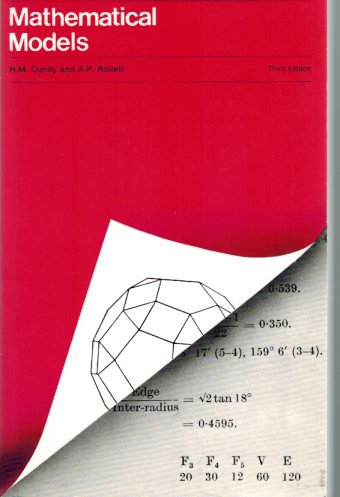
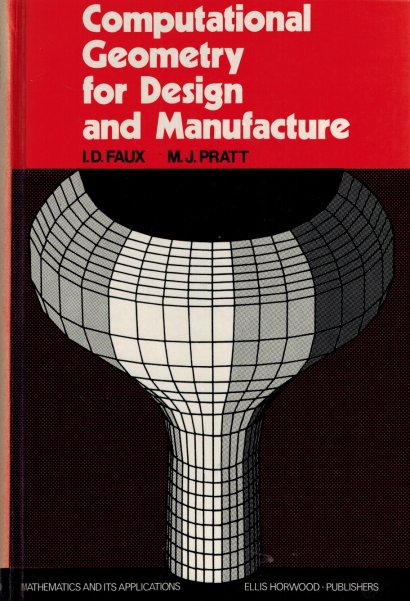
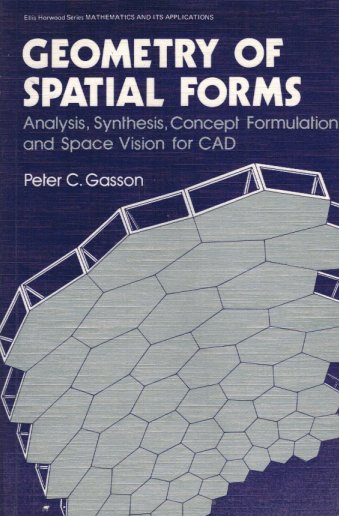
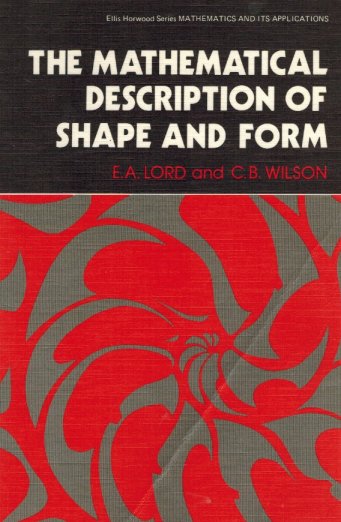
Since we are leaning towards (computer) applications, rather the the pure Math of Analytical or Algebraic Geometry i would recommend the any/all of the following books. The first three are particularly applicable to CAD, meshes and so on, The last (Cundy) is a fun book about the practical side of making physical models of Mathematical objects such as polyhedra, the cone that runs uphill and many more.