studiot
Senior Members
-
Joined
-
Last visited
Everything posted by studiot
-
How on earth can any mention of hydrogen be irrelevant in a thread all about hydrogen ? Your post that I replied to certainly gave (me) the impression that you were offering facetious replies And LNG boils at about -162, and nobody is considering it as a transport fuel either. Why did you raise the issue? For your information I have already referred to the use of hydrogen for heavy vehicles, via fuel cell technology. You should be proud of your countrymen's achievements. https://www.jcb.com/en-gb/news/2020/07/jcb-leads-the-way-with-first-hydrogen-fuelled-excavator You can also read a calorific value of fuels table and see why hydrogen would be better than most other fuels, if we can make it work. So there is no call to be sarcastic about the matter. Finally in the link I gave in the post you apparently object so strongly to, they explain why it isnecessary to compress fuel gasses to liquid form for storage. A fact of life I though you already knew.
-
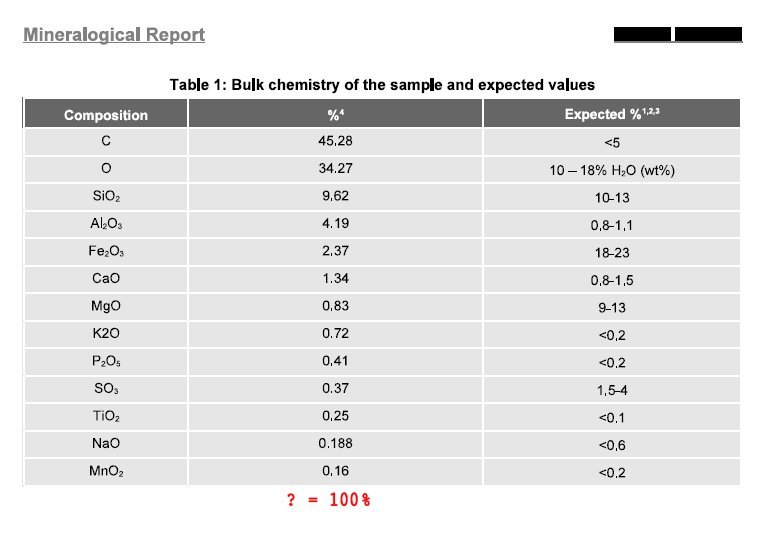
I don't think this object can have fallen from space. The chem analysis shows an amazing % carbon so it did not travel very fast through the atmousphere or it would have burned up. Sorry about the ? mark, I chose a sigma from the character set but it seems to have come out as ? mark. The other interesting thing about this analysis is the absence of hydrogen. However at 45% carbon I would guess some industrial chimney (there are plenty of these around Birmingham) or other was being cleaned out that night. If you have seen industrial chimneys at night you can often see the sparks and or material be ejected.
-
I didn't raise an issue about LNG.
-
Firstly thank you for coming back and telling us what is going on. +1 I couldn't find any reference to these 'diatoms' in the petrological report you linked to. ? If there are biological remnents included the question of how they got there is a good one. On Earth, microorganisms will start to grow on cooled pyroclastic material (old lava). Obviously some will overlay the old eruptive/outflow site. So in a later eruption some of this will be blasted skywards, rather than remelted. thus offering a viable mechanism. I'm not saying this is what happened, just that it should be considered.
-
Exactly. So what state might I expect a hydrogen tank and connection pipework to be in after 25 years bouncing about in a vehicle ? And whilst we are discussing it, hydrogen boils at -253oC whilst LPG boils at -42oC A world of difference in technological terms. But I'm sure you know all this as well.
-
This food technology course looks to answer your questions. http://ecoursesonline.iasri.res.in/mod/page/view.php?id=4025 The link starts at lesson 27 "jams jellies and pickles."
-
Good point. +1
-
Thank you for your continued responses. I remember the 1960s/1970s quite differently. That was the era central governments started failing us in a big way, the big banks starts playing roulette with their customers money. Of course back then there were those voices in the wilderness (myself included) who held the same opinion I have just offered. We are still making similar mistakes today. Hydroelectric you say ? Yes there is enough reliable tidal power available around our shores to power the whole of western europe if we chose. We could have that 'bridge' to Ireland complete with motorway + railway +all the cables and pipe you wish, generating most of our own power from the exchange water between the Irish Sea and the Atlantic. Also the 1960s/70s is the era we started pulling out of peaceful nuclear power. Here in Britain we have this unseemly scamble to cobble together 'a deal' to feed ourselves. A deal ? Why does the government not take charge and do the job properly ? Tory financial dogma.
-
Indeed so but you have not addressed my basic point that people are people and do not act in a technologically optimum way. As a matter of interest why do you think they stopped using steel and iron pipes for low pressure work in the gas and water industries, and are even replacing them in high pressure work these days ?
-
Or is that because Centrica has many other income streams ? Pesonally I think the whole gas market stinks and has done since privitisation. (pun intended). A far better and safer solution would be (have been from the 1960s) to concentrate on using electric heating and cooking rather than gas, as has been done in countries like Norway and Switzerland, and conserve the use of oil products for better purposes. That way two sources of inefficiency would be eliminated in the generation to end user chain as electrolysis and recombustion would not be necessary.
-
I was taught that (conventional chemical wisdom is ) that hydrogen is particularly dangerous because. 1) It is a very small molecule and therefore difficult to contain, most especially in old perhaps poorly maintained equipment. Leaks are more likely than with say propane. 2) If there is a leak, which there is when you change a propane bottle and can often be smelled around caravans, hydrogen is more dangerous because of its more explosive nature. What might happen if you changed over a hydrogen bottle in the same way ? What about the energy released is it not also greater with hydrogen ? Hydrogen releases 142 MJ /kg compared with your other fuels, gasoline, natural gas, methane etc are all in the 40 - 55 range so hydrogen is nearly 3 times as energetic. Solid fuels come in even lower with wood at 15 -20, coal at 20 -30. Alcohols are also in the 20 -30 range. All I am saying is that the use of hydrogen presents greater dangers than ordinary people are used to with the fuels, containment vessels and technology they already have. Perhaps fuel cells, being liquid/ionic phase will be safer but there is still the issue af a tank of a substance that is very dangerous if it gets out. I am not saying we should not avail ourselves of the technology, just that people cut corners (nuclear technology history confirms this as did London's largest ever explosion which was in a TNT factory). We should always take and enforce extra care with extra dangerous technology.
-
+1 But more than that, it is a dangerous storage medium compared to some others. However perhaps fuel cells are a way forward. (one day).
-
I have started a new thread for this as it raises an important interesting question that is not really 'Science News' Suppose beecee's dream is realised and one government or several governments research and develop really good hydrogen technology. Who benefits ? Big business ? The people ?
-
Yes, indeed there have: one of my more distant relatives was the fire officier in charge of dealing with the Buntsfield disaster. However I looked back to a time when gas that came through the pipe to consumers contained hydrogen gas because:- The changeover to pure hydrocarbon mixtures (mostly methane) started in 1960. And there have been significant disasters with this updated gas as well, for instance Ronan Point . I worked (a very little bit) on the aftermath at what was then called the Building Research Station.
-
Perhaps you have a short memory. Here are a couple quickly found https://en.wikipedia.org/wiki/Pittsburgh_gasometer_explosion https://www.scmp.com/magazines/post-magazine/short-reads/article/3008553/sudden-and-terrifying-explosion-claimed-40
-
The use of hydrogen as an energy source is as old as the hills. The use of hydrogen as an energy source commenced in 1792 when William Murdoch lit his house and office in Redruth, Cornwall from town gas, which is a mixture of hydrogen carbon monoxide and carbon dioxide. Since that time the have been sundry vaiations on that formula with 'water gas', 'producer gas' and other combustible formulations. History has also taught us of the dangers of these mixtures, both from poisoning and explosion. A different compound, hydrazine is also available and only marginally less dangerous. In case it is proposed that such materials be confined to industry, there have been many unintentional disasters in industry - industrial scale disasters, of course.
-
I disagree. I agree. The difference is, of course, that fly by wire is only a small part of the system necessary to fly remotely. Remote telemetry is still very complicated, and all that gear would need to be added to a simple fly by wire air or space craft. And then there is the time lag which becomes ever more significant with distance.
-
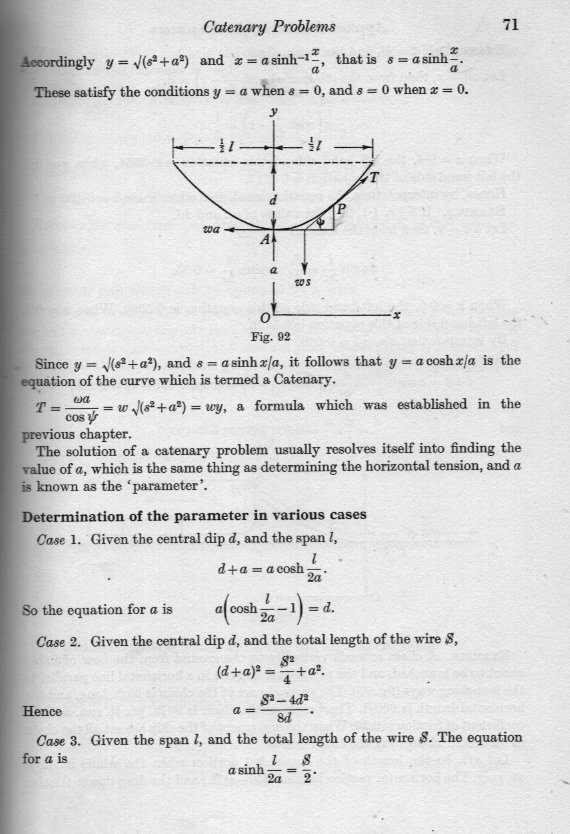
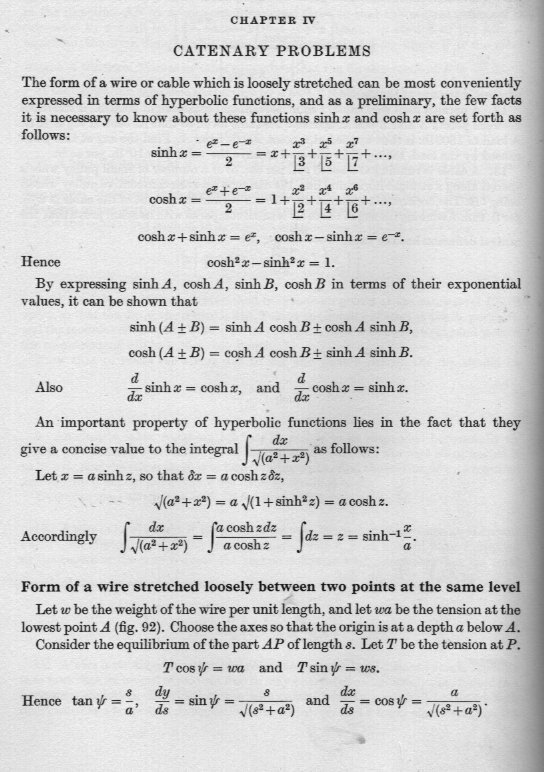
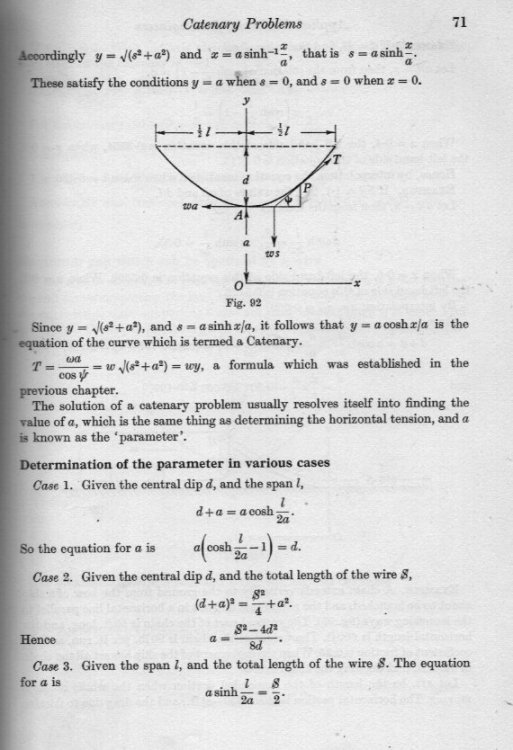
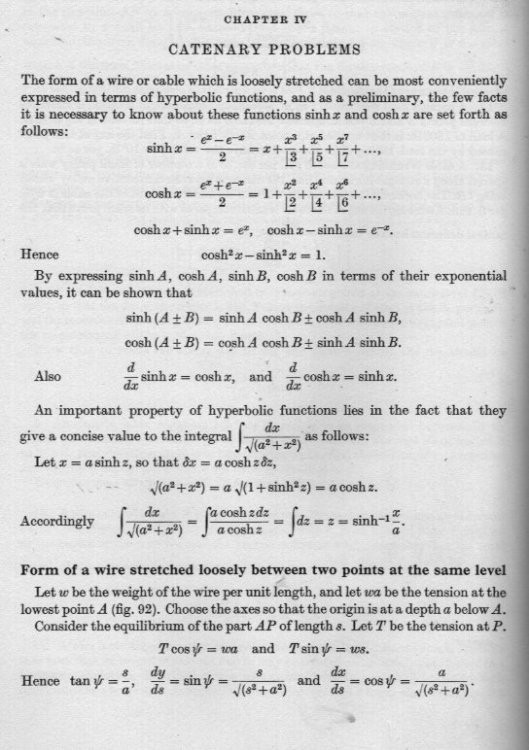
There are several ways to handle catenaries, but I often find that splitting the vertical axis into two with one section constant and the other parallel to the horizontala axis, as in the following.
-
So is there a problem making the substitution ? You have nearly done the question.
-
A very insightful comment, without any need to refer to index notation. +1
-
Why is this not in Homework ? Hints What is s ? What is velocity in terms of s? What is acceleration in terms of velocity ?
-
The problem with the rubber sheet is that the curvature of a rubber sheet is of the wrong sort of curvature. There are two sorts of curvature, extrinsic and intrinsic. The curvature of the manifold in GR is intrinsic. The curvature of the rubber sheet (manifold) is extrinsic. A further comment is that a single point has no curvature. A line has no intrinsic curvature but may have zero extrinsic cirvature or some value of extrinsic curvature. A surface can have no curvature, both extrinsic and intrinsic curvature or just extrinsic or intrinsic curvature. These situations can all be drawn or sculpted in our 3D world. Once we move to 3D however we cannot draw or sculpt extrinsic curvature and it is very difficult to imagine.
-
Stromatolites. Amongst the first living organisms on earth circa 3.5 billion years ago and still going today. They were responsible for releasing the oxygen into a toxic (to us) atmousphere and making it breathable for oxygen breathers. https://www.bushheritage.org.au/species/stromatolites https://en.wikipedia.org/wiki/Stromatolite You may have seen the BBC series The Power of the Planet, presented by Iain Stewart https://www.bbc.co.uk/programmes/p00gczg5 An interesting reverse (geological not biological) process is the 'rusting of the rocks' https://www.newswise.com/articles/how-rocks-rusted-on-earth-and-turned-red
-
Really ? What is n ? That leaves me still waiting for some unit free constant that couples length to any one of the other independent physical dimensions I have mentioned. Do you know what they are? If not are you not curious about my symbols ? I certainly don't agree that all forms of 'Energy' in general are proportional to temperature.
-
Hi Markus, I know we are always stressing there is no fabric. Have you heard of the cosmic Fabric model of gravity ? https://www.google.co.uk/url?sa=t&rct=j&q=&esrc=s&source=web&cd=&cad=rja&uact=8&ved=2ahUKEwjM-ouXq4PzAhUKxRQKHfQwDd4QFnoECAIQAQ&url=https%3A%2F%2Fwww.worldscientific.com%2Fdoi%2F10.1142%2FS0218271819500962&usg=AOvVaw3Kqo9MvdIjk3xvl4NsgsTR