studiot
Senior Members
-
Joined
-
Last visited
Everything posted by studiot
-
Now what about my comments on the issue of is gravity a force ?
-
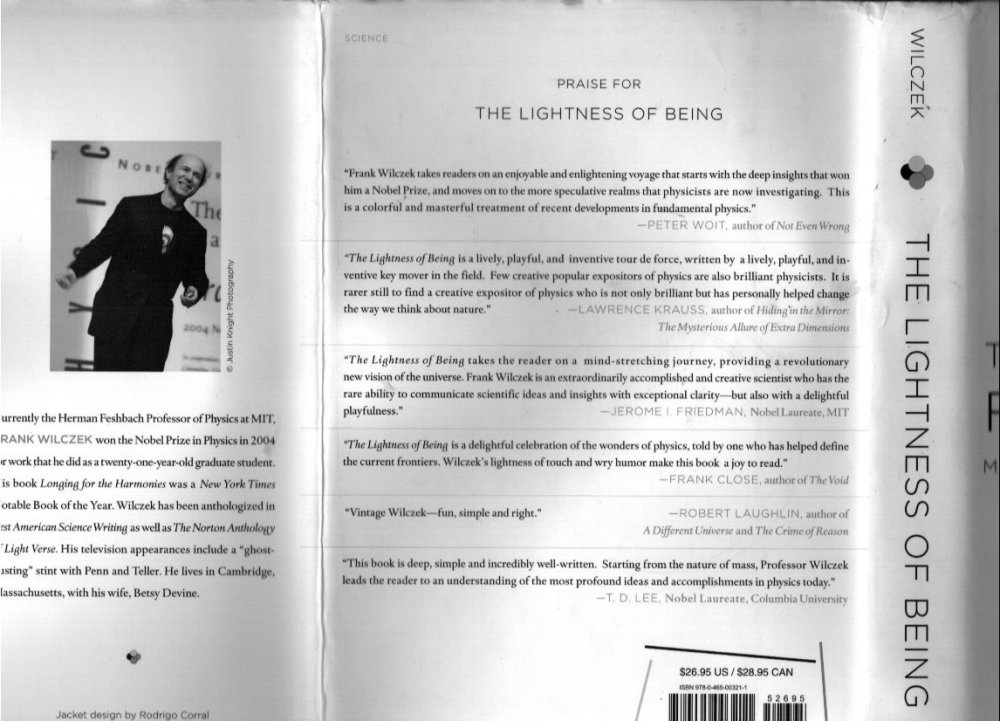
Prefessor Who ? I suggest you read Nobel Physicist Frank Wilczek's book The Lightness of Being You might find more than one surprise in this book, relevant to this thread. For one thing he devotes a whole chapter to resurrecting the lumineferous aether. For another chapter he discusses gravity and some of the matters raised in this thread.
-
But I am also disappointed in that this latest round of discussion is veering rapidly off topic whilst there is a real paucity of response to my most recent offering of new thoughts on the issue of is gravity a force or not. At least I didn't say don't worry about force and use the term the force of gravity together in one post.
-
This invitation to 'correct' is too tempting to pass up. 'ether' is an organic compound containing an oxygen bridge - that is a C-O-C part. Luminiferous aether was proposed by european scholars as a medium to transmit electrodynamic effects. Now for the more serious stuff. No, I think causal is to strong a word and not what MigL or I meant. I prefer MigL's interact or my affect. (MigL's is better) 'Causal' has special meaning in theoretical Physics, that a simple interaction does not. But you are wrong to suggest I think that 'affect' automatically means reality; you are trying to oversimplify my points. I was actually asking not stating, except that I stated this was in the context of seeking a test (I meant but did not say an objective test). I proposed a test derived from the common slogan "If it can't interact with us the difference between not existing and existing is moot" Philosophy and Science (and many other disciplines) tend to define away matters they can't or don't wish to deal with. I pointed out that English Language is not so restrictive and provides the apparatus to many forms of 'reality' and non reality. I was disappointed in the paucity of response.
-
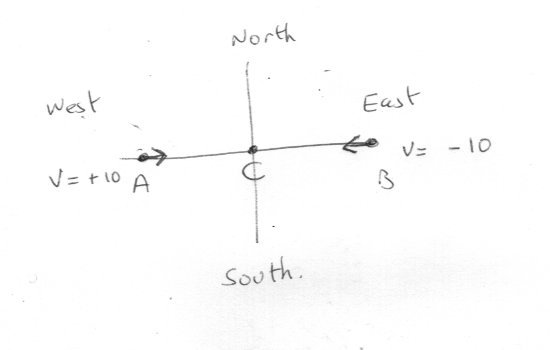
OK so in the sketch, A and B are moving in respect of the C frame. So if we want to find (calculate) quantities concerning A and B with repect to the C frame we have to correct for this motion. This is where my formula come in. [math]L = {L_0}\sqrt {1 - \frac{{{v^2}}}{{{c^2}}}} [/math] Now L0 is a constant, as is c and v is the relative velocity as already discussed. L is the distance that is measured in the C frame from C to A (or B). This can be seen to depend upon v. Further the formula allows us to calculate the contstant Lo by putting in v = 0. It can also be seen from the formula that L < Lo for any non zero value of of v. If v = 0 then L = Lo and the distance between C and A does not change, justifying my earlier claim that it is a constant. It is the distance between C and A that would be measured if they were in the same frame, which can only happen if v=0 (swansont) Since Lo is a constant and is evaluated by all observers as the same constant, it is a very useful value to calculate as I did in my first post. Because I can then use this value in the formula to calculate the distance C observes to A at any given velocity v. This I also did in my first post. Because it is so useful it is given the name proper distance. The proper distance is the distance between two objects corrected for the motion between them and is the same for all observers. I prefer to look at proper distance first then proper length, which is more confusing, because books talk about rulers and you then have to be careful to speciy which frame the ruler is laid out in. We can do that next time
-
Of course it has directionality. First we establish a coordinate sytem based at C. This is the C frame and C is not moving in this frame. A, and B are moving and both are approaching C at the same speed. But their velocities are different, because they are going in different directions. The exact opposite in this example. The negative is how we show which side of C the approach is made. Never be afraid to draw yourself a simple sketch. Have we got this straight now? I would like to move on to the next item in my calculations and I can then use this sketch to show what I am doing with the formulae so you can do less translation and concetrate on the physics/maths.
-
Clearly you know more about it than I do. Yes, but I prefer Rutherford. He was obviously prepared to make his philosophy fit his observations, not the other way round, despite his suprise.
-
My point is just how wrong Plato and company were in believing they could deduce everything by just thinking about it.
-
[math]\frac{2}{{40}} \times \frac{{1000}}{{250}}[/math] is wrong, can you see where ? This is homework ? Hint read the question again. But a jolly good idea to post the whole question and your working.
-
I think you misunderstood my point.
-
Yes I agree, some good stuff in there. Though I would sound the same warning about the ancient greeks (esp Plato) that swansont has already made. I am suspicious that this is too easy. It is easy to be seduced by thoughts of "how things ought to be" to the detriment of actually looking to see how things really are. So I am rather worried about this idea. Anyway, back to gravity as a force or not. Thank you for the excellent discussion recently +1 I have been thinking further and I have to say that now occurs to me that I have already presented a test of sorts. Is there, even theoretically, a situation where gravity occurs, but no force is exerted ie no force occurs ? If it is the case that gravity can occur without a force then gravity cannot itself be a force. Gravity may give rise to a force and seems to do so in some (most) situations, but that is not the same thing. One further comment. The comment by your hero that gravity depends upon scale is surely in direct conflict with The Principle of Relativity due to Einstein ? That is about the proposition that the universe is isotropic and homogeous. I do agree with his statement about fuzzyness however
-
This I cannot understand, how can one approach at a minus velocity, they both see each other approaching at 0.8c? Maybe this is the big hiccup but... if I run towards you at 5 km per hour, then you are approaching me at 5km per hour, from your perspective you, I would be approaching you at 5km per hour. Ignoring that in this example I am obviously the one running, but let's say we are in space and neither of us is doing anything, we are just in motion. Why would one of us think the other person is going backwards (this is what negative velocity implies, or at least how I interpret it, but that is probably wrong then). You call it the relative velocity, but that relative velocity must remain a positive number right, otherwise one would think someone is receding while the other thinks they are approaching? Since you are listed as still online, let's try and deal withthis one quickly. Let us say that T is to the west of S and travelling towards S. That is T is travelling east. Then travel to the east is positive and travel to the west is negative. So the velocity of T is positive. However T may also himself as standing still and S to be travelling towards himself as he stands still. Then S must be travelling west in this view. So the velocity of S, as seen by T is then negative. Now for yourself work out the same situation with regard to the point of view of S.
-
Oh dear and Oh good, at least you understand something. Every object has a frame in which it is 'at rest'. We call this its own frame. So S is at rest in the S frame T is at rest in the T frame E is at rest in the E frame and so on. S sees other objects moving 'relative to itself' in the S frame T sees objects moving relative to itself in the T frame E sees objects moving relative to itself in the E frame and so on. If the velocity of such movements constant the frame is an inertial frame If the velocity is not constant then there is acceleration (or deceleration) and the frame is not an inertial frame. Now taking just two objects, T and S, I said "The relative velocity between them" and you said "not moving at the same speed relative to each other" The point of relativity is that whatever T sees in the T frame, S sees in the S frame, but in reverse. So if T sees S approaching at velocity v (in this case 0.8c), then S sees T appoaching at -v (or -0.8c) (Note that we are saying T sees S approaching, it does not see itself as travelling it sees itself as at rest) Which is what I said, but not what you said. It is important to get this straight, before moving on to proper distance and proper length. v is the velocity you enter into the formulae for relativity and is called the relative velocity between T and S. (Note that observers in other frames will observe a different value for v) If you look back at my maths you will see two things. 1) The calculations come to the same figure whether you use v or -v since it is squared. If v has a value other than zero T and S are moving relative to each other but calculations in either frame will give the same result ie S measures the same distance to T as T measures to S. 2) If v = 0 then T and S are not moving relative to each other, and the measured distance between T and S is a maximum. This distance between them is not changing with time as the movement occurs. This maximum distance is called the proper distance. I will state that the proper distance has the same numerical value measured by all observers, not just T and S. Since T and S are not moving then they are in the same frame. That is we have reduced or transformed the motion of T to the S frame or S to the T frame. The proper distance is the distance measured between any two points in the same frame, ie at rest with rspect to each other.
-
I don't know if you understand what is meant by a traditional line vector force ? Gravity is a distributed force, also called a body force. This means it acts on each an every particle of a body individually. The combined effect of all these individual actions can often be modelled as a single line vector, acting therough the centre of gravity. So we have that bane of the schoolboy, 'a brick or block resting on a table', behaves (to use swansont's word) like this sort of line vector. But the dam I offered way back could well topple over if it has been designed as though the dam behaviour under the influence of gravity was the same as that of the block. It is necessary to consider the distribution of forces in such a case. So where does that bring us to ?
-
No your history is correct, but incomplete. No there is no universal definition of force, it needs qualifiers ( basically selective filters of interactions) An electromotive force creates current in an electric circuit. Does gravity do this ? Are there other differences between an EMF and gravity ? In an isolated universe containing one single solitary massive body ( a massive body is a body with mass, not necessarily a large mass) there is expectd to be gravity, but is there any mchanical force ? So the contact boys have a point. It takes two to tango. A force is applied between at least two bodies. Gravity can do this when our test universe contains at least two bodies. But how does it do this ? Gravity is a distributed force, so if the region of operation is large can it be considered the same as a traditional line vector force ? You see I am being 'scientific' in trying to narrow things down, using my preferred method of considering interactions. What about action at a distance? Well consider a small ring (small means small enough for our considerations) How does gravity act on it ? Gravity acts through the 'centre of gravity' of the ring, which is actually in the middle of the hole, and not a material part of the ring at all.
-
So we come right back to my original question How do we say what we mean by a force ? Possibly our recent discussion leads to the suggestion that one good way to a fruitful discussion is to consider how the force interacts with other better known (defined) quantities. Then we can limit our consideration to those quantities of interest, and state that "for our purposes", whatever those purposes may be, the quantity under consideration (gravity) is or is not a force.
-
Another problem with 'real ', which can be overcome in English but less well in Philosophy or Science is the fact that nouns come in many guises. Some nouns are simple and occur all at once, at the same time and in the same place. For example a rich tea biscuit. Others develop over time. This leads to the moral argument about when is an embryo / a foetus/ a human. Yet others change over time but are always recognisable, for example the answer to the question What is the gravitational field of an object, varies depending upon what place and time you are asking it about.
-
But some (Stokes) never believed in the aether. And yet others held an open mind. Yes they wrote mathematical works about it. Stoke's maths is interesting because he discusses the application of negative mass to gravity in that work. There is a summary in Berkson, that I referenced earlier. Let me play philosopher, or at least what I call the philosopher's favourite game; that of combining at least two incompatible statements to make a paradox. I offer that there is no such object as a four sided triangle.
-
Has that concept not affected many people for several centuries in their search for it, like your holy grail or perhaps the Physicist's TOE? I hope you will agree this is a more difficult question.
-
I'm glad you said reasoning ie rational thought. Yes Harry Potter was merely an example to show why the terms 'real' and 'exist' are not as tightly set at might first appear. This is also why I hold that English is more versatile than either Science or Philosophy because it can allow the existence of Harry Potter as an abstract concept. Science, of course, has branches that study the effects of HP on the 'real world'. As a matter of interest can you not think of a better offering , whose unreality is undisputed, to point 1,
-
Sounds good. 5. Many people have been affected in other ways, whatever they believe about HP. For instance many people have gained $millions on account of HP. Some people, who have never heard of HP and have no beliefs about him, have had their lives saved by charities funded through HP related donations. As a matter of interest, related to earlier discussion on belief in this thread, which definition of believe are you using ?
-
From a thermodynamic point of view per Caratheodory's version of the Second Law is appropriate. "Not all states are accessible, from a given state." (the shortened version) From a QM point of view there are electron orbital (bound) state transitions that are inaccessible. These are known as 'forbidden transitions'
-
The terms real and reality ; exist and existence can be thought of as ill defined. Instead of asking if something is 'real' can you offer me something that is not 'real'. How would I test this ? Can something which is not 'real' affect some things that are 'real' in any way ? Is Harry Potter Real ? Harry Potter has certainly affected millions of 'real' people. This, I would suggest, is the real reason behind why Science shies away from such terms (pun intended)
-
Let us do this a little bit at a time. Then it might 'click' for you. Did you understand lines 1, 2, and 3 above ? In particular did you understand how you get from line 2 to line 3 ?
-
If the entire cell was at absolute zero then every electron would be in its lowest or ground state, by the definition of absolute zero. So any change to even the state of a single electron would involve raising the temperature above absolute zero, something you have forbidden.