
studiot
Senior Members
-
Joined
-
Last visited
Everything posted by studiot
-
The strong nuclear force is not electrostatic in nature. We had a discussion recently about the four fundamental forces of particle physics and also a discussion about light and acceleration. But you are lsited as having just joined. Is there any connection ?
-
I'm suprised Wiki thinks they were reliable. They were the butt of jokes galore in the rest of Europe, including the UK. And of course the demise of the UK's own car industry amply demonstrates at least some truth in your statement.
-
A Trabant was the only car available to ordinary citizens of the former East Germany. If you could afford one you bought a Trabant or nothing. https://en.wikipedia.org/wiki/Trabant
-
How mant Trabants were sold ?
-
It amazes me how you keep coming up with such clear and simple correct statements and presentations, @Janus, +1
-
No one has said light obeys Newton's laws of mechanics. I did say But you obviously weren't listening.
-
You have already stated you don't understand the maths offered and shown no interest in developing that maths either. Maths is a lot more than just formulae. And Physics is something else again. Nature does what it wants regardless of us puny humans and leaves it up to us to figure out how Nature works and report correctly without trying to impose guesswork. A lot of knowledgable folks have already given their time here to try to point you in the right direction.
-
Light is is not a material object. Only material objects are subject to the effects of forces.
-
This is your only post where you actually asked for help instead of making stuff up about what you do not understand. When offered some (high school level) help you reverted to trying to impose your guesswork again, even whilst saying I can't see any point continuing this conversation. sorry
-
Then perhaps you need a limit. Do you know any calculus? Straightforward density at a point for instance is [math]\mathop {\lim }\limits_{\delta v \to 0} \frac{{dm}}{{dv}}[/math] Where m is mass and v is volume.
-
Let's try to approach this a different way . What is there about light speed that needs explaining ? The quantum wave function has nothing to do with light speed.
-
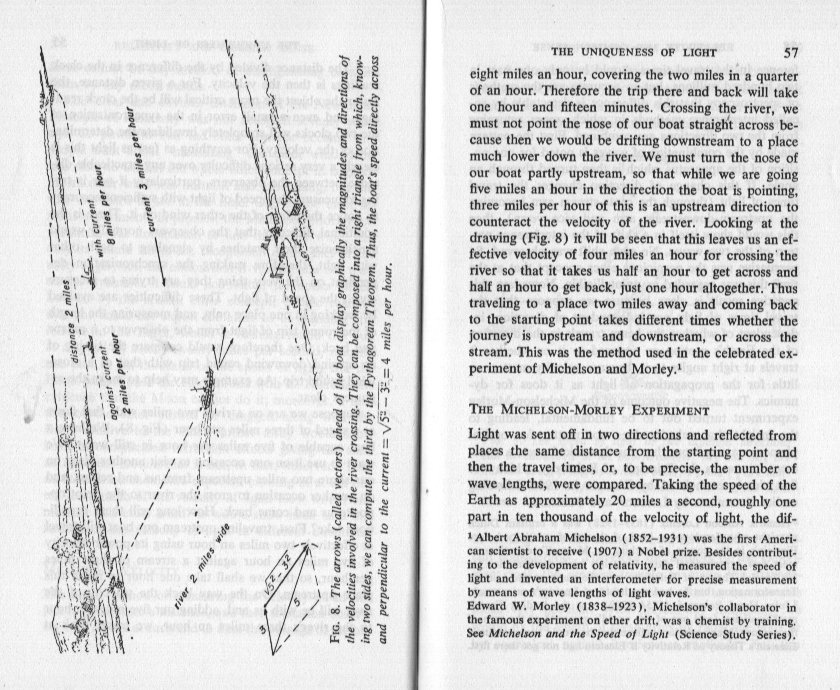
Did you mean this piece ? (From the 1964 edition) In future it would be very helpful to refer to the page(s) from the book. This is a discussion of Newtonian-Galilean mechanics, not Einstinian relativity. Actually he says the effective speed is 4 miles an hour for crossing the river. I think I understand you worry though. Bondi could have perhaps worded his text a little more clearly but technically he is correct. Here is my explanation, I hope it helps. In all such problems it is essential to qualify or specify the word 'speed' as there are several different speeds involved. I am not sure that using 'effective' is a good choice but since we are presented with it I will use it. The boat is stated to travel through still water at 5 mph. I have seen the terms 'actual speed' or 'real speed applied', but the best (clearest) term is 'the speed through the water is 5mph'. But remember that the water is not still. I would also like to make it very clear that you are mistaken in saying that the boat travels further than the width of the river. The boat travels exactly the width of the river, no more and no less. It does not travel in some curved path, whcih would be longer. This is because our frame of reference is the ground, not the water. So perhaps Bondi might have said that the speed, relative to the ground when directly crossing the river is 4mph, rather than calling it the effective speed. So we have a situation that the boat has a speed relative to the ground and the water has a speed relative to the ground. The first of these we don't know, but must calculate. The second we are told as being 3mph. These two speeds can be composed to eliminate the ground to obtain the speed of the boat relative to the water, and we are told this. This composition is done using an ordinary vector triangle or parallelogram which can be done. I will stop there and post since you have just come on line.
-
Why should it not tend to zero ? Zero is a valid state of charge. Further your integral is taken from zero to Q.
-
Thank you all for your replies. Peterkin's point is sadly demonstrably falsified by the recent events, at least in the UK. I think that we need a radical socio-political economic change to address the problem. This is the second once public collective service that has cost people dear in their failure to plan and provision for predictable emergencies that are known to have happened in the past. Last time was serious flooding and there were not enough pumps (and pump expertise) in the whole country to deal with the situation. This time it was failed electricity distribution systems and there were (and still are) not enough standby generating capacity.
-
You should not have any trouble with this brief description. https://astronomy.swin.edu.au/cosmos/v/Virial+Theorem The virial theorem was originally introduced in the mid 1800s in thermodynamics and describes the distribution of the total energy of a system of interacting particles between their energy of motion (KE) and their energy of configuration (PE) but is applicable to any such system with these characteristics. Hence itcould be applicable to galaxies, universes etc.
-
+1 for a genuine and very reasonable attempt to address the topic.
-
I don't think you were here when I described the teaching method of the best teacher I have ever had. (A level Maths) It may also be worth mentioning the Oxbridge (where I never went) Tutor system and how they differ from teachers and also the fact that 'tutors' in other UK universities are a pale imitation of this.
-
A week ago we had a moderately severe storm in the UK which lefts tens of thousans of properties without electricity. A week on and there are still thousands stranded. Watching the TV pictures of the emergency vehicles, I wondered what would happen if they were all electric ? More precisely how would they be recharged if there was no mains power available ? There are obviously not enough generators available to replace supplies to even the most needy as nursing and care homes went without electricity for nearly a week. What might happen or be needed if we had another really severe storm of the magnitude of the late 1980s and early 1990s ?
-
I would say that sensei has raised a serious concern about the safety of electric batteries that should be addressed by proper engineering considerations by the designers. Battery technology is progressing so fast I can't keep up with it. So I am forced to look at indirect measures. In several towns in the UK trials of electric scooters are taking place and results of the trials are now available. Amongst these results has been the observation of a high incidence of impact accidents including severe damage. However no fires have been reported as a result of any of these impacts. I repeat that proper engineers would have looked into the fire safety of impacts. If anyone knows for sure I would be interested to hear their views. Meanwhile the whole business of safety and reliability is surely off topic in a thread about chips ? I am starting a spin off thread to discuss something that occurred to me recently as a result of the storms in the UK in relation to these issues.
-
What does that mean ? Why nuclear ? Why assume ? Higgs operates on isolated particles. Both epsilon and mu are tensors in the general case, not scalar constants. Be warned that you only have 5 posts total in your first 24 hours here so don't waste them. I look forward to learning more in the discussion after that.
-
I don't know enough about the Higgs field to comment, I'm sorry. Perhaps some others better aquainted with particle physics will comment on this. But the Gauss' law you refer to has much much wider applications than electromagnetism. It is a piece of pure mathematics expressing the fundamental theorem of calculus. In Physics in various guises it appears in conservation laws as it applies to a conservative field.
-
I don't seen anything I said that disagrees with your post, anymore than anything you have said disagrees with mine. In fact I think you have also made some excellent and valid points.
-
Excuse me for butting into your vendetta against CNN. This is my thread and I will thank you for keeping on topic.
-
Especially if you don't know enough to critically appraise what you are quoting. Not necessarily. It depends upon the 'size' of that universe. What, pray is a flat curvature ?
-
Thank you for this interesting article, which complements the information I gave. +1 I see that it can be obtained as a single page pdf from the link you quoted.