
studiot
Senior Members
-
Joined
-
Last visited
Everything posted by studiot
-
How can electrons be in superposition ? The wavefunctions of the electrons may be in superposition, but not the electrons themselves.
-
So why are you posting off topic material and ignoring on topic material ?
-
Yes that is why I said the probability calculation is flawed. I apologise for my first edit, but I see I am not the only one getting the quote instead of the edit by mistake. I have put that right now. Schrodinger's original question was At the moment of opening the box is the cat alive or dead ? Now there are actually more than 2 possibilities. !) The cat is alive and well. 2) the cat is dying. 3) The cat is dead. Which comes back to my system of 1026 equations, which if linear could have 1026 solutions. Some of these would be assigned to each of the above situations. So your comment on correlation is hugely pertinent when trying to assess/assign probabilities.
-
Comments. 1) An average cat has a mass of 4kg. Most of this is water which has a molecular mass of 18g Using this and applying a factor of 90% to account for the otherr, heavier molecules making up the cat we have the number of moles making up the cat as [math]\frac{{4*{{10}^3}}}{{18}}*\frac{{90}}{{100}} = 200[/math] Multiplying this by avogadro's number we have the number of molecules in the cat to be [math]200*6*{10^{23}} \approx {10^{26}}[/math] This means that to calculate a superposition we must have a system of simultaneous wavefunction equations of the order of 1026 in number. Does anyone know the largest set ever solved ? 2) A superposition is not a single state since it does not have a unique solution. So in asking for a defined state, what you are really asking is like asking for particular line parallel to a given one, without providing the necessary information to know which one. 3) Your calculation of probabilities is flawed.
-
Thank you for the question and for the information (I had never heard of shor's algorithm) in your OP. +1
-
+1 for tenacity +1 for the clever use of English (and the truth of your comments)
-
Idioms are a sub division of 'figures of speech', which I believe to be the general term. My two naval examples are both idioms. But you do not necessarily need context for idioms; context is necessary for the first but not the second. Other figures of speech include Antiphrasis, sarcasm, Irony (saying the opposite of what you mean) Hyperbole offering an exaggerated version of the meaning.
-
Thank you for explaining that and +1 for understanding classical entanglement which is based on the idea that the two entangled entities are distinct and distinguishable at all times and in all locations. Note however that there are no 'states' in the scientific meaning involved. Classically the only way for your contents to change places is by a mix up (error) in the original packaging. This also nicely brings out the fact that classically the one letter could never change or be changed into the other one. That is neither letter could ever take the place (serve the function) of the other one. So the big difference between quantum entanglement and classical entanglement is that in the quantum case either particle can perform whatever function is required whereas in the classical case each of the entities can only perform one of the functions. Discussing the scientific concept of a 'state' will bring me back on topic which is the possibility of a conflict between Relativity and QM. Why do you never mention this in your posts ? OK so scientifically a state is governed by ' state variables', which are required to be single values. A state is fully defined when the individual values of all the state variables are known. For a state to exist all the values must exist and be unique, but they do not need to be known. Applying this to quantum states, it is an axiom of QM that the state variables are the variables involved in equations like that of Schroedinger (there are others) including their boundary conditions. So a specific quantum state is defined uniquely by a complete set of values of these variables. (The quantum numbers) Underlying the Physics of this is the Mathematics of existence and uniqueness of such equations and variables. This is why I say that even though we do not know the values of the spin quantum numbers of two electrons entangled in an orbital, they must each have a spin number. Furthermore Pauli says that these numbers must be of opposite signs. A 'mixed state' , by definition, therefore has no actual meaning. Furthermore, the idea of a single well defined quantum 'state' for an object as large, complex and diverse as a cat, has even less meaning as it were. On to Relativity. There are no 'states' in Relativity. I also noted that there in order for a conflict to be established we must be able to calculate different values for the same variables in QM and Relativity. Can you do this ?
-
For over 90% of my time in school we included a subject about the English language. (Note that opening statement is more difficult than you might think to make it unambiguous) This included study of what are known as 'figures of speech'. These are really expressions where the meaning conveyed differs from the literal statement in language. So we studied statements such as "Now he has nailed his colours to the mast" and "It was cold enough to freeze the balls off a brass monkey" In the first of these the meaning may fairly readily be deduced. The second one is less clear by a long way. Both derive from former naval practice. Yet again we studied expressions where only part of the expression is actually stated. Most would understand the imperative Halt! But again extra material is required to understand the simple one word phrase or sentence. Yes. This is the second point for this post. Context may be required for meaning to be conveyed.
-
The information could be, but doesn't have to be, digital. Take for instance the infectious disease nautical flag. The (non digital) information conveyed is clear in the quote. "I have or had some dangerous, infectious disease on board" However many implications (meanings) could be imputed to the flying of this flag; here are a few Keep away I require (medical) assistance The flag is false and my ship is a fireship, packed with explosive.
-
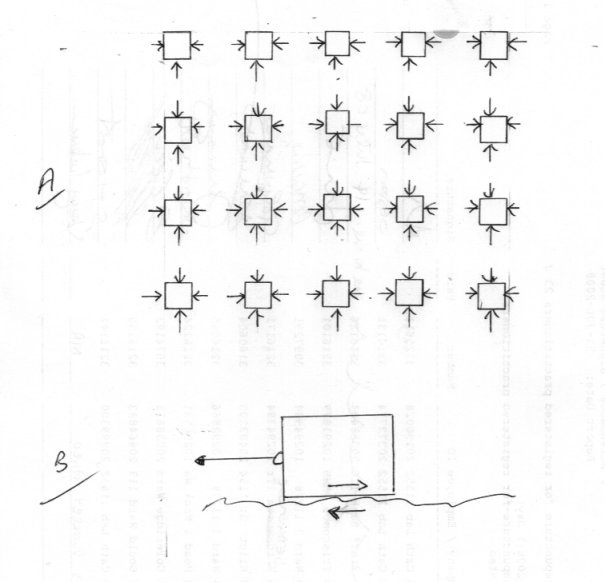
Is the inverse square law of gravity linear ? And is gravity a cohesive force ? I have started a thread about models, since you seem to be so reluctant to discuss cohesive models. Model A is a reasonable qualitative model to explain surface tension and more besides.
-
Well Katie did an excellent makeover on your English. I'm tempted to be a bit facetious, "What do you mean ?" Actually I'm not sure what this thread is about, but I'd like to add that there is a big difference between 'meaning' and 'information' in that meaning usually includes things like implications and connections to many other factors and pieces of information.
-
I presume you mean excerpt ? Yes there are dissenting voices, but your article confirms that the situation (in England) is still a 'compulsory' one. However I would recommend you read more widely than the Guardian, with its sensationalist style and agenda. For my part I note that here we have a classic tussle between the competing requirements of rights and duties. Every 'right' comes with a limiting duty to use that right or freedom properly. In this case I think the balance is on the duty side of the scale. I doubt that there is anyone at all who could literally do any job whatsoever. We all have to accept there are some jobs we would not be able to do for one reason or another. Much as I support helping blind persons, I would accept being driven by a blind taxi driver or airline pilot. An extreme situation I know, but illustrative of the tussle I mentioned at the outset.
-
The UK comprises four nations or countries and some islands, each with their own government. In Wales there is no such mandate proposed or in force. In England the mandate is already in force, but takes time to implement as might be expectd. I do not know the situation in NI or Scotland or the various islands. Do you ? I appreciate you wish to discuss the ethics of this 'mandate' , but I would also appreciate you getting your facts straight beforehand.
-
I note you are so busy correcting others that you still haven't bothered to correct your own false statement. Vaccination is not mandatory in the UK NHS service.
-
It is not a question of agreement it is a question of understanding QM and its definitions. Entanglement is not a state, which has a particular axiomatic definition in QM. Again it is not entanglement that says an observer does not know (in fact cannot know) exactly where a particle is, but Heisenberg. But this veering off topic now. In order to have a contradiction, it is necessary for the equations that define and measure relativity of simultaneity and the equations that define quantum entanglement to have at least one common variable that produce different contradictory results when some common variable is calculated from their respective defining equations.
-
So you consider N3 as a model ? I rather read a greater requirement into your original answer. Below are two models. Do either model N3 in your opinion ? How about models A and B below ? Do they meet your standards ?
-
Really ? Well you go with your Physics and I will stick with Schroedinger and Pauli. I look forward to your mathematical derivation of this fanciful description. S and P and many others have already provided many different derivations of their version to the world.
-
What about Newton's 3rd Law ?
-
I can't agree with this.
-
A very popular phrase in this website is in the words of Dr Swanson. Another member's longer description of a model is also quoted here The purpose of this thread is to arrive at a robust definition/description of a scientific model by discussion. Perhaps a summary could then be pinned for future reference as the same issues come up time and time again. To kick off I note that using just model by itself can be unhelpfully vague and there are many descriptors/qualifiers available. Models can be ( in no partuicular order) qualitative; quantitative; illustrative; comparative; graphical; analogue; digital; expressed by a process; expressed by a formula and so on. Since no model completely describes the subject, additional information is needed about the actual qualities described and any limitations imposed.
-
You've met our Prime Minister then. +1
-
Don't be sorry for being honest. +1 What is wrong with a qualitative (=schematic) model ? Phi actually suggested this. Newton's third law for instance is only semi-quantitative for instance, yet it is a very profound law about understanding the Physics. So don't be afraid of examining your idea that the mechanism of your 'cohesive force' is similar to the mechanism of surface tension. This can be done successfully with purely qualitative modelling.
-
I don't think so. Entangled electrons in an orbital are most definitely in one quantum state or another prior to observation, according to QM. However prior to observation the observer does not know which is which.
-
Glad you reminded members of the actual question in the OP. However it is a flawed question since you implied that it is mandated everywhere in the UK. This is just not true. Over the weekend, the BBC published a report suggesting the Welsh NHS is preparing to recruit many or all of the personel displaced by the English mandate. As to my answer to the question, Surgeons are required to be free of hepatitis (I understand throught the UK). Vaccination is not enough since it is known not to produce antibodies for some people. Is the mandate any different ?