studiot
Senior Members
-
Joined
-
Last visited
Everything posted by studiot
-
There is more you need to know about energy transfer in general and heat transfer in particular apart from Stefan-Boltzman. There are two coefficients called emissivity and absorbtivity which relate to energy in the general case and heat in a particular case. An ideal 'black body has an absorbtivity and an emissivity of 1. There are no known ideal balck bodies in the universe. Actual amounts of absorbtion or emission are multiplied by the appropriate emissivity or absorbtivity coefficient. There are lots of these coefficients for different wavelengths, different body surface conditions and (thank you Stefan-Botlzman) different temperatures/ temperature ranges. All bodies are in a state of both continual emission and continual absorbtion. Emission depends upon the absolute surface temperature, absorbtion does not. So the balance between emission and absorbtion is a dynamic one. A hot enough (high enough temperature) body will emit more than it absorbs. At a low enough temperature a body will absorb more than it emits. Oops pressed the submit by mistake. The importance of the S_B law and Planck's law come from that low temperature emission. Sunlight is emitted by a very high temperature body. This is absorbed by bodies in the atmousphere (both liquid droplets, gaseous, and particulate solids) which are at a much lower temperature. These heat radiations will be at longer wavelength than the received sunlight. It is this fact that forms the basis of the greenhouse effect. Please note this is a very broad brush treatment so ask for clarification/amplification of any point. I have highlighted the word surface in my text. This is because you kindly replied to my comment and query on the Earth's (surface) temperature to which I shall make a separate reply. Edit2 Real bodies are modelled as gray or grey bodies. https://www.comsol.com/blogs/understanding-classical-gray-body-radiation-theory/ However if you read the articles you will find references to my coefficients and many more factors, some of which also play a part in the 'surface temperature' of the Earth.
-
But then you get two tunnels or bridges for the price of one ! Joking aside, the mathematics may not have been wrong, but the communications may have been blocked by someone not listening. There is a story about a viaduct I built where something like that happened.
-
Yes, since my question was referred to here, I posted information from NASA, new to me, although now about 10years old. I was aware of Gore's chicanery, but the NASA article claimed that the CO2 rise had historically long been lagging, but recently changed to leading. So if anyone is interested in discussing this or better has information as to whether this new lead has been maintained since the NASA article i would be interested. However all the CO2 stuff is measured. This thread is about models. And I asked a serious question about the difficulty of defining 'average global temperature' which has not been taken up. Again it is an important point (to models) worthy of discussion. Thank you for bringing these points up. +1
-
Wouldn't you rather have a visit from St Patrick ?
-
Thanks. +1
-
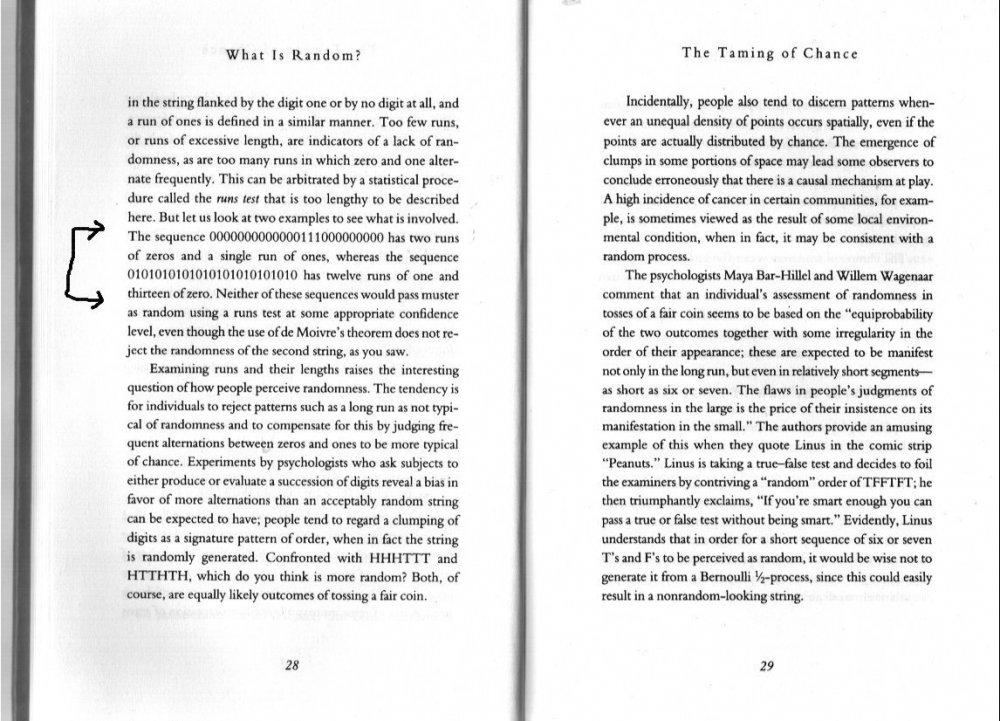
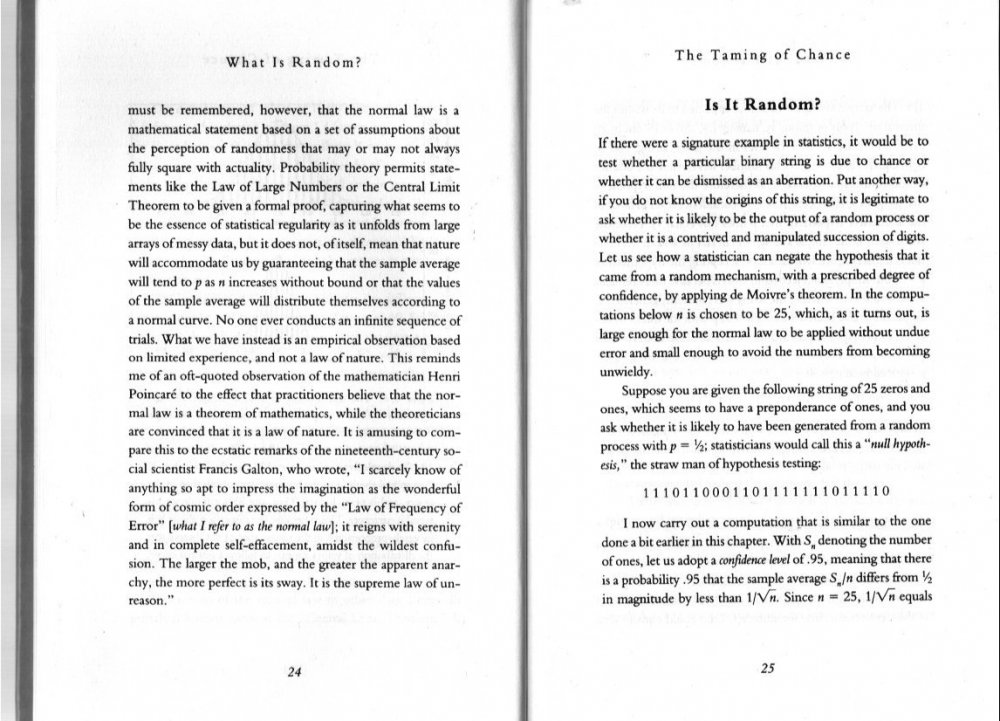
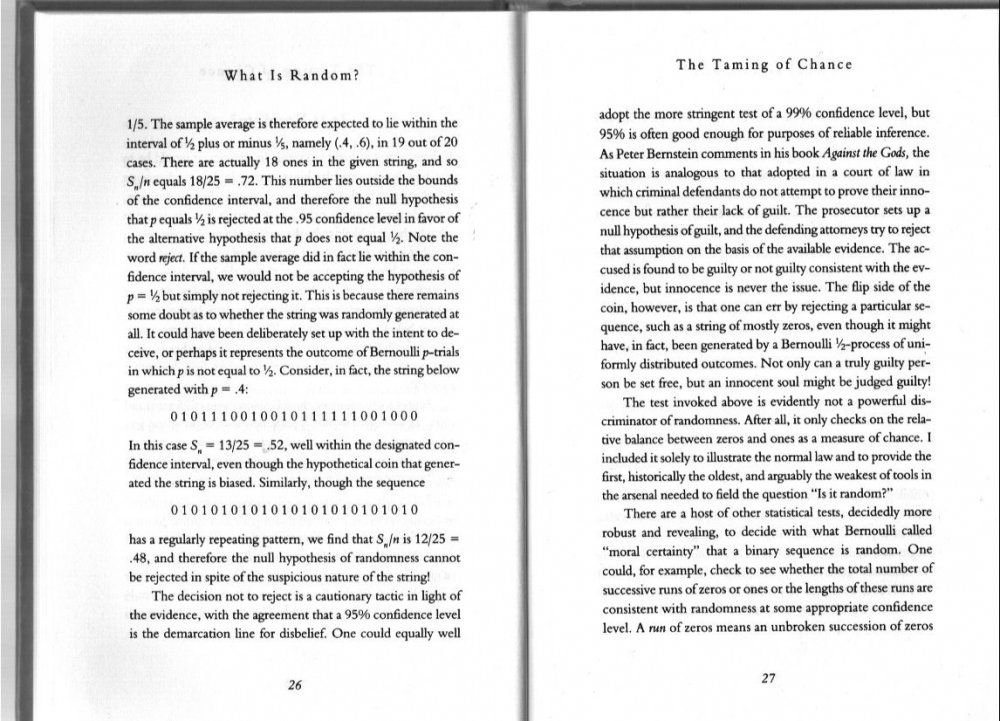
@joigus @Markus Hanke Here is an interesting discourse on order and disorder in relation to binary strings. From 'What is Random' by Edward Beltrami - Springr-Verlag . 1999 I have highlighted a short passage to read first. This explains the what it is all about ie what may be nuggets of order in a binary string. This passage is on the third attachment. The rest is supporting background. The point is how the nuggets can arise from purely statistical considerations. Entropy after all arises from statistical considerations of the behaviour of large ensembles.
-
Yes I agree this method is poor science. I have never heard of scafetta before, but I am immediately suspicious of the website posting the refutation you have linked to, because of this staement. I have done a great deal of curve fitting in my time and one thing stands out. The lesson that stands out is that the higher the order of the collocating function, the better the fit at the collocating points, but at the expense of the greater the 'wiggle' between those points. I can even supply many standard textbook references to this effect.
-
Where have you looked and what have you found out so far ? I would also advise providing a good deal more clarification of your question for anyone here to be able to help you further.
-
There have been too many red points scattered about in this thread, suggesting aurgement from antagonism rather than reason. So I have cancelled the one placed with this question, which seems a reasonable request to me. My answer to this would be the same as my answer to others for other climatic questions. Look to the oceans. In the oceans you will find lots of measurements of dying coral and acidifiction. Of course coral does not grow in heavily industrialised areas. Look to the oceans for the other big issues raised in this thread. Climate modelling is a very young science that was started by the father of climate science Gilbert Walker (1903) so it is worth reviewing his experiences. Gilbert was a statistician who was enganged to study the Monsoon. At that time it was believed that the monsoon was dirven by a periodicity, though no one had discovered an accurate mathematical model. Weather was thought to be a local phenomenon and 'climate' was a geographer's classification scheme. The era was also flush with the accurate modelling of the periodicity of the tides - a big success story. Walker assembled the largest data collection system and database ever undertaken by that time, a truly impressive feat and story in its own right. However he was forced to abandon the local weather cycles theory and nevr found a satisfactory way of predicting monsoons. In its stead he demonstrated the new idea of a 'global climate'. This became the beginnings of 'climate science.' I have not received an answer to this question (sorry for the mispelling) Another associated issue is that of what is meant by 'average global temperature' , which must be definable in order to measure a rise or fall. Time here is a big factor, which Walker was the first to address.
-
Whilst I accept your examples, I don't think they lead to your proposed conclusion. Does anyone have an update on this question of whether CO2 leads or lages temperature change ? As for measurement in Stevenson screens. About 2/3 of the Earth's surface is water. How many Stevenson screens are there in the middle of the ocean ? Proper global temperature measuement needs to take a variety of forms.
-
You should know by now that mathematicians like to make precise statements that are as general as possible and as vague as possible. So there is no limit to the nuggets of order, they could be large, they could be small. The mathematical phrase is 'at least' . Ramsey was not only active in this area, he was also active in developing applied variational theory and acting as a bridge between the era of Russell and that of Godel.
-
I suggest looking at Frank Ramsey's work. https://en.wikipedia.org/wiki/Frank_Ramsey_(mathematician)
-
Coulomb's law does not include c or mention time, though I grant you that r/c has the dimensions of a time. You have not answered my more important question as to which particle is which ie is the electron you mentioned the first or second particle. Without this vital information your two statements are just quotations from gobbledegook.
-
Please clarify which is the first particle and which is the second. Please also clarify why you did not mention force in the post I queried but now introduce it ? You actually said Which is the r I was asking about tending to infinity. Since c is finite but nonzero there is no division by zero and the ratio tends to infinity of time.
-
I am clearly wasting my time in this thread.
-
+1 What happens in this model as r tends to infinity since c is still finite ?
-
I can't buy into this. Energy is a property of something it is not a 'something' ie not a substance. Yes it is about a mathematical space which is an abstraction from 'real space'. I think that this space has also to be convex for the integrals to work (have meaning) in reality, though the subject of convexity is now a subject of much research. The surface or hypersurface referred to contain the variations, but modern terminology now refers to extremal principles rather than variational ones .
-
Although over 20 miles inland these wetlands are at sea level, some parts 1 -5 metres above and some a similar amount below. This reminded me that I haven't congratulated @beecee on his cricket teams performances lately. They deserved their victory. The point of this is to introduce a newly created wetland in the lower otter valley, in neighbouring Devon, is being returned to its natural state. in the late 1700s, the land was drained and protected from the sea by a barrier to create new farmland. But the land was always too marshy and prone to flooding, so became the Budleigh Salterton cricket club. The pavilion can be seen in the first video. The second video shows the valley in normal times, from 2 minutes in. The red rocks are the start of the 'Jurrasic Coast' with the old red sandstone low cliffs.
-
Looks an easy mistake to make. Thanks for explaining that. As to the flammability, the strongest (most concentrated) form of the acid is called glacial acetic acid, which is pretty reactive and some of these reactions can generate a lot of heat. I looked up its flammability and sure enough its vapour can form explosive mixtures with air above 39o C ICSC 0363 - ACETIC ACID (inchem.org) But you should never introduce glacial acetic acid at a primary school, and only with care at more advanced establishments. Glacial acid is about 17.4M so 0.1M will be quite safe. A couple of other thoughts. Sodium bicarbonate can act as either a base or an acid, depending upon what it is reacting with. Sodium or calcium carbonate is always basic. Chalk or limestone fizzes nicely and safely with various acids. You should be careful not to confuse strength and concentration and certainly not say anything to introduce such a confusion to primary pupils. I can remember half truths that were all to difficult to unlearn later from my school days.
-
Yes I was considering something like that. Recently someone posted a question about a homemade spectrophotmeter, can't remember the thread now. But looking at Ebay I found a complete monochromator from one for a couple of quid by typing in spectrophotometer. Anyway doogles' beef appears to be that he can't find any reference to people today measuring the absorbance of carbon dioxide relative to concentration. Od course all the constants for that is well documented today and he is asking the question backwards. Many institutes have been measuring concentration from absorbance for decades, for example this New Zealand agency. https://niwa.co.nz/atmosphere/facilities/baring-head/greenhouse-gas-analyses Perhaps we should be explaining that we know the relationship and are using it to measure the concentration, not the other way round, these days. Note there are also establishments using other methods such as mass spectrometry. All that is needed is to type into Google "analysis of atmospheric gas" to find lots of pages of folks doing this.
-
Lot's of queries here. 1) Where does the Methanoic acid, as trailed in your title come into it ? 2) 0.1M ethanoic acid contains 6 grammes per litre of acid. To be sold as vinegar the concentration must be at least 40g per litre. So 0.1M is very dilute. 3) Very strong ethanoic acid (glacial acetic acid) is certainly corrosive and unsafe. I have not heard of it being particularly flammable of itself. 4) There are brands of toothpaste based on sodium bicarbonate (baking soda) which would be alkaline to a suitable strength of vinegar.
-
@Doogles31731 You have not replied to the information (graphs) I gave you in my last comment or the comment itself about measurements on the atmousphere being better than laboraory measurements. You should look up 'extinction coefficients' and its relationship to 'absobance'. https://www.sciencedirect.com/topics/earth-and-planetary-sciences/extinction-coefficient One further comment. If we look at the graphs I posted what stands out is the large effect from a very small concentrations (in the range 300 - 360 parts per million) of carbon dioxide gas. This is the important lesson to be taken away, not the absolute values.
-
Glad someone found the article interesting.
-
You miss my point. I agree that further laboratory experiments are unneccessary. Spectrophotmetric experiments at varying concentrations are commonplace in Pharmacy and presumably Chemistry courses these days. But the point I was making is that because the Sun's rays are parallel and the Earth is curved, the distance travelled by a ray of light through the atmousphere varies with time of day and location. This has implications for the application of say Beer's Law to models. Also there are other particles in the air, particularly at lower levels, which also have an effect on the absorbtion and re-radiation process.
-
Image source, Historic England Image caption, The Sweet Track in Shapwick Heath National Nature Reserve is protected as a scheduled monument A 6,000-year-old wooden walkway over wetlands is no longer under threat thanks to conservation work. The Sweet Track, in the Shapwick Heath National Nature Reserve in Somerset, is set to be removed from Historic England's Heritage at Risk Register. The prehistoric track was built by the first farming communities in 3,806 BC and is the UK's oldest wooden walkway. BBC news article. https://www.bbc.co.uk/news/uk-england-somerset-60203225 What tickles me is the date it was allegedly built. 3806 BC. Not one year earlier or one year later ! Happy reading.