
studiot
Senior Members
-
Joined
-
Last visited
Everything posted by studiot
-
Evolution is about events of change. In which case Linkey needs to make a proper reasoned argument and explain what difference 'handicap' makes to evolution and why. Has it ever affected major evolutionary events such as the transition from sea to land, the development of eyes, ears etc ? Mate selection can only affect events in a very small way, if at all. And what about all those organisms that do not use sexual reproduction and mating. They are after all the majority of Life and always have been.
-
I'm sorry but this whole thread is the reason I find myself logging on and then just going away again more and more frequently.
-
That's because he thinks he is America.
-
Actually they dealt with this in the video too. Encrypted security certificates. They also pointed out that several companies now do this. But good question +1
-
Well I would be interested to see their solution to a hydraulic jump,or even the backwater curve behind an obstruction in the flow. Should be pretty easy for them as it involves an incompressible fluid.
-
Good because you have a penetrating mind, and the subject is too important to squabble over. I actually found the YT on an electronics engineering site where some of the discussion was about hacking routers, and how the TV had the capacity to do this.I see this as part of a pattern, not one isolated company trying to gain a market advantage. I have a first gen LG smart TV. When I first set it up it was oh goodie it has internet so I can get BBC iPlayer Plugging in the ethernet cable and clicking on the icon directed me to LG not the BBC. Getting the player through LG was so clunky I didn't bother further. But I did then wonder why I needed to go through LG to get to the BBC. That was 2016. Roll on 2026 and we have been upgraded to internet phones, a new router and other stuff. So I treated the TV like a wifi device (its not wifi by itself) got a cheap bridge and tried again. Bingo BBC iPlayer, via LG, now works properly. So LG have been working on their data centre end. Just as the YT article suggests. Unlike the TVs in the YT article my TV does not have a microphone, and I still can't imagine why it would need one. But back to the pattern. Channel 4 or 5 recently had a series of investigative documentaries about modern technology. The electric car one was very interesting, where they described and showed how at least some makes were spying on the occupants and at least one would not actually go unless it was connected to the internet, and could be immobilised by the factory at any time. In the UK we are being constantly exhorted to adopt 'smart meters' for electricity and gas. They do not tell you that the companies are stealing wifi and/or mobile phone capacity from users who are funding their networks in order to report back to their headquarters, by means of a daisy chaining process of signal packets. Nor do the gas companies like to admit that they need to connect to a consumer's electricity supply in order for their smart meter to work. The pattern I am referring to is that many large organisations now consider themselves above the Law of the land. We have seen some reference to this here at SF by other members. The shrug was a polite way to say that you are not obliged to view the video. There was enough text by me posted with the video for you to decide whether you were interested or not and to ask for further detail if the former case prevailed. Further you totally ignored the summary I actually offered in a second post following your request. Consequently I reject your beef as bogus.Good one line summary SJ. +1 But it is a long video and goes much further. Shrug. Can you summarise the Bible ? It is a very long video of many parts. These guys have been analysing thousands of lines of code (somewhere they mention 40,000 lines or words of disclaimer they encourage you to select all to approve. The outcome is that even when disconnected these screens monitor everything around them including trawling all networks and the network devices, your speech, and much more. One section had a doctor asking how he could have a confidential discussion with his patient when one of these screens was simply in the background ? I am not american, though these folks are, but it is suggested that there is corporate trampling all over the 13th amendment, though I don'r actually know what that is. It is the overall capability of the system that is concerning, not to mention the fact that the largest amount of digital traffic is now not human generated, which has serious implications for why we, the public, are paying for data centres that service these systems not us and generating huge amounts of unnecessary of global warming. Do this give an overview ?Yes the 3 body problem is difficult, but what about the many body system ? How many bodies are there in the universe ? But no new physics or maths is needed. It is like the problem Solve the simultaneous equations x + 3 = 15 x - 3 = 15 Solutions to the issues I mentioned will need new maths and/or new science. But please don't stop thinking about it there are plenty of further examples.We still only have two proper solutions for quantum mechanics. One for an isolated hydrogen atom (Schroedinger / Dirac) One for a single loose electron in electron bonding (Koenig Penny) We have yet to have any full solutions in Fluid Mechanics to the Navier Stokes equations. 2008 saw the failure of our so called solution to the Black Scholes equation in economics. We have no way of predicting the actual failure load of a simple piece of rope, we can only pull it apart and measure it. The list of what we don't know goes on and on. You are reading the wrong books if you think otherwise.Truth or still fiction ? Scary or what ?I hope everybody had a good laugh at my misspelling of zinc, even if no one mentioned it. Thanks for the replies, I was not investigating in relation to cancer, although I do know of a cancer patient who received emergency treatment for excess calcium in their system. I was actually trying to understand the conventional instructions vis a vis calcium tablets, taken for skeletal reasons - That is to separate in time by one to two hours the calcium tablets from any foods known to contain a significant phytic acid content. The conflicting statements were about the methods of destruction/reduction of phytic acid in those foods. It occurred to me that with 6 number OH groups, PA should be especially sensitive to microwave cooking, although apparently dry heating does little damage.Yes thank you. I am investigating the effect the takeup of trace minerals, particularly calcium, iron and since by human digestion. Phytic acid is apparently an inhibitor to this. https://hal.inrae.fr/hal-04667584/documentI am somewhat confused by The role of Phytic acid in dietary chemistry. Can anyone offer some non conflicting information ?It is very common to show the skeleton outline of modern day continents and countries superimposed on maps of ancient continents. It is important to realise that many parts of a modern country may not have existed, simply been under water at the bottom of a sea. at the time of the ancient map. Watch this Gif animation of Britain and you will see what I mean. Sorry it is not very large. Green is land, brown are mountains/upland, blue is sea the outline is white and the white blob is icecap. EDIT Sorry various browns are used for different things, uplift, vulcanism, land generation from sediment deposition.
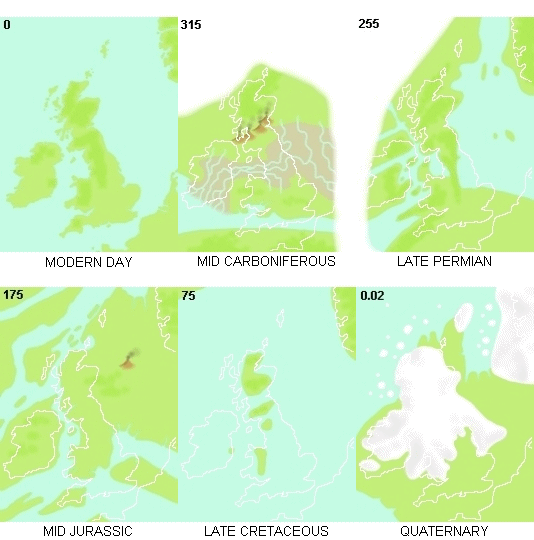 These two activities are not incompatible. We have a local radio presenter, the son of a farmer and a welder by trade, who is also well into local show bizz and builds carnival carts and other stage stuff.What do you mean ? NW Scotland was once part of North America and SE England is still under construction. 😀Yes that is part of what we were taught.Thank you for drawing our attention to this. +1 The rather later SW granite batholith has left no evidence of vulcanism. The vulcanism in eastern Scotland (Perth) is just a little bit younger than this and Edinburgh slightly younger still.I do believe I asked you a similar question a couple of posts back. Are going to attempt an answer ? Sorry if it was not clear. Yes I am well aware of the difference between Galilean relativity and Einstinian R. But don't they both satisfy the principle of relativity in that they expect the laws of physics ( as they then knew them) to operate the same in different moving frames ? Of course they did not know about the Doppler effect, let alone the relativistic Doppler effect Is a background stage not a different way of providing compliance within their knowledge ? But Lorenz transformations are not needed in this system. It is the system I called the schoolboy system for the OP. The speed of light is not invariant in this system. In Einstinian relativity - Swansont has already pointed out that rest mass is invariant, but relativistic mass is not. If you had three bodies ( say A , B, and C) moving relative to each other would you not choose the frame of one of them as the rest frame or the laboratory frame ? So if you chose C then you could calculate the velocity of A relative to B and find it was exactly equal and opposite to the velocity of B relative to A.Yes that's right. The lesson included the information that this is why beef comes from cows, pork comes from pigs and so on.At school in the 1950s I remember being taught that the British are a 'mongrel race and that is their great strength' as each invasion/addition/immigration has added something unique and worthwhile to the nation. It is sad that our governments continue to short change as many of these incomers as it can and always has done.I'm sorry, remind me again what you just said. 😄It is so easy to confuse yourself when pondering the subject of Relativity in general. Most properties are measured relative to a datum or standard. The results of measurement may also depend upon the method of measurement and/ or the circumstances of measurement. Galilean and Einstinian relativity are about whether motion affects these measurements. So consider an approaching meteorite, made of silicon, oxygen and iron. Its colour will change depending upon the speed of approach. However the atomic numbers of its constituents will not, as will its overall composition not change. However should we be able to remotely measure atomic weight (mass) this will depend upon the speed of approach. Does this help ? @Caruthers Is there a problem we can help you with ?

Important Information
We have placed cookies on your device to help make this website better. You can adjust your cookie settings, otherwise we'll assume you're okay to continue.