studiot
Senior Members
-
Joined
-
Last visited
Everything posted by studiot
-
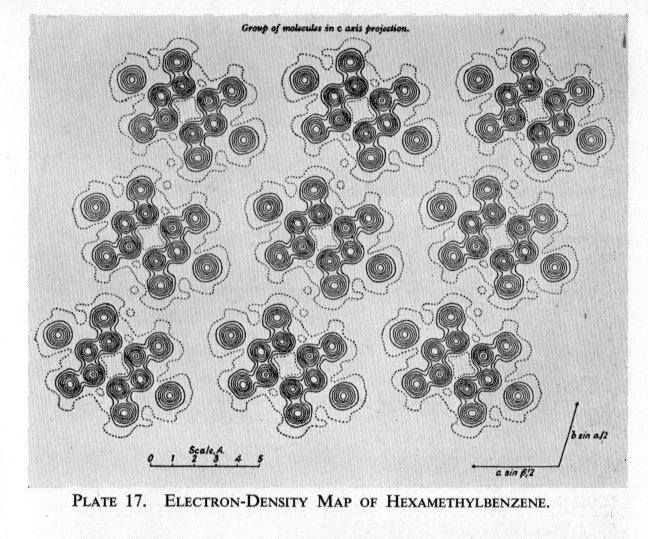
Really ? Have your read his paper ? Then how do you explain this ? Taken directly from his paper. Indeed we do. Here is a directly measured electron density map of hexamethylbenzene (after Spice 1964) I think it shows the structure rather well.
-
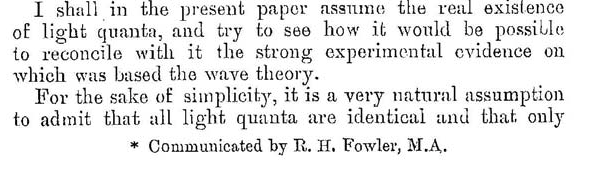
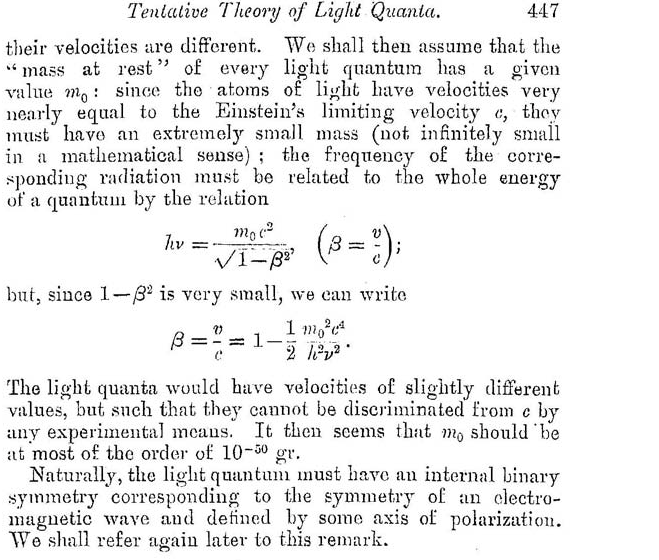
It would help if you took note of the steps I am offering. I think (and I may be wrong about this) that you have been following the wrong exposition of De Broglie's work (1924 and 1927 papers). Far too many (some well respected) texts offer this explanation of what he supposedly said. Consider a beam of EM radiation with energy E = hf, where f is the frequency. The wavelength. λ, is thus λ = w/f where w is the velocity of the wave. For EM radiation w = c so λ = c/f = hc/E This is all fine and dandy but But he did not say this. By analogy take the pair of equations k = 1/λ = E/hc and f = E/h because this false derivation does not lead to appropriate results, in particular matter waves as pilot waves, with a correctly defined group and phase velocity. They lead to a phase velocity, w = v/k = c and a group velocity g = df/dk = (dE/h) / (dE/hc) = c This is correct for a quantum which always equals c but not correct for a particle which moves with a velocity, different from c.
-
Please tell us more when you reply as more detail makes it easier to help. Differentiation is a process. A differential is the result of that process. (That is differential as a noun) But differential as an adjective refers to the difference between two values eg the differential pressure between inside and outside = (inside pressure - outside pressure) But there is considerably more required to understand things. Why is this posted in homework help ? Is this really homework or are you asking about mathematical theory, in which case you will attract more attention and answers if you placed it in the mathematics section.
-
Watch these animations. There are lots of youtube animations, this one is good because you can play with it, setting the vp and vg parameters to all possibilities to see the effect on the 'particle' carried. https://www.surendranath.org/GPA/Waves/GroupPhase/GroupPhase.html
-
Sadly you missed both of my points. By your own admission, anything you do from an armchair will be coloured by your experience. The blind man was an analogy and no analogy is perfect. Again I repeat the blind man must omit feature of the landscape.
-
Where is vp referred to in relativity ? What is v in your equation ? You introduced matter waves. What is the dependent variable in such a wave and what variables does it depend on ? I asked you about pilot waves do you know what they are ? You have entirely missed the point I was making which is Quantum waves cover all space at any one time and vary in time. As such they do not 'travel' anywhere.
-
-
Firstly I'm pretty sure you are not devoid of practical experience so will bring that to your thinking armchair. The first three names I mentioned, Plato in particular, wanted to strip philosophical analysis of all such experience and replace it with dreamt up ideals. Secondly I did not say that such proceedures, or the blind man's scenery description, would be totally wrong. Just that it would be substantially wrong and miss out many things. I would imagine that the law of averages would mean you would get some thing right.
-
Actually I don't know why you are discussing phase or group or any continuous wave velocity in relation to special relativity. SR has nothing to say about such things. It is stated in the title that it is about moving bodies ( not moving waves. ). Pilot waves, although an interesting variation, have not been substantiated experimentally. I had though your worry was that Lorenz formulae in general and gamma in particular did not reduce to newtonian mechanics as the velocity of a moving body reduces. Photons are not bodies in the mechanical sense any more than quantum probability waves are continuous travelling waves.
-
Isn't it ? What happens to gamma as v tends to zero ?
-
There I was, browsing for a new telephone. So here is the unexpected humerous example that the elementary AI algorithm offered me Why it thinks that folks frequently buy washing powder and plastic plants along with a telephone I can't imagine. But it is amusing.

-
Energy doesn't 'go anywhere'. It is converted from one form of energy to another. Have you studied the different forms of energy ? Swansont mentioned using the energy from falling weights, like your ball. It may interest you to know that this was the experiment that kicked off the whole science of energy. So it was a good question of yours. The experiment was carried out by one James Joule, for whom the unit of energy is named. https://resources.pcb.cadence.com/blog/2022-joules-mechanical-equivalent-of-heat-a-conversion-factor We did a simplified experiment like this in school by putting lead shot into the bottom of a tube and turning it upside down over and over again and then measuring the temperature rise in the tube. This was called an experiment to measure the mechanical equivalent of heat.

-
Noting your comment about attention span here is my short form answer. Matrices refer to when a bunch of things that have some sort of connection between them so that, taken as a whole they form something that is greater than their individual parts. The english word comes from the latin prefix 'matri' which refers to female matters and more particularly the latin word 'matrice' which refers to the womb. In English, the word matrix has been used to indicate this connection in many wide ranging places . For instance in education, matriculation indicates a connection between the subjects studied. Such connections may be shown in a data table, also called a matrix. Many subjects, including formal logic employ data tables. These types of matrix may or may not have a connection to linear algebra. In Materials Science, Chemistry, Engineering and related disciplines a matrix is formed when a large bunch of atoms are connected or linked (by chemical bonds) to form a continuous material. Other terms for this are substrate. An example would be the resin matrix in fibre reinforced plastic. In linear algebra a matrix is a data table in which all the entries are numbers or functions which have definite numerical values. Another word for this is an array of numbers. The connection between these numbers follows the rules of linear algebra.
-
Thank you for your reply. Note I said formal philosophers. Such as Plato, Kant and Wittgenstein. Archimedes and Bacon stood out because they embraced the formal but went further. By formal I mean those who believe that they can form a worthwhile opinion on anything and everything by sitting in their armchair and pontificating. To my way of thinking this is like taking a blind man to a known beauty spot viewpoint and asking him to describe the scenery. Something (a lot ?) will be missing; something will be wildly wrong in his description.
-
Perhaps you would like to rephrase this to resolve the apparent contradiction ?
-
The thing I have against formal philosophers is that they have been debating for thousands of years, yet Philosophy has no developed a growing and increasingly coherent body of a subject. As each generation discards what went before they are no further forward than they were millenia ago. Perhaps this contrast with Science is because Philosophy do not have the reality check of compliance with observational data.
-
Thanks I lost my last response and further thoughts to mathjax the mangler when I was collecting the OP's further questions to reply to. That is on top of the fact that we had had something of a crisis here, chez moi, and a hectic couple of weeks. I see from your link that PhysicsForums and Stack Exchange are also discussing this problem.
-
I would help you to think about what is the meaning of momentum. Momentum implies the exertion of a classical force. A simple classical (wave) explanation as to why light exerts a force when it impinges upon a massive body can be had direct from maxwell and the orientation of the E and B fields of the wave. The wave exerts a Lorenz force on the body at it impinges. But force is rate of change of momentum or momentum is the time integral of force.
-
The smooth change of refractive index condition is exactly what happens in marine acoustics. (It is not the only thing though.) In this context the eiconal equation is discussed chapter 2 page 5 et seq of the book most people refer back to by R J Urick Sound Propagation in the Sea. Originally written in 1979., but is now availble as a free pdf. Alternatively the eiconal equation for optics and many other uses such as the propagation of discontinuities is discussed in Erich Zauderer's book Partial Differential Equations of Applied Mathematics Wiley 1989
-
Of course there are. I never said the universe or anything else is completely deterministic. These are factual examples not analogies. But not everything in QM is indeterminate. QM expressly says that an electron cannot have a principle quantum number of exactly 2.375. It's not one side or the other ; all or nothing.
-
Here are two pages from the book by Nobel Physicist Frank Wilczek that may help you. Fundamentals Ten Keys to Reality. His whole theme is to cut down modern Physics, including the maths, to the bare bone essentials, so you might finds lots of useful understandable explanations here. Note here he says that none one really knows why particles have the mass they do and he lists at least three zero mass particles. In the main text he lists mass as on of the three essential characteristics or properties of matter. You will have to read the book to learn what he says about energy. You might be surprised
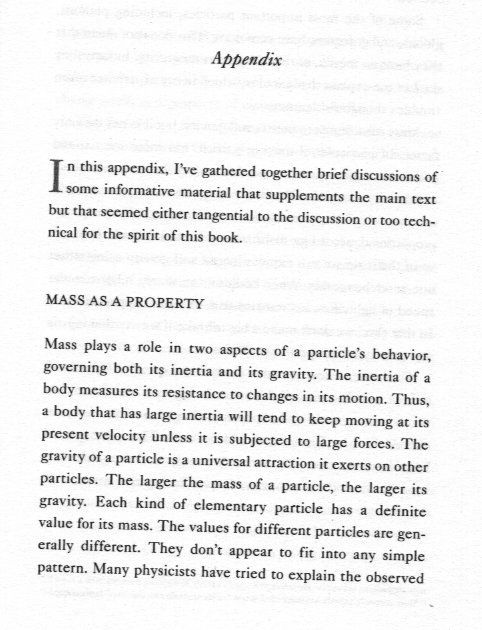
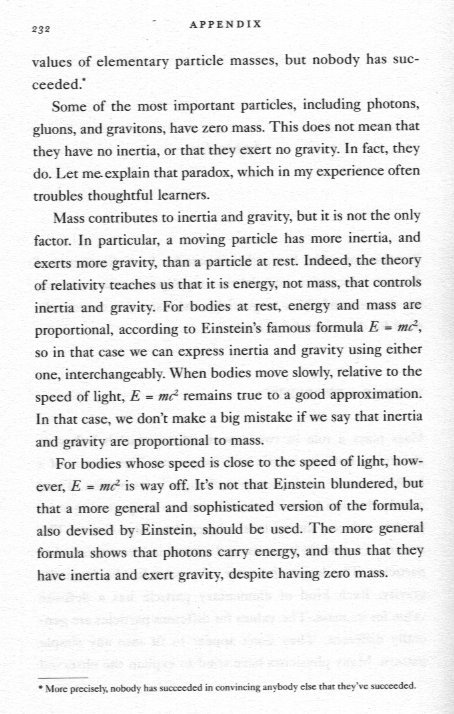
-
Nicely put. +1
-
etc Very patient answers if you ask me. +1 I was waiting till I cooled down to answer to thanks for saving me possible embarrassment. This whole thing sounds more like something EE Doc Smith might have written in the early 1950s
-
I haven't been able to get to this question yet, with all the chaff. Is prohibition a form of determinism ? It determines what you can't do after all. And QM prohibit an infinity of states to particles, waves and all sorts. Even in Thermodynamics there are prohibitions such as in Caratheodory's version of the second law. Eigenvalues, eigen states and eigenfunctions are all examples of discriminatory determinism, as was H Ford's declaration They can have any color they want so long as it's black. Swansont keeps telling anyone who will listen and many who will not that Science in general and Physics in particular is about models. Ever hypothesis, law, formula and so on needs testing, calibrating, with guaranteed known data and known results, outcomes etc. The only such guaranteed data is in the past.
-
Obviously they played this game differently in your playgound. This is a ridiculous attempt to contradict by ridicule. "Only some systems exhibit this." I said generally, why repeat it ? "Most systems are chaotic, " Stated without a shred of proof. "Take the state of Earth just after the Theia event. From that state, life is unlikely to form, and if abiogenesis does occur, it will most improbably evolve into anything that would be recognized as a mammal." ditto But here my comment about the compounding probabilities could apply. Also you have again omitted any proof of you modifying adjectives. "You drop successive grains of sand from a fixed point and which way a given grain goes is fairly unpredictable, but the eventual conical hill of sand is very predictable. " You actually agreed. How does that invalidate my point ?