
studiot
Senior Members
-
Joined
-
Last visited
Everything posted by studiot
-
I'm so glad you guys had this conversation whilst I was considering my answer. Like swansont, I originally thought you meant physical space and how you would measure the dimensions by physical observation. But 'space' in Mathematics is different from 'space' in Physics. Whatever the space you are referring to you would need to have more detail to proceed. In pure mathematics, space refers to a master or container set for several sets which make up the space. These are not subsets, since the nature of the elements in each is different. You need at least set of elements or points, a set of axioms and a set of relations between the elements. This gives rise to different mathematical spaces eg geometric space, hausdorf space, phase space and so on. These rules will enable the mathematical determination of both the meaning and number of dimensions of that space.
-
I'm not clear on exactly what you want to do. What do you mean by 'electrically conductive length' ? If, as you say, A and B are at fixed locations, and you wish to provide a current path from A to B a curve is the only way to provide variation. Are you aware of the difference between rheostats, potentiometers and variable resistors and their connections ?
-
Difficult because Gauss require a closed n dimension 'shell'. You can describe a closed sperical shell, which is 2D and curves in 3D. But it is not possible to surround an object in 4d with a corresponding 3D 'shell'. There is always a route through the 4th D from inside to outside. Flux refers to contours or imaginary equipollent lines in the normal way connecting points in the manifold.
-
last lines Gnoses mare Thebe trux
-
Is the constant factor mean over time? ⍙Y is just the change of the y axis over time Time doesn't enter into it. I foot is identical to 12 inches. If you prefer 100 cents makes one dollar, period.
-
One of the consequences of Gauss is that the view from outside a shell is independent of the disposition of the flux charge within the shell. Newton is not required for this and it also applies to fluxes other than gravity. In turn this leads to multiple, if not infinite, solutions. I see it as bit like the different between the moment of inertia and product of inertia. There are an infinity of solutions to question what disposition of mass yields a given moment of inertia, but only one to the question what yield a given product of inertia. Somewhere there is more to the story.
-
Wouldn't this contradict Gauss' shell-flux theorem ?
-
First day at school My kettle just died RIP boiling water You will be mist

-
This is where some very basic science comes in. You do not need college to know that there are many forms of energy and that all energy is measured in the same units. So the conversion of one form of energy to another is a quantity of energy, which is still measure in the same units. yes I know that over the centuries there have been many different measurings units for energy, just as with say length measured in feet, inches metres, links, chains furlongs and many more. But each can be converted into the other by multiplying by a constant factor, as the number of inches is 12 times the number of feet. Does this help?
-
emergent from what ? As I understand 'emergence' it arises because things have properties and emergence arises in very special particular cases of combinations of these properties.
-
Which is why you should put in the effort to study some very basic science. It took thousands of Men thousands of years to develop the knowledge and understanding of Physics that we have today. How long do you think it would take one man on his/her own ? Guessing is a very very ineficient way.
-
Very Euro-centric of you. The middle east and the far east had no such dark age. Overall, world-wide, there was no regression of technology. In fact, gun powder was invented during that period (9th century). Really ? I suggest you check your arithmetic. Let us say there was a small amount of progress in the largest continent, Asia. But this is only 31 million square kilometres. Set this against 29 for Africa, 21 for North America, 17 for South America, and 8 for Oceania (ignoring Antartica which has not been settled in human history) that makes 75 million square kilometers where no advances were being made.
-
If you would like to Stop, take a deep breath, and count to 10. Then try to reformulate your query so others can make sense of it it would be very helpful. Why do you think total mechanical energy would change over time ? The law of conservation of energy is actually more fully the law of conservation of mechanical energy of an isolated system and it states that the total mechanical energy of such a system does not chnage over time. Yet you have not stated what system and circumstances you are applying your thoughts to.
-
Good points, Ken. +1 But I think you should go back a little further than you suggest for the history. The groundwork was laid in the 1600s by Hooke and Newton and continued in the 1700s by the Europeans, starting with Farenheit. This lead onto Kelvin's Absolute temperature in the early 1800s. So by the time of the French- Spanish geodetic expedition to Peru temperature measurement was routine. They made the first systematically recorded temperature observations in South America. Hooke produced the first standard rain guages, wind guages, temperature gauges etc necessary for properly established scientific recording. Here is his scheme.
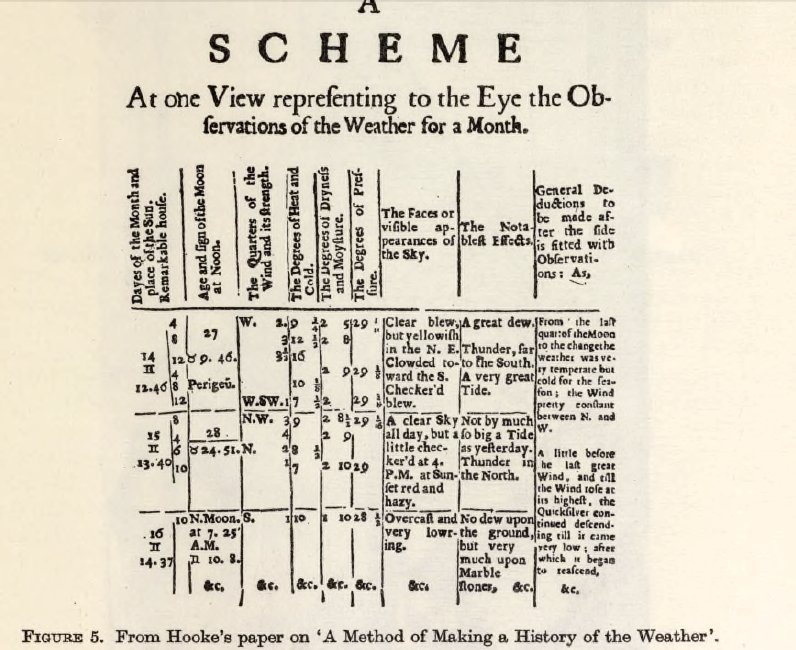
-
Yes indeed at one time there were lots of thermometers around. They were unevenly distributed over the globe, depending upon the resources of their nations in charge of their location. Also the readings were of uneven quality and some readings were more frequent than others. Readings were also taken at sea and more recently in the air by aircraft and ballons, manned and unmanned. Today we have the benefit of continuous near blanket monitoring by weather satellites using remote thermal imaging techniques. Both the average and local temperatures are known to affect various marker such as plant growth and pollen production, ice thicknesses and so on. Records of these from ice cores and fossils are used by paleoclimatologists to establish past temperatures. Does this help ?
-
OK so before I give any detail a couple of important things you need to know. There are two editions of VCA, which was first published in 1997. VDG&F followed in 2021 and was written in the same style and from the same viewpoint. A second edition of VCA (which I have) was published in 2023 and has some important typographic deficiencies remedied. The maths text is the same, but the many diagrams now all have explanatory captions, the index has been much expanded and a conventional referencing system added, and the book is in a larger physical size. The two books contain much common material and frequently reference each other. Between them they develop the author's theme that it is good for understanding to approach fundamental principles in maths from multiple viewpoints. He expresses how reassuring it is to come to the same result from different routes. Both books have Feynman's american ability to pull out the essential statements in a clear and obvious form and to highlight and separate them from the block of the text. I would certainly recommend both as a pair; you really need the 2023 version of VCA though. I already have three books entitled "The Geometry of Complex Numbers", but apart from the usual few diagrams you might find in any work on complex analysis they do not approach it from the geometric viewpoint at all. VCA certainly achieves this. VCA covers a lot of ground with good mathematical insights. But what it is not is a tabulation or treatise on the applications of complex analysis, which is where many readers are coming from. So if you want CA in the solution of differential equations, it only mentions 2, Schrodinger and Dirac, complex Bessel functions are not treated at all, you will have to go to alfhors for that. Complex integration is dealt with at a fundamental level, in relation to measure theory. It is not a textbook of complex integration techniques. (Conformal) mapping again much wanted by engineers is treated at a mathematically fundamental level rather that a catalogue of techniques. As promised the book is not a catalogue of algebraic results and formulae, with the excuse 'we can explain this result geometrically'. The results are there but arise naturally by considering the geometry ( my preferred way ) and also the topology / continuity. Also arising from this geometric approach Tristran delves deeply into noneuclidian geometry. Hope this helps, sorry it has taken so long to reply, but I needed to do justice to the books.
-
Thank you for this reply and the other posts you have recently made. I hope I am now clear on your input and can now discuss it further. 🙂 +1 I'll come back to 'value' in the context of your introduction of 'objective v subjective' in a moment. But first your use of relativity and relationship, although these words stem from the same root, they have different meanings and usage. Even though you are not a mathematician, you should be easily able to understand the very basic concept of 'relationship' in mathematics and logic. Like so many basic concepts in so many subjects 'relationship' manifests itself as having many shades of meaning. The are many types of relationship recognised. In fact it is a broad category and we distingusih further by either introducing special new words (as in function) or additional adjectives as in equivalence relation. You might find it useful to look at your own language wiki to find out about a particularly useful one in maths called an equivalence relation. https://en.wikipedia.org/wiki/Equivalence_relation Here you can see that in this type of relation you can sometimes substitute one 'value' for another - there is no subjectivity allowed according to the rules. So subjective v objective. I hear what you say about this but Nature (Physics, maths, everything) is remarkably obstinate in resisting Man's efforts to squeeze it into his own subjective categorisations. And so it is with subjective v objective. This is not an either or (binary) choice, but rather a scale of meaning. Science, in particular, tries to remain objective by various means. We like to think that if se set up a machine to observe and/or record it is objective because it can only record what it observes. But I know that Nature can play tricks on us, from my own personal experience during my time as a surveyor. When making important verticular angular measurements it is good practice to observe from both ends of the observation line. One end will generally be below the other so looking up (+ve angle) and the other end looking down (-ve) angle. But I have seen situations where it is possible for both angles to be +ve. That is both ends of the line appear to be looking down on the other. The angular measurement instrument (theodolite) is correct (objective) and it is not operator error. So Science is able to correct its faulty theory.
-
First I would like to say +1 to wtf for some very clear presentation of the issue. I would then like to add a little to the business of bijections and 'omitted elements' as noted in the emboldened words. [math]\begin{array}{*{20}{c}} 1 \hfill & 2 \hfill & 3 \hfill & 4 \hfill & 5 \hfill & 6 \hfill & 7 \hfill & 8 \hfill & 9 \hfill & {10} \hfill \\ 1 \hfill & 4 \hfill & 9 \hfill & {16} \hfill & {25} \hfill & {36} \hfill & {49} \hfill & {64} \hfill & {81} \hfill & {100} \hfill \\ 2 \hfill & 3 \hfill & 5 \hfill & 6 \hfill & 7 \hfill & 8 \hfill & {10} \hfill & {11} \hfill & {12} \hfill & {13} \hfill \\ \end{array}[/math] Here is something even more interesting The first line lists the natural numbers The second line lists their squares as per Galileo. The third line list the numbers missing in the second line from the first. This can also be put into a bijection. In fact we can derive any number of ever more complicated derived lines.
-
Surely this belongs in speculations ?
-
It is very important to always consider both magnitude and direction for forces. Horizontally the two slings are pulling in opposite directions. That is why there is a minus sign on one of them. Do you think they are also pulling in opposite directions vertically ? But well done for recognising the change from cosine to sine to get the vertical components (do you understand we are 'resolving vertically and horizontally into two separate components for each force ?) 🙂 Now we must include all forces that are acting on the free body - the log. You have forgotten one, the one you are trying to find - W. So you will have three terms in your equation, not two. Fear not it is good to work through at this level of detail as I feel you are learning and using what you already know. Can you have another go at the vertical equilibrium equation ? I note you have only been a member for 21 hours. New members are restricted to 5 posts in their first 24 hours, after that posting is unrestricted. We do this because it prevents ill intententioned new members or bots to post pages and pages of spam, as happens to some forums. Edit Since I see you are here now I will post the vertical equation for you to compare with yours and solve and speed things along. As the log is under vertical equilibrium by the actions of 3 forces Downward forces = upward forces W = 10.5 sin60 + 8.17 sin 50
-
The first part is correct 8.17kN * cos (50) = 10.5kN * cos (60) = 5.25 kN numerically But the correct equation from Law 2 is that they are equal and opposite since they are acting in opposite directions ! So to sum to zero one must be positive and one must be negative. So we have, taking left to right as the positive direction horizontally 10.5kN * cos (60) + ( - (8.17kN * cos (50) ) = 0 However that is the equation for horizontal equilibrium. For the log weight, you need the equation for vertical equilibrium of the log. Using what I have just shown you and taking up as positive, can you write the vertical equation ?
-
Hi, thanks for your reply. I’m in Scotland, and school started for us on 16th August. I understand the laws of static equilibrium, and I’m also familiar with FBDs. Great stuff. So did you do my little sum for me ?
-
I agree that a protracted discussion about what consitutes the Dark Ages is a tad off topic , but I think I have successfully communicated my point since you clearly understand the period of History I was referring to. My point, of course, was to challenge the OP assertion that technology (as opposed to other aspects of History) has been steadily advancing, which to me at any rate means that this is equivalent to stating that there have been no declines to below the standard previously achieved. I note that you have not addressed my clear examples to the contrary of the OP assertion.
-
Hello, Fiona and welcome. You say you are just starting Engineering Science, but in the UK we are on school/college holidays. So are you trying to get ahead or to catch up these holidays ? Either way you have come to the right place. So your question is from the Mechanics (statics) part of Engineering Science and refers to equilibrium. You need to know the three Laws of static equilibrium 1) The sum of all vertical forces equals zero. 2) The sum of all horizontal forces equals zero. 3) The sum of all clockwise moments equals the sum of all anticlockwise moments. You will not need all of these three for these early questions, but you will need some very simple trigonometry and how to draw and understand the 'free body diagram' on the right of your top diagram. We should start with this diagram so can you say why it has been drawn as it has and what it means ? If not then we can work through this first. Edit the site system has merged my two replies. I see you came back to look so here is a small hint. The log is in horizontal equilibrium. (Law 2) That means that it is neither moving to the left or to the right. That means that the sum of the lefward forces = the sum of the righward forces or the total sum of the horizontal forces = 0 There is only one leftward force ( the horizontal part of 8.17kN) and only one rightward force (the horizontal part of 10.5 kN) Note is say the horizpontal part because each force is acting at an angle to the horizontal. The value of the horizontal part is given by the formula horizontal force = actual force times the cosine of the angle the line of the force makes with the horizontal. Please check for yourself that 8.17 * cos (50) = 10.6 * cos (60) Is any of this familiar ?
-
Yes but did you understand swansont's comment that voltage is not a measure of energy ? Anyway thanks for the picture. It looks as though you have wrpped some copper or brass foil around a silver metal (aluminium or stainless steel) bowl. This constitutes a bimetallic coupling which will automatically generate a thermally sensitive potential difference. Thus if you expose the wrapped bowl to hot sun its temperature will ris, as will the voltage. So yes you could use this to generate some current but 0.6 volts is not going to get you much power.