studiot
Senior Members
-
Joined
-
Last visited
Everything posted by studiot
-
Isn't it also the longest path in some cases? Also what about connectivity ?
-
Are they right? Personally I wonder if they haven't already found it in New York https://www.bbc.co.uk/news/av/world-us-canada-66970292
-
I'm sorry but what has this to do with the OP ?
-
Thanks for the reply. It is interesting to think back to when I was at school. Some of my teachers issues two exercise books. One was for rough working and the other was for fair finished copy/output. This was actually a pretty decent system, although they were very hot on the 'fairness' of the copy. (note I am using the english words fair and copy as presentab;le and output). We were just coming out of post war, when paper was at a premoium. The previous generation had tales of writng first in pencil, then going over in pen with new stuff later and writing a block of text, then writing around the margins. Interesting that you only had one maths teacher (you didn't really did you ?) 😀
-
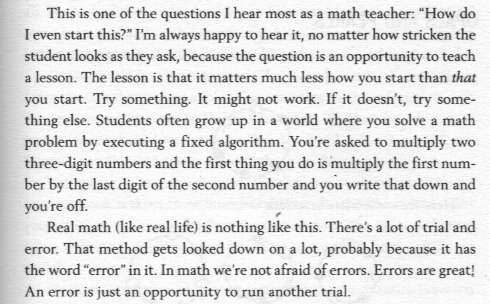
+1 for two fascinating pieces of information. Although it is (was ) my currency I never noticed that discrepancy or knew about russian geography teachers. Here is another quote from Ellenberg who has the ability to offer remarkably simple yet penetrating insights in his writings.
-
Flubber ? +1 That was a good film, (the 1961 original), complete with a mad professor.
-
So the last thre pages (of 5) are flawed. You have also agreed that at least the first page is also flawed and I invited you to correct it. I presume you are therefore going to withdraw this paper and perhaps substitute it with something better. When you do please be aware that your Fig 1 is very worrying. Since you have identified the length Beta (and gamma) with the bohr radius, which is the radius of an atom, it follows that your model electron must be several times the size of an atom. That is if Fig 1 represents you toroidal model of an electron. You should also be aware that the Bohr radius is the radius of a hydrogen atom in the ground state. Other electrons have different corresponding radii. Alternatively if you are confusing quantum orbitals with the Bohr orbital model of the atom then this is even more difficult to square with your model. Also to be considered is that the Bohr electron is in a bound state, whilst the Compton and Classical electrons are in essentially a free or unbound state. There is a lot of Physics for you to account for. There is a good summary of toroidal models and their faults from the original 1915 one to the present day here in pdf. https://www.ptep-online.com/2018/PP-53-06.PDF
-
Examples are really good when we are talking about words such as objective and subjective, so we both understand what the other means.
-
Not that you will ever thank anyone for the effort they have put in on your behalf, but let me Google this for you. It's all there for the asking. Cheap pens are made from polystyrene or polypropylene however https://www.faber-castell.co.uk/corporate/magazin/recyclates-marker
-
Phi is most used for a general or unknown angle, both in calculus and other uses of angles in Mathematics. The Golden Ratio is also known as the Golden Section and appears in mny places in maths and natural science, as Joigus says. Associated with the Golden section or ratio is the Golden Angle.
-
I am going to say +1 for this correct stetement. Time is indeed not a vector, but then I don't know who said it was. I further can't figure out what you speculation is or why this is in speculations at all. The whole classification scheme of scalars, vectors, tensors, dyads, triads and so on is a bit fuzzy so it is important to know whether you are talking mathematics or physics as they are different. Also a quantity can be a scalar in one situation andn a vector in another, which make matters even more complicated. Equally there are situations where time may be considered a parameter, a scalar, a dimension or something else entirely. So it is not a case of one or the other.
-
I saw this alleged response the first time and understood your description. Then I couldn't see how this addresses my query about symmetry and I still can't detect any refernce to symmetry in your reply. Am I being thick or what ?
-
Coincidences occur both in calculations involving units as well as numbers and calculations involving only numbers. For instance If I buy rope as 1 shilling a foot the units are 1 per 1. By a strange coincidence that is also 1 penny per inch : again 1 per 1. Or think about area; an area 3 feet by 3 feet makes 9 square feet or 1 square yard - not a coincidence and also not very useful to measure electron areas How about working in Barns ? Of course we can do without units 23 is approximately equal to 32. or better 32 + 42 = 52 and the net abounds with other coincidences By the way I am still waiting for a response this my question. I originally had some trouble downloading your 5-page paper, but I have now managed to do this. But if you will not read a 5- line reply from me, why should I read a 5-page paper from you ? Can you point me to the page and paragraph that contains the answer to my question ?
-
Looking back over the years SF averages at least one thread per year about concidence/numerology in maths http://blogs.scienceforums.net/ajb/2011/10/17/number-theory-and-numerology/ http://blogs.scienceforums.net/ajb/2011/10/17/number-theory-and-numerology/ and many more. The answer has never wavered.
-
The UK is now officially a third world country as regards education https://www.bbc.co.uk/news/uk-england-somerset-66910645

-
Proof is a high bar. Evidence for and against, along with argument of interpretation, is the best you can ever go for. But that's fine. For example, the world is spending trillions, without proof, that the CO2 levels will cause damaging climate change. I haven't heard one politician provide that proof or even call for it. What you can do is show what is illogical and downright silly, about the notion of design, and illustrate what kind of odds are in place, for and against there being an intelligent designer. Religious people often use the way out that "god moves in mysterious ways". I believe it can be shown that if he exists, he moves in incredibly stupid ways. Look again, I didn't say that, not quite sure how you managed to attribute Markus' comment to me. I was, in fact, musing on where something very similar to your suggestion/question is successfully attempted in physics and wondering if that template might in some way to your heart's desire. Yes, the London Eye is so much better, If speeded up the fan effext will even deal with global warming in London. 😀 p s I used to be able to increase the font size of a smiley, but it doesn't work any more.
-
I put the 'the 5 senses' in inverted commas to show that I did not accept that there are only 5 senses but was referring to someone else's classification. Perhaps it wouold be clearer if I made the commas bigger? I could say alcohol or I could say that as I understand the mechanism of balance it involves interaction with the environment by visual clues (sense 1) and measuring pressure/ pressure difference (sense 2) as well as feeling gravity.
-
Thank you for replying as someone who has actually seen it. The presenter, Chris Packham is a journalist, not a scientist and did a creditable job of presenting the material. So yes I enjoyed it. The episodes included short 'interviews' with a range of academic specialists from around the world. I especially liked the new material about Funghi and their fossil tree like growths that everyone thought were fossil trees. However I noted discrepancies between some of the episodes. So at the end of episode 2 they had rushed timeline forward several billion years to -700 million years and announced that in the next episode they would be taking it from there to discuss life and its great proliferation. Yet in episode 3 they barely reached -700 million years, yet kept jumping forwards to show magical open sky margins around tree tops, that I do not recognise from any forest I have ever been in, and made the claim that funghi, which they reckoned once towered over plant life once were relegated to the ground at this time. Yet all the pruning theory for trees and bushes tell us to 'open out the top area' so as to avoid colonisation by -- yes -- funghi and lichens (these latter did not merit amention in the programme).
-
Has anyone been watching the new BBC2 series Earth, presented by Chris Packham ? I wonder what you made of it ? I thought it had some new thought provoking ideas but found some thi ngs rather difficult to follow. It has not been clear what is established and what is hypothesis. The programmes jump backwards and forwards along the timeline so it is difficult to place material presented in context or connection with other material either in the series or elsewhere.
-
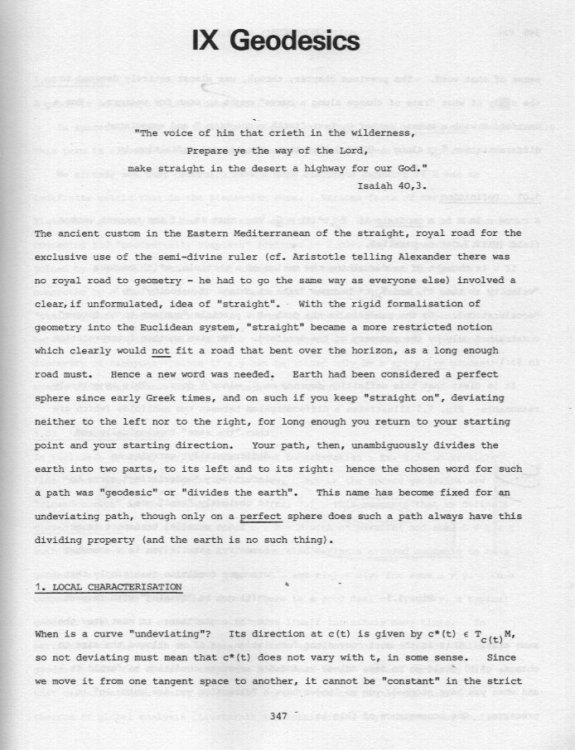
+1 to Markus. The actual definition of a geodesic is lost somewhere in the Terra Incognita of algebraic geometry - I have several all pretty impenetrable jungle. Here is the beginning of a good introduction for Relativists from this book.
-
Perhaps a nice one, but aren't 'the 5 senses' to do with the interaction between us and the rest of the universe ? And aren't bathroom visits due to internal proceses ?
-
Definitely. Another +1 to Mac. Well sort of, but I am not so sure that there might not be a way to prove the negative. In this thread I posted an analysis using Newtons Laws of Dynamics, (post 22) which goes some way towards achieving this for an entirely different purpose. I.m sorry I can't That we can separate the effects of external influence and internal process is all to often taken for granted ( and not always true either). Even Newton invoked it but did not explicitly state it.
-
You are just demonstrating ignorance of the way statistics and probability (they are not the same thing) work. Probabilities of 1 and 0 have special meanings, not possessed or needed by inbetween probabilities. Most people who think they know statistics are unaware of this. I wish I had £1 for each time I have pointed out on this forum alone that the 3 special meanings of a probability of 1 for instance are taught on the UK GCSE syllabus.
-
The odds against the first living creature are, by definition, zero since it happened.
-
Isn't that also true for the word Tennessee ?