studiot
Senior Members
-
Joined
-
Last visited
Everything posted by studiot
-
You might find this one simpler and more digestible.
-
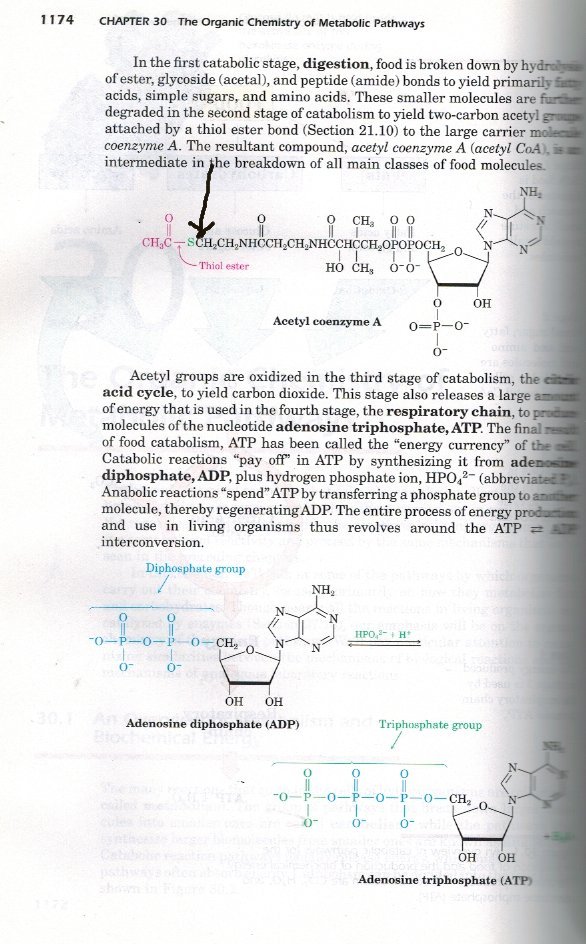
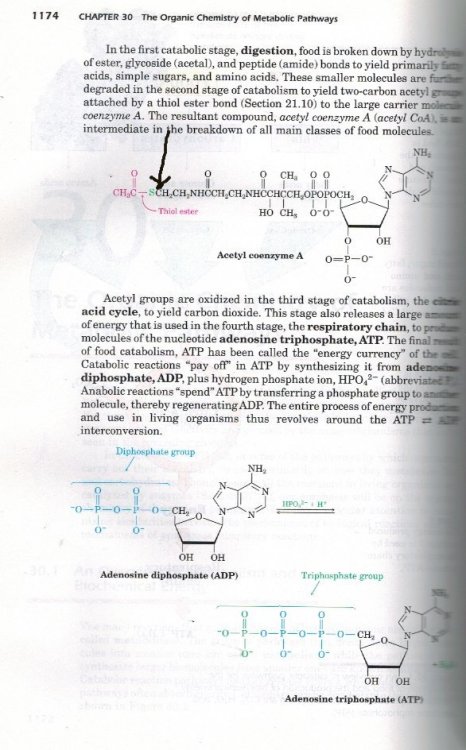
Here is some more information. Yes it's acetyl-thiolCoA Everything to the left of my marker arrow is expanded as previous diagram. Everything to the right is rolled into the CoA. It's from McMurray Organic Chemistry mine is the 4th ed. Sorry about the flatbed scanning but there 1350 pages so it doesn't sit well
-
Voila We seem to be making some progress. Did you catch what the detective said in my last post ? Because you should be setting out the facts and looking for a theory to fit them. Not setting out Gaia and looking for facts to fit the theory. So what is a summary of the facts ? Well the Earth began almost 5 billion years ago. And throughout that time conditions have been changing, sometimes steadily and slowly, sometimes quickly and dramatically. Some of these changes have resulted in great change in lifeforms at any one time. Some of these changes have been rapid enough to cause great change to the human population. How is this compatible with the conditions laid down in the Gaia Hypothesis of persistency of the conditions in comfortable late 19th century Europe ? Planet Earth does not fit Gaia, but somewhere else might. Note I see you have posted something about my 'Food Diagram' but I don't see any comment or question ?
-
Please note that axioms and premises are different things. Please note you have not answered anyone's questions or addressed their comments, which contain some very valuable information. This is a discussion site and you need to participate in the discussion not just repeat your question without adding anything further. OK some further helpful background. In Philosophy and more particularly formal logic there is not such thing as the truth. Truth, or more correctly, truth value, is as noted above a property we attribute to or deduce for some statement or other, as @TheVat states. We recognise 'orders of logic' because matters can become complicated. First order logic is as @joigus states contains what is known as the law of the excluded middle or that every statement has one of two truth values, True or False (T or F ) but there is no room for overlap, don't know , other value etc. We can obtain a false statement by the process of negation of a true statement and vice versa. (more of this in a moment) Statements can be simple in that they contain only one single idea or they may be compound or complex by combination of more than one simple statement. There are various connectives for combining simple statements into compound ones., including rules for combining their truth values to obtain an overall truth value. Herein lies the issue because mostly the rules work well, but some combinations lead to paradoxes or other troubles. For instance combining the statements In a village, the barber shaves every man in the village except himself. Every man in the village is clean shaven. So who shaves the barber ? These are two statments either of which or both could be assigned a T value. But their combination leads to an issue, given by the end question. Second order logic was introduced to analyse such statements by doing away with the law of the excluded middle. OK so back to negation. Within the confines of Euclidian Geometry there are 5 postulates or axioms. Over the millenia the last one has received considerable attention. Through every point, not on a given straight line, only one parallel line may be drawn. - Truth value T Now negate this to obtain a false truth value. Through every point, not on a given straight line, it is possible to draw more than one parallel line Now the truth value is F And in this form the statement will work perfectly well as an axiom. A final point. In the world of engineers, machinists, carpenters and other practical folk there is a process called 'truth testing' Does my wheel bearing run true? Is my spirit level true enough to build my brick wall ? Is this rope strong enough to support the weight ? The last one giving the clue as to the meaning in this context of conformity to some standard or criterion.
-
Certainly not a dead end. The sulphur process (sulphur is in the same periodic table group as oxygen) is still active today. Both NASA and NOAA and many other authorities now have reports on it. You intrduced the word intermediate, which implies to me that it was a necessary calling point to get where we are. The fact remains that there are many organisms that do not rely on photosynthesis alive and well today, some do not even need oxygen. they are competitive species, not stepping stones. Remember also that if the Chixelub metorite had not happened we would not be here, the dinosaurs would still rule the Earth. I first heard the parable of the puddle on ScienceForums and I think it offers an amazing insight. I posted the invitation to give some other member a chance to post it. Since no one has, here is my version. Somewhere in a hot country lies a dusty road full of potholes. Every night it rains and puddles form in the potholes. Every day the puddles evaporate in the heat. One morning a pudle woke up (became self aware) and thought "what a wonderful world and how lucky am I ?" This pothole is exactly right for me. It is me shaped. During the day, the puddle evaporated and the traffic passed, extending the pothole. The next morning the puddle woke up and thought....... I have been watching a TV detective series and in the last episode he says an interesting thing. "We should not look for facts to fit our theory of what happened; we should look for theories to fit the facts."
-
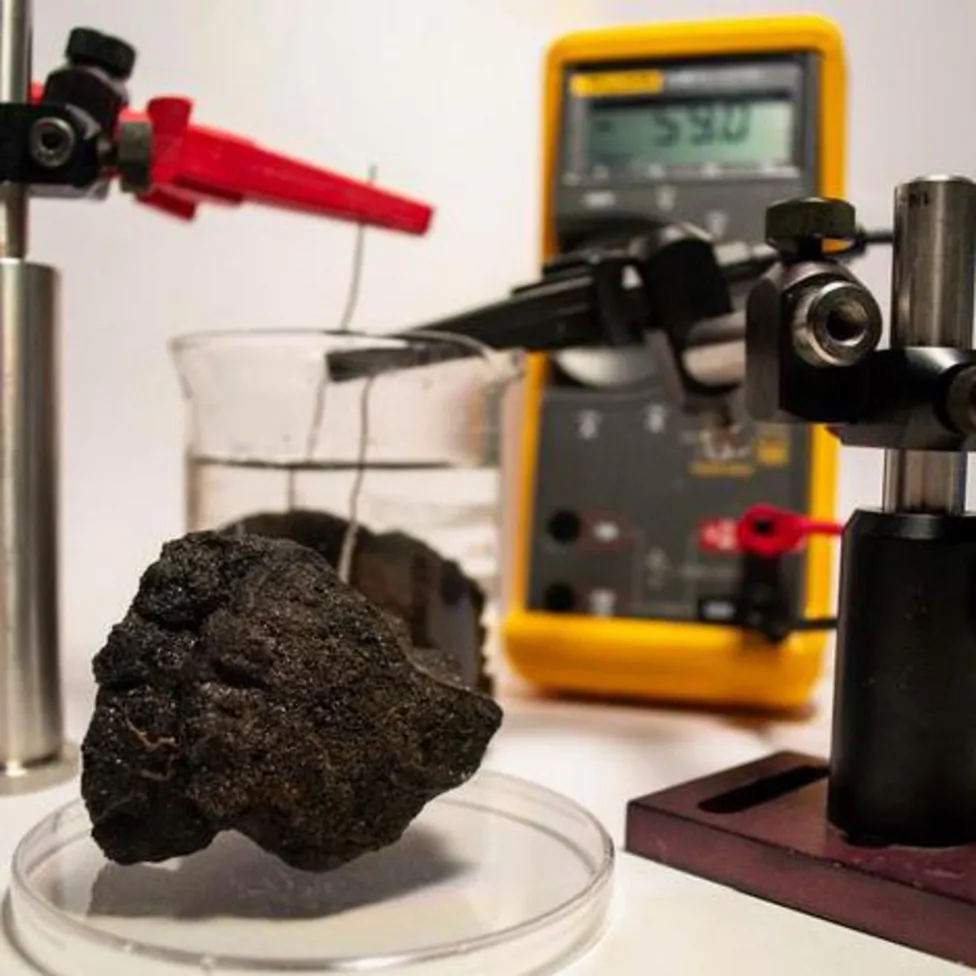
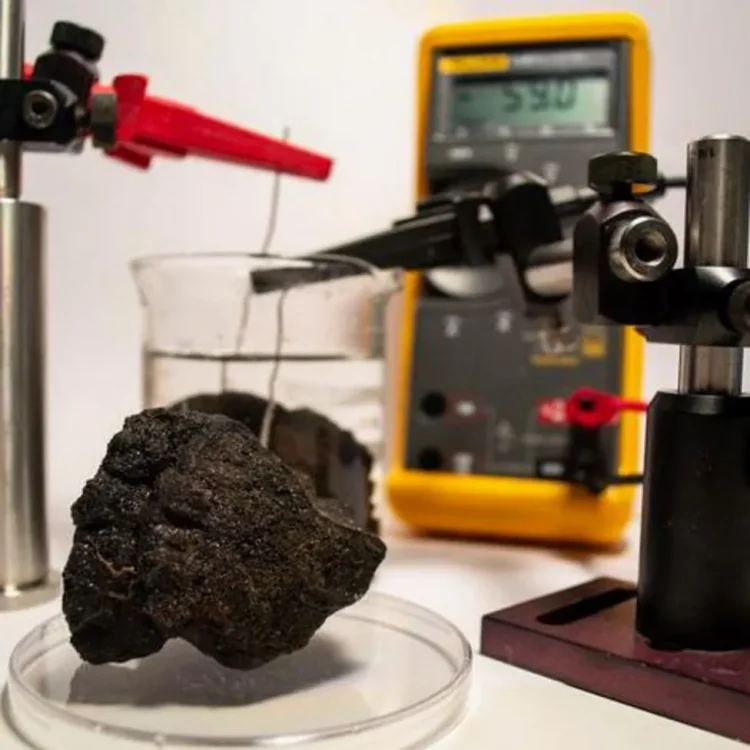
+1 I didn't see any quantitative evaluation of the rate of oxygen production. Only a general statement that the oxygen in the water was higher than expected. The oxides that make the nodules are semiconductors, not conductors so this will lead to a high internal resistance for any 'battery'. We regard the voltage voltage step across a pn junction as a barrier not an EMF. Voltage / current curves of such devices do not start at zero. Your earlier overvoltage comment applies. So the rate of oxygen production will be low but, of course, geological timescales are available at the bottom of the ocean.
-
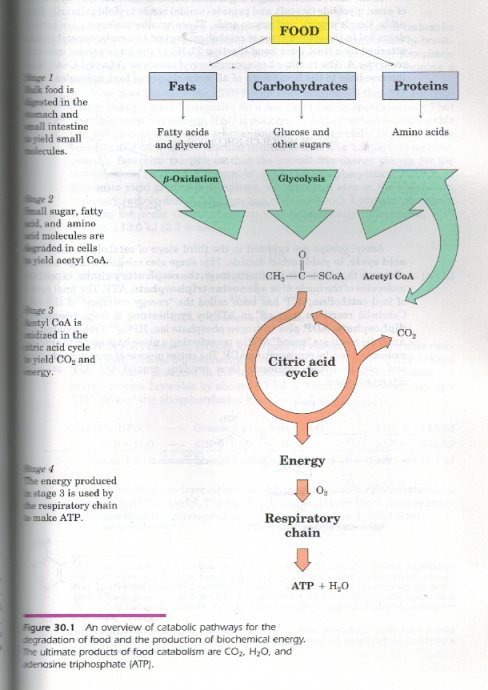
In exactly what way is n(CO2 + H2S + O2 + H2O) = (CH2O)n + n(H2SO4) intermediate between n(H2O + CO2) = n(CH2O) + n( O2) and Catabolism
-
I have two good oceanography books. Oceanography Summerhayes and Thorpe Oceanography Thurman and Trujillo Both both have nice pictures, and discuss the nodules at length. I didn't realise that 'manganese nodules' were first reported by the Challenger expedition (1872 to 1876) It is interesting that when introduced they go by the name manganese or ferromanganese and the introductions all seem to refer to them as metals. It is only when you delve deeply into the text that they admit they are a mixture of iron oxide, manganese oxide and other oxides and salts.
-
https://www.bbc.co.uk/iplayer/episode/m0021d0b/countryfile-chew-valley
-
-
Did you see the recent Countryfile program about the Chew Valley project ?
-
I agree that journalistic science can be quite misleading, especially when rushed to press. I really hope that a BBC Science Correspondent knows the difference between voltage and current, but I am not sure from this And this certainly says metals But I never thought about it till now, I just took it on trust. Nor had I heard of the nodule forming on a nucleation surface such as a shell fragment, but that makes sense.
-
Aren't nuclear subs prototypes for this ? They can stay submerged for long periods. You are also talking control theory here which has restricted definitions of balance, cyclic and feedback, as to for instance Gaia.
-
Contact potentials apply to all materials in any states, not just solid metals, though some contacts may be unobtainable. For instance Dowling showed the CP between liquid and solid bismuth in 1928. https://journals.aps.org/pr/abstract/10.1103/PhysRev.31.244 Seawater is a soup of ions and those nodules are a mix of many substances. Perhaps hydrogen is adsorbed on the nodule and released over a long time period. Whatever is going on is very complicated. As a student in the 1960s, I remember reading about those nodules in SCIAM. They were all set to mine them in those days, but it has never happened. But as far as I remember they were reported as metallic rather than oxides. One component was manganese.
-
Time to trot out the parable of the puddle ?
-
Isn't the contact potential the potential difference equal to the difference of the work functions ? So this should exist between any impurity and the base metal?
-
Thanks but that is not what I meant.
-
Does it have to be oxygen and hydrogen ? That is not the way ( biological) photosynthesis works.
-
If you weren't such a smart alec I would remark that Is exactly Higgs theory. But I doubt if you would know what I meant.
-
Why does the list sometimes report the members as 'last visited' and sometime 'online now ?' especially when the member looking the information is clearly online ?
-
Well the article does say that they have measured a (contact) voltage difference of the order of a Leclanche battery and there are plenty of possibilities for the impurities to be say 1.1 to 1.6 volts different in work function. If the main metal in the nodule is Iron then Calcium fits the bill. There is a convenient table on Wikipedia https://en.wikipedia.org/wiki/Work_function
-
https://www.bbc.co.uk/news/articles/c728ven2v9eo
-
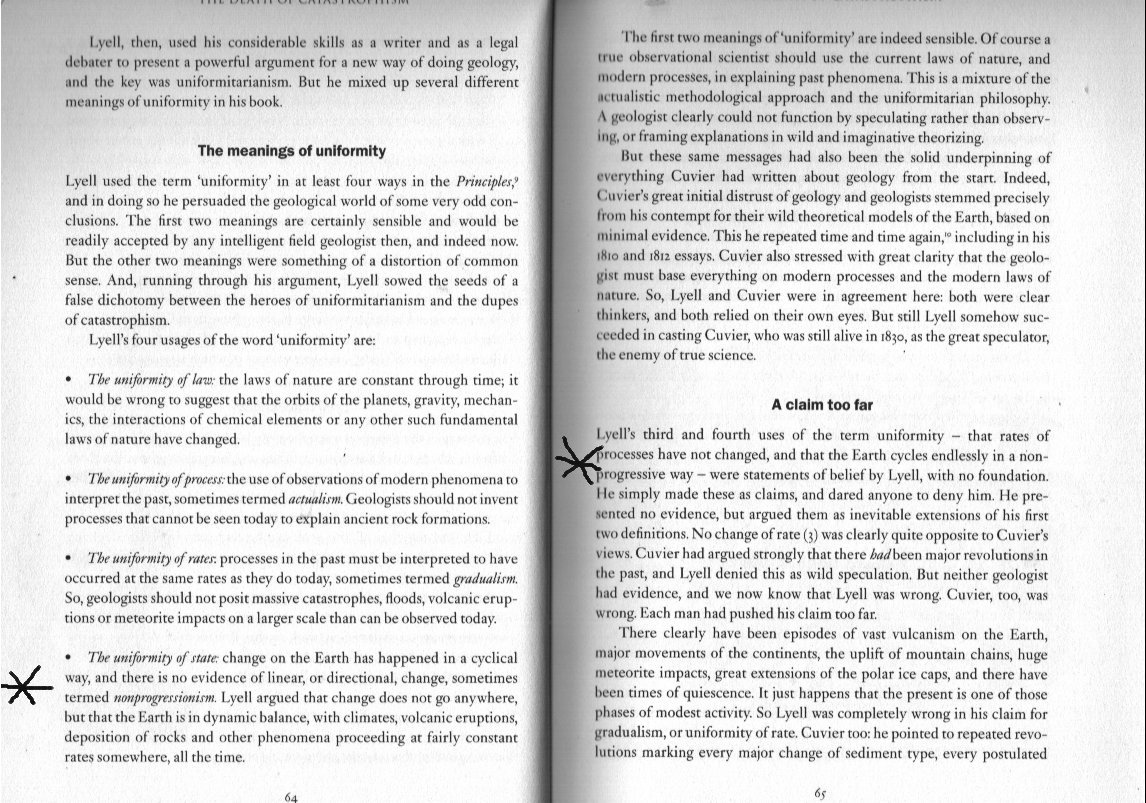
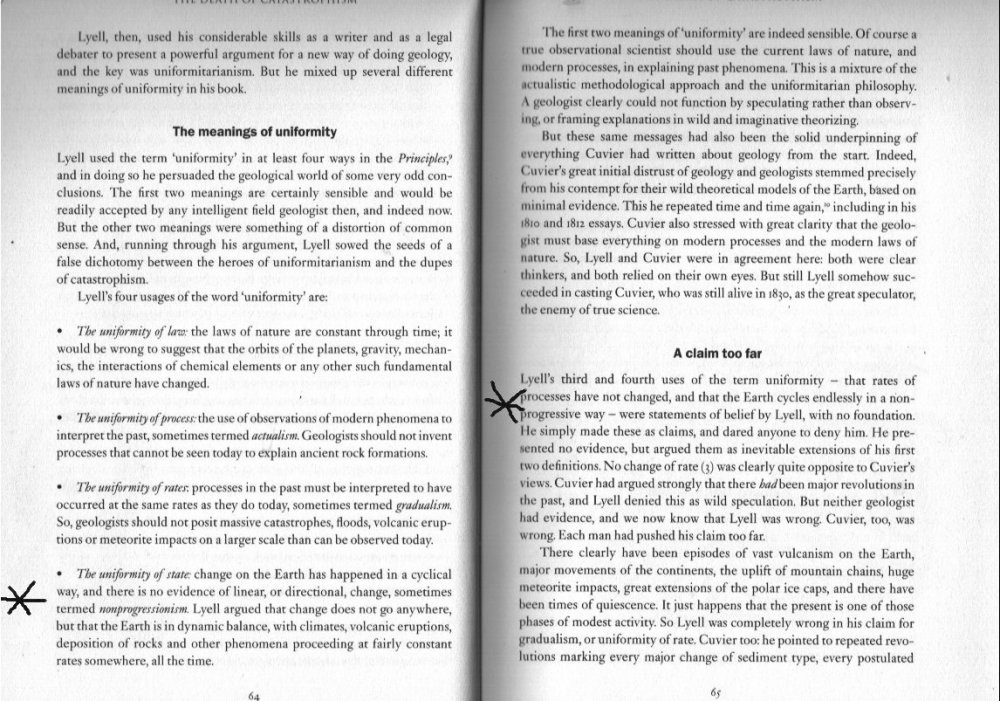
That's where asking the internet comes in useful. Asking respectable sites like Wikipedia, Nasa and the friendly folks at ScienceForums. 1 I have told you several times that Gaia is an idea that works ie is self consistent. But it just does not happen to be in effect on Earth. 2 NASA's Daisyworld states explicitily that it only addresses one single factor Your idea of balance requires a multifactorial analysis. Gaia acknowledges this and offers a multifactorial balance. However I have also noted that has also been extended by mystical and (semi) religeous groups so if you are not going to use Lovelock's original you need to make that clear. Of further interest I pointed out that the original statement is basically a restatement of Lyell's Uniformitarianism. It is worth noting that, as with Gaia, the original "uniformity" (lyell never used the word uniformitarianism) has been hijacked by later workers for their own ends so I am posting the original 4 postulates. Gaia is a transcription of postulate 4 which I have starred. Note the first two postulates are the same as those used by physicists Newton and Einstein in their theories, that both space and time are homogeneous and istropic. I'm glad you pointed this out +1 I brings out what I have been trying to say that several terms used here are subject to contextual differences of definition. Balance, cycle, feedback being the most obvious. I've been watching your comments on feedback with increasing interest, and you raise important points a) because there is an awful lot of misunderstanding mixed in amongst the loose terminology, and b) because it gets really complicated really quickly. Loosely, feedback occurs whenever a process output is fed back into the input thereby modifying the subsequent output. However, there are some major provisos here, particularly with regard to causal links. 'Feedback' cannot as of current scientific concensus refer to the transfer of anything back to an earlier point in time. It therefore is not a transfer from an output back into the input that created that output. It is a transfer from an output phase into a subsequent input phase. Some examples may help explain: I'm glad you noticed this one. also +1 So what is the popular decision ? Should we include definitions in this thread or start a new one for that purpose ?
-
I have already complimented you on introducing DaisyWorld. But please realise its limitations. Yes Albedo is a very important factor, particularly as the ice sheets grow or recede. which might lead to an acceleration of change. But it is not the only factor and rarely the controlling factor. I found the video interesting, but NASA did not offer their mathematics. From their explanation I can deduce that they are using some kind of Volterra (predator-prey) equation, which is known to have chaotic features (sudden jumps and bifurcations in its solutions) in its phase space. It also depends upon where those ice sheets are (as well as their elevation) since the available insolation energy varies with position on the Earth. A further important effect is that of energy transport , which again is greatly affected by the disposition of the land masses. And the distribution of land masses is controlled by plate tectonics. So from the very earliest to the most recent times Very different regimes of atmouspheric pressure, temperature and composition have prevailed or persisted for long periods of time. During these periods quite different land and oceanic conditions pertained in respect of disposition of land and ice over the globe. Also quite different regimes of energy transport (ocean currents and atmouspheric winds) pertained. So it is not suprising that different forms of life appeared and disappeared over time. Two things follow from this. Our own particular set of circumstances which do indeed constitute a stable state and embody several mechanisms for resisting change (Gaia) have only persisted for a total of a few tens of millions of years so it cannot be said that The Gaia State is ideal, natural, normal for the Earth (or not) We can say that it is very convenient for our form of Life. Since the earliest forms of life did not use or generate oxygen through the chemistry Agent Smith has outlined and even those later ones that did we largely wiped out by the planetary environment 250 million years ago we cannot say that evolution had proceeded in a simple linear fashion to ourselves.
-
I see you studied English and Physics at school. Did you also study History? And in the over 40 years since 1981 what have been your sources for current affairs ? So let us start with a bit of History. Anything that can be made from oil can also be made from coal and used to be made during the first half of the 20th century. Known world reserves of coal 1.1 trillion tonnes (tonne = 1000 kilogrammes) coal contains perhaps 98% carbon. (google) Known world reserves of oil 1.2 trillion barrels (a barrel has a mass of 139 kg oil contains about 92% carbon) So in carbon terms coal outweighs oil by a factor of (1.1 x 1000 x 0.98) / (1.2 x 139 x 0.92) = 7 So are we really so short of resources ? During World War 2 Germany started with no sources of oil but plenty of coal, and was always squeezed thought the war and forced to manufacture synthetic fuel as a resul. During the aparteid embargos, South Africa was in the same position. Again during WW2 oil in Britain was rationed and some farmers garnered gas from chicken manure to powere their machinery. This tradition has continued into the second half of the 20th century and beyond. A modern improvement has been the rapid growth of the anaerobic biodigestor industry, which turns waste organic material into useful gas fuel and other products. Another modern innovation is the way advanced countries (also the greatest consumers) are recyclying ever increasing percentages of oil products, particularly plastics, or phasing them out in favour of renewable materials. Talking of plastics did you know that the first ever plastic is made from milk and still used in high quality glues and artists paints? In the lubricant world two major fronts of advancement have happened. Firstly the addition of inorganic substances to improve the lubricant performance. for example 'Moly' or Molybdenum Disulphide. Secondly the design of machinery has changed dramatically, being both much lighter and thefore imposing less bearing loads, and even going so far as needing no lubrication whatsoever, for example the change from magnetic platter hard drives to solid state. So perhaps you can see that Engineers and Scientists are not as green as they are cabbage looking, the real problem being the greed of those who control the resources and are looking for profit or power