studiot
Senior Members
-
Joined
-
Last visited
Everything posted by studiot
-
Take a look a a bar of plumbers bar solder. It is easily strong enough to write with. Don't forget theat the Romans invented lead plumbing. Here is some current data, I don't have information on the roman mix, but the modern bar is only 60 - 70 % lead. https://soldersandfluxes.co.uk/product/grade-d-1-2-kg-bar-pack-of-1/ I think lead marking has more permanancy than charcoal, but as previously noted both have been used. The original question asked about pencils. The significant innovation with the pencil is the casing holding the marking material.
-
I believe the Romans used a real lead stylus. What we know as the 'pencil' ie a soft marking core housed in a wooden casing was invented sometime in the 15th or 16th century. Sometime between the Romans, say AD 500 and AD 1500 graphite displaced lead but when is uncertain. https://kitkemp.com/a-short-sharp-history-of-the-pencil/ Charcoal sticks (without casing) have been used for marking for thousands of years.
-
I think you will find that copper - tin -antimony solder is mainly for the plumbing indistry since its three main properties are that it solders well to copper and brass but has relatively low electrical conductivity and is poison (lead) free). This mixture is usually sold without incorporated flux, unlike reels of electrical solder. Does your incorporate flux? https://www.amazon.co.uk/AIM-Solder-5167-Aquasol-B0B94M73NC/dp/B0B94M73NC https://www.copper.org/environment/water/e_p_lead.html https://www.waterregsuk.co.uk/downloads/public_area/guidance/publications/general/april_2021/9-04-02-soldersfluxes-v3-1web-_apr2021_.pdf
-
I note that you have been a member longer than I have and have contributed to several threads in your science area of Biology / Chemistry, and have good knowledge of the terminology in these areas. So let me start by pointing out that is not an equation. It is (an attempt at) a mathematical statement or expression. An equation is a statement or expression containing an equals sign. Not only does it fail to be an equation, it also fails to be a proper or valid expression since the connectives (add, multiply and divide) employed are all meant to form combinations of the objects referenced (200%, 4,3 and 2). The 200% object is of a different type from the other 3 and not conformable to combination with them. Sometimes objects of dissimilar types can be combined (as with complex numbers) but generally the rule is that dissimilar objects cannot be combined. As a biologist you will be familiar with the idea of 'counts'. I cannot tell without context whether the 4, 3 and 2 are simply numbers or actually counts.
-
Have you thought about symmetry ? If I take a hexagon and rotate it 60o about its centre, what change has occurred ?
-
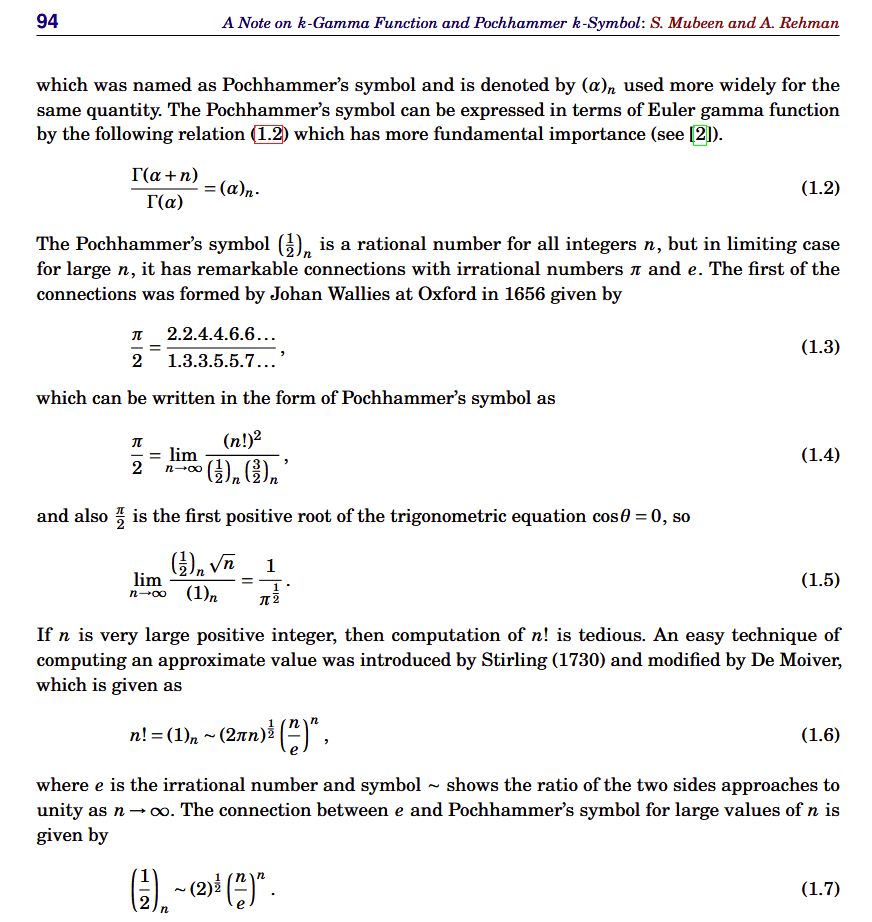
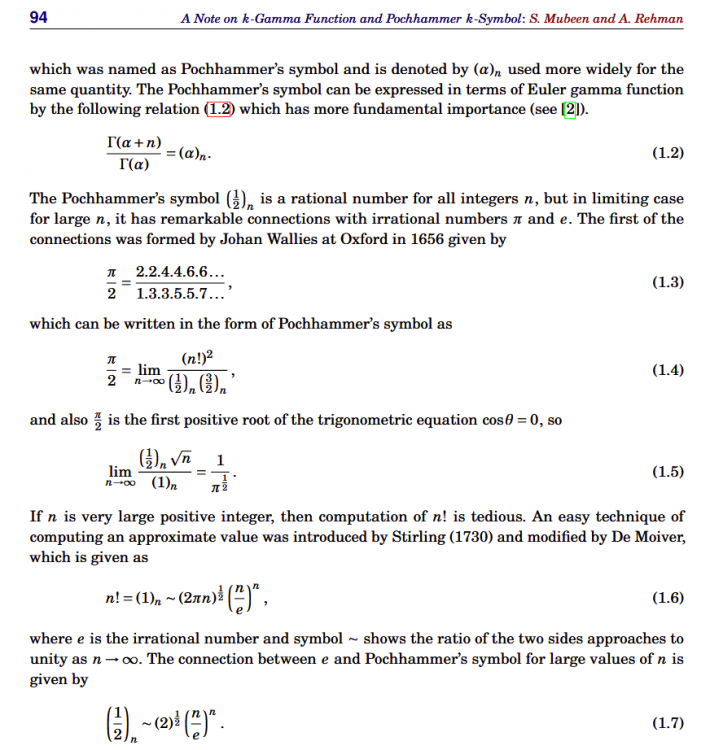
So you are saying that this new calculation is simply an application of this? from this paper https://www.google.co.uk/url?sa=t&source=web&rct=j&opi=89978449&url=https://www.rgnpublications.com/journals/index.php/jims/article/viewFile/252/229&ved=2ahUKEwjQ2fm934iHAxXgZEEAHdMYBrc4ChAWegQICBAB&usg=AOvVaw2wk5RR2G_aIiTmqkQoxzvZ In which case can we see the arithmetical / algebraic working (with proper definition of all parts) ?
-
Thank you John If the series sum is truly independent of lambda , I thought I put in a value and have a go at summing it. But I hit a stumbling block. What does the subscript (n-1) mean at the end ?

-
I really don't see the issue here. Many physical phenomena (perhaps most) have a spatial distribution so it is not suprising that something like scattering displays this characteristic, due to its statistical nature. And Pi is linked to spatial distributions both through the error function and the perfectly symmetrical ball in n dimensions. So any measurement of distribution will also include a measurement of Pi. But not this is only a measurement, not a mathematical derivation as in the Euler identity Since a perfectly spherically symmetrical distribution involves the volume, measuring the volume of an inflatable sphere is probably a much simpler way of achieving this end.
-
I'm glad to see you are taking a mathematical approach to this. One very important way we control waves is the ability to focus them. There is plenty of maths available covering this. This means that the spatial distribution of the wave is not the same in all directions. Another exploitable property of waves is resonance. Keep up the good work. +1
-
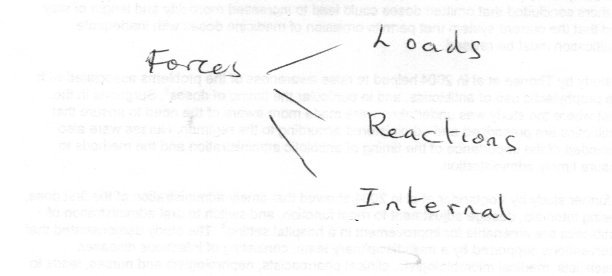
In Engineering we deal with real world objects called Bodies. Bodies can be affected by agents we call Forces according to specific rules. Individual forces cannot combine directly, but many forces can act on a single body - with the overall effect being a specific combination of the effect of each force acting individually. The same effect as all these combined forces can also be caused by a single suitably applied force called the resultant. Because both bodies and forces exist in the same geometrical universe or framework, there exists a correspondence between the geometry of the lengths and positions of the bodies and the geometry of the diagrams describing the forces. In fact one is a scale diagram of the other. For our present purposes forces acting on a by may be considered as a) Externally Imposed - These are called Loads b) Constraints on the Body by other bodies or forces - These are called Reactions c) Forces generated internally witin the body by the actions of (a) and (b) We will only need to examine (a) and (b). Rules for the actions of Forces on Bodies A force is a push or a pull All forces act only in straight lines, called their line of action. Forces cannot "turn corners" or "change direction" Interaction with a body may produce a new force in a different direction. Individual forces generally act on bodies at a single point called the point of application. A body for which the resultant of all acting forces is zero is said to be in equilibrium. A consequence of (5) is that a body with only a single non zero force acting on it cannot be in equilibrium. If a body is under the action of two forces it can only be in equilibrium if the two forces are acting along the same line. A body under the action of two or more (non zero) forces may always be brought into equilibrium by the application of an extra single force whcih is equal in magnitude but opposite in direction to the resultant of the original forces. This is callant the equilibrant. (This forms the force basis of the triangle of forces). The nature of the geometrical link between the configuration of the points of application and the directions and magnitudes of the applied forces enables a diagram called "The Polygon of Forces" to be either drawn or calculated. Scale drawing alone was once a popular method of obtainingt the Resultant/Equilibriant without calculation. The Triangle of Forces is simplest such polygon and uses three forces, two applied plus the resultant/equilibrant In the next post I will show how this is done using some simple example diagrams. I will also comment on where and why your information is correct or incorrect. I also think you are perhaps confusing the obtaining of a resultant by the triangle of forces with resolving a single force into components in specific directions, which the triangle can do for you because of the aforementioned geometric relationship. But this is a different calculation altogether.
-
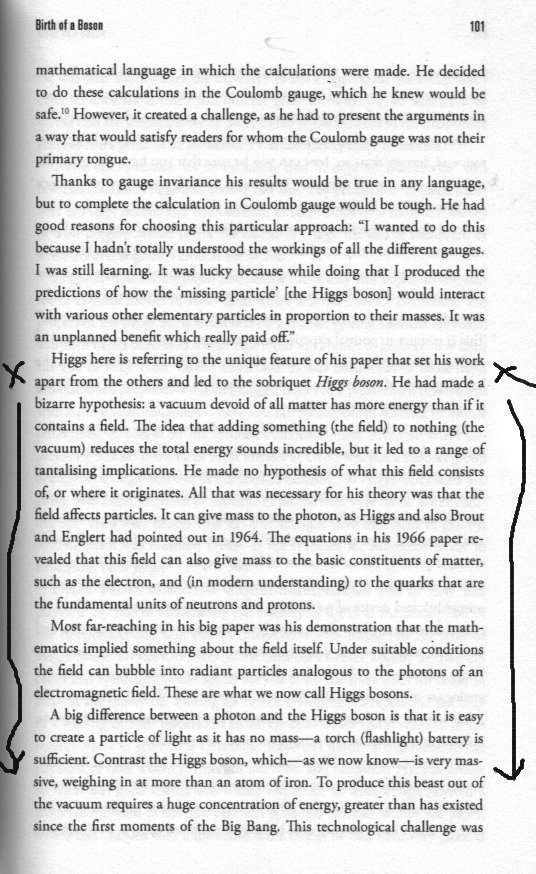
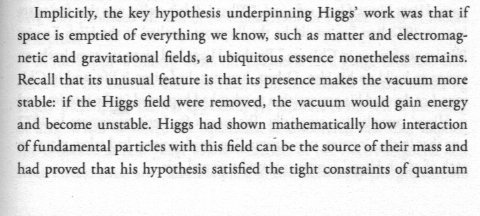
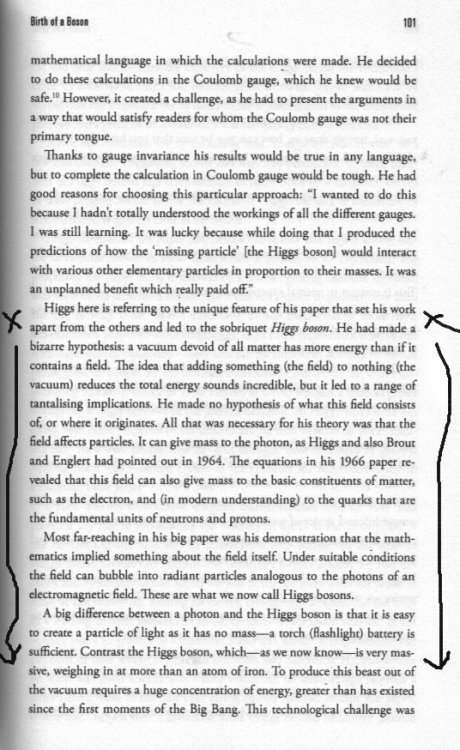
Here are two quotes from the book I recently mentioned in the book talk section that aptly illustrate how readily Frank Close gets to the nub if the matter.
-
Oh! You may be about half right. Unfortunately this includes some serious misconceptions which could lead you far astray if this not not a one off. What a pity you didn't want to discuss the problem from start to finish. A good place to start would be to answer the one simple question I asked, or ask for more information about it.
-
Forgive me for knowing what i am talking about. You posted Applied Mathematics in the Analysis and Calculus subforum where it is certainly misplaced, but i thought it a small point, easily rectifyable. Perhaps @swansont would be kind enough to move it to Applied Maths where it truly belongs. So what is the triangle if it is not part of the physical world? This is just incorrectly imagined nonsense, as written above. It certainly has little or nothing to do with the 'triangle of forces'
-
Thank you for your reply. I am still not clear what is going on here and therefore what your actual question is. Can you (scan/photograph) and post the passage from the book as printed please. You need to be aware that there are (always) two triangles involved. There is the real world-object triangle which defines the geometry of the situation, both in terms of distances / positions and angles. And there is a purely theoretical abstact triangle others have referred to as a vector triangle. This second triangle is similar to, but not congruent with, the real world triangle. Two triangles are said to be 'similar' if they have the same angles, but not generally the same side lengths. Triangles which have both the same angles and the side lengths are said to be congruent. I am guessing that mixing up these two different triangles is the source of your difficulty, but I can't be sure without sight of the original.
-
Some Professors are noted for the wide understanding of their subject and how it all fits together and combine this with the ability to present an understandable and coherent picture. This ability picks out important insights. Firstly the 2022 book 'Elusive' by Frank Close, Professor of theoretical physics at London University offers a remarkably clear account of 'Higgs Theory' and its connection to Quantum Theory, Relativity, and particle physics, in plain English in the body of the text and in Mathematics in the appendices. Secondly the 2012 book '17 Equations that changed the World', Professor of Applied Maths at Warwick University is equally worth reading, especially the penultimate chapter on the 'Black-Scholes Equation' , which should be read by anyone who thinks they know anything at all about Economics. A real eye opener. The two books have one mathematical caveat in common. 'Consider the conditions of applicability of this theory, before use!'
-
Yes I think you may be missing something. Is your triangle a real object like a triangular shelf bracket, say a length of strip metal bent into a triangular shape ?
-
My apologies make that 14 seconds of arc
-
OK this (payfor) tutor site works through a question from Kreysig Functional Analysis and its applications https://www.chegg.com/homework-help/questions-and-answers/kreyszig-introductory-functional-analysis-applications-chapter-5-applications-banach-fixed-q34808855#question-transcript At the moment my copy of Kreysig is buried, I should be able to retrieve it tomorrow but this is the picture I was looking for 912 × 996 I don't know what you maths background is or if you are seeking the underlying pure math or the (very widespread) applications ?
-
It doesn't 'explain the equation'. You supply an equation, the theorem applies in one way or another to all equations. I will look out a picture that makes this clearer. Can't seem to find the best one on big G.
-
If you ever return to discuss your proposal I take your point "So far I have heard replies suggesting that I try something else" To deal with this enquiry, please note that this is not a new method of demonstrating (and measuring) the curvature. The Romans knew about it, as did they about the difference between using a water level and a line of sight. So let us fast forward to modern times when this difference was not appreciated, causing major disruption to a giant construction project I havd direct experience of. Over your distance of 1 km the a level line is approximately 79mm below straight sight line. however sight lines, including lasers, are not perfectly straight and refraction causes the line to dip below the straight by about 12mm over 1 km This has the combined effect of reducing the difference between a level line and a sightline to about 67mm. Another way to look at it would be to note that you would have to depress your laser sight line by nearly 2 seconds of arc to align on the level spot 1km away If you have the interest we can discuss this further.
-
The theory of this is given by the Banach fixed point theorem otherwise known as the contraction mapping theorem. https://web.stanford.edu/class/math51h/contraction.pdf https://en.wikipedia.org/wiki/Banach_fixed-point_theorem This gives the range on input values for which the process will converge to the desired solution and the conditions for convergence. The trick with iterative solutions is to arrange or transform the equation into a form that converges over the desired range.
-
First I am going to say +1, for actually answering another member. First time that I can remember. Then I am going to say that light reflected off snow can lead to a conditions we call snow blindness. This is not permanent , means that your eye have been looking at a patternless reflection for too long. They will recover after closing them or looking away at something more normal for a while. Photokeratitis (Ultraviolet [UV] burn, Arc eye, Snow Blindness) - College of Optometrists (college-optometrists.org)
-
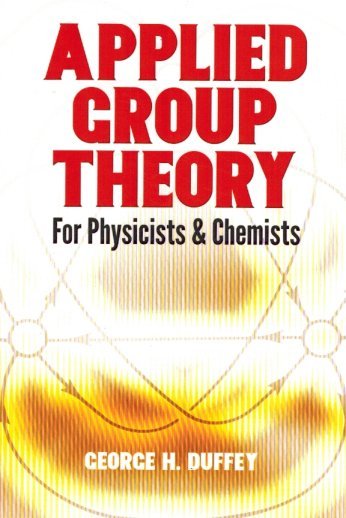
1) There is no difference. Groups are sets with a suitable associative binary operation. Some groups have additional structure, eg abelian groups, which have a commutativity requirement. Non commutativity is very important in QM and leads to the uncertainty principle. Try this postgrad book. 2) Hopf algebras also explot non commutativity. https://www.theoremoftheday.org/MathsStudyGroup/SeligHopf.pdf
-
Hey folks it after christmas/newyear so I've gotta give this refreshing bit of 2024 sanity a thumbs up. +1
-
Anything like this ? can you catch a screenshot of your own ?