studiot
Senior Members
-
Joined
-
Last visited
Everything posted by studiot
-
I keep telling you that the only way to correctly and accurately analyse such problems is to use measured properties or parameters. Those analysts with suffieient experience may be able to guess or estimate suitable values for at least some of the variables. Consider this simple question I have a length of rope specified at 100kg breaking stength. What force is rquired to break it ? In other words if I hang it up and add weights to the bottom what weight will I require to break it ?
-
I never said it does, nor does millman's theorem. Forget the ground. The circuit analysis must also describe the situation where there is no ground.
-
What is very clear is that you have not understood it. What I can't understand is why you would wish to argue rather than expand your knowledge and understanding. Firstly I haven't assumed anything (except linear circuit theory. Non linear theory gets exceedingly hairy) Secondly you haven't understood the most basic property of all real world voltage sources. I have already been through this. It is impossible to specify the output of a real world voltage source without reference to the load current, which is something you are trying to do. Thirdly U1 and U2 cannot be anything but equal since they are connected across the same pair of circuit terminals.
-
It's probably called the ~Dark Web because there is no electric voltage coming from the ground. So there are no electric lights in the Dark Web. Forget it. This suggests to me that you still don't appreciate the nature of electrical quantities. Since you haven't answered my comments. Further I still have no idea what level to pitch the next bit at. At the end of this discussion I was going to point you at Millman's theorem (also known as the parallel generator theorem). This represents the general case and was developed for three phase elctrical supply where the three phases are often connected to a single load in what is known as a star connection. So help me to help you here
-
Well I for one don't accept that premise. What 'laws' do you think are different at these scales ? So you chose not to answer my question.
-
The most important lesson any student can learn is Read the question and answer it, not some other question that was not asked. Added to this in a wider context for life is RTFM - Read the frigging manual. So did you read the rules for the forum you have posted in ? I gave you a hint in the form of a question. - since we may not do your homework for you But you ignored it and argued instead, like a smart alec. Here is another comment/hint. There is no requirement for 0 or 9 to appear in every set of numbers or digits. If you still don't understand - ask.
-
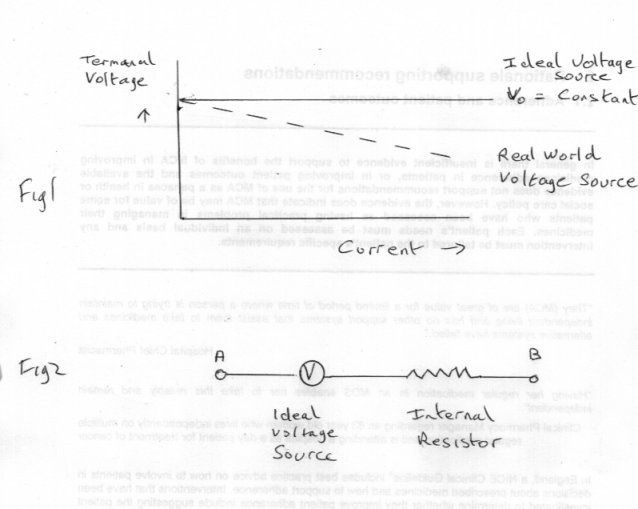
This looks really promising, you have some idea about voltage sources. +1 Electrical engineering is an intensely practical subject. It is very fortunate that we are able to model the behaviour of electrical systems by carefully defining a few ideal or perfect components or elements. But we should always keep in mind that there are no such things as ideal or perfect elements in the real world. Note this is true in other disciplines as well as electrical enginering. When we measure the performance of real world voltage sources we find the graph in fig1 applies without exception whether we are talking about alternating or direct, pulsed or steady and whatever their source of EMF (electromotive force). So it applies to generators, dynamos, batteries thermogenerators etc. Looking at fig1 we see that the ideal voltage source output remains constant, whatever the current draw. But the output of the real world voltage source fall proportionately with increasing current from a maximum at zero current. So we construct a model of a real world voltage source by combining an ideal voltage source with an ideal resistor in series, as shown in fig2. The ouput of this real source appears between terminals A and B and is called the terminal voltage. In the next post or two I will go on to show how to use this extra information to determine the effect of combining two batteries of different voltages and capacities across the same load. We can also discuss conservation laws in the light of this new information. The situation there is somewhat more complicated than a simple answer. You will need to be clear upon the difference between an EMF and a Potential Difference (pd) and also the difference between voltage and current. There are circuits which are called voltage to current converters, but they are not rectifiers and act quite differently from what we are talking about.
-
See my answer to your other question then come back for more help if you still can't answer it yourself.
-
Zero is an even digit. Ask yourself what is a the difference between a digit and a (whole) number ? What is your definition of an even number ? A side note other numbers and digits are either positive or negative. Zero alone is neither (or both) So don't mix up sign and even/odd.
-
Well I for one don't accept that premise. What 'laws' do you think are different at these scales ?
-
Of course there is overall conservation of energy, so I don't know what you mean, or why you are speaking of energy, conservation or otherwise. But more to the point neither I nor anone else can understand you so called diagrams. You have been asked by others to clarify these and write them properly. I have asked you to clarify your wording since it suggests you don't know or understand enough electrical theory to pose the questions properly. What do you know about voltage sources and internal resistance ?
-
Not doe I trust politicians. Does anybody ? But your response to my suggestions was disappointing. Plants need carbon dioxide and they first appeared (in the oceans) about 1 billion years ago. Without atmouspheric carbon dioxide there would be no plants and therfore no us. The fossil record shows plants back to at least this age ago. So ther must have been atmouspheric carbon dioxide to at least that time. That is an example of non mathematical scientific reasoning that you need to employ to get a starting grip on your enquiry. Polictical reasoning (is there such a thing ?) is irrelevant.
-
How much hydrogen ? 5 molecules or 5 x 10²³ molecules ? The problem is one of energy density, not of energy per se. If you have enough gas (eg a big enough star) The probability of a local collision achieving the necessary energy density is sufficient to iginite the process. As the volume gets smaller the probability drops so you have to wait longer, maybe longer than the age of the universe. So you supply some energy (not necessarily heat) to increase that probability to an acceptable level. But you then run into the second and bigger problem. Containment. Gravity does this in a star. But if you use a solid container the temperatures are so high that the walls would vapourise. One alternative is to use the electromagnetic force instead of gravity. Up to recently most efforts have been directed this way. Another alternative is to use the fusing material itself and use kinetic or laser energy to create a collision somewhere within the body of the target material. This is now being tried more often. But the problem with this then becomes keeping the reaction going until it can become self sustaining. So the amount of energy required depends upon exactly what you are trying to do.
-
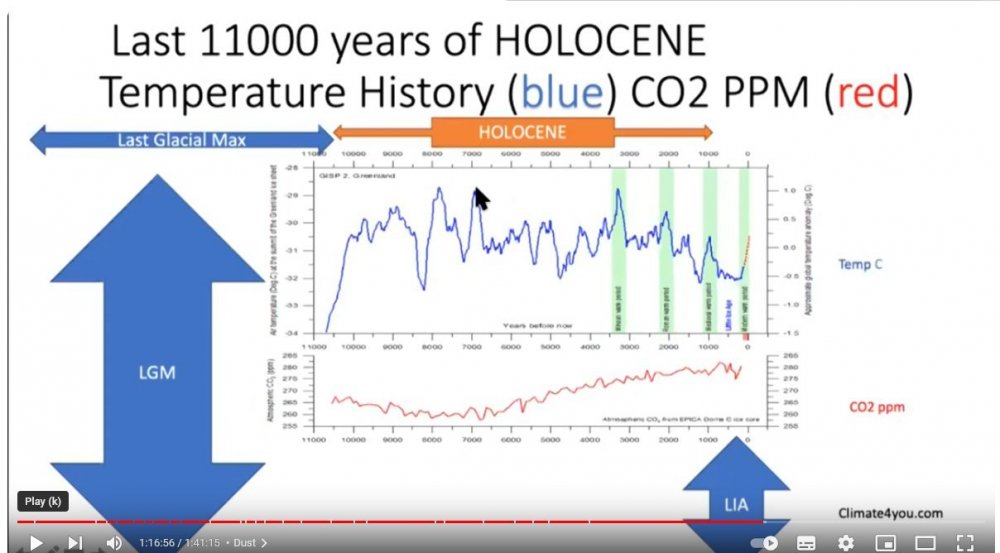
If you really want to study this, The subject is called paleoclimatology. Here is a graph of the C02 levels compared with temperature levels over the last 10,000 years. You can see the timestamp from the video lecture by Roger Palmer. The whole video is the first in a series and is 1 hour and forty minutes long. However it is really excellent and I heartily recommend it. If however you would prefer a book, The Emerald Planet by David Beerling provides a different perspective. Good luck but it is up to you to do some work to get up to speed on what scientists have found out and how they found it. Data comes from ice cores, tree samples, rock analysis, deep sea sediments.

-
gosh I never heard this before. Thanks. +1 And there was I ready to argue that hydrogen can also be considered a metal !
-
Luckily for me I don't know that one, but probably. Do tell
-
Indeed so. But the OP has chosen to pour scorn on my explanations and the engineering community in general and gone searching the dark web for free electricity. Yes I have already said I would expect a much lower yield when operating at low voltage. When i was first at University it was all the rage to contruct one's own HI Fi amplifier. This endeavour demonstrates two separate effects mentioned. Firstly the dreaded 'earth loop' reducing the output from HIFi to unlistenable. Secondly in the detailed layout of the amps the requirement that the low power input signals did not use the same supply return path as the signals in the high power output stages, leading to significant signal quality degradation as the supply zero shifted up an down with the heavy currents.
-
If you are an occupier of land that is crossed by the higher voltage power grid you can physically obtain a'free' supply of electricity by running a cable in or on the ground beneath a phase wire. Doing this with the standard mains supply will not yield much power. Of course this quibble comes from thinking that grid engineers are fools.
-
A word of warning. I am not happly with the author's use of the word 'delamination', although I will accept it is better than the geologist's standard use of the word. I do wish experts in one discipline would refrain from pinching a word already well established in other disciplines and redefining it.
-
Really ? https://www.123elec.com/equipement_mise_a_la_terre I think masse means bulk or lump of or body of. I think I understand the process being referred to and it is illegal in most, if not all, countries. Every year in the UK a handful of farmers think they can get away with it and are prosecuted. It certainly does work, but as you say the energy comes from the supply, not from the ground, although the ground is involved in the theft.
-
Here is a long discussion, from 2009, started by someone else who wanted to either not do the work or hide the fact that he could not do it. It started off with parallel ac generators and ended with parallel DC batteries. https://forum.allaboutcircuits.com/threads/two-pm-alternators-in-parallel-query.17892/page-4 I'm sure we have had this same question here at SF since 2009, but I haven't been able to find it at the moment.
-
Excellent advice. +1
-
I can understand the question you have asked, but I don't know where to start with an answer to a standard electrical engineering problem, faced and solved every day all over the world. That is because your diagram is flawed. How can we proceed since I don't know your level of electrical circuit knowledge? But this shows a misunderstanding of rectification.
-
What you have said is pointless. If you want help say so and cooperate with others. Otherwise please stop wasting their time.
-
You were asked what your diagram meant. What you have drawn is meaningless. If you want help say so and cooperate with others. Otherwise please stop wasting their time.