toucana
Senior Members
-
Joined
-
Last visited
Everything posted by toucana
-
The Taiwanese government has said itself within the last week that they do not have adequate resources to defend their island against an attack by mainland China, nor could they withstand a blockade for very long - as documented in this report by Helen Ann-Smith for Sky News on 21 September. https://news.sky.com/story/taiwan-does-not-yet-have-sufficient-arms-to-defend-itself-vp-tells-sky-news-13590292 In this report (@14:30) she interviews the CEO of one of the principal Taiwanese manufacturers of sea-borne drones who says that their company’s production is being stifled by a political impasse over defence spending, and he also warns that Taiwan’s stock of conventional weapons would be fully depleted within two weeks if the PRC attacked Taiwan. A critical package of $14 billion worth of arm sales to Taiwan was placed in abeyance by the USA following meetings between President Trump and Chinese leader Xi jinping in May this year, and remains in limbo. Meanwhile Taiwan’s principal opposition political party recently blocked, then cut in-half President Lai Ching Te’s $40 billion 8-year defence program budget - and they specifically stripped out the budget allocations for Taiwan’s planned indigenous drone and missile defence programs. Taiwan imports 97% of its energy and, and has a food self-sufficiency rate of just 35%. A blockade would create immediate resource starvation, and many defence analysts believe that targeted Chinese cyber and precision missile strikes could completely paralyse Taiwan's power grids, communications, and transport infrastructure within 72 to 96 hours.
-
As China’s leader Xi Jinping concludes his state visit to the USA this week, attention will now turn in security circles to the vexed question of whether China might launch an attack on Taiwan, and if so how soon ? For a number of years American military strategists have been concerned about something known as the “Davidson Window”. About four years ago Admiral Phil Davidson the former commander of the US Indo-Pacific Command told Congress that China could be ready and willing to take control of Taiwan by 2027 https://www.globalguardian.com/global-digest/will-china-invade-taiwan This year is seen as a milestone of special significance to mainland China because it will mark the 100th anniversary of the founding of the PLA (Peoples Liberation Army) i.e. the Chinese Red Army which defeated the Kuomintang forces in 1949 and established the PRC on 1 October 1949. The Communist Chinese have never accepted the suggestion that Taiwan is anything other than an integral part of mainland China, and they have long memories and almost infinite patience too. There is a famous (but apocryphal) story that back in 1970 Mao Zedong was asked about the impact of the French Revolution and replied that it was “Too early to say”. The story arose from a translation error in a question to Zhou Enlai about the 1968 student riots in Paris rather than the French Revolution of 1789, but it is a good one, and quite telling. https://www.markpack.org.uk/38813/zhou-enlai-mao-tse-tung-impact-of-french-revolution/ The military calculus is quite simple. If China wishes to invade Taiwan, then it would most likely do so in the months of either April or October, because these offer the optimal weather condtions and calmer sea states required to launch a major amphibious naval operation across the 100 mile Taiwan Strait. As Kublai Khan the leader of the Mongol Yuan dynasty of China found out in both 1274 and 1281, it is an exceptionally bad idea to launch a major naval invasion fleet during the Monsoon seasons in the East China Sea. Both attempts by the Mongols to invade Japan ended in catastrophe when the entire invasion fleet was destroyed by typhoons which the Japanese christened Kamikaze ( 神風 - ‘Divine Wind’). The political calculus is more complex. One hidden factor is a perception that the USA may well achieve “Semiconductor Sovereignty” by 2030 meaning it would no longer be dependent on the world-leading technology skills of TSMC (Taiwan Semiconductor Manufacturing Company) - a potentially critical factor in the ongoing race between America and China to develop and weaponise AI systems of warfare. The other key political factor from a Chinese point of view is their perception of the USA’s current level of military distraction, and their general state of readiness and ability to respond to major military developments around the world. The answers to these questions at present could hardly be more ominous. Xi Jinping will have seen for himself that the USA is being led by an infirm and cognitively impaired 80 year-old president who is mainly concerned with vanity projects such as building ballrooms and triumphal arches. Chinese military analysts are well aware that the ongoing war with Iran has left the USA military establishment with critical shortages of high-tech weapon systems, and that the loss of military bases and logistics facilities in the middle-east and elsewhere has stretched its ability to project US naval power around the world to the breaking point. The ongoing purges of high level military leadership carried out by the alcoholic charlatan currently in charge of the Pentagon represent another ongoing catastrophe which won’t have escaped the attention of Chinese observers either. If the Chinese did decide to make a move on Taiwan in the near future, then its first manifestation will most likely be the announcement of a maritime blockade and a quarantine of the island.
-
You might wish to delve into a book called ‘The Soul of The White Ant’ by Eugène Marais (1871-1936) which was first published in English back in 1937 - a year after his death. https://en.wikipedia.org/wiki/Eugène_Marais Eugène Marais was a pioneering Afrikaans naturalist and ethologist who studied and wrote about both primate behaviour and colonies of termites in particular. Within his own lifetime he was probably better known to many fellow South Africans as one of the most popular and widely read poets and short-story writers in Afrikaans. In his book ‘The Soul of The White Ant’ Marais formulates a theory that the termite nest is similar in every respect to the organism of an animal. He observed that the workers and soldiers resemble red and white blood cells, while the fungus gardens are the digestive organ. The queen functions as the brain, controlling the collective mind, and the sexual flight of the kings and queens is similar in every aspect to the escape of spermatozoa and ova.
-
The ideas you refer to partly echo those found in a family of dissident religious traditions colllectively known as Gnosticism which were found in the territories of the early Christian churches but which were extensively suppressed after 367 AD when much of their literature was destroyed after being condemned by church authorities as heretical. A final manifestation of Gnostic teaching took place in southern France, in the Provence area, where a large religious movement known variously as the Cathars (pure ones), ‘The Albigenses’, or ‘The Good Men of Lyons’ obtained a considerable following from 1103 AD onwards, before the movement was brutally suppressed by the Catholic church in a series of military campaigns known as the ’Albigensian Crusades’. These culminated in the destruction of the last great Cathar fortress at Montesgur in 1244 AD, when 225 male and female Cathar ‘Perfecti’ who had surrendered to the Catholic armies were seized and burned alive after refusing to renounce their beliefs. Many Gnostic systems believed in a dual creation. Simply put, they believed that the world in which we live was not created by the original creator God of the universe but by a lesser deity or 'demiurge'. This lesser corporeal world they held to be an inferior and defective creation which had been used to entrap higher spirits from the realms of light into a miserable and mortal existence within the gross world of matter. It was a tenet of Gnosticism that human beings had forgotten who they really were, where they had come from and what they could aspire to be. Salvation from an endless cycle of incarnation within the material world was provided by Gnosis (γνωσις), the transmission of true knowledge of our real situation which provided the means to escape from the mundane world and return to the realms of light. Some modern religious thinkers refer to this concept of the material world as the “Soul Trap”. One account of this Cathar world view was preserved by a clerk of the Holy Inquisition which had investigated them in some detail: "They teach that this world will never come to an end, that the Last Judgment has already been made, and will not be made again, and that hell, eternal fire and eternal punishment are in this world and nowhere else." - (Raineir Sacchoni - 1250)
-
bioRxiv preprint article: https://www.biorxiv.org/content/10.64898/2026.09.17.752363v1
-
-
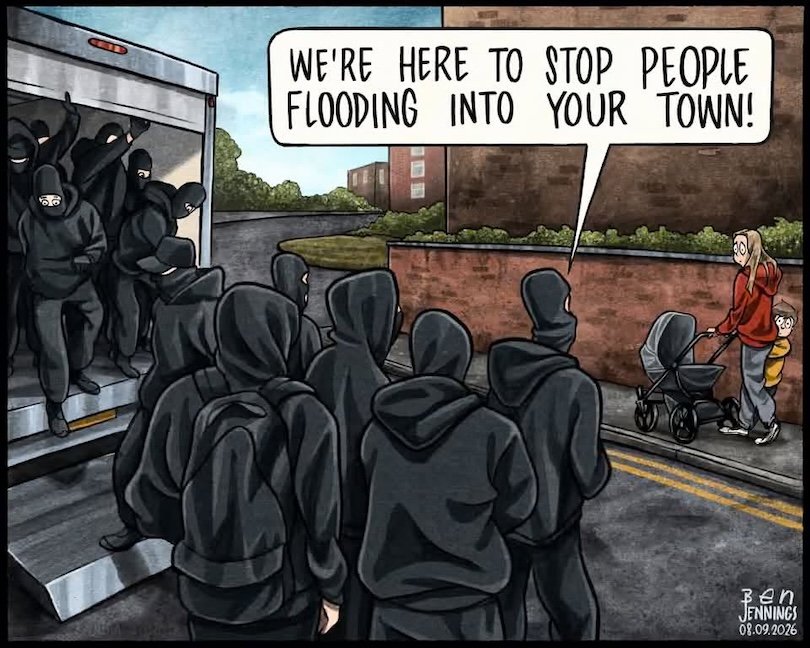
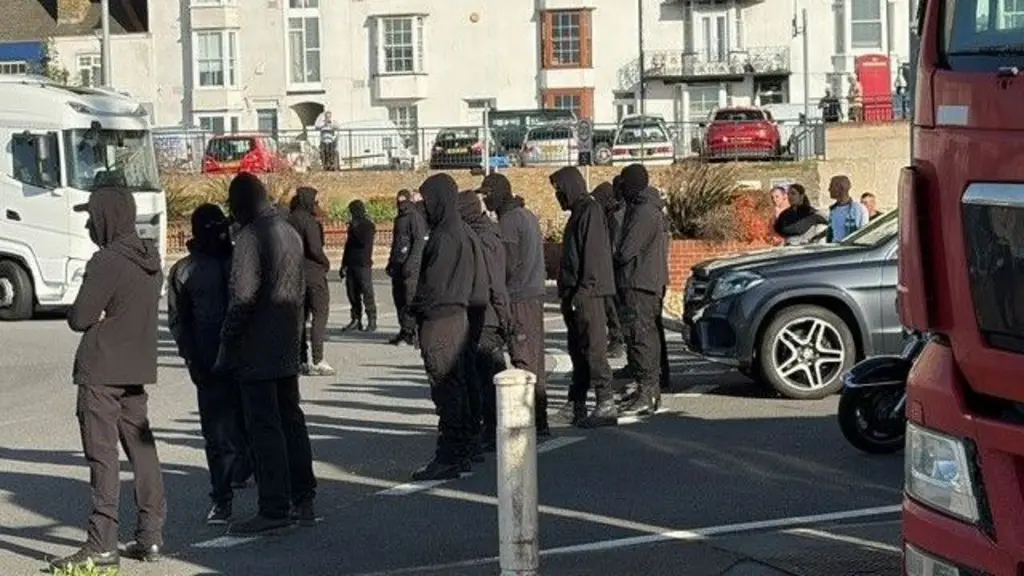
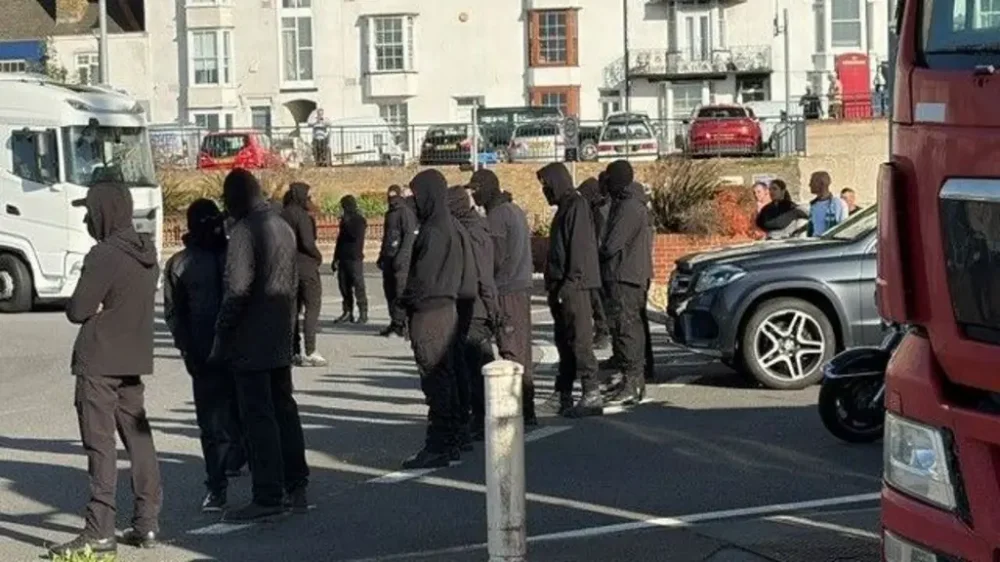
Cos-play anti-immigrant Fascists blocking roads near Dover this morning to coincide with the final day of the Reform Party conference up in Birmingham. https://www.bbc.co.uk/news/live/cmwyzxlzxpzgt The usual suspects and hold-overs from the EDL, BNP and NF. As a number of other people have pointed out - given how virulently islamaphobic these groups are, it’s rather funny they seem to be so oddly fond of wearing veils.
-
With apocalyptically awful timing, Reform is currently holding its annual party conference at the Birmingham NEC, and Nigel Farage went on stage today with a Trumpian speech of such monumental stupidity that it is hard to see any viable political way forward for either him, or his cod-fascist cosplay ‘party’. https://www.bbc.co.uk/news/articles/clyeq5jvd2po This type of political power-play is no longer working particularly well even in Trump’s MAGA dominated Washington DC. For a tawdry and peripheral political figure like Nigel Farage who reminds many UK voters of a beery frog-faced, fag-smoking spiv from the 1940s, it is an overplay of epic and delusional dimensions. Not so much cooked as stuffed.
-
On Tuesday 25 August, John Ratcliffe the Director of the CIA flew to Moscow in a large C-17 Globemaster III American military plane for an in-person meeting with his opposite numbers in the Russian FSB. He left the same day, apparently earlier than expected, without meeting the Russian leader Vladimir Putin. US and Russian government sources have both declined to comment on the reasons for this unscheduled visit, and were reluctant to confirm that it had even taken place https://www.theguardian.com/us-news/2026/aug/25/cia-director-john-ratcliffe-moscow-russia A lightning personal visit of this type to Russia by a Director of the CIA is a very rare event. The last time it happened was in late November 2021 when CIA Director William Burns unexpectedly flew to Moscow in an attempt to discourage Putin from invading Ukraine. US intelligence analysts had detected unmistakeable signs that Russia was about to attack, and the CIA Director was sent to tell Putin that there would be serious consequences if he did so. Russa ignored the warning and invaded Ukraine anyway on 24 February 2022. There is much speculation as to what was discussed at Tuesday’s meeting. Putin is said to have signed three new undisclosed decrees on Monday. One of them is believed to relate to a new large-scale mobilisation of Russian military forces. Another is thought to authorise the Russian government to seize control of key elements of their national infrastructure which are being degraded by Ukrainean drone and missile attacks. The final one is said to define new battlefield objectives for Russian military leaders within the coming year. https://www.youtube.com/watch?v=PnMxpQb5gbo It is unclear whether the CIA Director was warning Russia not to ramp up their recent wave of hybrid sabotage and cyber attacks against western European countries, or whether there are real fears that Russia might launch a conventional attack against Baltic state border countries who are NATO members - which would trigger an Article 5 response. Other items on the agenda might have included American concerns over the growing involvement of North Korean forces in the Ukraine conflict, or their annoyance with Russia’s ongoing defiance of international trade sanctions on Iran. One thing seems clear however. The Director of the CIA was probably sent to deliver an ultimatum or warning of some description, and was apparently given very short shrift.
-
Guanyin (Chinese: 觀音) has an interesting history in Chinese Mahayana Buddhism. From around the end of the Chinese Sung dynasty in the 12th century AD, this Bodhisattva was represented exclusively as a female figure associated with compassion, and most particularly with the needs of women. https://en.wikipedia.org/wiki/Guanyin The Chinese name Guanyin 觀音 means “Hearer of Prayers” - female ones in particular - and this was how this particular Bodhisattva came to be represented in Chinese Buddhist iconography and sculpture - as a female figure. But that was not quite how this Bodhisattva originally arrived in China. Guanyin was originally part of a dyadic Bodhisattva known in Sanskrit as Avalokiteśvara whose following in China was associated with the second-wave arrival of esoteric Tantric Buddhism known as Vajrayana Buddhism during the Chinese Tang dynasty (618 - 907 AD). In the Tantric Buddhist tradition, Bodhisattvas were often represented as binary sexual pairs, male and female combined in one entity. But for some curious reason the male half of this dyad fell into disuse, along with the male name Avalaokiteśvara, leaving only the female half Guanyin in devotional use from the Sung and Yuan dynasties onwards.
-
Ars Technica ran a story the other day about how 404 Media connected with a bookseller who agreed to plant an Airtag in a rare book that was part of a bulk order. Ars TechnicaHidden Airtag reveals Amazon is trashing rare books to tr...Amazon’s team uses a T. rex preparing to devour a book as its logo.That Airtag was then tracked to an Amazon AI training facility in Las Vegas that housed a team focused on tearing books from their spines and scanning pages, 404 Media reported. Apparently tone-deaf to the escalating backlash over destructive book scanning, a logo on the door of that team’s warehouse, VGT3, showed a Tyrannosaurus rex preparing to devour a book, 404 Media documented. Amazon have declined to comment beyond stating : “Amazon purchases books through commercial channels to help develop and improve the products and services our customers use,”
-
David Bowie appeared in some 30 feature films which included major acting roles in: “The Man Who Fell To Earth” (d. Nicolas Roeg 1976) “The Hunger” (d. Tony Scott 1983) “Merry Christmas Mr. Lawrence” (d. Nagisa Oshima 1983) “Absolute Beginners” (d. Julien Temple 1986) “Labyrinth” (d. Jim Henson 1986) “The Last Temptation of Christ” (d. Martin Scorsese 1988) He also played memorable cameo roles in numerous other films including: “Twin Peaks: Fire Walk With Me” (d. David Lynch 1992) —> as agent Philip Jeffries “Basquiat” (d. Julian Schnabel 1996) —> as Andy Warhol “Prestige” (d. Christopher Nolan 2006) —> as Nicolas Tesla As well as voicing characters in a video game “Omikron: The Naked Soul” (1999), and in Luc Besson’s animated film “Arthur and The Invisibles” (2006) amongst others. https://en.wikipedia.org/wiki/David_Bowie_filmography
-
This adds a whole new meaning to the phrase - "He died with his boots on !" - (p.s. nice to have the forums back again).
-
The Japanese study involved taxi firms located all over Japan from Fukuoka on Kyushu, to Sapporo in Hokkaido, and also included firms from the capital Tokyo, as well as Takamatsu and Shizuoka on Honshu - all major islands of the Japanese achipelago with a combined population of some 122.4 million people as of 2026. The other study cited was in New York City which is a massive conurbation with a population of 8.58 million people, the largest city in the United States - hardly regionally specific samples or aberrations.

-
There has been some discussion as to whether taxi drivers keep their wits about them, drive more carefully in general, and are less likely to be involved in road traffic accidents than drivers of private cars. https://www.helpinginjured.com/blog/ridesharing/do-rules-for-taxis-reduce-accidents/ A counter argument is that taxi drivers spend a great deal more time on high-traffic urban roads, so their total annual number of collisions can be higher, and the consequences of a collision can be more serious because cab drivers and their passengers often fail to wear seatbelts on short urban rides. Fatigue caused by long hours of work can also offset the greater driving experience of professional cabbies. Another study in Japan analysed traffic accident statistics and data recorders fitted to cabs from eight different professional taxi firms across the whole of Japan. https://hal.science/hal-05424169v1/file/Tu-B1-3_594298_FASTzero25_Final_Paper_Aga.pdf The conclusions indicate that professional taxi drivers who have held a licence for over 10 years were the least likely to cause an accident. The DR (data recorder) stats suggest that taxi drivers generally drove at safer speeds and braked almost instantly and more effectively within a TTC (time to collision) window when crossing vehicles appeared in their view. The study concluded that they were more observant, and more likely to be following defensive and predictive driving protocols.
-
An even more spectacular example of structural failure during a routine load test happened on Friday 16 October 1970 when two spans of the famous Victorian pier at nearby Clevedon collapsed during a water ballast test. Clevedon Pier wasn’t fully restored and reopened until 1998 - almost 30 years after that ill-fated ‘safety test’.
-
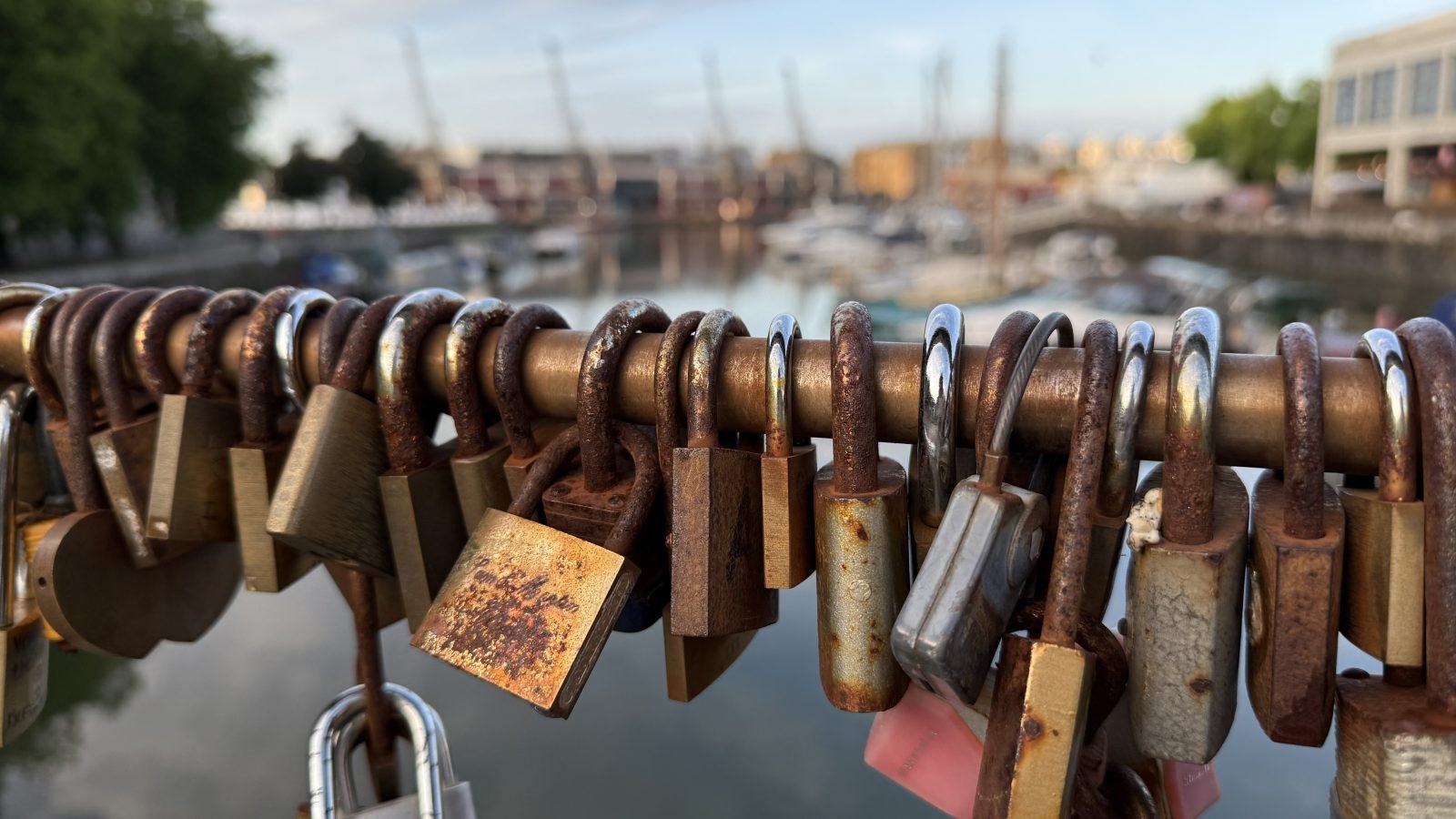
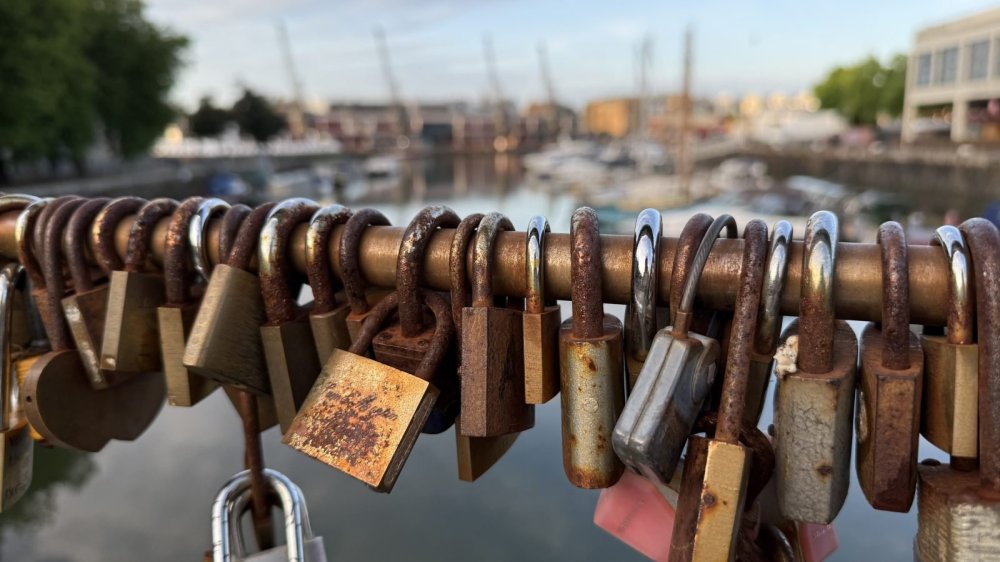
It hadn’t been lifted for almost a decade, partly because of the barnacle-like encrustation of nearly 3 tonnes of old padlocks attached to the superstructure over the years by love-sick romantics. No one felt like attempting to operate the bascule until these ‘Lovelocks’ had been removed. I used to work down at the harbour and can remember standing on the quayside watching while Pero’s Bridge was first being tested by Ove Arup who were the original consulting engineers. That single hydraulic ram always seemed distinctly inadequate for the task and the imposed load. Even when it was brand new, the mechanism was straining, and there was a visible lateral jitter as the bascule section came back down to rest. There have been numerous comments in the local press about quite what went wrong. Apparently the engineer ignored a suggestion that they should use a crane to do an initial lifting test. Other people have suggested that the heatwave temperatures may have caused some expansion problems - some even blamed the solar eclipse which took place later the same day !
-
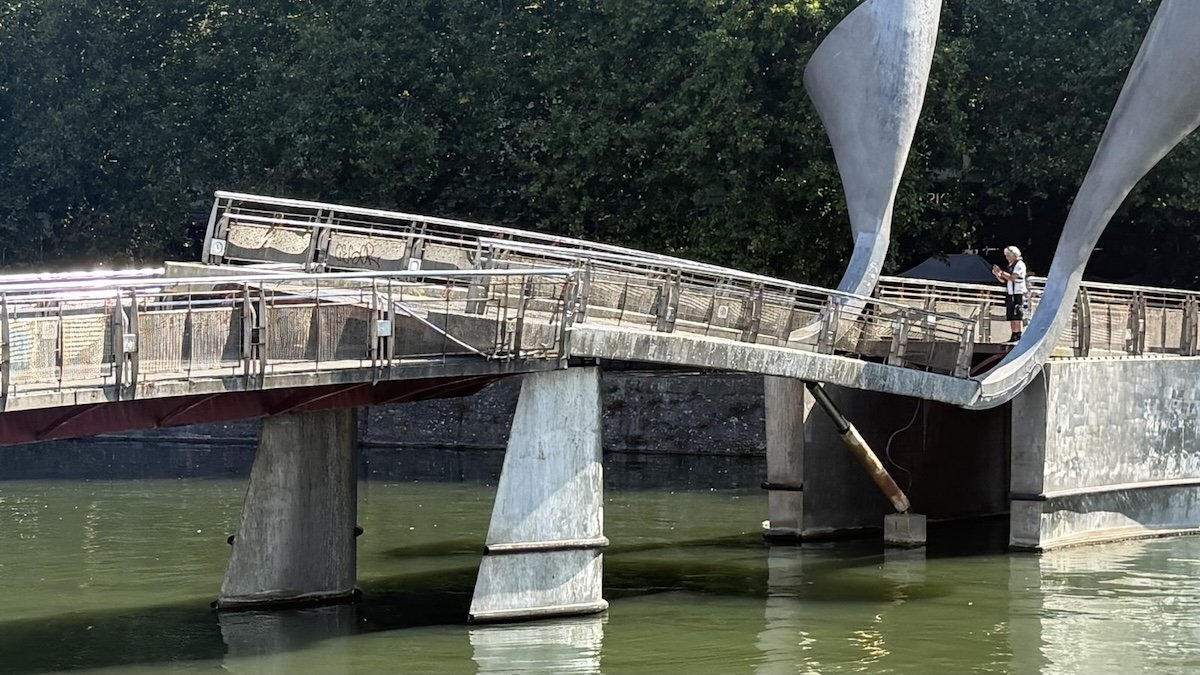
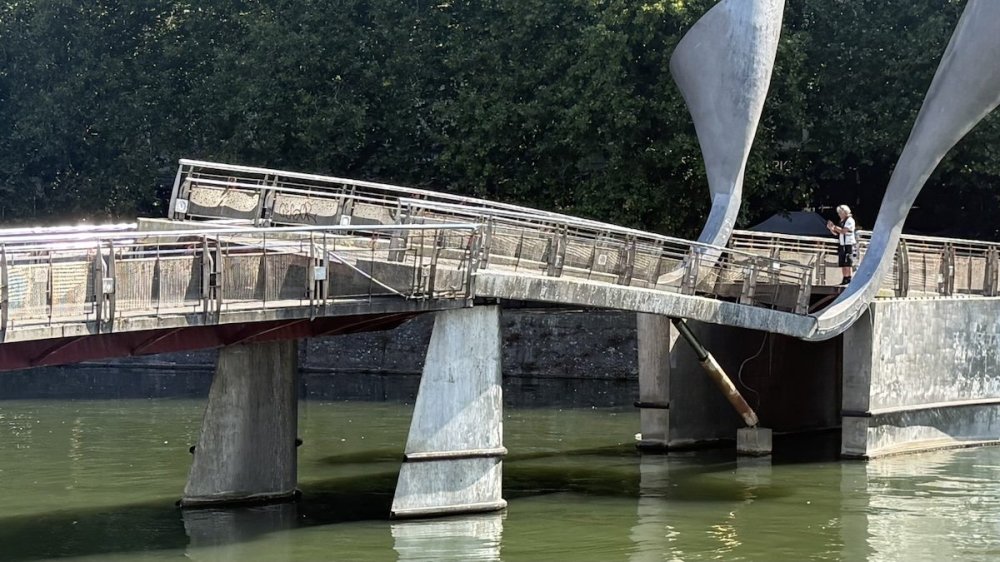
Pero’s Bridge in the scenic harbourside centre of Bristol has been abruptly closed after failing a routine safety check in a fairly spectacular manner this morning. https://www.bristol247.com/news-and-features/news/peros-bridge-closed-major-structural-fault/ Bristol City Council engineers were testing the lifting mechanism of the bascule footbridge which spans St Augustines Reach just outside Arnolfini Gallery on Narrow Quay, and links pedestrian and cycle traffic over the water to Millenium Square and the Watershed on the Canons Marsh side. The bridge had been closed around 9 am, and the bascule portion had been lifted to a 45° angle for the first time in nine years when the hydraulic ram seals failed, and the bascule fell back down with an enormous crash and jumped its bearing tracks as it did so (The large decorative ‘horns’ are actually lead-filled counterweights). Fortunately there were no casualties According to sources who witnessed the incident, it was the City engineer’s first day in a new job, and one that he is unlikely to forget - (assuming it wasn’t also his last). Pero’s Bridge was built as a Millenium project, and opened in 1999 to almost immediate controversy as its Irish designer Eilis O’Connell promptly disowned it, citing poor workmanship and implementation of her award winning design. The new footbridge was named after Pero Jones an 18th century West Indian boy who was a personal slave of John Pinney - a plantation owner and sugar merchant whose home is preserved as Bristol’s ‘Georgian House’ near Brandon Hill. Pero’s Bridge soon became a favourite location for couples wishing to install ‘Lovelocks’ to celebrate their union by attaching padlocks to the footbridge, and then throwing the key into the harbour. Last year Bristol City Council removed 3 tonnes of these locks after concerns had been raised that the extra weight might cause the bridge to malfunction.
-
The population weren’t “replaced” by Normans in 1066, they were simply added to by a relatively small number of French speaking Normans who were fairly quickly assimilated into the population in exactly the same way that surviving Romans and Latin speakers were after the collapse of Roman dominion in Britain around 410 AD. What the Normans did bring was a new and fairly short-lived system of aristocratic governance known as feudalism which collapsed a few centuries later - thanks to the depopulation effects of the ‘Black Death’ plague pandemic that devastated Britain from 1348 onwards. I still maintain that the only people really entitled to call themselves ‘Britons’ on either linguistic or ethnic grounds are the descendants of the Brythonic and Goidelic speaking Celtic tribes who fought against both the Romans and the later invaders they referred to as ’Sasunnachs’ - i.e. ’Saxons’.
-
The original Ptolemy world map doesn’t exist. What purports to be a surviving form of the map is a late Byzantine reconstruction created by monks under the direction of a Byzantine scholar called Maximus Planudes shortly after 1295 AD. It was reconstructed from descriptions and data contained in a manuscript attributed to Ptolemy and known as the Geography (c.150 AD). https://en.wikipedia.org/wiki/Ptolemy%27s_world_map The name Pretani found in Ptolemy’s Geography is a Greek transliteration for the name of a particular Celtic tribe said to be translated as “painted’ or ”tattooed folk” (c.f. Pictae in Latin) which mutated into a later Welsh word Prydain. Ptolemy was far from the earliest Greek writer to mention this name either:
-
I wonder if the author of the OP has any idea where the the terms “Briton” and “British” originally came from ? (Probably not as they seem to hail from Russia/Ukraine). The terms historically refer to speakers of the Brythonic group of Celtic languages - specifically the P-Celt speakers who spoke (and still speak) Welsh, Cornish, and Breton (in northwestern France). My own paternal line is from the outer Hebrides in the far north of the UK. My father was the first member of that line to speak English as their first language. The mother tongue of his own father and all his ancestors back into the mists of time was Scottish Gaelic, which is part of the other Q-Celt aka Goidelic branch of the Celtic languages that were spoken in the British isles for many centuries before Anglo Saxon was first heard on these shores.
-
There is an urban legend that back in 1899 Charles Holland Duell who was the Commissioner of the US patent office suggested that his position should be closed down because “everything that can be invented has already been invented”. The story is quite untrue, and was based in part on a joke printed in Punch magazine that same year which in turn played on a comment made in 1843 by an earlier commissioner Henry Ellsworth who said that “progress was so fast it taxed belief.” https://en.wikipedia.org/wiki/Charles_Holland_Duell The timing of 1899 and the locale of a patent office is however quite interesting. In June 1902 an obscure German physicist called Albert Einstein was employed in the Swiss Federal patent office in Bern as a technical expert class III. He whiled away his time by writing private research papers, including one on special relativity in 1905, and another on the photo-electric effect the same year (which won him the Nobel prize in 1921) before being promoted to the rank of a second class expert in 1906 - in which capacity he worked for another three years, before leaving to pursue full-time academic work on general relativity in 1909. https://en.wikipedia.org/wiki/Annus_mirabilis_papers Given that another German physicist Max Planck also first presented a paper on quantum theory in 1900, history suggests that any attempt to write an endpoint into scientific discovery is likely to be premature.
-
Back in 1981 a German SciFi novel called ‘Der Letze Tag der Schöpfung’ by Wolfgang Jeschke was first published, and was translated into English a year later as ‘The Last Day of Creation’. https://en.wikipedia.org/wiki/The_Last_Day_of_Creation The opening part of the novel deals with the topic of temporal anachronisms i.e. the discovery of anomalous artefacts identifiable as fragments of a high technology recovered from parts of the ancient geological record where they had no right be. In a number of cases these objects were first discovered during the middle ages or earlier, and had been preserved and venerated by the Catholic church as the relics of saints. In a pre-scientific era, such artefacts were so far beyond the comprehension of those who discovered them, that they were often treated as examples of a Xoanon - a Greek word for a cult object or statue belonging the gods and fallen to earth from heaven. ‘The Last Day of Creation’ isn’t predicated on a Silurian hypothesis: it’s actually to do with the possibility of time travel - but I won’t offer further spoilers in case anyone wants to read it. The relevance here I suppose lies in the difficulty of even recognising any puzzling remanent of an ancient technology for what it is. One example that comes to mind was an unrusted iron dagger discovered in 1925 by Howard Carter inside the burial wrappings of the Egyptian pharaoh Tutenkhamun which puzzled archaeologists enormously. https://www.bbc.co.uk/news/world-middle-east-36432635 Tutenkhamun died around 1323 BC and was mummified over 3,300 years ago, but the Iron Age did not begin until around 1200 BC - so you have an apparent anachronism The explanation is that the ancient Egyptians used iron ore taken from a meteorite - as was established in 2016 when scientists found that the iron blade contained high levels of nickel and cobalt similar to those found in another meteorite that had landed in northern Egypt in prehistoric times.
-
Ceuta is correctly described as an ‘autonomous Spanish city’, one which happens to be located on the North African coast on the La Almina peninsula which is joined by a narrow isthmus to the territory of Morocco. The interesting point is that it isn’t the only one. There is another autonomous Spanish city and former free port called Melilla which is located several hundred kilometres to the east along the Moroccan coast on the eastern side of another peninsula called the Cape of Three Forks just north of Nador. But you won’t hear very much about it in the news because the sea passage to Almeira in Spain from there is about 103 miles - five times longer longer than than the sea crossing between Ceuta and Algeciras which is barely 20 miles. Morocco maintains irredentist claims on both Ceuta and Melilla, but has discovered that fomenting chaos in Ceuta by standing down their border guards at regular intervals and allowing tens of thousands of illegal migrants to flood into Spanish territory generates a much more gratifying amount of press coverage and Schengen related paranoia in the EU, because Ceuta is so much closer by sea to mainland Spain.
-
Update: The DOJ has now dropped all charges against Olympian David Hearn who had been arrested and charged with 'vandalism' of the Reflecting Pool in Washington DC. NBC NewsTrump administration drops Reflecting Pool case, blaming...The Justice Department said “it is difficult to attribute the widespread damage to the Reflecting Pool to vandalism, let alone to establish that fact beyond a reasonable doubt.”