
toucana
Senior Members
-
Joined
-
Last visited
Everything posted by toucana
-
As far as I can recall the chutney was placed on the dining table in a cut glass decanter with a stopper, and was mainly consumed with cold cuts of meat served with hot vegetables - e.g the usual Boxing Day repast. Some ppl also liked to add a dollop to their biscuits and cheese - if taken as a third course. It’s basically quite a sweet-tasting apple chutney with a pervasive tang of root ginger. The recipe that I found is written in my mother’s hand, but I strongly suspect that she herself copied it out from an older recipe written by one of her own paternal aunts who was an excellent cook. Quite where she originally got it from is anyone’s guess. At least one of my distant relatives on that side of the family was a clipper captain who sailed the world in the second half of the 19th century - so the recipe could well have come from the Raj.
-
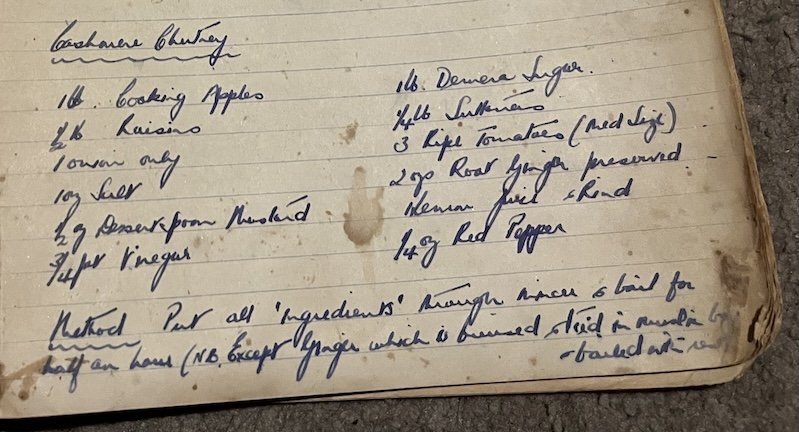
Not long ago I mentioned an old family recipe for “Kashmir Chutney” in a thread about ‘The Third Condiment Mystery’ (Chemistry - 5 June 2025). During the Xmas holiday season, I decided hunt out and check that recipe from a box of ancient family papers in my brother’s possession. To my considerable surprise, the hand-written recipe I unearthed was clearly titled “Cashmere Chutney”. I had always been under the impression that this condiment was called “Kashmir Chutney” and that Cashmere was a type of Himalayan goats wool normally used for making sweaters and shawls ! The explanation seems to be that Cashmere was once the normal anglicization for the Himalayan areas now known as Kashmir and Ladakh from the 17th century up until the beginning of the 19th. In the Napoleonic period however, shawls and garments made from a fine wool known as pashm in that area became fashionable imports into Europe. Within a few decades, the name ‘Cashmere’ had become firmly attached to these woollen products, and an alternate Sanscrit based word ‘Kashmir’ was being used to refer to the general geographical area. The decisive change came in 1872 when the British Raj in India decided to adopt a new grapheme-based system for transliterating Indian place names. It was called the Hunterian system, and was perfected by Wiliam Wilson Hunter, the Director General of Statistics in India. Thereafter ‘Kashmir’ became the official geographical name used in all government documents and maps - which provides a useful dating clue as to when our family’s chutney recipe was first written down. https://grokipedia.com/page/Hunterian_transliteration For anyone who is curious, the recipe for “Cashmere Chutney’” is as follows: Cashmere Chutney 1lb Cooking Apples 1lb Demerara Sugar 1/2lb Raisins---------------------- 1/4lb Sultanas 1 Onion only -------------------- 3 Ripe Tomatoes (med size) 1oz Salt 2 oz Root Ginger preserved 1/2 Dessertspoon Mustard 1 Lemon Fruit & Rind 3/4 pt Vinegar 1/4 oz Red pepper Method Put all ‘ingredients’ through mincer and boil for half an hour (N.B. except Ginger which is bruised & tied in a muslin bag & boiled with rest.)
-
This seems to be a linguistic rabbit-hole of unexpectedly large dimensions. The name Toronto is said to be derived from a Mohawk word tkaraonto documented as far back as 1615 which referred to sapling trees planted by the native Huron as a fish weir in a river area between two lakes. So right from the start, a letter ‘K’ has been lost overboard in the passage of time. Canada is officially a bilingual country, and it would appear that Francophone speakers (both mono and bi-lingual) usually enunciate both the T letters in ‘Toronto’ quite clearly. Whereas monoglot speakers of American English are prone to slur a medial ’T’ into what is known as alveolar ‘tap’ or flap sound - written as ⟨ɾ⟩ in the IPA - or even into a glottal stop IPA ⟨ʔ⟩ in some cases. https://en.wikipedia.org/wiki/Voiced_dental_and_alveolar_taps_and_flaps Some natives from the downtown area of Toronto apparently like to rhyme ’Toronto’ with ‘piranha’ - there is a joke that you can tell how close you are to the downtown by the frequency with which you hear this :-)
-
I found myself embroiled in an unexpectedly lively argument the other night with an online friend over the native pronunciation of Toronto. Quite a few sources, including this professional dialogue coach, assert that native Canadian speakers often elide the second ’T’ and pronounce the city’s name as “Tuh-RAHn(t)-o”. https://www.youtube.com/watch?v=ERCujbX8aqE&t=295s My online friend who has lived there for most of their life however insists that this is complete fiction, and they became quite irate when I referred to online sources on the subject - apparently I was peddling “AI Slop” in their view. (I live in UK and have never visted Toronto) Linguistic sources suggest that Canadians quite frequently elide a ’T’ if it follows a stressed syllable - e.g. ‘Internet’ becomes ‘In-ner(t)-net’. Are there any native Canucks from Toronto who would care to offer an opinion ?
-
The taste of chocolate bars varies considerably according to the manufacturing process used to create them. In Europe cocoa beans were orginally mainly roasted and ground into a powder used to make a rather bitter hot drink - not dissimilar to the use of roasted coffee beans. https://en.wikipedia.org/wiki/Chocolate_bar The development of ‘Eating Chocolate’ arose from a new process first developed by a Dutch chemist in 1828 that separated cocoa butter from the shell of the bean and neutralised the bitter taste with alkali salts. It was a British confectioner Joseph Fry here in Bristol UK who had the idea of recombining this extracted ‘butter’ with the ground chocolate powder and extra sugar to create a smooth and stable eating ‘tablet’ of chocolate around 1847. British chocolate must contain at least 20% of cocoa solids by law, whereas American chocolate need only contain 10% - hence the waxier taste found in Hershey bars - they contain higher levels of cocoa butter and vegetable oil. Milk chocolate was invented in Switzerland around 1875 by adding condensed milk into the cocoa powder and butter mix as well. Dark chocolate commonly contains around 70% cocoa solids.
-
A few years ago a senior journalist on our local evening paper told me a story of how he and a coach-load of other journalists were taken off on a complimentary tour of famous Scottish whisky distilleries. The schedule involved visiting eight such distilleries and sampling the product at each one - he subsequently had no lucid memory of anything that occurred after arriving at the fourth one.
-
Cardhu whose name comes from the Scottish Gaelic Carn Dubh - ‘Black Rock’ is a Speyside distillery that was first set up around 1824 and run by two women: Helen Cumming and her daughter-in-law Elizabeth Cumming - making it the first distillery officially pioneered and managed by women in Scotland. Helen Cumming was the wife of a whisky smuggler called John Cumming, and the distillery was originally an illegal farmhouse operation located near the top of Mannoch hill near Archiestown. https://en.wikipedia.org/wiki/Cardhu_distillery
-
Whisky and whiskey are both variant anglicisations of the Scottish Gaelic expression uisge beatha which means ‘Water of Life’ - probably a calque of the Latin phrase aqua vitae. Whisky is the favoured spelling in Britain and Europe, while whiskey is the common spelling in Ireland and the USA. Laphroaig is from the Gaelic Lag Bhròdhaig meaning the ‘the hollow by the broad bay’ - a reference to the geographical location of the distillery on the Hebridean island of Islay. According to a BBC news report last week, Jim Beam the maker of bourbon whiskey will shortly halt production at its main site in Kentucky for the whole of next year. https://www.bbc.co.uk/news/articles/cy5gv5z24n2o A major reason for this shutdown is the trade war started by president Trump in April 2025 which has provoked punitive retaliatory tariffs, and a Canadian consumer boycott which has led to a catastrophic 85% fall in US bourbon exports to that country.
-
I was a film projectionist responsible for a pair of 35mm projectors for many years. One of the critical lubrication points of a projection mechanism is the crossbox which houses the maltese-cross intermittent gear that provides the stop-start motion that draws film through the projection gate. You never start a projector up without first checking the oil level in a transparent glass on the side of the crossbox just below the filler plug - the oil level should always be halfway up the glass. But this visual check can only be done when the projection mechanism is at rest. The moment you start the motor, the oil level becomes chaotic and unreadable. When you stop the projector, you have to wait several minutes for the oil to drain back into the reservoir before you can obtain any useful reading of the level in the crossbox. This sounds rather similar to the effect you describe. Basically it’s quite normal - (in projectors at least).
-
It would appear that whoever tried to redact these files was a novice Adobe Acrobat user. In many cases all you have to do is put your cursor inside a document window, hit ‘Select All’, ‘Copy All’ and then ‘Paste’ into a blank document in another text editor with a different colour background. (On a Mac that’s —> ⌘A, ⌘C, ⌘V). In other cases you may need to import the target into an OCR (optical character recognition) tool - start with Google Images at https://images.google.com and click the ‘Search by Image’ camera icon, then drag the file to a drop box box that opens - and click ‘Select Text’ and ‘Copy’ options. The term used in political science for this type of Trumpian regime is a ‘Kakistocracy’ (Greek κάκιστος - kράτος) https://en.wikipedia.org/wiki/Kakistocracy “Government by the worst, least qualified, or most unscrupulous people”.
-
The Screen !

-
RIP Tom Stoppard
-
'Baba' I believe comes from Meher Baba (1894-1969), the name of an Indian Parsee guru whose teachings Peter Townshend was following at the time.You presumably don't realise that there is such a thing as Vegan Cheese either - said to be quite tasty too. https://en.wikipedia.org/wiki/Vegan_cheese Why don't you go and eat a horse ? - your blood sugar seems to be on the blink atm.Or are you perhaps using the expression ‘quantum clock’ as a metonym for all objective scientific methods of measuring and quantifying time - in which case why not say so ? I would refer you to the Sleep Foundation articled I quoted from earlier which says: "In most adults and adolescents, this master clock operates on a cycle that’s slightly longer than 24 hours. In order to maintain alignment with the 24-hour rotation of the planet, the master clock must adjust by about 12 to 18 minutes every day. For this reason, it times circadian rhythms according to environmental cues known as “zeitgebers,” German for “timekeepers.” Biological clocks and zeitgeber cues are both involved - there is no either/or here - both are relevant. The point of mentioning biphasic sleep patterns was to answer a humorous aside made by TheVat about typical patterns of sleep duration, by pointing out that monophasic sleep appears to be a relatively modern cultural adaptation.What exactly is a ‘quantum clock’ in this context, and which part of the humen anatomy do you think it resides in ? I’’m wondering if you even realise that quantum clocks have to be laser cooled to near absolute zero in order to function ? Which part of the brain or human nervous system do you think functions at just above 0° Kelvin ?Infants need 11 to 17 hours of sleep per 24 hours, toddlers require 10 to 13 hours of sleep per day, and teenagers usually need 8 to 10 hours of sleep per night according to sleep research studies. It’s only older adults who commonly require 7 hours or less of sleep each night. https://www.mayoclinic.org/healthy-lifestyle/adult-health/expert-answers/how-many-hours-of-sleep-are-enough/faq-20057898 What is really interesting however is that well up until the 18th century, many western people used to follow a biphasic pattern of sleep. Quite a number of written sources indicate that people often followed a pattern of “two sleeps” involving a night divided into two halves with a period of social activity in between. https://www.bbc.co.uk/future/article/20220107-the-lost-medieval-habit-of-biphasic-sleep People would take their ‘first sleep’ between 21:00 and 23:00, be active and be awake from 23:00 to 01:00 - a period of time also known as a ‘watch (echoing the naval term “middle watch’’), before taking a ‘second sleep’ that ended at dawn. There is much discussion as to how and why people shifted over to a monophasic pattern of sleep from the early 19th century onwards. Industrial shift working, artificial illumination at home which encouraged people to stay up later by shifting the circadian sleep cues, and the invention of the alarm clock in 1787 have all been cited.I think you should do a little more research into Circadian Rhythms before being quite so dismissive about the role of 'time-keeping' in human biology. Circadian Rhythms Circadian rhythms are controlled by biological clocks located in organs and glands throughout the body, but all of these peripheral clocks are commanded by a “master clock” in a region of the brain called the suprachiasmatic nucleus (SCN). In most adults and adolescents, this master clock operates on a cycle that’s slightly longer than 24 hours. In order to maintain alignment with the 24-hour rotation of the planet, the master clock must adjust by about 12 to 18 minutes every day. For this reason, it times circadian rhythms according to environmental cues known as “zeitgebers,” German for “timekeepers.” Light and darkness are the most important and powerful zeitgebers. Other zeitgebers involved in circadian timing include : Meals Exercise Social interactions Daily routines Stress These zeitgebers trigger the release of hormones in the brain and the delivery of chemical signals to body tissues. Thus, the master clock is able to effectively time vital body functions, such as the conversion of food into energy, fluctuations in body temperature, and when a person feels like sleeping or waking up. https://www.sleepfoundation.org/circadian-rhythmIt all comes back to time-keeping, and how we as human beings synchronise and regulate our internal metabolic body clocks with the mechanical clocks and social systems of time management that we all need to live within. There are certain strong physiological cues that predispose humans to take in nutrition at particular times of day. ‘Breakfast’ for example is so named because we quite literally need to break a fasting period of some 8 to 10 hours spent asleep (that’s etymology for you). The physiological cues that drive us towards the breakfast table are low blood sugar and raised levels of a hormone called ghrelin produced by the stomach. A pineal hormone called melatonin is produced by the body at night as part of the human ‘circadian clock” and it functions as a sleep cue by building up after supper around two to three hours before we normally go to sleep. Melatonin also functions as an appetite regulator. Rising levels of melatonin stimulate the production of a hormone called leptin by the fat cells in our bodies, and that functions as an appetite suppressant. https://revistapesquisa.fapesp.br/en/a-connection-between-sleep-and-hunger/ Melatonin levels fall steeply towards the end of the night, and as daylight returns, leptin production is replaced by that of ghrelin, as we awake, take breakfast, and prepare for our period of maximal activity in daylight hours once again. Carefully timed oral doses of melatonin can be successfully used to counter jet-lag for this reason: https://www.timeshifter.com/jet-lag/melatonin-for-jet-lag-type-dose-timingThe pendulum clock was invented in 1657 by the Dutch mathematician Christiaan Huygens who thought his revolutionary new mechanism could be used to be build an accurate marine chronometer. He quickly found out otherwise when it was tested by his younger brother Lodewijk during a sea voyage to Spain in 1660. https://en.wikipedia.org/wiki/Christiaan_Huygens The rolling motion of a ship in heavy seas disturbed the pendulum, and rendered the chronometer no more accurate than conventional clocks of the period that could lose up to 15 minutes per day.There is a fascinating book called Longitude by Dava Sobel (1995) which tells the story of John Harrison (1693-1776) an English clockmaker who invented the first reliable marine chronometer, and of his battles with the Commissioners of the Board of Longitude to collect a prize of £20,000 for solving what was widely regarded as one of the greatest scientific problems of the era - how to calculate a ship’s longitude when far out at sea. https://en.wikipedia.org/wiki/Longitude_(book) Harrison’s H4 marine chronometers ran accurately on GMT, and longitude was calculated by comparing this with a local clock time that was reset each day by a navigator taking noon-day shots with a sextant. A difference of four minutes corresponds to one degree of longitude. (The earth takes 24 hours to revolve 360 degrees, so one hour marks 1/24 of a revolution or 15 degrees, and 60/15 = 4). It's an interesting topic, but one that probably belongs in another threadThe mess tables were usually suspended by ropes from the ceiling in between the guns, and also had raised rims to help retain the trenchers and drinking vessels in heavy seas. https://snr.org.uk/maritime-art/the-sailors-mess-c-1800/ The watch-keeping system of bells was based on the use of a 30 minute sandglass kept by the helmsman’s position. As soon as the sand ran out, the ship’s bell was rung and the sandglass was inverted to run again. In the days before the Harrison H4 marine chronometer was perfected (c.1773), this form of time-keeping in tandem with the magnetic compass and ‘chip log’ was the only way of estimating a ship’s longitude by dead-reckoning. - (Latitude could be found by taking sun-shots at noon with a sextant).
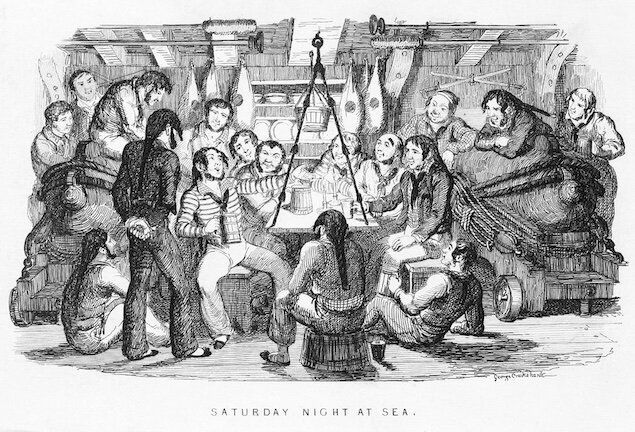 The concept of “Three square meals” had another provenance dating from slightly before the industrial revolution, and derives from the serving time of meals onboard British naval warships in the later 18th and early 19th century. This in turn relates to the system of watch-keeping used in the British navy to this very day. The crew of a ship are divided into two 'watches' called 'port' and 'starboard' who alternate on duty according to a pattern of seven watches. Five of the watches are of 4 hours duration, the other two from 4 p.m. to 6 p.m., and 6 p.m. to 8 p.m. are of 2 hours duration and are known as 'dog watches'. The purpose of 'dog-watches' is to force an uneven number of watches in a day to ensure the men are never on duty at the same time from day to day. https://en.wikipedia.org/wiki/Watchkeeping The time within a watch is marked by chiming the ship's bell every half-hour with a rising number of strokes up to '8 bells' to mark the end of of a four hour watch, or '4 bells to mark the end of a 'dog'. Middle Watch - 00.00 - 04.00 Morning Watch 04.00 - 08.00 Forenoon Watch 08.00 - 12.00 Afternoon Watch 12.00 - 16.00 First Dog 16.00 - 18.00 Second Dog 18.00 - 20.00 First Watch 20.00 - 24.00 In British warships around the time of Lord Nelson, breakfast was served at around 7.00 am (at “six bells” in the morning watch) and consisted of oatmeal porridge and ship’s biscuit. Dinner was served around 11.30 am to midday (“seven bells” in the forenoon watch) and was the main meal of the day consisting of boiled salt beef, peas and biscuit. Supper was served around 4 pm or 6pm catering for the men in the shorter ”dog watches”, and usually consisted of biscuits and cheese. Sailors ate from square wooden trenchers with raised edges known as a “fiddle”. These tray like trenchers gave rise to the term “a square meal”, and the raised edges of the tray acted as a form of portion control. Having food piled higher than this edge was known as “being on the fiddle” - a punishable breach of naval discipline and rationing control. https://collection.thedockyard.co.uk/objects/9066/square-plate The British navy in the time of Nelson was famous for its strict watch-keeping, and a rota of meal times which ensured that sailors were well-fed with “three square meals” per day.The string instruments in an orchestral score often have a familial grouping of stave abbreviations: V1/V2 —> Violin1/Violin2 Vla —> Viola Vc —> Cello C —> Contrabass https://orchestrasounds.com/2013/12/10/score-basics/ Because the ‘C’ is reserved for a contrabass.



Important Information
We have placed cookies on your device to help make this website better. You can adjust your cookie settings, otherwise we'll assume you're okay to continue.