
joigus
Senior Members
-
Joined
Everything posted by joigus
-
Sure. Very different things. Vacuum energy is very different even from the initial big bang theory before inflation was started by Alan Guth. So it was a contender of the big bang theory. The big-bang theory prevailed after Penzias and Wilson found CMB (1964), and inflation was introduced to solve some of its puzzles. Back in the 40's the idea that the universe was eternal and essentially the same at all times in its history was still popular. That had been Einstein's motivation for introducing a cosmological constant in 1917. He wanted a static universe. He failed at this, as his cosmological solution would have been unstable, not static.
-
Yes. This is the Bondi steady-state model. I grew up with that theory being a serious contender. But that theory came long before inflation, and actually before Penzias and Wilson's discovery of the expanding universe. Hermann Bondi wanted to account for a stationary universe, which we don't believe in anymore. It purported that the density of matter in the universe is constant. It also implied that the universe is eternal. It sounds similar, but it's quite different.
-
The term "coupling constant" comes from field theory. In field theory, all matter and radiation is studied in terms of fields. Fields are quantities whose value depends on position in space, as well as time. Fields have kinetic energy. This appears in the equations in the form of time variation of those fields. Fields also have "internal energy" due to spatial gradients of their values. They also have interactions with other fields, that appear as proportional to the product of one field with another. The constant of proportionality is called "coupling constant", and how big it is tells you how strongly they interact with each other. Fields also have self-interactions. These appear as powers of the field itself. Those also have coupling constants.
-
Thank you, Studiot. Standard cosmology separates different terms for these local densities. I hesitate to use this word "local" on account of how much confusion it's created through the years. People distinguish several terms on the RHS of Einstein's eqs. within the FRWL model according to the different stuff that fills the universe, which leads to the standard "epochs" post-big-bang: radiation dominated, matter dominated, and vacuum-energy dominated (present cosmological epoch): Radiation-dominated: energy density proportional to a-1 Matter-dominated: energy density proportional to a-3 Vacuum-energy-dominated: energy density = constant (a-independent) where a is the scale factor. It's in this sense that I say the vacuum-energy density does not dilute when the universe expands. As everything else would dilute (a-1,a-3), on account of no new matter or radiation being formed, while the vacuum energy density is kept constant (which leads to the exponentially growing solution with time that characterises vacuum-driven universes, also known as De Sitter universes) that's why I say it seems difficult to conceive of a model made of stuff --never mind it coming from negative-energy interiors of BHs. It doesn't seem plausible to me. It's the least I can say.
-
And by the way. It's an illuminating exercise to write down the equations of GR for a completely silly, trivial, flat spacetime, by calculating the Christoffel symbols, the geodesic equation, etc. in curvilinear coordinates. Of course, all the components of the Riemann tensor will be identically zero. But every definition and procedure for curved ST goes through. Here's a suggestion: Try and use your imagination, and write down a set of curvilinear coordinates that cover most of flat space, you can fill this totally dumb, seamless, featureless spacetime with (non-existent) "singularities" that all disappear once you introduce the proper set of (singular) coordinate changes that remove all your (non-existent) "singularities". Your toy model of field equations is the Laplace equation with the obvious boundary condition of all fields vanishing at spatial infinity. The genius of Kruskal was to realise that's kinda similar to what's happening with the Schwarzschild space time during a time when many people working on GR were still just chasing shadows. Stop chasing shadows, please. Now I do rest my case. --- One final caveat. If you insist on thinking of so-called vacuum energy in tems of energy content of some stuff, in the sense that it can be expressed as a density of "something", you're gonna run into problems. We call it "dark energy" for lack of a better word. But it's not really a local energy density. Dark energy does not dilute when you stretch your spacetime. This doesn't bode well with the proposal that it's due to a density of stuff filling in spacetime. And QFT certainly needs not negative energies. Those "cores" of negative energy would be quantum-mechanically unstable, it would violate causality, etc. You need a Hamiltonian bounded below for good reasons.
-
No. It's our old friend the Cartesian plane \( \mathbb{R}^{2} \). Flat, trivial manifold, with Riemann tensor identically zero, and (0,2) signature. It's totally isomorphic to its tangent space. Yet there are singular charts, and singular changes of different charts. I argued, in a way that you either have been unable or unwilling to understand that those singularities say nothing about the plane. They are singularities in the parametrization. It's plain to see now that you don't understand what a differential manifold is. That's why you're making incorrect statements about Schwarzschild spacetime over and over. And over. And over. And over... Yes, it would.
-
Polar coordinates on the plane: (r,theta) Change of coordinates: x=r*cos(theta) y=r*sin(theta) Singular @ r=0, as J(x,y/r,theta)=0 there. Is something fishy going on at r=0? No! A plane is a plane is a plane. (Sigh) Why?
-
I suppose what you mean is that a 2-sphere cannot be mapped with just one chart. I fail to see how this is relevant here. You're still trapped in the mirage of singularities of the coordinate chart. By the same token, you'd probably think there's a problem at the north pole of a sphere... I rest my case.
-
No. GR's job is to describe gravity. Nobody has ever said it's supposed to describe reality. That's a pretty tall order. That's why Einstein himself immediately started working on unification. This is probably Maxwell's most valuable legacy. So you don't believe in calculus then. I see no other way to interpret what you're saying. What does that mean, "the sphere is not reducible"?
-
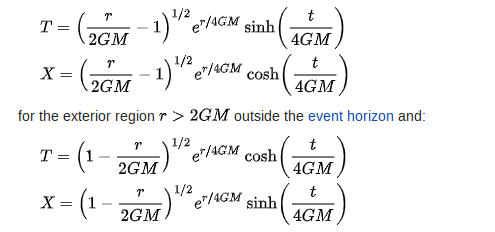
Here's the Kruskal-Szekeres change of charts: It's singular at r=RSchwarzschild=2GM because the Jacobian is zero there. I don't know where you got the 00 problem from. 00 is no problem if you can calculate the limit. The problem is the Jacobian is zero. This is not allowed for good reasons I'm not going to delve into. But:What is a chart? It's an assignment of coordinates: \[ \phi:\mathcal{U}\subseteq\mathcal{M}\rightarrow\mathbb{R}^{4} \] This could be the Schwarzschild chart. And in comes Kruskal: \[ \psi:\mathcal{U}\subseteq\mathcal{M}\rightarrow\mathbb{R}^{4} \] What's a change of charts? In this case from Schwarzschild to Kruskal: \[ \psi\circ\phi^{-1}:\mathbb{R}^{4}\rightarrow\mathbb{R}^{4} \] The initial chart is singular at the 2-surface r=2GM. Now Kruskal introduces a singular change of charts that restores smoothness on that region. It stands to reason that you must do something drastic on r=2GM if you want to restore smoothness. This is a particular feature of analytic continuation in this case. Now "stasis". You do not look at the metric in a particular coordinate set and infer anything. That's a sure way to make mistakes. What you do is what Markus told you: In this case, if one wants to prove that the metric is static, what one does is define a Lie derivative, and from there introduce time-like Killing fields. Then prove that your metric is invariant under those infinitesimal transformations.
-
No. It's essentially the same complaint. People often confuse the dumbed down idea, the metaphor, the motto, with the real idea. Physicists come up with these metaphors to help themselves, and others, remember, understand, and suggest: Antiparticles are ordinary partlcles going backwards in time. Virtual particles carry interactions between real particles. Black holes evaporate. Etc. Those are not the ideas. They are motivational instruments. You can't go from the motivational instrument to the actual theory without filling in the details. That's what I meant.
-
You're living dangerously here. Time propagates with respect to "something else". And what might that be? And how does it relate to everything else that's known? Feynman bitterly complained about ideas like this: Maybe time is not continuous. Maybe there are other dimensions. Maybe spacetime is a fractal... Yes. But how does it relate to everything else we know? What the auxiliary hypothesis that gets you out of this arbitrariness/circularity? I'm not saying that everything we define must be directly measurable. In quantum mechanics, we speak of the wave function, which is not an observable of the theory. But we have ways to check that it's a useful and relevant mathematical construction. In the case of QM, it's Born's hypothesis that the odds of something happening can be calculated from the wave function as quadratic functions of this wave function. Also interference patterns, etc.
-
Ok. I will try to think about this more carefully tomorrow. Or more likely, over the weekend. But flatness of the universe, as commonly expressed in cosmology books, seminars, etc., refers to spatial flatness. Not to Doppler effect. Doppler effect has to do with ratios d(tau)/dt; that is, proper time over coordinate time. It's, for lack of a better word, some kind of "time curvature". Flatness of the universe refers to flatness of the spatial sections of it. Because the question stemmed from a post on "velocity of time", and you mention Doppler effect, I think there might be the rub. Does that make sense to you?
-
Why do you say Kruskal has been "pushing the equations"? The equations give a catalogue of exact solutions, and Kruskal didn't touch Einstein's equations to do what he did. He just re-arranged the solution. He re-expressed a well-known exact solution by analytic continuation (maximal analytic extension). He introduced a change of charts, which is singular at the point where the initial chart was singular. Sure enough, if you plug in the solution in Einstein's equations again, but in terms of Kruskal coordinates, it still satisfies them. Are you saying it doesn't? I agree with you that the actual singularities probably point to a region were GR alone probably is not the whole story, so they're not "real", if you will. I totally agree with, No, it doesn't. Schwarzschild's solution looks the same for all times. In fact, the solution is unrealistic, among other things, due to this. It was always there and it never grows. The fact that there is a time doesn't imply the metric is "dynamic". It doesn't display collapse, it doesn't display accretion, it doesn't display evaporation. But Markus will explain this better, I'm sure.
-
Oh, I think Bohr's pessimism will never be rebutted as a factual constriction of Nature. But Bohr has been a little bit obscure to me at times when trying to explain why. But we're getting off the tracks here, because I don't think he ever gave much thought to black holes. Although, as Markus knows well, and you probably do too, there may be a connection between complementarity and BH's through the EPR = ER principle.
-
As it stands today, quaternions are used as an alternative representation of the Dirac equation. The 4 components would correspond to the 4 components of the Dirac spinor, which are interpreted as both spin states of electron and positron. I'm not aware of any full-fledged formulation of QED based on quaternions. I don't know much more about this idea. As to octonions... mmm. I don't know. They are non-associative, which is, right off the bat, quite strange to represent physics. But who knows.
-
Yeah. Some nifty definition is needed here. I'm not saying it's impossible to define a "speed of time" in a meaningful way. Cosmology comes to mind. The second quality standard that a definition worth the name has to satisfy is being useful. Otherwise, speed of time = rate of change of time with respect to time = change of time / change of time = 1
-
Forgive my ignorance but, what exactly is the "speed of time"? You cannot define things in a vacuum. How do you measure that speed? In order to measure a speed, you need a quantity changing. And then you need something else changing in a way regular enough from the perceptual POV to serve as a standard clock. What is the standard clock against which time is seen to change?
-
Superstring theory purports to generalise the standard model. In the SM neutrons and protons, as well as mesons, are not elementary, but aggregates of quarks and gluons. So strings would correspond to quarks, gauge bosons (photons, W, Z and the graviton).
-
The coordinate r is not the radial coordinate. That much I, for one, will concede. For starters, Schwarzschild's r in the interior maps time, not space. But even outside it doesn't have to be, even though the temptation to call it so is very strong. If you want an argument that shows this very clearly, consider this: Scharzschild coordinates separate the angular factor so that the total solid angle gives 4*pi. Well, that cannot be. And the reason is that in a space with (positive/negative) spatial curvature, there must be an angular (deficit/excess). Of that, Scharzschild's coordinates tell us nothing. Here's the thing: Coordinates in GR are meaningless. Scharzschild's coordinates are only meaningful at spatial infinity. What you do in GR is pick out a set of coordinates that suits you to solve the equations, then do an analytic extension that smooths out all the singular points of the coordinate chart, then you identify the real singularities (infinite curvature). Finally, you discuss causality and the like in terms of the best set of coordinates(Kruskal-Skezeres, conformal, with Penrose diagrams, etc). Mind you, if your favourite coordinate chart that you used to solve the equations was "contaminated" with spurious singularities, you will have to introduce a singular change of charts that undoes the damage. It's not you, it's not me, it' generations of physicists that have been confused by the mirage of their coordinates charts. GR is a lanscape to tread very carefully.
-
As exchemist said, neurons are too big to be affected by a single atomic event. When an action potential is triggered, many atoms are involved. On the other hand, although cosmic rays hit our bodies constantly, keep in mind: Not all DNA is being constantly transcribed and translated. A big part of it is not being expressed, and never does during an organism's lifetime. Many genes code for IF, THEN clauses in the genetic code: If such environmental factor is present, then synthesise such and such protein. Also, there are specialised enzymes that detect changes in DNA and correct them constantly to a precision that's about 1 part in 109 --if I remember correctly. Finally, modified cells produce chemicals that act as stress signals, resulting in the removal of the cell. Among the suite of enzymes that cells produce, several of them are in charge of telling the cell when to divide (mitosis). If the part of DNA that does this job is damaged, it's certainly possible for a cell to start dividing indefinitely. That's what happens when carcinogenic mutations take place. It's perhaps worth noting that cosmic rays are not the main source of high-energy radiation that we're exposed to. Rocks are probably a much more important factor. For genetic mutations to be inherited, they must affect sexual cells (gametes).
-
That's what I meant. There is no interference pattern. There is interference, of course, but we wouldn't be any the wiser about it by watching just one electron. Thank you, because I think the point is important. Sometimes brevity is not your best friend.
-
The second person would see the electron land somewhere on a screen and wouldn't notice anything remarkable at all. No interference, because it's just one electron. It's been done, and that's what happens.
-
I'm not sure what strings you're referring to here. There are hadronic strings and superstrings. Hadronic strings are a model to represent bound states of quarks joined by gluons (making up the body of the string). It takes at least two quarks to make a hadronic string. Or --most likely-- you mean superstring theory (really tiny strings of Planck size). Then every elementary particle (electrons, quarks, photons...) would be a string. As a quark is, as far as we know, elementary (point-like, no internal structure), every quark would be a string within the framework we call superstring theory.
-
This should go in Speculations, and wild ones at that.