
Ghideon
Senior Members
-
Joined
Everything posted by Ghideon
-
? The isotope deuterium has one proton, one neutron and one electron as far as I know.
-
Yes, many times! I'll see if I find something interesting to add. But first I got curious @joigus: I did a quick test* on a few models and got different answers: ChatGPT, 4.1 mini - No, ChatGPT 4.o - Yes, DeepSeek-R1-Distill-Qwen-14B - Yes Is there is any reason for the different answers?. Is the "No" answer always wrong or is there a context where "No" is correct? To check if the answer, according to the model, depends on context I used the following prompt (ChatGPT 4.o): The output provides some insight into how a model may produce "yes" or "no" to the original question depending on the context: Final test for today: since the model ChatGPT 4.1 mini generated the answer "no", what happens with a slightly modified prompt? Answer: Further tests could use for instance : Note: this is not an attempt to defend generative AI models or criticism against the question @joigus posted. I just got curious since this specific topic is closely related to a project I'm involved in. *) If interesting I can upload the full conversations; it gets quite long after a few interactions.
-
@iNow on my computer and phone browser (both Safari) I click my avatar picture close to the top right corner of the forum, and the Mark all read is in the menu that opens:

-
I asked, a Japanese car, A Toyota’s a Toyota, right? Response: No! Fiat; if on race track. Go hang a salami, I'm a lasagna hog!
-
In case it helps, just an idea; While the product [math] f = d* m * t [/math] is dimensionally wrong, you can still say that force depends on distance, mass, and time by introducing an unknown function [math]f = F(d,m,t), F:D \subset\Re^{3} \rightarrow \Re[/math] where D is the set of allowed triples (d,m,t). The explicit form of F is not yet known, but whatever it is, F(d,m,t) must have the units of newtons.
-
Testing after forum update Sentence with three definitions [math]f(x^{2})=\frac{y}{2} [/math] \(f(x^{2})=\frac{y}{2}\) [latex]f(x^{2})=\frac{y}{2}[/latex] end of sentence. Sentence with no math. New sentence [math]f(x^{2})=\frac{y}{2}[/math] \[f(x^{2})=\frac{y}{2}\] [latex]f(x^{2})=\frac{y}{2}[/latex] end of sentence.
-
Note: In my opinion the title of the tread "Simulating Physics with AI" does not relay match the AI related questions in the opening post and this possibly causes some confusion. I try to address the content of the post rather than what the title could imply. I found a video closely related to the question in the opening post where the presenter is using ideas from computer vision problems (convolutional neural network) to work on temperature fields; closely related to the specific section: The video, titled "Can AI Uncover the Laws of Physics by Observing Apples Falling from Trees?" also briefly discusses the general question about AI capabilities to (re)-discover Lawes of physics (stated in the opening post). Here is the summary of the video, from YouTube (emphasis mine): Moving beyond mere pattern recognition, machines are now capable of extracting new insights from hidden trends and patterns, generating lifelike images and coherent text, and making complex decisions in intricate environments. As these advancements progress at an astonishing pace, it begs the question of whether artificial intelligence (AI) will eventually attain the level of intelligence required to delve into highly intellectual pursuits, such as comprehending the fundamental laws of physics in nature. In this presentation, Dr. Baek will highlight some of the recent frontiers in physics-aware deep learning and demonstrate their application in solving complex mechanical engineering problems, ranging from designing composite materials to predicting quantum spin dynamics. The video is a recorded presentation from University of Virginia, link https://www.youtube.com/watch?v=qhSkX7DjvSM
-
As far as I know the answer is yes. But the output from the AI* will not be a neat equation. Some short, more technical, notes: Neural networks are powerful function approximators, yet their "black-box" nature often renders them opaque and difficult to interpret**. The model will be able to predict how a physical system evolves. The result of the machine learning is weights in a neural network, not compact equations. some models struggle with discovering conservation laws. The following paper gives an overview of some challenges, including "black box" Lagrangians: Source: https://arxiv.org/abs/2408.14780 AI used in those softwares is for other purposes, not related to what OP is asking about. *) "AI" in this case are machine learning and various neural network architectures such as Physics-Informed Neural Networks (PINNs). **) paper that may be of interest.https://ar5iv.labs.arxiv.org/html/2003.04630
-
I don't understand your diagram, maybe I misinterpreted it? Your diagram states f=dmt Your definition, with units added: f: force (N) d: distance (m) m: mass (kg) t: time (s) Units in your formula: dmt implies units m*kg*s Force in SI units is: kg*m*s-2 The units don’t match, and no physical law I know of supports such a relation. So the diagram seems incorrect and nonsensical in physics.
-
Same on Safari, apple laptop. Strange behaviour: I need to drag the heart icon, drop it onto the up or down button, then click the button. (see attached animation) 1.m4v
-
Thanks for the explanation! That reminded me; I had not yet tested the behaviour of the "wrap in quote". The new "wrap in quote" has the capability of moving already pasted text into a quote if the cursor is located in a paragraph. I find it useful for my style of writing; results in less cut & paste.
-
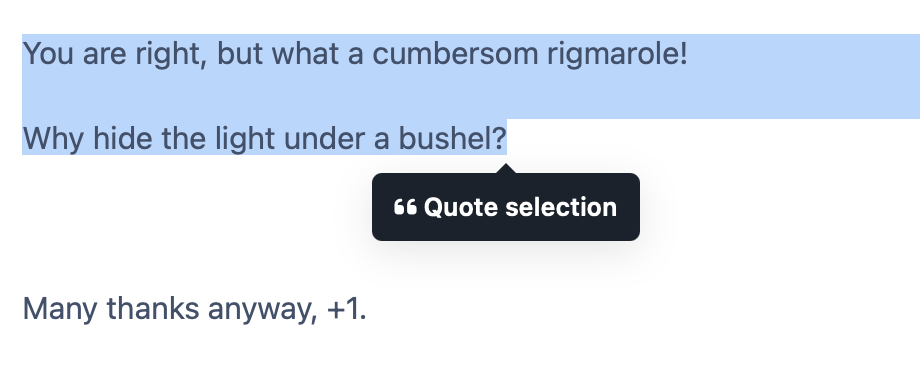
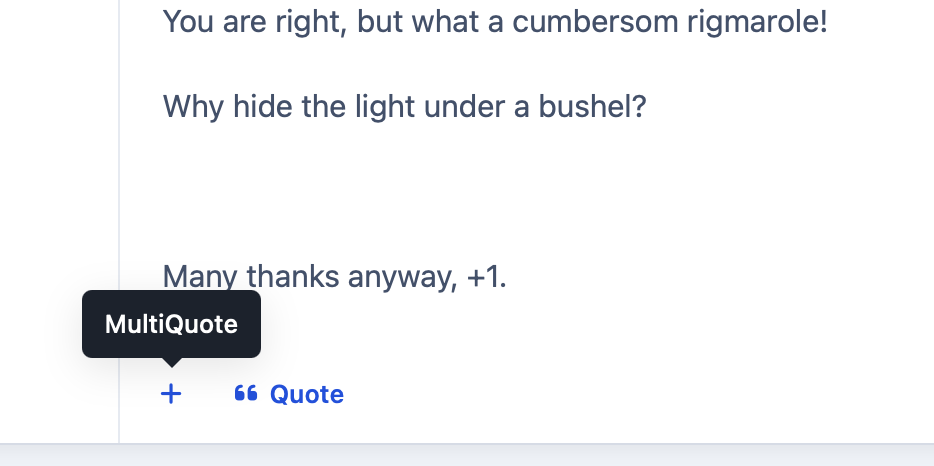
There might be differences between browsers, I found some quote functions I don't remember from before. The first one is quite useful: 1: mark a piece of text, a quote button appears: The resulting quote: 2: Quote button for one or more posts, available at the bottom of posts: The multi quote (the + button) collects a "stack" of quotes, this stack is available via a button and clicking the button inserts the quotes in the post, at the location of the cursor. (screen shots from Safari browser on Apple MacBook)

-
I got a lot of those when clicking "scienceforums.net/contact/" trying to fill out the form, but so far not when logging on or when posting. I used relay service "iCloud Private Relay", standard Safari browser. I note that this was som days back but in case it helps: I used the contact form available at the bottom of the page on Friday. The forum tried to send an email verification, but I never received an email so I could not use the form. ("contact us" from the password reset / account creation area seems to work differently as @MSC pointed out, and that helped me.)
-
What type of tautology are you interested in? Logical and computational tautologies are within my area of expertise. (Language and legal tautologies for instance, not so much.)
-
I agree. Was just curious about OP's point of view before writing a critical answer. Also, the opening post mentions "products" and gives an example of one LLM based product but does not mention context or interactions. The output such products produce depends on what it is used for and what input it is given. A good example is given above: (Retrieval augmented generation. In RAG systems, the quality of generated responses is determined by both the foundational model's capabilities and the relevance of the data retrieved during the process. )
-
Before I comment on the details, are you speaking of AI in a broad general way or are you focusing on generative AI? I note that you gave one example that is based on LLM: Did you create the list of competence levels or is it from some source? Additionally, I wonder if the linear structure of your list accurately reflects the non-linear nature of both human learning and AI development. Example: As far as I know human babies demonstrate pattern recognition and adaptive responses at early stage, for instance based on smell and taste. This is something that generative AI based on a language model does not demonstrate, how does your list take this into account? I note that you say: (bold by me)
-
Are you referring to the Heisenberg uncertainty principle? If so, what makes you think that it has a practical impact on scientists abilities to measure positions and velocities of macroscopic objects such as stars? (edit: x-post with @Genady )
-
ChatGPT, go-to model for private tasks and for some work. (using paid version; see official price on their web) Some examples: -General exploring of LLM and what their capabilities and limitations are -Getting a second opinion when helping my kids with homework; taking a picture of a problem and asking for different approaches. -Using plugins, for instance "@Wolfram" for mathematical results by using Wolfram alpha -Loading a few (public) papers and asking for comparisons, differences or if a statement is supported by the papers or not -Building GPTs to explore what kind of ecosystems that may or may not emerge in the world of GenAI. Copilot (licensed by employer) -Work, especially any work that needs access to corporate data or that is intended for use in a commercial context Local installation of Stable Diffusion or Flux.1 (free, not counting local hardware) -Image generation Local installation of Llama 3.1 (free, not counting local hardware) -Experiments with text; comparing to larger models, testing the limits of smaller local models For some tasks, such as organising a workshop or preparing a seminar I may use combinations of the above models depending on the context and the points I want to illustrate.
-
Maybe you can do an experiment? Like dropping a small round object in front of the camera and see what the resulting video looks like? You could try different things so that air resistance affects the velocity, for instance a small metal ball, a piece of paper, a tiny feather or similar.
-
Is it from a night vision camera? Is the shutter speed slow? My guess is flight tracks of an insect, like small moth, over several wing beats. I assume you mean the bright things moving, as seen in this screen shot from 2s into first video:
-
Not true. The complexity of a problem doesn't stem from failure. Successful and unsuccessful researchers alike can appreciate that some problems are inherently complex due to gaps in current knowledge, not because of their inability to resolve them. Note that "complex" is not the same as "complicated" (edit: Noting that the member is banned; I will not spend time to sort out their misconceptions.)
-
I'm trying to understand the question. Is this a correct interpretation @Downlord4spaceflight? "When we cool a superconductor and place it above a magnet, it can float or hover because of special magnetic effects. If we start adding some non-magnetic weight to this floating superconductor, how much extra weight can it hold before it stops levitating? Essentially, what is the maximum additional mass the levitating superconductor can support while still staying afloat above the magnet?"
-
During my vacation I learned, among other things, that Minimum Description Length (MDL) principle can be seen as a formalization of Occam's Razor in the context of statistical modelling and data analysis. Thanks @joigus for sharing this that triggered my curiosity: I had some practical experience from related areas such as data compression and communication. But I did not know much about the science that formalize and quantify intuitive but vague concepts (for instance complexity, simplicity, randomness of individual objects) and hence allows one to talk about them in a rigorous way.
-
Yes. I need glasses.
-
What scientists and what experiment are you referring to? Is the above part of your alternative history plot? There was an observational test of general relativity in 1919*. Widespread newspaper coverage of the results from the solar ecplise experiment led to worldwide fame for Einstein and his theories. The Second World War was between 1939-1945. *) https://en.wikipedia.org/wiki/Eddington_experiment