
Ghideon
Senior Members
-
Joined
Everything posted by Ghideon
-
Sorry, I thought you were familiar with regular expressions. I'll explain later Your answer is incorrect. You seem to assume that the cheater "U" has some special meaning. That is not correct. See my first post.
-
The first regular expression gets at least one match in any input string, since the whole pattern is optional due to the placement of the star "*". It has one capturing group. The second regular expression requires the string " U " (Capital U surrounded by spaces) to occur once while the two patterns "bba" and "aab" are optional This regular expression has two capturing groups. Why do you think they are the same? It is easier to guide if you give some hint about your reasoning. Example: First regular expression matches for instance the whole string: "bba U aabbba U aab" (The second regular expression matches the initial substring "bba U aab") The second regular expression matches for instance the whole string: "bbabbabba U aabaabaab"
-
Archimedes: Zeno's chicken crossed the road; my methods take into account the fact that under the conditions stipulated the amount of time taken at each step is geometrically decreasing
-
Maybe we should add some unsourced ones and have a guess who? "Here is a helpful animation displaying the relativistic effects when a chicken crosses the road, as seen from a stationary observer." "The chicken crossed the road in 18.3400000000021 seconds, measured in the chickens frame of reference." "No model. No math. You have no theory. Your idea how the chicken crossed the road have been debunked over and over. Thread closed!" "A charged chicken crosses the road at an angle of 90 degrees, in what direction will there be a magnetic field?"
-
Paul Dirac: The chicken operates the quantum lab from home. Non commuting operators do not need to cross the road.
-
Erwin Schrödinger: My chicken is dead and alive; it sneaked across the busy road while I was looking the other way.
-
In what kind of journal you intend to publish? The kind that will neglect the issues raised in this thread? Question: your new edition contains a relation between charge and the value of Hubble 's Law*: As the parameter [math]H_0[/math] changes over time, does that mean your idea is that for instance an electron's charge changes over time? Does that macho observations? *) It's tricky to quote your paper, trying to use screen shot.
-
Thanks for the update. The new edition does not adress the open questions above. That material is still in the updated version. To make things easier, how about posting a revision that only includes the correct material you wish to discuss?
-
Sorry, misunderstood opening post. I'm of little help here, for the little reading about programming I currently do I'm more into online tutorials or documentation.
-
(bold by me) Thanks, but three of the books on the list seems to be about other topics than programming, was that intended? Last edition Code Complete by Steve McConnell i know of was released in 2004, I consider it rather outdated by now.
-
If the link I provided does not work (it works for me) Google for 'The Map of Mathematics' Poster by Dominic Walkman. I'm not sure about posting the actual picture here on the forum due to copyrights. The link again: https://www.flickr.com/photos/95869671@N08/32264483720
-
I'll try not to interrupt your discussion, just a question: do you mean centre of mass of balls only, centre of mass of the balls + the box the balls bounce around in? Other?
-
Not sure I grasp the idea completely but maybe the "the map of mathematics" could act as a starting point or act as a rough guide? It is a one page drawing showing how many concepts such as pure mathematics, applied mathematics, number systems, topology and many other fits together: https://www.flickr.com/photos/95869671@N08/32264483720
-
I have passively followed this from the sidelines due to limited knowledge in the area but I've learned a few things*. Are you sure? There are now 10 pages of excellent examples and objections from several experts in the field, none of which seems to bring you closer to the desired understanding. I've browsed through the thread again, each time a critical argument is added the standard type of response is: What prevents you from understanding the objections related to your idea while at the same time you seem capable to understand several other complex concepts of physics**? What prevents required new tools from being added? I may have some ideas about (over-)simplified analogies as a complement to the expert explanations given so far but at this time I'm not sure if that is what you are looking for? *) @Mordred's "What curves is the principle of least action" certainly trigger some thoughts, I'll try to study that, check if my intuitive understanding of that single line matches the mainstream science. **) I lack your level insight into GR but I can still understand much of the discussion.
-
Does the time dilation for observers in relative motion in a flat Minkowski spacetime count as an example?
-
Thanks, variations of SEIR is in use here. There is also a full scale model of the population on individual level, microsim*, but AFAIK not yet adopted to the new situation. Your post helped me in the right direction for further reading. Neighbour countries here have adopted other policies and have a lower number of deaths now. A better protection of the elderly people and/or people seems to be one important factor where others seem to have been doing a better job than Sweden. The underlaying reasons for that will probably be analysed and debated for years. I think your question is interesting because "success" needs to be defined one way or another In the context of the thread, Success Stories must be possible to separate from Abysmal Failures to be able to improve policies. Otherwise it will be tricky to compare policies and improve. I do not know if success now in the early phase is a guarantee for success in the long run. *) https://books.google.se/ extract https://arxiv.org/pdf/0902.0901.pd
-
Several valid points regarding Sweden have been made in posts above. My experiences so far: -There is not enough data available to state anything conclusive regarding the current approach here in Sweden. It's too early. -Most decisions so far seem to be based on scientific evidence. -As far as I can tell there are good models, adjusted to local conditions but maybe not adjusted to Corona yet My guess* is that the lack of data makes it hard to run the models with a valid set of parameters, models have been proven to work in other situations may or may not produce good predictions. The models' predictions are open for various interpretations. Data in this early stage can support both a lockdown and an open strategy; there is an overlap. Both may be sound scientific interpretations, there are scientists (and others) on both sides in the discussion. I can't guess if this policy will have a good or bad outcome. But I can see the logic behind the attempt to balance for instance: -Base decisions on local conditions, not so much on what others have done. -Try to close down enough to allow for health care to cope and adjust. But do not close down more than that. -Try to make recommendations that people will choose to follow over an extended period of time, it is not a three weeks sprint run for a vaccin. There are lots of other observations to add but that would turn this into blog post. If there is interest in some specific aspect I'll try to answer or find sources. *) I do not have studied the numbers and methods enough claim any insight (yet).
-
No problem, welcome to the forum! I agree. And this is an interesting topic. Regarding the opening question, and in addition to Phi's link, here is some info on the history of plate tectonics theories. The articles also contains some references covering competing theories (for instance expanding earth) and reasons why scientists abandoned them. https://en.wikipedia.org/wiki/Timeline_of_the_development_of_tectonophysics_(before_1954) https://en.wikipedia.org/wiki/Timeline_of_the_development_of_tectonophysics_(after_1952) Note: the pages are marked as having some issues so some care may be needed when reading. But usually the references sections may point in the right direction.
-
Could you present a plausible mechanism allowing that to happen, and explain how it works? Without usage of those substances maybe the current scientific consensus regarding this topic would make more sense?
-
Today I learned that skills improved by participating here on scienceforums can, at least in some minor way, be helpful in the current virus situation. I joined a local initiative where students studying from home can ask about math and physics. Debating science here has made me more confident regarding mainstream science and how to respond with useful hints (instead of solutions) to homework questions.
-
That is a good point. Redistribution of large amounts of water is not impossible, but hard to do cheap or with limited resources. There are large projects to redistribute water across seasons (Hoover Dam for instance) so with appropriate political will, need and organisation it would be possible to do geographically as well.
-
I cannot claim to be an expert but there is some quick local numbers. Also note that the local conditions here seldom causes drought. In Sweden there is a yearly production of 900x10^9 l of drinking water produced* Fuel delivered for usage by vehicles is approx 12x10^9** That means that the drinking water volume is 75 times the volume of fuel. And note that this is drinking water only. To that one have to add the vast amounts of water needed for other purposes such as farms. One figure I found* is that the amount is approx 28 times the volume of drinking water. The above example means that if 1% of the water would require a relocation it would still be approx 20 times the volume of all fuel transported. So in addition to the problem of making a profit as stated above there is the issue of delivering enough volumes of water to make a practical difference. References. Sorry, some may not be available in english at this time: *)https://sydvatten.se/vattenforbrukning/ **)https://spbi.se/statistik/volymer/
-
It may be easier and more efficient if you also provide a picture? If each interested member have to interpret your description there is plenty of room for confusion?
-
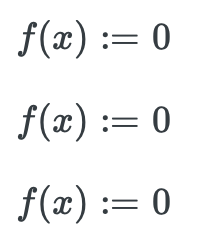
Three different modes tested: [math]f(x):=0[/math] \(f(x):=0\) [latex]f(x):=0[/latex] Code for above is [math]f(x):=0[/math] \(f(x):=0\) [latex]f(x):=0[/latex] Screendump from browser Mathjax-config: inlineMath: [ ["\[math\]","\[\/math\]"], ["\\(","\\)"], ["\[latex\]","\[\/latex\]"] ],
-
Thanks, that's a better expression.