Ghideon
Senior Members
-
Joined
Everything posted by Ghideon
-
If you list the obstacles and problems that you need to overcome, may you could present a guess?
-
The equation [math] x^{2}=1[/math] has two solutions, [math] x=1 [/math] and [math] x=-1 [/math]. Maybe that is what you mean by two input values, I do not know. Only one of 1 and -1 may be used at a time as already stated: The above means that in [math] x^{2}=1[/math] you may use one of 1 and -1 so that: [math] (-1)^{2}=1[/math] or [math] 1^{2}=1[/math].
-
You have not yet addressed the problems that prevents your method from being useful. I do not know to what extent this forum thread will help. Your method as presented:
-
Here is a discussion that may apply: https://github.com/ethereum/web3.js/issues/2739 Fixing the issue seems to be a work in progress.
-
Machine learning in general is important*. Below is another paper at least partly connected to you idea; analyze scientific papers and combinations of papers to find overlooked information or suggest areas where more research could be fruitful. https://newscenter.lbl.gov/2019/07/03/machine-learning-algorithms-can-uncover-hidden-scientific-knowledge/?utm_source=thenewstack&utm_medium=website&utm_campaign=platform The paper may be behind paywall: https://www.nature.com/articles/s41586-019-1335-8 *) In my opinion, I am biased due to my profession.
-
For further study you may have a look at the travelling salesman problem: Here is a passage that connects to your approach, describing how trying combinations is not a practically useful approach. In your case the goal is not cheapest solution but a combination of programming constructs that solves a problem better. But in my opinion the analogy holds at an abstract level. https://en.wikipedia.org/wiki/Travelling_salesman_problem There have been many improvements that makes it possible to find solutions for larger and larger sets of cities and distances. My point is that travelling salesman problem could be a starting point for understanding why the current approach you have suggested is impractical. It may also show how scientists approached an initially impractical problem. I believe the travelling salesman problem is a reasonable start since it is easy to understand and have been studied extensively. Note: It does not solve the problem you have presented, it may act as a guide for further learning.
-
I asked you to show that for the inequalities you used. Please provide an answer. Here is a link to the unanswered question: scienceforums.net/.../comment=1163549
-
There are plenty of examples in physics where a certain mathematical framework works for some cases and not for some others. Newtonian physics vs special relativity is one such example. The physics does not have to follow the logical conclusions of the mathematics developed by Newton.
-
I have not used PyTorch so I can't offer an opinion but I would not be surprised if there are scenarios where PyTorch is an obvious choice. Google for instance provides Tensor Processing Units (TPUs) and TensorFlow could be a good choice when the model has suitable properties. https://en.wikipedia.org/wiki/Tensor_Processing_Unit
-
Please provide the details here on the forum. Please include or describe the physics that justifies the relations; the relations are not physically valid for arbitrary numbers.
-
It think you are missing the, or avoiding, the problem: Assuming you generate combinations of words that are allowed in a programming language: A quick calculation will show you that if you fill the entire visible universe with super computers and let them run for 13.5 billion years (roughly the time since Big Bang according to current models) that will not on average be enough to locate a solution for the approach presented.
-
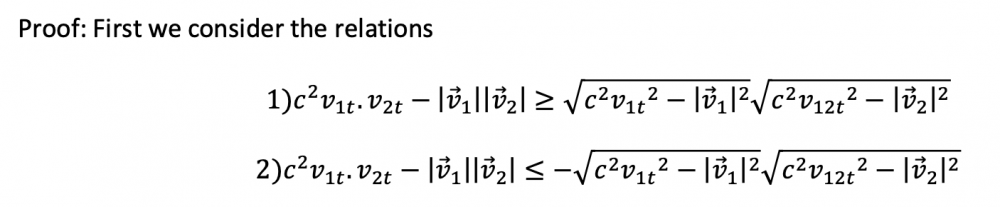
Two relations taken from your paper: Can you show that they are valid in the physics under discussion? As Joigus said:
-
It would have been interesting to compare that with those who were involved in selecting material for the churches made from bricks. I am not sure they would share your view. As far as I know the churches has not been flooded. If the people that built them were to know that they would last for hundreds of years they might claim that to be "evidence" for their view rather than your view. A scientist may instead have look at climate, geology and other factors for an explanation that better suits the spirit of this forum.
-
A note related to algorithms; quantum computers may have impact in the future: https://en.wikipedia.org/wiki/Quantum_supremacy https://science.sciencemag.org/content/370/6523/1460 (I do not have access to check this paper) Note! I do not know if the problem described in this tread will benefit from quantum algorithms or quantum computing. My point is just that ongoing research tries to address tasks that are not practical to solve due to problems similar to the problems in OP's approach.
-
http://letmegooglethat.com/?q=install+the+package+within+the+Pycharm+environment. The first hit on google returns a guide for: "Install, uninstall, and upgrade packages—PyCharm"
-
If you manage to reduce the search space to something that will be practical I guess there would be a lot of interest. There are many different approaches* in computer science to search for solutions in efficient ways when there are too many combinations to try. But I am not aware of any efficient way to do this by generating all combinations and looking at them one by one. Your idea looks similar to a brute force attack for cracking passwords; it is not practical when there are too many combinations to test. Sorry, I do not understand the above and its connection to the topic. *) Discussing such approaches in better suited for a separate thread in mainstreams sections.
-
Side note; around here there are several churches built using bricks. Oldest one was opened in 1192. A more recent example opened in 1959.
-
Generating combinations is not so hard. The problem is that there are so many combinations to generate. For the approach you have provided the wait will be very long.
-
It looks very similar to this thread: https://www.scienceforums.net/topic/123025-python-tree-program-multiple-children-module-error/?tab=comments#comment-1152593 have you tried that?
-
True, the statement seems ok (roots of quadratic equation)
-
Thanks, I'll check that later. Here is another one: Is that correct? It seems to imply that if 2>1 then 2<-1 which is not true.

-
This sounds like a different* approach than the random sentence generation in OP; encoding or embedding a large amount of specific knowledge before running any searches? Here is a paper about Deep Learning for Symbolic Mathematics: https://arxiv.org/abs/1912.01412 Here is an article commenting on the paper: https://www.quantamagazine.org/symbolic-mathematics-finally-yields-to-neural-networks-20200520/ Maybe the above is a simple version of what you are trying to achieve? *) I may have misunderstood something, could simply be a language issue.
-
Question: do you assume |a1| >=| a2| and |b1| >= |b2|? From your attached paper: Without |a1| >=| a2| and |b1| >= |b2| the square roots may be imaginary. Is that intended? From your attached paper:


-
Thanks for your reply. I'll wait until you provide some way you attempt to separate the valid data from the huge amount of invalid data. Also note that you keep repeating the same simple examples. An analogy with your rectangle: Assume the program gives "The area of a rectangle with sides 4 meters long is the sum of the length of its sides." 4+4+4+4 gives you 16 which happens to match the numerical value of the area. If we knew enough about area calculation to spot the issue then we had no need for the program? For a more contemporary example, the output could be something like "convolutional neural networks generally provide better results for image recognition than an architecture based on a recurrent neural network". it would be one of millions of similar statements.
-
You told me to wait: It seems though as my 1st question was answered. What we have looks pretty obvious; scientific papers written in the near future will most likely contain a combination of existing words (together with numbers and mathematical symbols). Even for some novel concept existing words and mathematics could be used to define the new concepts. My 2nd and 3rd question seems to be unanswered.