
Ghideon
Senior Members
-
Joined
Everything posted by Ghideon
-
Ok. But if the experiment is supposed to be totally independent of time then it would be ok if one of the clocks is standing still, or randomly change ticking? That does of course not sound correct so you probably mean something else. But that "something else" seems to be time. But the number is not allowed to change arbitrarily? The number of events is very highly tied to time; maybe you have a definition of frequency that is not depending on time?
-
You said the clocks were moving. How do you decide when to take the reading that you later wish to compare? You also seem rely on time since you expect the clocks tick at a specified frequency.
-
But then you still rely on time in the observations and also describe a different experiment? Also note that your experiment seems to give the same result for two different setups: A: two clocks deviating due to time dilation as per Relativity theories B: two clocks deviating due to one of them running slow caused by setup issues* *) Fictive example to highlight the issues, @swansont would most likely be able to provide something better
-
(Emphasis mine) Just curious: Without time, how do you relate the observations of number of events for two clocks? When comparing the number of events for each clock there has to be some concept of starting and ending the counting of events?
-
I'l have to do some creative translation to try to answer: Surge = move suddenly and powerfully forward=acceleration? Waist of time = waste of time = a delay relative to something. Do you mean something like time dilation? If my interpretation is correct the answer is: Yes, if you accelerate atoms (matter) relative* to a stationary observer it will cause a clock riding along with the accelerated matter to measure less time passed than what the stationary observer measures on a stationary clock. *) for instance a certain distance along a circular path until the atoms are back at the location of the stationary observer
-
What kind of programming is that? Large enough quantities of mass or energy* will have a measurable effect on time: An observer closer to a source of gravitation (mass) will measure that time passes slower compared to an observer at a larger distance from the source of gravitation. The effect is described in General Relativity. *) E=mc^2
-
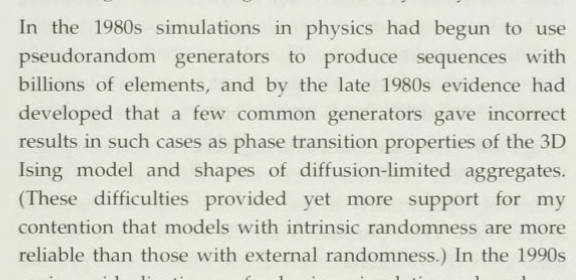
Not sure this is what you are looking for but physical computers are (usually) deterministic machines. Obtaining true randomness can be a challenge and there are cases where randomness is required, for instance in physics simulations or cryptography. So in theoretical computer science your question seems to make sense and in that case some kind of randomness needs to be "invented". Wikipedia has some information: https://en.wikipedia.org/wiki/Pseudorandom_generator And here is an extract from Wolfram, Stephen (2002). A New Kind of Science:
-
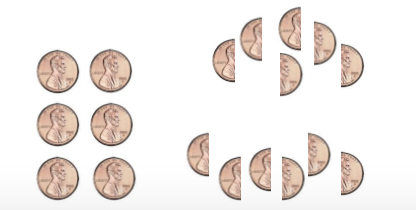
Then they are not pennies, they are mutilated coins, a change of units.
-
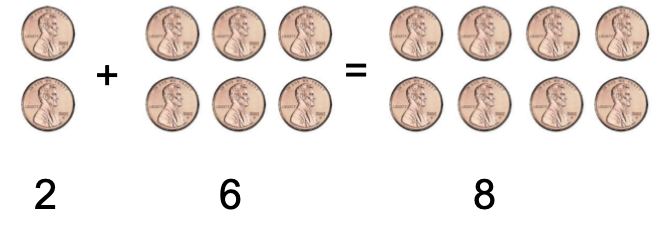
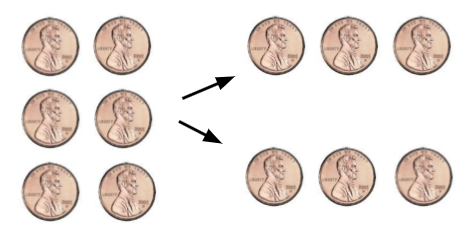
Maybe a picture helps you understand Janus answer? 2 pennies plus 6 pennies equals 8 pennies: It seems like 6 pennies split equally means 3 pennies each: That does not seem like a reasonable conclusion in this context. As Janus said, units will not be consistent if you do something like:
-
I read your opening post and I did not understand all parts of it. But I was curious and hence asked a question. I was under the impression that posting an idea on a discussion forum meant that you had an interest in a discussion. Seems I was mistaken, sorry. My comment will therefore be short: Your explanations are incorrect. Permanent magnets do not blow. Magnetic fields are not winds. Your force vectors seems to have incorrect angles. Your idea does not match observations.
-
Why? I don't see how there is a force component towards the magnet in both cases.
-
Check the amount of energy per square meter. Also, if you do not agree on the searchlight, please comment on the other two examples I gave.
-
Do you have a reference to material that have caused you to misunderstand physics? Your ideas does not match observations, examples: 1: If you were correct* then for instance a strong spotlight shining at an airplane at night would affect the airplane gravitationally. But searchlights does not cause airplanes to fall down. 2: Black holes does not give off electromagnetic radiation (light) yet scientists are able to measure gravitational waves from black hole collisions; gravity and light is not related** in the way you seem to claim. 3: Friction, strong enough to affect movements of celestial bodies would have a huge effect on their atmospheres and/or surfaces. We do not observe such an effect. *) You are not correct **) General relativity predicts behavior and interactions of gravity, energy and mass. It is a well tested theory that does not match your claims.
-
Are you looking for heuristics that could be developed and supported by science (models and observations) as comparison to reasonable methods that may be not scientifically tested? Example: sorting out all edge pieces that makes up the other boundary of a jigsaw is a reasonable starting point, but is it more efficient* than first sorting pieces by color? Your question also trigger many interesting thoughts regarding a human's approach vs what the outcome would be from a computer model. I'm thinking different that heuristics may be applied; for instance if there is only one way pieces fit due to their shape then the jigsaw could (theoretically) be solved even if pieces are upside down, by only looking at shapes. But for a tessellated jigsaw puzzle the shape is not giving away information where a piece should be placed. If two pieces of a tessellated jigsaw would have an identical printed motive then there are more than one possible solution. To me it looks like various types of jigsaws and hence the methods used to find the solution belongs to different "classes". Can these types be approached by formal mathematics**, analyzed and compared? If so that is another scientific aspect of jigsaw I guess. I'll postpone adding more machine learning aspects until/unless you wish to dig deeper into that area, I would risk turning this post into a blog at this time. I totalt agree. This triggers some healthy out of the box thinking, a good way to spend some of the time this first day on the new year***. *) as measured by some agreed upon scientific way, I have no suggestion at this time. **) I do not know what branch of mathematics that would be. ***) according to local time zone and calendar. standards here
-
Ok. Ok. I'll wait for that.
-
Brute force yes* Ignorance no. Brute force + ignorance probably no. Here is one paper not based on brute force or ignorance: https://arxiv.org/abs/1603.09246 (I have not had time to read the paper in detail) There are several properties of jigsaw puzzles that have interesting connections to machine learning in case you wish to discuss that aspect of your question.
-
It got lost in translation, may I ask for a clarification? Are we discussing a picture cut into various pieces or a saw with a fine blade enabling it to cut curved lines? I guess both can be approached scientifically. Unsupervised Learning within machine learning is one area where solving jigsaw puzzles is scientifically analyzed as far as I know.
-
I can't see that what you have presented would result in a manageable number of combinations to search through. None of the main issues with your idea have been addressed.
-
Can you provide me with an explanation instead of questions? You are claiming that all measurements within the solar system are off by a lot more that 10%.
-
Let's assume atmosphere effects cause parallax based distance measurement to fail by the huge amount you claim. Then please explain how parallax measurements are consistent with many other kinds measurements? All the various measurement methods fail but still produce similar outcome, how? Please provide a detailed explanation. Not unsupported claims; claiming that atmosphere can cause an effect is not the same as there is an effect.
-
Let's assume for a second you are correct. Then measurements that rely on angle and known distances on the surface of the earth gives wrong scale or distance for nearby celestial bodies. According to your idea: is basic trigonometry wrong or is measurements of distances on earth wrong? (Or both, or something else?) Please provide a detailed explanation.
-
I do not understand where you addressed this: The distance to Venus is more than one light minute. Distance to celestial bodies can be measured with experiments based on parallax and such a measurement relies on rather basic trigonometry. If your claim is right then every measurement of for instance distance from earth to Venus and earth to sun are wrong? Please provide a detailed explanation why you reject the results of basic geometry. Please include necessary mathematics to explain your version of parallax measurements. Does that matter? When someone shows enough interest in your thread to actually read it, compare the facts with established theories, try to draw conclusions and then ask for followup information it could be in your interest to try to answer and clarify rather than complain, repeat or add unrelated information?
-
That means you have a stable connection at this time. Options: Leave the terminals running until there is an issue and check the output. Or start both terminal commands again as soon as there is an issue with internet. And/or make a wild guess that DNS is the issue and add 8.8.8.8 as secondary DNS in your router though the administrative interface you posted. Side note: As a reference: example output when there are issues with the connection: % ping www.apple.com | grep -v "bytes from" PING e6858.dsce9.akamaiedge.net (2.22.41.97): 56 data bytes Request timeout for icmp_seq 154 ping: sendto: No route to host Request timeout for icmp_seq 155 ping: sendto: No route to host If internet connection is completely down there is approximately one new error every other second or so. For intermittent errors there will be a few lines printed, then nothing for a period of time. (Not possible to tell for how long) If the connection is very reliable then there will be no timeout or "No route" messages for maybe days or more. Due to the time difference I may not be able to followup until tomorrow.
-
I think you missed part of the command, "bytes from". Copy paste the string below ping www.apple.com | grep -v "bytes from"

-
That is ok, it just goes on. To stop the command you can use CTRL-c to get back to the prompt to type other commands. Next we will try to see if there is an issue externally. This may take some time to spot depending on how often there is an issue. We will modify the command to help Open two terminal windows In the first terminal type ping 192.168.100.1 | grep -v "bytes from" The ping will try to connect to the router. the vertical pipe sends the output to another command called grep. The grep will filter out all "OK" answers so that only errors will be printed on screen. That means you can leave the command running and check after a while that there are no timeouts or other errors. in the second terminal type ping www.apple.com | grep -v "bytes from" (Or any other reasonably stable website of your choice) You now have two ping running. If the issue is on your LAN or in the cable or adapter you should get errors in both terminals at the same time If your errors are in router or outside then the second terminal will likely print many more errors than the first terminal