
Ken Fabian
Senior Members
-
Joined
-
Last visited
Everything posted by Ken Fabian
-
@SuperSlim- The actual water molecules are constantly moving and do not returned to where they were. Irrespective of examples of "elasticity" in fluids (interesting, thanks studiot) water returning to the shape of a container after being disturbed - what is described in the original example - is not demonstrating elasticity.
-
Small differences between virus strains mean vaccines for one strain can still improve resistance against other strains. Where they don't then altering existing vaccines or creating new ones becomes necessary. WHO says -
-
Despite some outward similarities that is not elasticity. It isn't settling into that bowl because water is elastic, but because it is a fluid in a container, affected by gravity. The absence of other factors, like vibrations of the container allows the water to become still again. Other factors will matter - any variations in temperature within the water will result in water movement by convection and if in open air, the surface likely will be cooled by evaporation, so there will be continuing movement. Water has surface tension as well, affecting it's shape in a container, but if the water were elastic the bowl wouldn't matter - the water would retain the bowl shape without the bowl. It doesn't.
-
Truisms. They sound so right... yet can be so wrong; most people operate within the law because there are legal and social consequences to breaking laws aka behave badly. "Bad people" don't always find ways around the law. It may be imperfect but the rule of law has been profoundly beneficial. I think we have laws because people are more likely to be cautious of consequences than be good. Going by Plato's truism there would be no point to the rule of law - although I'm sure he had more to say about law and governance, with more nuance.
-
It is interesting as a thought experiment but I am doubtful of the actual viability of such "machines". The obvious answer is asteroids and comets but the practicalities of actually mining and refining them are pretty much entirely hypothetical. Without the active geology including liquid water of a planet (and often biology too) essential materials may not exist as usable ores. Complex machinery tends to require a wide variety of materials and we currently draw on a multitude of specialties to produce them - multiple specialties for just one material. Requiring mining on planets to obtain them greatly increases the difficulties. And what kind of energy sources will they use, especially at any great distance from a star? There will be high energy requirements and low grade ores are likely to require ever greater energy inputs to get the required amounts - with potential diminishing returns. I think it possible that energy requirements outside an inner solar system can exceed what is needed for the essential infrastructure, including energy production capability - ie there may be physical limitation (which would also apply to space colonies). Are these machines going to be building and running fusion power plants? Fission would be easier (but not easy) but whilst fissionable materials almost certainly exist there they are going to be at very low concentrations except on geologically active planets. Seems like these won't be merely machines somehow reproducing themselves - the requirements for interstellar space probes being anything but simple - it will be advanced machine economies made of multiple industries reproducing themselves. I think so unlikely as to be indistinguishable in practice from impossible. I am not sure what is required can be pared down sufficiently to work in the absence of a large and advanced industrial economy - where essential but difficult to refine and produce materials have a sufficient variety of uses and levels of demand that industries can be commercially viable providing them. When it comes to manufacturing machines to make machines that can manufacture themselves it seems we might be able to bypass those limitations but I suspect in reality there are physical limitations that cannot be readily overcome.
-
Once we move into the realm where salaries become a matter for negotiation rather than a set hourly rate do women earn as much as men? It seems to be a common claim that they do not, although I don't have links to demonstrate. They also appear less likely to be employed in those senior positions - some of which will, on the face of it, be her choice, possibly in negotiation with her husband, to not pursue such careers, in favor of more traditional roles such as child raising. But some won't really be choosing freely. I also think they don't get career advancement equality when they do choose such a career path. Some of those jobs seem to require an absolute job before family mentality and I suspect just being female leads to doubts (in predominately male selection processes) that they will in fact let someone else... care for sick kids or whatever, so the male applicants will be preferred.
-
@cultsmash - There is a big difference between truth and truisms - I see little of the former, lots and lots of the latter. What hasn't been demonstrated is any deliberate or systematic denial of freedom of speech. So far no-one here has prevented you saying anything, nor prevent others from disagreeing with you - although if the unprovoked insults keep coming (this forum has rules you are expected to abide by) and the discussion goes downhill far enough you might have to freely say things somewhere else. I expect people here will honestly and sincerely and freely (sometimes quite passionately) discuss and debate the benefits, harms, limits etc of free speech if that is what you want. Is that what you want? If you want everyone to agree with you - you won't get it. I personally draw the line at wishing people I disagree with harmed or dead and I avoid crude and gratuitous insults but will criticise freely where I think appropriate - freedom of speech means you have to put up with people disagreeing with you.
-
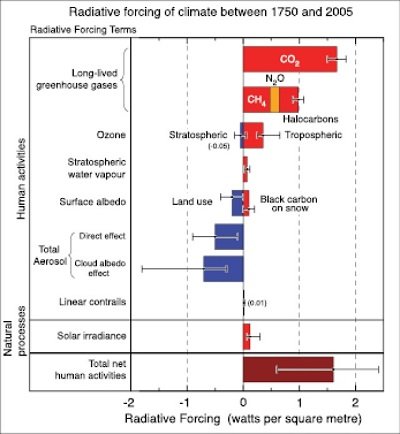
Well, this thread might omit things like milankovich cycles and I'd be surprised if climate modeling includes it - after confirming it is insignificant at the time scales they work with. Climate science doesn't focus only on CO2. But it is the biggest forcing, second only to the atmospheric aerosol pollution that masks a large part of how much we've been enhancing the greenhouse effect. In their role of advising the likely climate consequences of economically significant activities climate scientists are right to make CO2 the headline act - without neglecting the others - (a bit old, but.. Given the dominant role CO2 has in current warming, it's propensity to exceed the capacity of vegetation and ocean carbon sinks and accumulate, along with the susceptibility of carbon sinks to stop being sinks and cross tipping points to become sources aka carbon feedbacks (aka CO2 driven warming preceding rising natural releases of CO2) it is right for policy making to give it high priority. It is not the greenhouse potential of relevant atmospheric gases that is presenting challenges for improving climate change projections. In that sense climate science is a lot less about CO2 as about the internal climate responses and feedbacks. The overall, ongoing gain of heat in air, land and water is not in doubt. It is clearly evident, eg in the ocean heat content data, so "no change" has stopped being a valid null assumption. How that heat gain plays out in terms of the weather and climate we experience is challenging climate modelers; itmay be hard to pin down precisely but climate models are doing it more than well enough to on with.
-
In terms of modern biology such an organism would be defenseless and have no advantages over competing organisms; most likely it would be an easy meal for the abundant array of highly evolved predatory organisms we have now. The (unknown) conditions for such an organism to evolve and survive would have been very different to most of the current biosphere - even without competition and predators they may be unable to survive the chemistry of present day Earth.
-
I suspect it is the same culture war and conservative commentators like Peterson will pass over the reasonable feminists in favor of finger pointing at the unreasonable ones and encourage the unthinking to believe they are all like that. He seems to use his understanding of human psychology to identify the buttons to press - to provoke the nutters of one side to repellent idiocies and the biases of the ones to unthinking support of the political conservatism he chooses to support and promote.
-
They go back to late 1800's is because they have that data, from weather records, albeit with increasing measurement uncertainty the further back, and therefore they should not leave it out. Using 1950 as a starting point would include most historic emissions and most of global warming to date. It will show a higher warming trend over that period than the ones that go back as far as temperature records - leaving less room to argue global warming isn't happening, not more. Suggesting (accusing) climate scientists of deliberately misleading by doing so is kind of weird - as well as kind of slanderous. Pretty much any suggesting climate scientists are seeking to mislead is slanderous. Speaking of a burden of proof, and the allegations you make about climate scientists seem quite broad, some extraordinarily serious - but climate science, the least proved, is the only one that's "settled". That's because they've been driven out, not because there is any more certainty. The consensus is self perpetuating. It's nothing to do with evidence. All you get from climate science when you ask for the evidence is "we made this model". but they want to mislead. If facts don't fit the theory, change the facts. but the bad stuff, the over the top conclusions are not questioned. It comes across as trollish. Casually hurtful too, I would think - accusations and presumptions of serious professional misconduct with blanket nasty character judgements, of working climate scientists you've never met, without any evidence. Myself, I don't doubt lead scientists especially feel the great weight of responsibility that comes with being asked to provide the studies and reports and advice on something this serious, but you want to believe they are running an elaborate con-game? I can point out that global temperatures are rising, ocean heat is at record temperatures, that ocean heat does records most years now, that new daily record high temperatures occur a lot more frequently than new record cold temperatures, that global sea levels are rising, that the rate that sea levels are rising is rising... etc. To what point? You know this stuff, or can if you choose to. Or you can choose to believe all those measurements are unreliable, have been misinterpreted or even that they have been falsified; clearly you must be thinking along those lines. So, is it really a requirement that you be convinced for concerns about global warming to be credible. Is it really up to us here to convince you and if we can't then you can feel justified in holding to global warming fears being exaggerated or falsified? Governments have called for studies and reports, going back many decades and we know what they say - the same whether governments lean Left or lean Right and a credit to our scientists that they haven't bowed to the almost overwhelming political pressure to produce less alarming conclusions.
-
I've recently been through drought - the most extreme here recorded - and fire (the most extreme experienced, with extreme and unusual fire behavior) with local average temperatures raised above pre-industrial by 1.4C (1C global). The previous worse drought was only a decade earlier. Droughts and fires with global temperature at 3-5C higher - perhaps 4-7C average higher locally, potentially higher again during heatwave conditions WILL be catastrophic. It doesn't take specific study to have high confidence that such temperatures will be regionally catastrophic - but if you have to have them to take it seriously there are studies looking at the impacts on crop yields, infrastructure etc. As there are for attribution of climate change contributions to extreme weather events - https://news.climate.columbia.edu/2021/10/04/attribution-science-linking-climate-change-to-extreme-weather/ But maybe it won't ... get that hot? Be catastrophic if does? Because climate science doesn't look at the possibility that it won't? That all the understanding of climate processes they've built up and how they interact might be wrong and no-one is checking? Nonsense. Climate science checks it's assumptions all the time - and finds the fundamental ones to be sound. I think the kinds of questioning you think should be done has already been done and to be active in climate science you surely need to keep up; re-arguing the fundamentals that were subjects of intense scrutiny in the 1970's and 1980's is taking climate science backwards. If you quack like a duck - bring out the worn thin old doubt and deny arguments - and hold the science to be wrong until and unless you understand it and agree with it, hold it to be wrong because you think it is a conspiracy of incompetence or grant grabbing (or blind ideology or perhaps globalist/socialist/environmentalist conspiracy so remarkable even the top Intelligence agencies in the world can't find evidence) you probably are a closed minded climate science denier. Climate science isn't fuzzy and nebulous - like the "but they don't allow anyone to question", "it was hotter someplace a century ago", "they question the accuracy of someplace hotter a century ago, typical" those kinds of arguments (paraphrased rather than quotes) are just typically fuzzy and nebulous and false criticisms that climate science deniers use in place of showing where the fundamentals of climate science are wrong.
-
Pedantry I think. They won't find work in the climate field because of incompetence, not because they question; they need to show where and how current understandings and conclusions are wrong and they can't. They need to show their "superior" understanding is correct and they can't.
-
That fervency is a concern; fervency is a function of strong belief you are invested in rather than a question to be answered. In this case it is belief in something that is currently not achievable. I'm interested in what makes it seem so compelling to support it with fervency. Well, I did say it probably should be discussed independently - questioning why came out of the discussion and was not a deliberate attempt to hijack the thread.
-
I probably won't be able to make point by point replies and cover everyone - I know I am expressing what is a minority opinion (at least in this forum) and there have already been a lot of comments. I do think serious questioning of assumptions is in order - but I should also say I feel no special satisfaction from my conclusion that without extraordinary technological advancement that makes living on Mars a trivially easy proposition (and therefore not essential to species survival) it won't happen - and that there is nothing inevitable about that kind of technological progress. It is not a matter of time passing or even time passing whilst maintaining space agencies that have colonising space as a stated objective; that kind of advancement is about the long term health of whole economies and strong support for R&D of all kinds. And because technology is constrained by physical limits that can mean that even where things are possible they can remain uneconomic. Overall I've been disappointed that no commercial opportunities in space besides communications and Earth observation have emerged - but then, I was a child in the 1960's (with The Space Race) who was a keen reader of SF that almost universally promoted Grand Space Dreams, sometimes quite deliberately, eg leaving memes like low gee will be good for people's health and longevity to survive to this day. I was once an optimist and expected at least some zero-gee commercial manufacturing to have emerged that made space stations self supporting well before the turn of last century. I thought Moon bases would be a sure thing and the bootstraps principle - just go there (it being cheap and easy) and we would find and build the ways to make it work after. I've revised my views. I read and delighted in stories like Heinlein's Moon is a Harsh Mistress (space travel so cheap and easy Earth could dump convicts there, with echoes of Australia's convict colony heritage and subsequent successes) and I didn't question the practicality and economic viability of dirt poor people farming in tunnels - even managing to having pasture for milking cows as well as large scale agricultural exports. It never occurred to me just how much tunnel and supporting infrastructure, equipment and outside supply doing so would really require. Heinlein's positivity about going ungoverned - cool, no laws or cops - also got revised too. Turns out it is very difficult to do agriculture under such conditions, with costs that are somewhere well beyond extreme. Unfortunately we have been primed by fiction to believe it will (eventually) be easy and the costs won't be prohibitive. We will achieve the tech advancements that are achievable - a real question here about beliefs people have that progress is unending, in exponential style (I rather think it has to be an S-curve) or inevitable. I think it depends more on whether wealthy and Earth economies can encourage and afford doing open ended R&D than in having these Grand Space Dreams as explicit goals. It isn't simply a matter of time - the enduring health and wealth of Earth economies is far more crucial to those goals than maintaining focus on those specific goals. We can revive those grand goals in light of positive developments. We can't assume it is better to maintain them in the face of impossible odds rather than retreat and regroup and rethink. ---------- It sounds like the most fundamental belief is here is expansion into space is an expression of a biological (or perhaps social) imperative for long term survival of our species that includes by default some other species - with concern for the survival of other species probably determined by the extent of their usefulness rather than any overarching philosophy. But I don't see that we have been all that serious about addressing long term survival and avoiding or escaping global catastrophes or we would be seeing a lot more efforts put into lesser (but still very serious) risks, including into improving the good governance and priorities that would address them. The immortality of the species isn't on most people's radars - more of them will be coming at it as about individual immortality from a religious perspective than species/humanist, but I do see parallels; it gives a sense of security to believe there will be life after death. Human expansion into space - currently not much better than dipping toes in the water, but constantly hyped as desirable and inevitable - gives people a sense of security, a comforting belief that the human race will go on forever. The dedicated agencies we do have that are assessing our existential risks and developing responses are few and limited - and from that perspective expanding into space as a principle response starts looking like it kicks that can down the road rather than faces up to those risks, which include serious issues that need urgent attention and resources in the present. Switzerland is the only nation I can think of that can house it's whole population in bunkers - in part I suspect because they have cut so many tunnels, it meant adapting them rather than starting from zero. It isn't about saving a select few at the expense of the rest - which is how other nations appear to do bunkers. There is no suggestion the Suisse nation could expect to live permanently like that, yet if these concerns about existential risks (that supposedly drive space ambitions) were any kind of priority isn't that what the (nearer term) goal would be? Surviving the less than total catastrophes is essential to any goal of species immortality - a healthy, wealthy advanced Earth economy being the necessary requisite to achieving ongoing improvements to the space capabilities that are viewed by our space optimists as the ultimate insurance. I think it takes other less noble motivations to keep space agencies well funded and that colonies are not strongly supported goals in and of themselves. Without those other motives the whole space as the route to species immortality thing would be harder to sustain. I wouldn't say it is a pragmatic course to look to expansion to space as our way to species immortality - to me pragmatism would look at all our options, short and medium and long term and admit the gap between what is required and what we are capable of is extremely large and focus on nearer term goals using other options. Whilst we can count on improvements to technologies in the near term there are none in the offing that makes a self reliant Moon or Mars colony an achievable goal. We should not pretend it is, no matter that the idea of species immortality has a feel-good quality and we want it to be achievable -part of why I think the support for grand space ambitions like that has little real bearing on what space capable nations are doing. International rivalries and military considerations have more to do with keeping NASA and others well funded, which funds contractors like SpaceX in turn. SpaceX hype about Mars keeps public interest and support for space agencies high, which comes back around as further contracts. But I maintain that without clear commercial viability no private company will do more than token Mars missions (where they won't risk ongoing company viability). I think no amount of taxpayer funded Mars ambition can compensate for the absence of profitability, irrespective of how the idea of humans expanding beyond Earth is comforting.
-
I'm willing to discuss why I think seeding Earth life on planets around other stars is an unworkable and ethically dubious sci-fi fantasy and is not science - although I am not sure what I would add that I haven't said. I am also willing to discuss why people are so taken by such unrealistic ideas - the philosophy or ideology or whatever it is that underpins popular belief that expansion into space is some kind of species saving necessity or destiny or inevitability, even when I suspect I will be outnumbered amongst an atypical selection of people who include more enthusiastic and interested optimists than within the broader community. Probably better for another thread. If it appears condescending of me to fail to hold those Grand Space Dreams as self evident and beyond argument - to treat buying into it as a potential human failure rather than noble and glorious - so be it. That some (maybe most) people here do appear to treat future human expansion into space as self evident and beyond argument seems indicative of something very different going on than scientific curiosity. But I am not sure we can discuss it without personal insults when I suppose just claiming it not entirely rational - and may be driven by primitive biological urges rather than logic and reason - will probably be taken as insulting.
-
I read enough of the links to be impressed with the amount of effort Gros has put in and disappointed in the value judgements that are fundamental to his promoting this a good thing to do. In discussing the ethics (which there was not much of) we get what I think are shallow lines like - "In contrast one may note that the microbes living on old earth, being them bacteria or eukaryotes, have never enjoyed human protection." I don't get the impression that Gros is actually open minded about whether this is a good and wise goal, rather that he is promoting it as a good and wise goal. Just not doing a good job of it imo. It may be written up in science paper style and contains sound science based examinations of what such goals might require but it is all very much promoting a Grand Space Dream in the unquestioning style of an enthusiast, which impresses other enthusiasts. It involves science but the why of it - the very core - is not science.
-
@beecee - I have never suggested life, intelligent or not, must be rare in the universe - we just don't know - but in fact I do think abiogenesis is likely to be common, and think that is an argument against seeding planets from afar. Sure, I think Mars offers nothing worth sending crewed missions for and that unrealistic hype about it deserves being called out. Looking for life is probably the best reason to want to explore Mars and the capability to do that comes from a grounded economy made up of grounded people who retain curiosity but aren't explorers or colonists or ever expect to live anywhere else, for whom Space is about national pride and infotainment, when they pay attention at all. Looking for evidence of life off Earth is best done with probes. Pretty much everything of value we do in space can be done without astronauts. "Space Faring Species"? Feel good hype imo, not supported by the reality. I really do think the Genesis Project is science fiction parading as science and the goal itself - spreading life beyond Earth - is not science. You can disagree with me. I sure disagree with you.
-
Science fiction parading as science? Biology is Destiny? (Freud apparently, but a different context). We don't know how common life is or how like or unlike terrestrial life other life is. We don't know if non-biological oxygen rich worlds exist - none have been identified, they are hypothetical - or know if they will be truly sterile. Attempting to find out would be science. Seeding sterile worlds to see what happens could be science. Seeding worlds in order to spread life isn't science. A shame Mr (Pr) Gros has wasted so much intelligence and energy on this; applied to something worthwhile would be better.
-
"Obliged" how? If you are trying to put the question and your answer onto a science footing I think you are not succeeding. To me "Probable sterile worlds" is a lot different to "sterile worlds" but the practicalities of how panspermia might be done deliberately are a side issue when it isn't clear why we should devote resources to it. Calling it human destiny or any kind of inevitable doesn't really do it. Space faring species is a bit of - a lot of - an exaggeration or maybe hyperbole. We'll go further and further sounds like a marketing slogan. To me the more you try to defend panspermist ambitions as based in science the more like belief, ideology, religion it sounds. A psychological or perhaps that should be slight-illogical problem?
-
The Genesis Project sounds like hubris to me. And there are some big assumptions about our ability to tell from afar if the planet is sterile or if there is any native life present or, I suppose, life seeded by other Panspermists. Probes that must be pared down to barest functional minimum to support the mission objective of seeding planets don't sound like they will be capable of the comprehensive planetary survey required to determine if life is present. I don't think we will have failed as a species if Earth life fails to spread beyond Earth or outlive it. Billions of years seems like an extremely generous allotment.
-
I think the question probably belongs in Psychology or perhaps Religion - Panspermia as a matter of naturalistic rather than strictly religious belief in human destiny to spread themselves and terrestrial life into space or something. Why we might support it is only tangentially about expanding knowledge. I don't think entertaining such ideas is really about doing science.
-
Were this readily achievable, perhaps it would be something to consider in detail. As long as it isn't, I would say no. I wouldn't say yes even as a hypothetical because, hypothetically, there would be a lot of considerations, including that it closes off opportunities for life apart from Terrestrial. That might even include closing it off to other Panspermist inclined species or upsetting species that might object to Panspermia. I don't see it as anything like sailing ship era practices of leaving animals like goats in anticipation of later visits - it won't be about humans and preparing worlds for future visits or colonisation; it offers nothing that tangibly benefits those doing it. If it primarily about introducing extremophile micro-organisms it won't save the great diversity of Earth life from extinction - and if people cared enough about that we'd be doing a lot more to preserve and protect them a lot nearer to home. For all that it would seem to be noble and uplifting in ways people would support I suspect most people most of the time won't really care that much and I'm not sure those commenting here are going to be representative of attitudes at large. A sustained effort to convince people that it is worthwhile might be needed - and more likely aimed at evoking crude emotional responses (like with promoting colonisation of Mars) rather than based in deep reasoning. I do wonder if there are likely to even be worlds capable of sustaining life that fail to develop it (as a possibly inevitable consequence of being capable of it plus billions of years of opportunities). Capable of sustaining life but not having any could be exceptional - but we don't know. It would be a difficult process to determine if a world capable of supporting life is in fact lifeless - check every undersea vent and artesian resevoir? Sending automated probe/seeders with limited capabilities to assess - working on too simplistic assessment criteria, eg gross atmospheric indicators - seems unwise. I suppose nations or coalitions might consider such things if they become capable of it and it is popular and widely supported. It isn't something normally within the duties of care or scope of governments as we have them.
-
What are "coding principles"? Why are they relevant to biological evolution? Most mutations will be either irrelevant or "garbage" but those that are deleterious get taken out by natural selection. Development of new anatomical structures is rare and much less likely after they have already evolved and successful organisms that reproduce in vast numbers already have them. Most of the significant and complex anatomical structures go back a long way; the advantage of crude sight when everyone else is blind is much greater than when everyone else has eyesight with hundreds of millions of years of evolution behind them. Hard to believe is not a science based conclusion. It isn't even scientific skepticism; true skepticism includes a commitment to learn rather than simply argue the negative.
-
Um, if the ground rotates the wheels using vehicle momentum to turn the propeller it will slow the yacht/vehicle down in direct proportion to the (ideal) thrust. To me that doesn't appear to explain it. The bike vid example you provided did a better job, showing that there is still wind interaction with the moving vane as it passes through still air, and in the correct direction. I think it got me thinking in the right direction but it hasn't got me to the finish line. Unless that IS the finish line? The notion that those vanes are acting much like a keel/centreboard keeps coming to mind - like the way the wheels prevent a sideways motion so a tangential force only produces motion along a predetermined line rather than principally a means of providing power; not sure that is helpful or not. It is fundamental to conventional sailing of course but in this case the vane's motion is connected to the ground, not the yacht... and I may be just circling back on myself... And that didn't really help either - which could be more about my comprehension than the quality of explanation. I may yet encounter an explanation that better suits my comprehension and I expect I'll keep coming back to this until I have understood it..