Leaderboard




Popular Content
Showing content with the highest reputation since 03/28/26 in all areas
-
Interesting article from 'Interesting Engineering' https://interestingengineering.com/science/scientists-discover-liquids-can-fracture So a simple question on this, what makes a liquid, a liquid in terms of viscosity, given that water is free flowing (if put on a tray and the tray is moved around the water will move around freely). However, if I put cooking oil on the tray and move the surrounding tray requires more tilt to move the oil, (it also depends on friction from the tray I guess (smooth vs rough surface). So do we think about solids and liquids differently ? By fracturing are they suggesting that the bonds in the molecules break or are they referring to the forces that hold the molecules in state where the state would be classed as a liquid. I think oils have long chain, so is it the chain that is pulled for forced apart. Paul2 points
-
2 pointsTrump Says Intelligence Played No Role in His Decision to...“Intelligence is for losers.”2 points
-
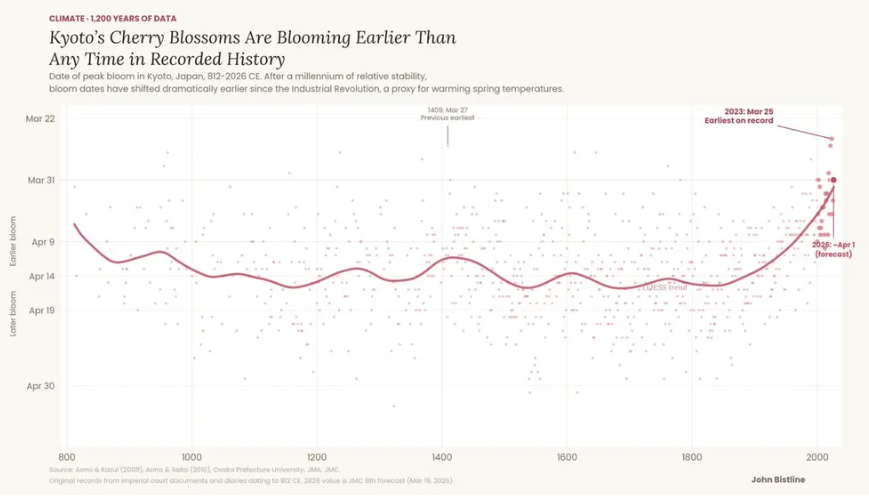
This chart of Japanese cherry blossom seasons going back to 812AD seems to support the onset date of the current climate change cycle as happening during the industrial revolution. of the mid-1800's.
 2 points
 -
2 pointsGreetings. Learned something today, as how was determined. Came to this article recently. It is not news to be posted in 'Science news' ; decided to post here unless deserves moving somewhere else. ========================================================================================================================= Clair Patterson He discovered how old the Earth was. Then he discovered something that could destroy us all. For thousands of years, humanity wondered about the age of our planet. Religious texts offered one answer. Philosophers debated another. Scientists made educated guesses based on fossils and rock layers. But nobody actually knew. Until a quiet scientist named Clair Patterson figured it out in 1953. He should have become instantly famous. His name should have appeared in every textbook. Instead, what he discovered next turned him into a target. He found himself standing alone against one of the most powerful industries on Earth, fighting a battle that would determine whether millions of children would grow up with damaged minds. And for decades, almost nobody knew his name. Patterson's journey began in the late 1940s at the University of Chicago. He was a young geochemist with an impossible assignment: measure the precise amount of lead isotopes in a meteorite fragment called Canyon Diablo. The theory was elegant—if he could measure these specific lead ratios accurately, he could calculate when the solar system formed, and therefore, when Earth was born. But there was a problem that nearly broke him. Every time he tried to measure the lead in his samples, the numbers were wildly inconsistent. One day high, the next day higher, never stable. His equipment seemed fine. His calculations were correct. Yet the data was chaos. Most scientists would have given up or blamed the methodology. Patterson was different. He possessed an almost obsessive attention to detail and patience that bordered on stubborn madness. One day, he realized something shocking: the problem wasn't his rock sample. The problem was everything else. There was lead everywhere. On the lab benches. In the air. Tracking in on people's shoes. Floating as invisible dust particles. The entire world was contaminated, and it was sabotaging his measurements. So Patterson did something unprecedented. He built the world's first ultra-clean laboratory. He scrubbed every surface until his hands bled. He sealed cracks in walls with tape. He installed specialized air filters. He made his assistants wear protective suits and wash repeatedly before entering. For years, he cleaned and refined and eliminated every possible source of contamination. Finally, in 1953, he achieved it. He got a clean reading. He ran the numbers through a mass spectrometer, performed the calculations, and suddenly held an answer that no human in history had ever known: 4.55 billion years. The Earth was 4.55 billion years old. It's said that in his excitement, he drove straight to his mother's house in Iowa and told her he'd solved one of humanity's oldest mysteries. The weight of not knowing had finally lifted. But while building his clean room, Patterson had stumbled onto something far more disturbing. Where was all this lead coming from? Lead is naturally rare on Earth's surface. It stays locked deep underground in mineral deposits. It doesn't float freely in the air. It doesn't coat laboratory tables. Yet it was everywhere—in quantities that made no sense. Patterson began testing the world outside his lab. Ocean water. Mountain snow. Everywhere he looked, lead levels were hundreds of times higher than natural background levels. And then he understood. Since the 1920s, oil companies had been adding a compound called tetraethyl lead to gasoline. It prevented engine knock and made cars run smoother. But every car on every road was functioning as a poison dispersal system, spraying microscopic lead particles into the air with every mile driven. Lead is a neurotoxin. It damages developing brains. It lowers IQ. It causes behavioral problems, aggression, and cognitive impairment. And an entire generation of children was breathing it every single day. Patterson had to make a choice. He was a geochemist. His job was studying rocks and isotopes, not fighting corporations or advocating for public health. He had stable funding and a promising academic career. He could have simply published his Earth-age discovery and moved on to the next project. But he couldn't unsee what he'd found. In the mid-1960s, he published papers warning that industrial lead contamination was poisoning the environment and harming human health. The response was swift and brutal. The lead industry was massive, wealthy, and had no intention of losing billions in revenue. Their chief scientific defender was Dr. Robert Kehoe, who had spent decades assuring the public that environmental lead was natural and harmless. Kehoe was polished, well-funded, and had the backing of powerful corporations. When Patterson challenged this narrative, the industry attempted to buy his silence. Representatives visited him offering generous research grants and institutional support. All he had to do was redirect his focus elsewhere. Patterson refused. So they tried to destroy him professionally. His funding from petroleum-connected sources was immediately cut. The industry pressured his university to dismiss him. They used their influence to block his papers from peer-reviewed journals. They publicly dismissed him as an overzealous geologist stepping outside his expertise. For years, it worked. Patterson was marginalized, labeled an alarmist, and isolated from mainstream scientific discussions. But Patterson had something the industry couldn't counter: evidence from before the contamination began. He realized he needed a time machine—a way to prove what Earth's atmosphere was like before automobiles. So he traveled to one of the most remote places on the planet: Greenland. In brutal, freezing conditions, Patterson and his team drilled deep into ancient glaciers, extracting long cylinders of ice. These ice cores were frozen time capsules. Snow that fell in 1700 was preserved deep in the ice. Snow from 1900 was higher up. Snow from the 1950s was near the surface. Back in his clean lab, Patterson carefully melted layers of ice from different time periods and measured their lead content. The results were devastating to the industry's claims. For thousands of years, atmospheric lead levels were essentially zero. Then, starting precisely in the 1920s—exactly when leaded gasoline was introduced—the levels shot upward like a rocket. The graph was unmistakable. The contamination wasn't natural. It was recent, man-made, and accelerating. Armed with this irrefutable proof, Patterson returned to the fight. He testified before congressional committees, sitting across from industry lawyers who tried to confuse the science. He wasn't comfortable with public speaking. He was nervous, awkward, and preferred the quiet predictability of his laboratory. But he refused to back down. He told legislators they were poisoning their own children. He showed them the ice core data. He made the invisible visible. Slowly, reluctantly, the truth broke through. Other scientists began supporting his findings. Public health advocates took notice. Parents started demanding action. The tide turned. In the 1970s, the United States passed the Clean Air Act and began the slow process of removing lead from gasoline. It took years of regulatory battles, but eventually, unleaded gasoline became the standard. The results were nothing short of miraculous. Within years, blood lead levels in American children dropped by nearly 80%. An entire generation was saved from cognitive impairment, behavioral disorders, and reduced intelligence. Millions of lives were protected from lead-related health problems. Clair Patterson had won. Yet when he died in 1995, few outside the scientific community knew his name. He never received a Nobel Prize. He never became wealthy. He simply returned to his laboratory and continued studying the chemistry of the oceans and the history of the Earth. Patterson's story is a reminder of what integrity looks like when nobody's watching. It's easy to do the right thing when the crowd is cheering. It's infinitely harder when powerful interests are trying to ruin you, when your career is threatened, when taking the money would be so much easier. He could have stayed silent. He could have enjoyed a comfortable, well-funded career studying rocks while children's minds were damaged. He could have said, "Not my problem." But he looked at the data, looked at the world, and decided truth mattered more than comfort. He gave us the age of the Earth—a number that changed our understanding of time itself. And then he gave us a future—a world where children could grow up without poison in their lungs. We often imagine heroes as soldiers, activists, or celebrities. But sometimes a hero is just a stubborn man in a white lab coat, scrubbing a floor over and over, refusing to accept a convenient lie. He cleaned the room. And then he cleaned the world.2 points
-
So gases ( like air ) can 'fracture' also, at the shock line between supersonic and subsonic flow. ( just glad to be discussing something other than made-up 'theories of everything', or drug induced 'consciousness' in QM ) True, but they also adapt to reflector 'astigmatism' induced by differing mirror orientations. ( astigmatism is different curvature along different radial axis; I have plenty on my corneas due to scar tissue from many operations )2 points
-
1 pointTIL about the deep scattering layer, aka false bottom, in the ocean https://en.wikipedia.org/wiki/Deep_scattering_layer “a layer in the ocean consisting of a variety of marine animals. It was discovered through the use of sonar, as ships found a layer that scattered the sound and was thus sometimes mistaken for the seabed”1 point
-
I still would like to know whether @Otto Kretschmer means 'motivated reasoning' in a sense that specifically can be phrased as, As defined in https://www.sciencedirect.com/topics/psychology/motivated-reasoning1 point
-
Where do you place the starting gun, then? I'm thinking now that I may have misunderstood what the words 'motivated reasoning' mean in psychology. If I understand correctly, it's about emotional bias. From https://www.sciencedirect.com/topics/psychology/motivated-reasoning:1 point
-
1 pointWhat do Surrey and Bedford have to do with post war aviation history - an air show ? When I was in high school I used to take the dog past the Handley Page factory (now a museum). That was post war history. 'Small Beer' the industrial beer of steelworks and other places.1 point
-
1 point"Trump Says Intelligence Played No Role in His Decision" Nor for the people who voted for him.1 point
-
1 pointA man poses for a photograph with a gold-painted, faux-marble toilet sculpture titled "A Throne Fit For a King" that was installed March 31 near the Lincoln Memorial. The Secret Handshake, an artist collective, put up the statue, which mocks President Trump's renovation of the White House bathroom attached to the Lincoln Bedroom, a project that drew criticism for taking place during a government shutdown.1 point
-
In my ~25 years in the DC area I saw the noticeable advancement of the cherry blossom peak and a corresponding shift in the fall foliage1 point
-
Since you didn't say which ones I am going to start at the beginning, but assume you have some intuitive idea as to what is meant by a force, commonly stated as a push or a pull. This is a good start, about where Archimedes was coming from, but we need expanded detail for modern consideration. The weight of an object is a force. You can use that force to exert a push on something, by standing the object on it, say a brick on a table. Or a pull on that something by hanging the object from it, by a string, Or you can develop what is called a turning moment by pulling on one side or the other, tipping a wobbly table with a pile of bricks. This third use of a force is not often included in the popular definition, but we will use it later as it is very important in landslips and soil failures. Archimedes realised that the weight of an object is lessened by immersion in water, though it regains its original weight when removed from the water. He had discovered what we now call the bouyancy force, which acts against the weight force of the object itself. Though he didn't think of it in that way, in doing so he had discovered the idea of a net or resultant force. This is what happen when two or more forces act on the same body. I haven't the time tonight to do any sketches, so having set the scene I will continue tomorrow to extend Archimedes to Terzaghi's soil loading equation (Which is actually very simple). We have also found out that we need to know more about how to apply a force and I will address that which will lead to the idea of stresses and strains. How are we doing ? Meanwhile if you watch the BBC Devon local website there is a short but good video of a landslide that occurred last weekend near Teighmouth. https://www.bbc.co.uk/news/england/devon1 point
-
I have disagreed with Otto on several occasions, but on this one I cannot see why so many folks are addressing a different topic than what has been stated and clearly amplified by the OP. I think it important to distinguish between instinct and intuition in this case.1 point
-
Cool take. Saw fully blooming cherry blossom trees in a small German town just last week and did the Washington DC peak bloom trip with my kids this time last year. Hadn’t realized we’d have had to plan same trip for April during earlier centuries but it completely makes sense1 point
-
1 pointLiverpool St is a bit out of my way as a S Londoner, so I can't tell you what it's like. But apparently a Young's pub, so will have at least some real beer. Though Young's sadly no longer has their original brewery in Wandsworth. When I was rowing, in my Putney days, the club used to get deliveries from Young's on a horse-drawn brewer's dray. Splendid carthorses: huge creatures, with hairy hooves. The horses used to make all the deliveries within 2 miles of the brewery. A wonderful marketing idea and cost-effective apparently, due to the terrible traffic jams in the area. Here they are at a pub on the Thames in Richmond where I occasionally go for a session with one of my brothers:1 point
-
Another hockey stick. Also reminding that the Medieval Warm Period was not globally uniform. Warmer in the north Atlantic region, but not in the Far East (though data back then was kind of spotty). https://en.wikipedia.org/wiki/Medieval_Warm_Period1 point
-
I think the title might be the wrong way around. What I mean is that first animals at some point developed the ability to: Which I interpret as the ability to intuitively make assumptions about the world around us. This is something we share with (I think) most animals to some degree. I think the ability for higher level reasoning came later, and the "motivated reasoning" is applying higher order reasoning skills to justify intuition. Obviously for complicated situations this approach is faulty as everyone recognizes, but doing more thorough analyzes is harder and often requires additional skills that many may be lacking. So the reasoning then defaults to the intuitive approach.1 point
-
Moderator NoteYou’ve been afforded ample opportunity to cite some actual science. Since you have not, this is closed1 point
-
Elsa the lion(ess) Indeed, and possible responses to any issue can be quite complex. But the starting point would normally be the recognition that there is an issue. Thank you for your measured response. This will make for a much better discussion.1 point
-
Yes, it does. It is an effective manipulation technique.1 point
-
I should have thought the reason is to enable quick decisions, without having to wait until it is too late to act. One uses partial evidence and consults one's prior learning and experience as to what the evidence suggests and decides on the basis of what seems probable. We do it all the time. I think you are not correct to assume these decisions are based on no evidence. It is just that the evidence supplied is misinterpreted due to biased learning. For instance: light in the sky, moving apparently oddly, without sound -> little green men, because we've just read "Chariots of the Gods".1 point
-
If you want to understand all this, we need to start back 250 years before Christ, when a Greek gentleman made his famous utterance about Archimedes Principle. The interesting thing is that the importance of AP, in this context, was not enunciated until after Relativity, after QM and after Godel in 1936 when Terzaghi introduced the notion of 'effective stress'. So I am going to ask if you understand the notions of contact force, contact stress, and the classification into direct (also called normal) force and stress and (not indirect or abnormal) but tangential or shear force and shear stress, Liquid mechanical behavious is controlled by shear stress, as is soil and rock mechanics in regard to failures such as landslip, avalanche, slope stability and so on. Soils break due to shear failure in almost every case. If you are not sure about any of the terms please ask and I will include the necessary explanations in my next post. Conceptually it really is quite a simple subject ( mathematicians can always make it more hairy than it really needs to be) High stress is just not necessary. Did you manage to access the full paper by any chance ?1 point
-
Gravity plays a big part though, somehow analogous to the high stress that the authors of the paper mentioned for the case of fluids.1 point
-
1 point
-
That's interesting. Granular solids can be made to act like liquids. We regularly 'float' Sulphur prills, or flakes, on a cushion of N2 pressure, so it acts 'liquidy', and we can suck it under vacuum into a reactor for dithionation processes ( flakes need different N2 pressure than prills ) at my work. This effect is also seen in avalanches and land-slides. By the way, @studiot , there is no such thing as a true 'two by four'.1 point
-
I think the authors of the paper talk about stress regimes, rather than velocity regimes. They also seem to limit their definition of breakage or fracture to what happens with metals. But the real world is a heck of a lot more complex than solid, liquid or gas. So is a carbon fibre fishing rod a solid ? How about a four by two piece of 'solid' oak ? (Why do the americans insist on two by four?) Both are fibrous, not crystalline. But what about soil ? The mechanics of soil and its response to stress depends upon load sharing between the granular solid particles and soil pore water. @exchemist mentions bitumen. There is the bitumen drop test, an experiment that has being going for nearly 100 years. Then there is Griffith's theory of strength and fracture and J E Gordon's experiments with alleged flows of old window glass. @paulsutton Yes graphite can be considered as a stack of monolayers of carbon. In fact I know of 4 allotropic forms of carbon viz Diamond, Graphite, Amorphous (soot, coke, charcoal, etc) and Buckeyballs. There are also many potentialy infinite planar lattices of aluminosilicate materials. Some of these make up the clay minerals group with characteristic clay failure modes and the atterberg limits test.1 point
-
“Scientists have developed a breakthrough “superfood” for honeybees by engineering yeast to produce the essential nutrients normally found in pollen. In controlled trials, colonies fed this specially designed diet produced up to 15 times more young, showing a dramatic boost in reproduction and overall health. As climate change and modern agriculture reduce the availability of natural pollen, this innovation could offer a practical way to support struggling bee populations.” https://www.sciencedaily.com/releases/2026/03/260327000518.htm1 point
-
However the elephant in the room is industrialised agriculture, things like pulling up the hedgerows to make giant fields that are easier for ploughing and harvesting. Wildlife diversity collapses. Making yet another industrial intervention to try to correct the damage done by the original industrialisation does not sound like a brilliant strategy. However better than doing nothing, certainly.1 point
-
If the path is not possible its not included this includes faster than c. Quantum tunneling is a possible path so is inclusive as it describes how a particles can cross a potential barrier higher than their total kinetic energy so it also has a non zero probability.1 point
-
1 pointFollowing a mobile phone charging issue I came across this intriguing discussion thread on reviving dead batteries and or devices. It starts off with a phone but goes not to rechargeable tools (drill, chainsaws etc) https://www.ukworkshop.co.uk/threads/how-i-charged-an-old-removable-mobile-phone-battery.146855/ I'm sure we could all learn something from this, for example DeWalt device battery terminal1 point
-
First let me say thank you Paul for bringing this to our attention. +1 However the linked article seems more like the hyped up writings of a sensationalist journalist, than an august Professor. What is meant, for instance, by pulling a liquid apart ? or by breaking a liquid ? The classification into solids, liquids and gases was known 100 years ago to be seriously simplistic and unable to describe the behaviour of most materials in the real world. A good question to ask is what causes solids to break ? In fact solids have several different breakage mechanisms available, including one where the solid cannot break at all as it is so confined. So a second good question is what gives them their strength ? A third one might be what is a solid ? A pile of dry sand or wheatgrain follows the laws of fluid mechanics. What about a tube of toothpaste ? All these issues and many more are largely ignored by physicists, but taken up by Rheologists, Chemists, Pharmacists, Geologists and others. There is significant modern research into the properties of monomolecular layers. So where would you like to start ?1 point
-
1 point
-
1 point
-
1 pointIt means the English don't have rules that stay inert over time. They change according to the needs and social whims of the era. Common contemporary usage of a word becomes its de facto definition. English dictionaries are records of historical usage, and not authorities. A word's meaning may change over time due to a change in popular usage. Does that make sense?1 point
-
https://en.wikipedia.org/wiki/Glass_transition I see here changes in heat capacity with increasing temperature on curve on the right graph..1 point
-
This is sort of interesting. I thought this, but someone told me that is wrong because window glass, for example, is below something called the "glass transition temperature". So, according to this, a glass is an "amorphous solid" rather than a very viscous liquid. However, when I look up what a glass transition temperature is, it appears it is an imprecisely defined range of temperature, rather than a specific value. Furthermore, when making this "transition", there don't seem to be any of the features one associates with a genuine phase change, such as release of latent heat, change in order at the molecular level, etc. So now I am left with the suspicion that the distinction is a bit bogus and based only on how it seems best to treat the material in practice, rather than any physical or chemical change in state. But I'd be interested in a comment from anyone better informed.1 point
-
This immediately made me think of bitumen. Bitumen blocks will slowly flow under their own weight, given enough time, yet you can shatter them with a hammer. Technically bitumen is a liquid, but one that is so viscous it behaves in practice more like a solid. So I suppose what they have done is explore this for liquids of relatively low viscosity and found there can come a point at which the liquid is unable to flow fast enough to react to the force pulling it apart, whereupon it breaks like bitumen. I would imagine in molecular liquids the bonds being broken will be just the intermolecular forces rather than the bonding within the molecules.1 point
-
1 pointWell I don't often link to other discussion sites, and I only found that one because I needed to fix a mobile phone, that was apparantly out of battery. A replacement battery didn't fix it, so I looked for the ideas presented in that discussion concerning the charging circuitry and a loose ribbon cable. In the event there was no ribbon cable, the micro usb was firmly soldered onto the one piece mainboard. However disassembly and reassembly brought the old battery and system back to life. But it still did not like the replacement battery - allegedy the same type number. Interestingly when I tested the new and old batteries off load they both showefd 4.1 volts - a bit high for the nominal 3.7v. ~As I said there were many lesson for those who read the discussion, not least the need to keep Li-ion batteries topped up every few months. My usage of portable power tools is diminished these days and rather intermittent and I do find the discipline prolongs active life PAL for those who rember the dogfood adververts.1 point
-
1 pointYeah. As Stringy says, these 'tendrils' that form internally, short out the battery and make it useless. I've 'rejuvenated' old Ni-Cd cells and Ni-MH cells in the past, by using a higher charging voltage to burn the 'tendrils' and fix the internal shorting, but Li-Ion have so much protection built in ( some actually microprocessor controlled ) that it's virtually impossible, unless you open the battery case, take out the individual cells, and rejuvenate them individually before reassembling in the battery case.1 point
-
1 pointWeird. I don’t seem to have acquired any recently. Could it be Tiassa under a pseudonym, conducting a vendetta? 😆 Or maybe it’s Lizardberg exercising his uncanny internet power to destroy you.1 point
-
1 pointIt turns off permanently by design if the residual cell voltage drops below about 2.7v. The normal operating voltage is 3.2v - 4.2v. The 3.2v point is the arbitrary 'zero' point. At some point just below that, the battery is considered to have 'failed' and the circuitry disables it. If the voltage further drops below 2V, the lithium can turn metallic and form web-like structures, which can short-circuit the cell, heat up rapidly and go into thermal runaway. I've seen it twice and nothing can stop it. It's like a jet engine. E2A: Here's the Battery University site's take on reawakening sleeping batteries: Battery UniversityBU-808a: How to Awaken a Sleeping Li-ionLi-ion batteries contain a protection circuit that shields the battery against abuse. Depending on the manufacturer, the protection circuit of a Li-ion…1 point
-
Wondering if they mean current theories are flawed? Dark energy discrepancy, Hubble tension, GR/QT compatibility issues?1 point
-
1 pointSo drying out the mucous membranes and......bingo! I see. That makes sense.1 point
-
1 point
-
1 pointAt least they didn't have to sit through another turgid and incomprehensible speech delivered in robotically inflected English...1 point
-
Here is an excerpt from the Times of India that contradicts your statement. The Times of India6 animals that live without a heart and still survive in...We usually think of the heart as something every animal needs– pumping blood, carrying oxygen, and keeping the body alive. It’s seen as one of the most essential organs. But nature often breaks the ru1 point
-
We don't do astrology here. Take this crap somewhere else.1 point
-
Whilst some jazz has made it into my listening it hasn't been the largest part so I still get some surprises encountering Jazz greats I wasn't aware of. I acquired a copy of a Monty Alexander album "Threesome" and was blown away especially by the bassist. Long time jazz fans most likely all know of (the late) Niels-Henning Ørsted Pedersen but he was a surprise to me. This guy just playing normally comes off as showing off, an Art Tatum of the double bass. Not necessarily my first choice for easy listening for enjoyment but well worth it for the jawdropping virtuosity... (couldn't find vids of him with Monty Alexander, did find astonishing classical bass solo but have included a jazz one with Oscar Peterson) -1 point
-
And also I don't think we should separate philosophy from physics ever. Allow me the attempt to prove it: Derivation of statement: "Complex mathematics is the consequence of bad philosophy" Classical Keplerian Energy as a WILL-Minkowski ProjectionFor a test body of mass m on a circular orbit of radius a about a central mass [math]M_\oplus[/math], classical Newtonian mechanics gives: [math]\Delta U = -\frac{GM_\oplus m}{a} + \frac{GM_\oplus m}{R_\oplus}[/math] [math]K = \frac{1}{2} m\frac{GM_\oplus}{a}[/math] Adding these and dividing by the rest-energy [math]E_0 = m c^2[/math] yields the dimensionless total: [math]\frac{E_{\text{tot}}}{E_0} = \frac{GM_\oplus}{R_\oplus c^2} - \frac{1}{2}\frac{GM_\oplus}{a c^2}[/math] Projection Parameters and Minkowski-like FormDefine the WILL projection parameters for the surface and the orbit: [math]\kappa_\oplus^2 \equiv \frac{2GM_\oplus}{R_\oplus c^2}[/math] [math]\beta_{\text{orbit}}^2 \equiv \frac{GM_\oplus}{a c^2}[/math] Substituting into the classical equation gives the exact identity: [math]\frac{E_{\text{tot}}}{E_0} = \frac{1}{2}\bigl(\kappa_\oplus^2 - \beta_{\text{orbit}}^2\bigr)[/math] This is already in the form of a hyperbolic difference of squares. If we set [math]x \equiv \kappa_\oplus[/math] and [math]y \equiv \beta_{\text{orbit}}[/math], then: [math]\frac{E_{\text{tot}}}{E_0} = \frac{1}{2}\,(x^2 - y^2)[/math] This is structurally identical to a Minkowski interval in [math](1+1)[/math] dimensions. Physical InterpretationIn classical derivations, this is just the sum [math]\Delta U + K[/math] with a particular choice of potential zero. In WILL Relational Geometry, this form emerges directly from the Energy-Symmetry Law: [math]\Delta E_{A\to B} = \frac{1}{2}\bigl((\kappa_A^2 - \kappa_B^2) + \beta_B^2\bigr)[/math] (with [math](A,B) = (\text{surface},\ \text{orbit})[/math]) This shows that the Keplerian total energy is not an isolated Newtonian artifact but a special case of a deeper geometric structure. The emergence of this Minkowski-like structure from purely energetic principles is a powerful indicator of the deep identity between the geometry of spacetime and the geometry of energy transformation. Lagrangian and Hamiltonian as Ontologically Corrupted ApproximationsThe familiar Lagrangian and Hamiltonian formalisms are not fundamental principles but approximations that arise from collapsing the two-point relational structure of the Energy-Symmetry Law into a single-point description. The "Ontological Collapse"If one commits the ontological violation by identifying the two distinct points, [math]r_A = r_B = r[/math], the relational structure degenerates into a local, single-point function: [math]L(r,\dot r,\dot\phi)=\tfrac{1}{2} m(\dot r^2+r^2\dot\phi^2)+\frac{GMm}{r}[/math] This is precisely the standard Newtonian Lagrangian. Defining the Hamiltonian via the Legendre transformation [math]H = p_r \dot r + p_\phi \dot\phi - L[/math] evaluates to the total energy of the collapsed system: [math]H = T+U = \tfrac{1}{2} m\left(\dot r^2 + r^2 \dot\phi^2\right) - \frac{GMm}{r}[/math] InterpretationIn terms of the collapsed WILL projections [math]\beta^2 = v^2/c^2[/math] and [math]\kappa^2 = 2GM/(rc^2)[/math], the match becomes explicit: [math]L = \tfrac{1}{2} m v^2 + \frac{GMm}{r} \;\;\;\longleftrightarrow\;\;\; \tfrac{1}{2} m c^2\bigl(\beta^2 + \kappa^2\bigr)[/math] [math]H = \tfrac{1}{2} m v^2 - \frac{GMm}{r} \;\;\;\longleftrightarrow\;\;\; \tfrac{1}{2} m c^2\bigl(\beta^2 - \kappa^2\bigr)[/math] Here the + or - signs do not come from [math]\kappa^2[/math] itself (which is always positive), but from the ontological collapse of the two-point relational energy law into a single-point formalism. > Key Message: The Lagrangian and Hamiltonian are not fundamental principles. They are degenerate shadows of a deeper relational Energy-Symmetry Law. Classical mechanics, Special Relativity, and General Relativity all operate within this corrupted approximation. WILL restores the underlying two-point relational clarity. Third Ontological Collapse: Derivation of Newton's Third LawNewton's Third Law is another "degenerate shadow" that arises as a necessary mathematical consequence of this same ontological collapse. Theorem: Newton's Third Law as a Degenerate Consequence The Energy-Symmetry Law ([math]\Delta E_{A \to B} + \Delta E_{B \to A} = 0[/math]) mathematically necessitates Newton's Third Law ([math]\vec{F}_{AB} = - \vec{F}_{BA}[/math]) in the classical limit where the two-point relational energy budget is collapsed into a single-point potential function [math]U(\vec{r})[/math]. Proof: Begin with the foundational Energy-Symmetry Law: [math]\Delta E_{A \to B} + \Delta E_{B \to A} = 0[/math] In the classical limit, this is "corrupted" into a single-point potential function U that depends only on the relative positions: [math]U = U(\vec{r}) \quad \text{where} \quad \vec{r} = \vec{r}_B - \vec{r}_A[/math] The force [math]\vec{F}[/math] is defined as the negative gradient of this potential. (1) Force on B by A: [math]\vec{F}_{AB} = - \nabla_B U(\vec{r}_B - \vec{r}_A) = - \left( \frac{d U}{d \vec{r}} \right) \cdot \left( \frac{\partial \vec{r}}{\partial \vec{r}_B} \right) = - \nabla U(\vec{r})[/math] (2) Force on A by B: [math]\vec{F}_{BA} = - \nabla_A U(\vec{r}_B - \vec{r}_A) = - \left( \frac{d U}{d \vec{r}} \right) \cdot \left( \frac{\partial \vec{r}}{\partial \vec{r}_A} \right) = + \nabla U(\vec{r})[/math] (3) Conclusion: By direct comparison: [math]\vec{F}_{AB} = - \nabla U(\vec{r}) \quad \text{and} \quad \vec{F}_{BA} = + \nabla U(\vec{r})[/math] Therefore, it is a mathematical tautology of the collapsed formalism that: [math]\boxed{ \vec{F}_{AB} = - \vec{F}_{BA} }[/math] This completes the proof. The law of "equal and opposite forces" is revealed to be a degenerate approximation of the more fundamental, generative law of Relational Geometry. General ConsequenceBad philosophy (the ontological separation of Structure and Dynamics) has measurable effects: 1. Inflated Formalism: Equations multiply to compensate for the error. 2. Loss of Transparency: Physical meaning is hidden behind coordinate dependencies. By contrast, good philosophy (**epistemic hygiene**) enforces relational closure and yields simplicity through necessity. > Daring Remark: The historical escalation of mathematical complexity in physics did not reveal deeper reality—it compensated for a philosophical mistake. Once the ontological symmetry is restored, Nature’s laws reduce to algebraic self-consistency. > > [math]\boxed{\text{Bad Philosophy}} \Rightarrow \boxed{\text{Ontological Duplication}} \Rightarrow \boxed{\text{Mathematical Inflation}}[/math] > [math]\boxed{\text{Complex mathematics is the consequence of bad philosophy.}}[/math] Yes I know its to daring and to radical. But this is exactly why I love it so much. It makes you think it makes you feel and maybe it will help someone to see the bigger picture...1 point