Jump to content

Markus Hanke

Resident Experts
  • Joined

Everything posted by Markus Hanke

  1. It is valid in the sense that macroscopic physics (except gravity) are taken to arise from locally interacting quantum fields - which are necessarily subject to CPT invariance. This being said, not all macro-phenomena require this full symmetry set. Consider for example any AC circuit - on a macroscopic (!) level, it makes no difference if the charge carriers within the circuit are negatively or positively charged, you get the same behaviour for whatever elements are in your circuit. So this is macroscopically C-invariant, without needing to be P- or T-invariant. It's only when you look microscopically that you'll realise that positrons in a standard wire won't work out very well, unless you replace the matter the wire is made of by anti-matter. I'm not aware of any physically reasonable sources and boundary conditions that yield non-orientable solutions to the Einstein equations. Of course you can artificially construct such solutions, but they won't describe physical spacetimes - which is a good thing, since not all physical systems are P-invariant, so you wouldn't want to have such solutions.
  2. Yes, at least partly. Even if there is no conventional source in the immediate vicinity, the field itself has a gravitational effect, so it extends outwards from the central source. Another important reason is internal consistency - spacetime is required (by definition) to be smooth and continuous everywhere, so the geometry in the interior of a body must connect to an external geometry in a way that guarantees this requirement to hold. It turns out that this provides a strong constraint on what an external geometry can look like - in 4D you simply can't have a flat external geometry connect to a non-flat internal one in a way that preserves smoothness and continuity at the boundary. The entire concept of a 'graviton' stems from an attempt to apply the framework of quantum field theory to gravitational interactions, just like it was done for the other fundamental interactions. However, while this works just fine for EM, weak, and strong interactions, we already know that this approach fails when applied to gravity - you can write down a QFT for a massless spin-2 field, but you will find that this must necessarily contain infinities that cannot be removed from the model by any means. So it cannot make any physical predictions, and is thus entirely useless. The approach simply doesn't work, which is why I think the concept of a 'graviton' is fundamentally meaningless. Gravity simply doesn't quantise in the same way as the other interactions, which is why much active research is conducted on alternative approaches, such as for example Loop Quantum Gravity.
  3. Yes, I would tend to agree.
  4. A still more disturbing issue arises if you turn this question on its head - will torturing humans be considered unethical by an (sufficiently advanced) AI? Is it even possible to impose a code of ethics onto an AI, by hard-coding it, such that no conflicts with our own ethics arise? Are sufficiently advanced AIs capable of organically evolving a system of ethics, and what would such an ethics look like? Will it conflict with our own human ethics (not that there even is such a universally accepted ethics), and if so, in what ways? I should remind everyone of Roko’s Basilisk - even though there are many problems with this concept (and many modern philosophers seem to reject it), it still raises some increasingly important questions that, IMHO, need urgent attention, given the pace at which the field seems to be developing now. As an aside, please do note that sentience and consciousness are not the same things. Sentience is simply the ability to register and distinguish between pleasant and unpleasant sense data - to have a full consciousness in the sense that this is commonly understood also requires at a minimum sapience (the ability to form coherent thoughts from prior experience, memory, etc), and intentionality (representing concepts, as well the ability to direct awareness to specific objects), in addition to sentience.
  5. It doesn’t have to block out all radiation, just a noticeable portion of it - all you want to check for is whether the gravitational interaction between two neighbouring bodies reduces once you introduce shielding. In my last post I have already suggested an experiment that you can - in principle at least - do at home: get a Cavandish apparatus, and place it into some kind of Faraday cage, such as a few layers of tinfoil. So long as there are no gaps or conducting paths, this provides a good ~70-80dB worth of shielding. That’s more than enough for you to be able to tell whether there’s a change in the value of G due to shielding, or not. You said before that the radiation in question is electromagnetic (photons). If instead you need to introduce new, hitherto unknown entities in order to make your idea work, then you are better off just sticking with spacetime. All forms of energy-momentum are a source of gravity, not just mass. This also includes stress, strain, pressure, electromagnetic fields, energy density, momentum density, and also the gravitational field itself. For example, the region in and around a Schwarzschild black hole is completely empty - there is no “mass” located anywhere (\(T_{\mu \nu}=0\) everywhere in that spacetime). The entirety of that gravitational environment is made up of gravitational self-interaction alone.
  6. 1. When you place an accelerometer into free fall, it will measure exactly zero at all times, irrespective of how it falls. Therefore, no forces act on it. Ergo, gravity isn’t a force of any kind. 2. You can place (electrically neutral) test particles behind appropriate shielding that blocks out all (or at the very least most of) the ambient radiation hitting it. This has demonstrably no effect at all on how they behave gravitationally. Ergo, gravity has nothing to do with ambient radiation pressure differentials. 3. Newtonian radiation fields (ie vector fields) of binary sources are dipole in nature, and thus their polarisation states differ by 90 degrees. Real-world gravitational radiation on the other hand is quadrupole radiation, with polarisation states inclined by 45 degrees. Ergo, gravity isn’t a Newtonian force field. 4. Ambient radiation (being mostly photons) cannot and does not couple to rotational angular momentum of a near-by central body. In the real world though, angular momentum does very much have specific gravitational effects. Ergo, gravity has nothing to do with ambient radiation. 5. Real-world gravity distorts shape and volume of freely falling test bodies, which ambient radiation differentials cannot do. Ergo, gravity is not radiation differentials. 6. Ambient radiation does not dilate the relative rates between clocks, as real-world gravity does. For example, electrically neutral unstable elementary particles such as the Z-boson do not couple to the photon field, and yet their lifetimes are dilated in the same way as any other clock under the influence of real-world gravity. Thus, gravity isn’t just radiation pressure. And many more… This is nonsense - “radiation” in this context is just electromagnetic fields, which can be measured to extraordinarily high precision. Using SQUIDs, you can (e.g.) measure magnetic flux densities on the order of 10^-18T. So we have a really good idea about ambient radiation environments. And by shielding it - which is simple enough to do - you can check whether this has any effect on gravity, which it evidently doesn’t. Furthermore, we can directly measure the gravitational effect of small-ish everyday objects on each other just fine, even using simple table-top setups like the Cavendish apparatus (we did this as a project when I was in high school). You can buy DIY kits for this and try it out yourself at home, in fact I would very much encourage you to do so. You can also place that same setup into a vacuum chamber surrounded by appropriate shielding, and find that the gravitational effects do not change at all. In fact, even just wrapping 2-3 layers of standard kitchen aluminium foil tightly all around the Cavendish apparatus in a way that leaves no gaps and no conducting paths will reduce the internal ambient EM flux densities by roughly a factor of 10,000 (~80dB of shielding or so), and thus any gravitational effects should reduce accordingly. You can (at least in principle) try this at home, and what you will find is that that is not what happens - there will be no changes at all in gravitational attraction. Thus, the notion that gravity is just ambient radiation pressure is a very bad model, since it bears no resemblance whatsoever to what we actually observe in the real world. Spacetime is a model - we take the description of some real-world scenario (like e.g. two bodies beginning a free-fall toward one another), put it into the model, do the maths, and out comes a prediction of how this system will evolve. We can then check this prediction by comparing it with what actually happens in the real world, and it will either turn out to be correct, or not. This is very much in accord with the scientific method - if the predictions are correct, the model is good; if not, it needs to be amended or discarded. A model in physics does not in general make any claims about ontological truths; it claims only that its predictions accord with real-world observations, and thus that it is valid in that specific sense. In the case of GR, the claim is that the mathematical entity of a semi-Riemannian manifold with curvature that is constraint by a specific relationship between metric and energy-momentum distribution shares the same dynamics as those observed for real-world test particles under the influence of gravity - there is a specific mapping between these two, but not necessarily an ontological identity. There might well be an identity, but that isn’t the a priori claim here, and in any case largely a philosophical question. You on the other hand don’t have anything at all - it seems you don’t even have a mathematical framework that allows specific numerical predictions to be made, and thus you don’t have anything that can be subjected to the scientific method in the first place. So you aren’t doing science, you are just wildly guessing - and it appears you are doing this solely based on your personal dislike of GR, which, in my humble opinion, is a really bad reason. We want to move forward with better models, not regress back to LeSage et al, which we already know cannot work for fundamental reasons.
  7. This would be what QFT in curved spacetime does - that’s different from quantum gravity, which is a quantisation of gravity itself. Fusing gravity with the Standard Model actually goes beyond mere quantum gravity - this would be an attempt at a ToE, a theory of everything (in contrast to quantum gravity, which only concerns itself with a quantisation of gravity alone). As Genady has said, the most well known attempt at a ToE would be M-Theory, which involves different types of strings and branes. While M-Theory has yielded some interesting and useful results, I don’t think it has been very successful at describing the actual world we live in, so its ultimate scientific value is debatable. The singularities I mentioned appear if you attempt to quantise gravity itself using the machinery of QFT, ie if we attempt to apply the same mathematical machinery we used so successfully for the other interactions to the case of gravity. The problem is that, unlike is the case for the other interactions, the infinities that appear for gravity cannot be removed from the theory, which makes it impossible to extract any kind of physical prediction from it. You can write down the Lagrangian for this attempted theory, but once you try to actually calculate any sort of real-world situation from it, you get only gibberish. So it’s entirely useless. To be honest, no one knows - the problem is that the domain of quantum gravity is way outside of what we can probe with our instruments, so we really don’t have any observational data at all available to provide us with some hints about which direction to take. We are basically groping around in the dark. This is why there are so many very disparate attempts at quantum gravity models. We know only that such a model must reduce to well-known GR in the classical limit, but that’s about it - and that’s not much to go by.
  8. I forgot to mention - the above (called the “no-hair conjecture”) is true only in stationary spacetimes, so it is not generally applicable in all cases. Secondly, intrinsic angular momentum (spin) of quantum systems isn’t the same notion as the classical angular momentum of objects such as black holes.
  9. This is not true, because there are more fundamental interactions than just electromagnetism. Once you consider the weak and strong interactions, then the types of particles which are subject to these will carry more properties, such as colour charge, weak isospin, chirality etc etc. There is no equivalent to these properties for black holes, not even in principle.
  10. A quantum field is a mathematical entity that takes a point in spacetime and returns an operator, which can then be used to calculate real-world probabilities. They “interact” in the sense that the probability for some specific event playing out a certain way will, in general, contain contributions by more than one field. Quantum fields live in spacetime - so these two are separate entities. Spacetime provides the stage, whereas QFT describes the play that happens on that stage. Ordinary QFT - the kind that is e.g. used to formulate the Standard Model of particle physics - presupposes that the spacetime it lives on must be flat Minkowski spacetime, so it explicitly excludes the presence of gravity. In other words, ordinary QFT doesn’t have anything to say about gravity at all. Now, it is possible to generalise the mathematical machinery of QFT to curved spacetime backgrounds. The result is something very complicated indeed. But the basic paradigm still holds even here - spacetime (irrespective of its precise geometry) and the quantum fields that live on it are separate entities, so even this generalised version of QFT doesn’t tell you anything about gravity itself, it just lives on a stage that is now no longer flat, which introduces some interesting effects, but no fundamental insights into quantum gravity. QFT in curved spacetime is not a quantisation of General Relativity. In QFT, gravity isn’t a field, it’s a fixed background on which the quantum field “lives”. This makes gravity fundamentally different from the other interactions. It is really simple - almost trivial even - to write down a QFT for a spin-2 particle that couples to the energy-momentum tensor as its source, which would naively be expected to give you a QFT for gravity. This physically just means we are treating gravity the same as we do the other interactions, ie as a process that is mediated by a suitable boson with the right properties that couples to the right source term. Unfortunately, it turns out that the resulting QFT is entirely useless, because once you try and extract any real-world predictions from it, all you find are infinities that cannot be removed. Thus, the paradigm we used so successfully in describing the weak/strong/EM interactions, fails rather spectacularly when we try to apply it to gravity - this is essentially because the other interactions live on spacetime, whereas gravity is given by the dynamics of spacetime. They are fundamentally different things. Plus, there is a multitude of technical reasons why this can’t work. I think nowadays no one believes any more that it is possible to model quantum gravity simply by applying the old QFT paradigm to GR (if it was that simple, we’d have cracked that nut decades ago). It will require an entirely new paradigm.
  11. This is definitely part of a possible solution. However, I don’t think this gives the full picture, because it seems to me - and that’s just a personal observation - that at the foundation of every conspiracy belief lies the desire to condense down an inherently complex and unpredictable world that is full of “grey zones” (morally, politically, philosophically etc) into a simple “good” vs “bad” narrative that is easy to grasp and understand. All such theories I can think of, irrespective of specific details, always and ultimately boil down to this - the idea that there is some nebulous “them” who do everything in their power to hide “the truth” from “us” for some nefarious purpose or another. Structuring the world in this simplistic manner gives one a sense of empowerment, since it feels like one sees through “their” deception and can actively resist “evil” by not buying into the alleged lies. To give just one random example - Flat Earth is ultimately not really about the shape of the earth at all, but about the fact that there is a “them” who have been hiding the “true” shape for their own evil ends. This tendency to want to simplify things in this manner stems from a deep-seated sense of powerlessness in the face of an increasingly complex world that is harder and harder to grasp and understand for the common Joe-on-the-street. It’s really very difficult to address this - but yes, education and critical thinking skills are definitely a large part of the answer.
  12. This is an Internet meme (“Free Wifi password”) that for some reason or other seems to have gone viral - though, as studiot has correctly point out - the picture you have attached here has a typo in it, and the dx should be outside the square root. Anyway, here’s the link to a step-by-step solution, which simply involves recognising the meaning of the those integrals, and a view basic calculus facts: https://medium.com/@ericphamhung_76823/solving-the-free-wifi-equation-no-integrals-needed-b74930f18d93
  13. There’s no way to be sure that this is what he was actually working on, but it might be interesting for the reader here to know that we now do have a fully worked-out tetrad formalism for General Relativity. This is, in fact, a more general description of GR than the usual tensor formalism, because it contains additional degrees of freedom - physically, these allow for gravity to couple directly to intrinsic angular momentum (ie spin). So long as we deal with purely bosonic matter fields, this doesn’t make any difference, and the physical predictions are the same. However, in situations where we are dealing with predominantly fermionic matter fields (or a mix of bosonic and fermionic matter), this leads to the appearance of new gravitational phenomena such as spin-spin and spin-orbit coupling. Since some of these mechanisms have repulsive effects, under some circumstances this leads to predictions that differ from those of ordinary GR in major ways - for example, given the right initial and boundary conditions, it is possible to avoid the formation of singularities during gravitational collapse processes. The trouble here is that, even though the tetrad formalism of GR is still purely classical, the extra degrees of freedom it introduces will also modify the fermionic wave equations in relativistic QM, notably the Dirac equation and the Rarita-Schwinger equation, making them non-linear. In principle at least this should be testable. In the case of the Dirac equation, there is currently no experimental evidence (that I’m aware of) to suggest such non-linear contributions do in fact exist. Of course it could just be the case that these effects are too small to be detectable yet…but still, the evidence is currently absent.
  14. I think you aren’t too far off with that. The only thing I’d point out though is that ‘behaviours’ require interactions - so again, we arrive at the view that systems aren’t actually defined by stand-alone ‘things with properties’ that are real even in isolation from everything else, but rather by interactions and relationships with other systems. Thus, ‘reality’ might be contextual, and it becomes an essentially meaningless concept if you try to divorce it from relationships to other systems; something can be said to be real precisely to the extent to which it relates to its environment in specific ways.
  15. I completely agree. This is why I’m personally biased towards looking at the wave function not as a description of the system itself, but rather as a description of how it relates to other systems. Which is essentially Rovelli’s approach to the whole issue. It’s a bit like a tree - it has many branches, but the bird can only land on one branch at a time. That doesn’t mean the act of it landing somehow makes all the other branches magically go away - it means only that for that particular bird, only that particular branch matters at that time, since this is where it interacts with the tree. Once it sits perched there, the other branches have become irrelevant, but not any less real; to the bird it just might look as if the tree has been reduced to that one branch it is sitting on. Prior to landing, there were many branches, each with a certain probability to become the landing spot; but the actual contact itself is always made with only one specific branch, which is determined by how the bird flies his final approach. This changes nothing about either the tree nor the bird, and requires no unknown mechanisms to work. This is of course an imperfect analogy, but you might get my drift. But I would even go a step further - I question the assertion that “a system exposes a causal interface to its environment; therefore, there must be something that possesses such an interface (ie the “real” system)”. I think this does not necessarily follow at all - I see no reason why the causal relationships cannot be the system. There doesn’t have to be anything “underlying” it - reality can just be a network of relationships, rather than “things”.
  16. As Genady quite correctly said - the geometries in exterior vacuum and in the interior of bodies are not the same (in fact, they are quite different), so the trajectories will not in general be the same. What will be the same though is the situation at some distance from the central body - for some exterior and sufficiently distant observer who measures the gravitational effect of the body, there will be no difference between the body being extended and “Gruyère”, or melted down and small and compact (provided the entire situation is spherically symmetric).
  17. It doesn’t have to be on the scale of the BB. In practice, any binary pair of massive enough compact objects will emit (currently) detectable G-radiation - examples would be binary neutron stars, or binary black holes. Also the merger of such objects (and, in the case of black holes, the ring-down phase afterwards) will be a G-wave emitter. I would hazard a guess and say that our G-wave detectors will become more sensitive as time goes by, so eventually we should also be able to detect the gravitational signature of less massive things, like ordinary binary stars. But I think we are very far away from being able to detect anything much smaller than that (like eg oddly-shaped planetary bodies).
  18. Perhaps an illustration would help to clarify the difference between “dipole” and “quadrupole”. In the following, the two black dots in the middle move only vertically, i.e. up-down - so there’s only two “poles” (hence dipole), being the top and the bottom. Like so: https://en.wikipedia.org/wiki/Dipole#/media/File:Electric_dipole_radiation.gif On the other hand, the following shows a situation where the system oscillates up-down and left-right. Here you have four “poles”, being top, bottom, left, right. Hence quadrupole. It’s essentially a combined system of two dipoles. https://en.wikipedia.org/wiki/Gravitational_wave#/media/File:GravitationalWave_PlusPolarization.gif EM radiation is at least dipole, e.g. electrons oscillating up and down in an antenna will generate electromagnetic waves. Gravity requires at least a quadrupole in order to generate gravitational radiation - a system that has only a dipole moment is not enough. Does this make sense?
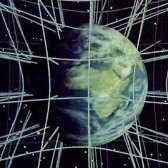
  19. I wasn’t able to find a visualisation of what you’d see if you were to look out the front window of a relativistic rocket, but I found a visualisation of how your visual field gets distorted at a constant v=0.9c: The accelerated version would be similar, just…well…accelerated. The angular size of your visual field would shrink more and more as you keep accelerating (“tunnel vision”). You would also notice something strange happening behind the rocket - things would at first seem to recede fast, but then they’d appear to slow down and eventually “freeze” into place at some apparent distance, while all the way being redshifted away into invisibility. It’s as if a horizon forms behind your rocket - this is called a Rindler horizon. Looking at the above animation, I don’t know if you would consider the trampoline to be a good analogy for this. Mathematically the coordinates used to model accelerating frames are those that describe hyperbolas, so I guess there is some justification for it.
  20. @Genady: Stephani’s Exact Solutions to the Einstein Field Equations is an absolute must if you want to go above and beyond the basics - not only does it classify the known exact solutions according to different schemes, it also explains the general features of these classes of spacetimes, and their mathematical treatment. The book also gives an overview over which general methods are available to find solutions to the equations, and what forms these solutions may take. So it’s definitely much more than “just” a reference catalogue. But be warned - this is definitely not a beginner’s text, it’s mathematically fairly demanding in places.
  21. Something similar happens in written Thai as well, though to a much more limited extent - there’s specifically two short vowels that are not always written, but implied. That actually caused me a lot of grief when I first started learning.
  22. Yes, good point Yes, with “necessarily” being the key term. It does work sometimes and gives the right intuition; but at other times it doesn’t work. The problem is that generally speaking there is no easy way to tell which is which - that’s why I think it’s dangerous to mix Newton with GR. That’s a difficult to answer question, unfortunately. My own GR understanding came about as the sum total of a large number of different texts, and there’s really no single book that has all the subtleties in it. One text that was instrumental for me personally is one that is unfortunately not available in English (to the best of my knowledge), which is T Fliessbach, Allgemeine Relativitätstheorie. It’s the only text I have seen that explicitly and step-by-step goes through the entire procedure of solving the Einstein equations for Schwarzschild and FLRW from scratch - you can see exactly where sources come into this, how boundary conditions appear, where things like the mass term in the metric originate etc. It found that very illuminating, because it shows how many of our Newtonian intuitions about gravity just don’t hold. But like I said, unfortunately there seems to be no English version. Then there’s of course MTW - ignoring the introductory parts, it’s the only text I know of that goes into the question of why the field equations look like they do. It goes into the topological considerations and conservation laws that underlie the entire machinery of GR, and explains the actual meaning of things like the Bianchi identities very well. I have not seen some of this material in any other text I know of. This is a 1500 pages tome, and evenly divided between introductory topics and more advanced stuff, but I think anyone interested in GR will take something away from this book, irrespective of what level they are on. For the formal maths the gold standard is of course Wald, though to be honest as being an amateur I found it to be above my pay grade. I can see this would be of great benefit to someone who actually has a background in maths, or at least has studied the entire subject matter at university level. It’s a great reference for theorems, proofs etc though. If you can give me some time, I will have to think about your question some more, and have a look through my personal library. It’s been years since I’ve really gone through these books - I’ve taken the key points out and compiled extensive notes for myself, which is what I am mainly working off these days. I might add some more recommendations here later
  23. I think this statement is both false and ultimately meaningless. First of all, the distinction between “simple” and “complex” is not objective, but very much contextual - what’s simple to me might be complex for you, and vice versa. It depends on our respective backgrounds. Secondly, even if the distinction was objective, the statement that you haven’t really understood something unless you can explain it to your child/grandmother etc is clearly misleading - it was never meant to be taken this literally. In my native language, we have a reasonably complicated system of declining nouns and conjugating verbs - according to grammatical case, gender, number, aspect, conditionality, tense etc etc we add prefixes, suffixes, prepositions and postpositions, and sometimes we change the middle part of the word as well, depending on what type of word it is and how it is used. There is also a large number of personal pronouns, never even mind all the irregular verbs, plural forms and so on. There is no way I could quickly and easily explain these things to someone who comes from a different language background, irrespective of what age they are, because some of the basic concepts (e.g. grammatical gender of nouns, or explicit declination by case) simply may not exist in other languages. Of course anyone can - at least in principle - learn the language, but it is generally going to take years of study and practice (unless you are lucky enough to have a mother tongue that is closely related), and not so many foreigners ever become completely fluent in it. It’s just a grammatically complex language, to the extent that even native speakers occasionally have trouble with complex grammatical structures. Does my inability to easily explain these things mean I do not understand the concepts of my native language? Of course not - I understand them perfectly well, to the extent that they are intuitive and self-evident to me. But that doesn’t mean I can easily explain to someone from a different linguistic background why “girl” should be of neutral gender, or why the “me” in “give me it”<>”give it to me” requires different pronouns. Some of these things don’t evenhave explanations, they are just conventions that have organically grown over time, so they have to be acquired, not understood. It’s no different in science - e.g. I understand the concepts of differentiation and integration well enough, I consider these basic operations just like addition and subtraction. But could I explain them to a 5-year old, who has no concept of curves, functions, variables, tangents, limits etc etc, in a way that he’ll actually end up understanding it all? Probably not, unless I’m dealing with an unusually gifted child. But my inability to explain does not mean that I don’t understand, it just means that the child doesn’t have the necessary prerequisites yet to benefit from my explanations. Crucially, my inability to explain it also doesn’t mean that the 5-year old cannot acquire this understanding over time - if you teach him the requisite concepts, there’s no reason why he couldn’t understand differentiation and integration once he’s a bit older. You just start with the basics, and then build onto them. That’s how people acquire new skills. How do you define “fundamental” and “derived”? To me, the most fundamental and most broadly-applicable principle, which underlies a guess-timated 70% or so of all know physics from the Standard Model right up to General Relativity, is the principle of extremal action: \[\delta S=0\] This statement is as simple in form and function as it is powerful, and as close to a “theory of everything” as we have at this point in time. It also does not rely on any particular choice of units or spacetime embedding. To me this is pretty much the bedrock of much of currently known physics, though my feeling is that you probably wouldn’t consider it “fundamental”.
  24. I don’t know, to be honest. In GR, the n-body problem is notoriously complicated, because you cannot ignore the non-linear effects; and once you add angular momentum to the situation, I wouldn’t dare to make any predictions based on intuition. This is a scenario that would require a numerical simulation. Yes, this is true at some distance from the geon - in fact, this spacetime is asymptotically flat, so sufficiently far from the geon the situation becomes completely Newtonian, it looks just like any other gravitating body. But my point was that the geon itself cannot exist in Newtonian theory - it’s just a region of non-trivial spacetime curvature that is held stable purely by non-linear self-interaction effects (there are no other forms of energy-momentum). Newtonian gravity has no such effects, nor does it have any concept of spacetime curvature, so the concept of a “geon” would be meaningless within that theory. You couldn’t describe the geon itself using Newtonian gravity - only its effects on external test particles that are sufficiently distant. It’s even more than that - it’s the question “how much energy-momentum in total does a given region of spacetime contain” that hasn’t got a straightforward answer that all observers can agree on. Fundamentally this is because you need to account for contributions from gravity itself, but in GR these contributions are not localisable, so they are difficult to work with. But in GR this isn’t really a big problem, because this concept of mass is not really used anywhere. You don’t necessarily need a concept of mass in order to solve the field equations, and obtain particle trajectories. This is unlike in Newtonian theory, where you have no choice but to use “mass”, because it explicitly appears in all the equations. The other option is to not look at this in terms of mass at all, but treat it purely as a geometric problem. This is what I tend to do. The advantage of such an approach is that it is pure GR, so it works in all cases, because there is a set procedure you can go through to work out the maths. The disadvantage is of course that even in some seemingly simple scenarios you may not be able to develop a good intuition of what happens, because the geometry is just too complicated to be sure. Your V-shaped arrangement of test particles above is a good example for this. So perhaps we can say that a mass-based Newtonian intuition will work fine in some cases, but some other cases require a fully geometric GR approach. The question is of course how do you know the difference, and unfortunately there’s no general answer to that. For me personally, any spacetime that contains degrees of freedom such as angular momentum, charge, multipole moments, stresses, strains etc etc, I wouldn’t treat using Newtonian-based intuition, because I have been stung with this too many times in the past. This is why - and you might have noticed that over the years - when I answer people’s GR questions on this forum, I am very careful about giving intuition-based predictions about what happens in specific scenarios; in fact I try to avoid doing so altogether, unless I have the mathematical abilities to actually check the prediction, or the scenario is already known and has been analysed in the literature. GR is just a very subtle beast, and it’s easy to be wrong about things.
  25. I can’t really meaningfully comment since this isn’t my area of expertise. But I would like to offer a simple observation that may be relevant - I spent the first few years (up to the end of primary school) of my life in one of the former communist Eastern Bloc countries. Communist ideology was being drilled into people relentlessly and at all times, from kindergarten to primary, secondary and tertiary levels, as well as all public media etc. Outwardly, the vast majority of the populace toed the party line, shouted the right slogans, joined the right political committees, sang along with extra gusto when the national anthem was played, and so on. This is what ensured you were left alone, and could live a quiet life in relative comfort. But behind the scenes it was a different story - I can tell you for a fact that very few people actually genuinely believed all the nonsense the party tried to indoctrinate its citizen with. Nearly everyone we knew back then had hidden antennas in their attic to pick up western TV/radio; nearly everyone got clandestine “care packages” with well-concealed goods from relatives in the West; nearly everyone managed to get their hands on books that were technically blacklisted. It was pretty much an open secret. People outwardly played along out of fear, or simply in order to be left alone and live in comfort, but very few were “actual” fervent communists (though of course these did exist). In the end, how many genuine (=not organised by the party) mass protests were there in favour of keeping the Iron Curtain drawn shut? And that was before Internet and means of mass communication. So what I would suggest is that just because people are exposed to attempts at indoctrination of some kind of another does not at all mean that they will actually pick up these doctrines and make them their personal belief systems. They might outwardly play along with them, but that’s not the same thing at all. We’re not just unthinking sponges that unquestioningly soak up everything we are confronted with - human beings are much more complex than that, and that’s true even at a young and impressionable age. I think that’s too often forgotten. Hence, especially in the age of the Internet and easy access to information, banning books from schools and library is a nonsensical and ineffective waste of time, in my opinion. I would conjecture that the influence of upbringing and general social environment is far greater than anything that might (or might not) be taught in schools.

Important Information

We have placed cookies on your device to help make this website better. You can adjust your cookie settings, otherwise we'll assume you're okay to continue.

Configure browser push notifications

Chrome (Android)
  1. Tap the lock icon next to the address bar.
  2. Tap Permissions → Notifications.
  3. Adjust your preference.
Chrome (Desktop)
  1. Click the padlock icon in the address bar.
  2. Select Site settings.
  3. Find Notifications and adjust your preference.