studiot
Senior Members
-
Joined
-
Last visited
Everything posted by studiot
-
I am not familiar with that area but here are a couple of references. http://www.spanglefish.com/northclydearchaeologicalsociety/documents/the-beach-copy.pdf Also chapter 6 of this report https://thelochsidepress.com/wp-content/uploads/2023/08/Rosneath-Peninsula-West-Community-Development-Trust-FINAL-REPORT1.0.pdf
-
My question was not a riddle, nor intended to catch anyone out. It was intended to show that when you try to look at it, some situations are not amenable to the objective / subjective classification. I have seen the Hight St / Anytown construction on example form filling and also advertisements. Objective / subjective is just not relevant to this. So thank you for replying, all I really wanted was your answer, which I think, amply demonstrates my point that the classification objective / subjective is not relevant to every situation. But you are asking specifically about the scientific aspects of this and so here is a scientific question. What is the boiling point of water ? Answer If I am sitting in my bivouac on top of Mt Everest, making the tea it is about 70oC. If I am sitting on my boat in Plymouth Marina, making the tea, the answer is about 100oC. So is that subjective or objective ? Again I say that the situation is not really amenable to the classification. I gave you a working definition, for scientific purposes, in an earlier post. This has the advantage of not having to rely on presumption or existence, which is another iffy word for scientific purposes. And yet if you try to apply it to my tea making you run into trouble.
-
Apology accepted. But I'm afraid that you missed my main points entirely. I think your use of the word objective and its derivatives is too wide and too general. I suggested that the meaning and use has changed over the millenia (did you miss my references to the ancient greeks?). I further suggested that there has been a tightening to the definition in more recent times as a result of practical considerations. But you have not provided us with a working definition ie one that I can apply to any situation. So here is a simple question to discuss about this issue. Consider the following situation: I am reading a magazine and see on some page the following address 15 High Street Anytown What is the objectivity involved in this reading ? I think (though I may be wrong) that you answer could go a long way towards tightening up this discussion as swansont asks, rather than keeping veering off along every tangent that arises. +1
-
Just saying at this point in time that "true" objectivity and no objectivity do not exist, but that inded there are many shades of grey. If statistical allowance is required to compensate for the fact that no two experiments are ever exaclty the same speaks to my point that even measurement is not 'true" objectivity. This is a discussion site. If that is the depth of your discussion I take it you don't really want to discuss my chain of reasoning, just pontificate. Or maybe I didn't explain the chain of reasoning very well, you certainly didn't respond to it.
-
So are you challenging all the geodetic measurements of the last four centuries ? This topic does not belong in Classical Physics ! Please speak to a moderator to get it moved to where it belongs.
-
What was your purpose in posting this ? I do not wish to waste time on a substantive reply if you are not really interested in it.
-
@TJ McCaustland Am I to take it that you are no longer interested in your question ?
-
Particularly for exchemist (and a few others) How do you tell a chemist from a plumber ?
-
Hello Luc. I agree that the subject of objectivity merits some closer examination and, in my view, updating. So +1 for doing all that research and introducing the question. You may, however, find that my answer gives you much to think about. You use of the phrase "true objectivity" implies that there is, or could be, more than one objectivity or interpretation of the concept, but there is only one 'correct' one. Nowthe ancient greek philosophers grappled with similar difficulties such as 'perfect' or ideal and infinity. But they never reached satisfactory conclusions because they were stuck with the notion of 'one correct definition', just as they were stuck with binary logic. They did, after all, invent the 'law of the excluded middle'. We now call this first order logic and distinguish multiple orders of logic. I suggest that objectivity is another such concept and, as has already been suggested, there are scales or shades of objectivity. It is interesting to note that all your quotes and examples refer to historical thought up to the first half of the 20th century. Up to this time engineers facing a similar problem related to safety used to employ what was called 'a factor of safety' which meant that if the requirement was to carry say 100 tonnes they designed for 100 x a factor of safety greater than 1. Around 1900 this factor was often 3 or more to reflect the degree of uncertainty they were facing. They began to realise that things were not cut and dried and that probability has a part to play. They resolved their issue (unlike the ancient greeks) by the introduction of 'limit state theory'. The basic tenet of limit state theory is that "Since all calculations are prone to result in (random) errors we require that the calculation is performed in such as way as to evaluate a known and acceptably low probability of failure" The ancient greeks also thought that there is in general only one way to achieve a 'correct' calculation. Again we now know better and have updated this notion so for instance structural engineers may now choose from a variety of energy methods, flexibility methods and force-displacement methods for a structure. Of course they must all come to the same answer, which is comfortingly known as 'the independant check'. For independant read objective. ~A working definition of onjectivity for scientists might be that the result or outcome of a scientific experiment or measurement should not depend upon the observer. That is John, Janet or Jehosephat should all find the same result when performing the same experiment, with due statictical allowance for the fact that no two experiments are ever exactly the same.
-
The stratigraphic record is very sparse to missing for the period when it was thought that there may have been an intense ice age of the magnitude tojustify the name Snowball Earth. This report suggests that this was about 720 mya. It also suggests that the full stratigraphy is to be found on some remote Scottish Islands. https://www.bbc.co.uk/news/articles/cj9l2mrn43jo
-
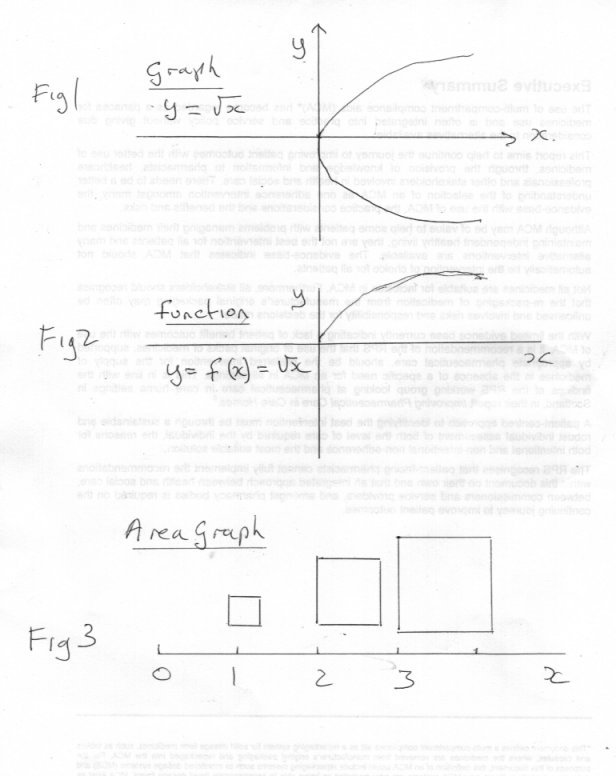
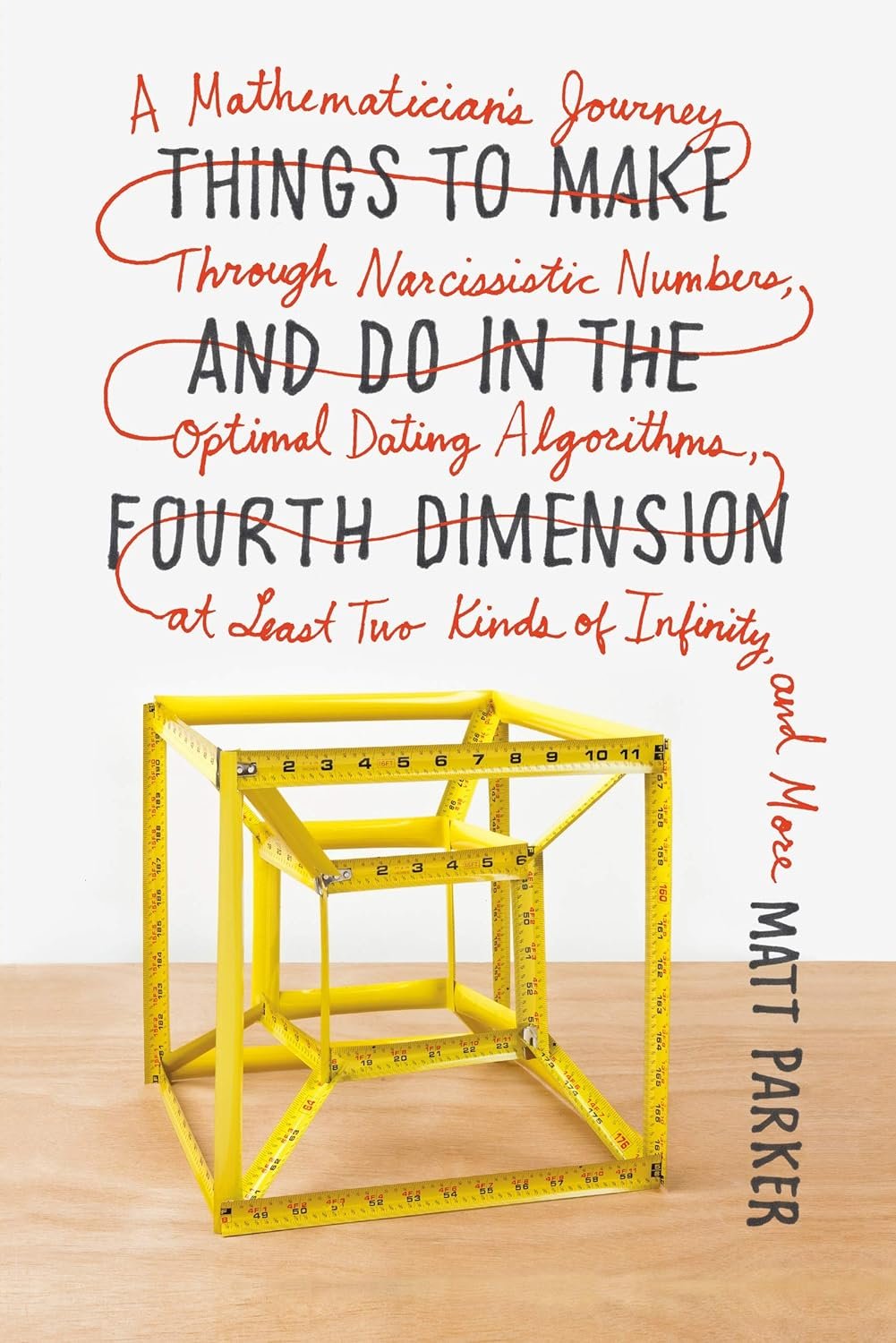
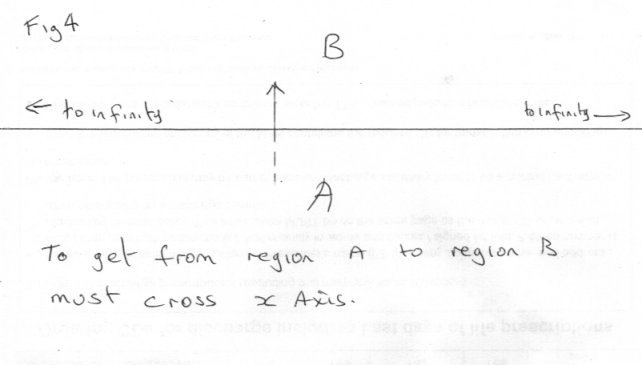
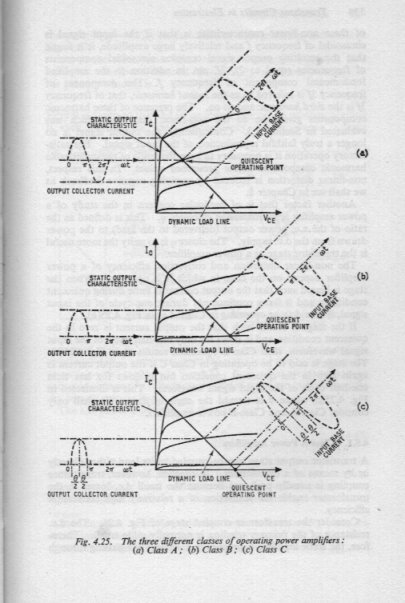
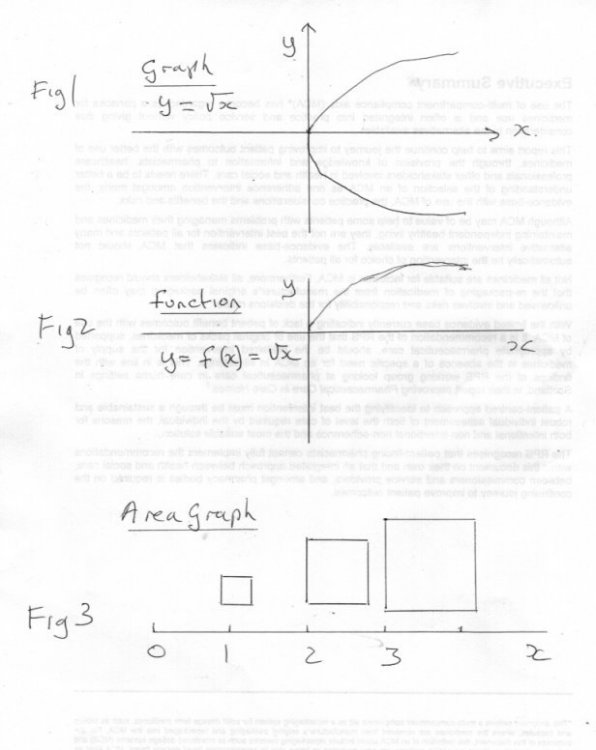
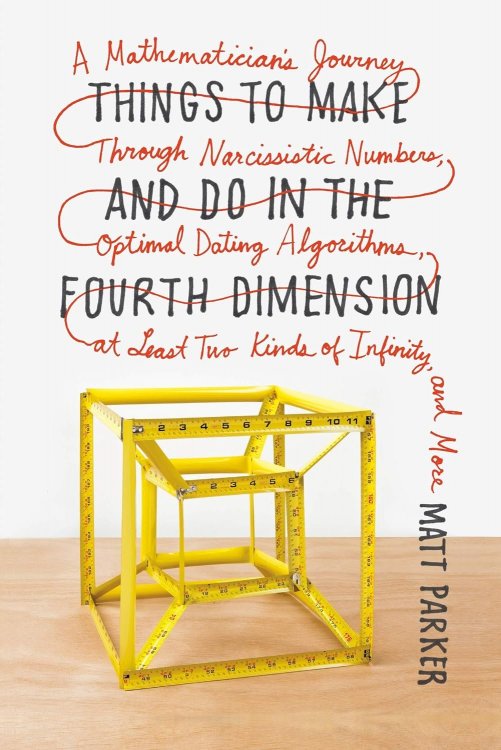
Well I agree with you. Glad you are following, don't forget to ask for clarification if you need it. I think it is exchemist who is fond of quoting " The map is not the territory". Certainly a good insight always worth bearing in mind. So let us clarify a few things, especially if you are finding KJW's post rather formal (but correct). It will be necessary for you to distinguish between a graph and a function. They are not the same. Indeed there are graphs that are not functions and functions that are not graphs. A function is very tightly defined in maths and one distinguishing characteristic stands out. You select a particular value as an input from the independant variable or set of values if there are several such. Applying the function yields one and only one result or output as a value of the dependant variable. I can't stress the importance of this enough. On the other hand a graph can show what happens when the may be many possible outputs for a given specific input. Figs 1 and 2 Show the graph of the square root. The square root function only has positive values as shown. The graph allows both the negative and positive. We will come on to why this distinction is made later. Fig 3 shows another sort of graph (which actually is a function as it passes the one value result test) but it does not fit with KJW's dimension statements. It is what is known as an area plot of the function y = x2. The area of the squares represent the value of y at the numbers 1,2,3, ...etc. I have drawn this one because it leads into a very important idea you will need when we come to vectors. A much more complicated graph appears in the next figure, where each value of x has many values of y in a branching tree structure. The are the characteristic curves of a transistor amplifier output. Superimposed on this are some other lines, marked load line, input and output signals. The load line is actually a function, the tree of characteristics is not. My final figure, fig 4, shows a piece of paper representing the x axis. Of course this axis goes to infinity in both directions so I hope you can see that it is not possible to get from region A to region B without crossing the x axis? Now a piece of paper is 2 dimensional. If we allow 3 dimensions the we can approach the x axis, move around it in the third dimension (ie leave the paper) and get from A to B without crossing the line. This introduces the idea of what happens in 4 dimensions and why we can get from inside a 3 D box to outside , without passing through a wall - obviously not possible in 3D alone Some more terminology. The first 3 examples are all about geometry, the fourth example is about topology. Back to MigL here. Graphical representations are usually geometrical. that is how that started. But topology, which grew out of geometry and is now a different subject, has an entirely differnt definition of a graph in terms of connectivity. I'm going to be away for most of next week so take your time to think about these things so here is a recommended book, t6he delightful Things to Make and Do in the Fourth Dimension by a modern mathematician, Matt Parker. Just a small Penguin paperback but well worth the read and loads of fun.
-
Ok perhaps fair enough but
-
True but irrelevent. Halley's is an ice comet. The irridium signature in the debris of Chicxelub points to a rocky/metallic asteriod.
-
But that isn't quite 'graphing', that describes the coordinate system not the 'graph'. So yes the coordinate of a point is described by n variables in n space. But as n increases the types and nature of availbale 'graphs' increase. In 1 dimension n = 1 and you can't reall describe much. just different length segments of the same infinite line. In two dimensions you can play about with lines and get straight and (plane) curved lines as graphs. The idea of a function makes sense as does an independent variale (usually x) and the dependent variable (usually y). In three dimensions you get more scope and can describe surfaces, solids and so on. One type uf graph using 3 dimensions is a countour graph such as is used on maps. This is really a sequence of plane curved sections, ie 2D sections. Recently it has become very import in the technology of '3D fabrication by printing' of objects. You can also have knots and other fancy constructs in 3D that have no counterpart in 2D. Many of these constructs dissapear with the step up to 4 D. How are we doing are you following so far ? Keep asking and we will cover these.
-
Can you explain woldfires over the Ocean ? @Sensei makes a very good point. +1 One problem a breakup hypoyhesis must answer is this. The meteoriod had been travelling for up to billions of years, so all the part had plenty of time to achieve the same velocity, even if lightly attached. So all the parts will have had momenta and energy proportionate to their masses, and even if only touching wouldhave continued together since there is no friction is space. So a breakup mechanism is required. The only reasonable one I can think of would be impact by another object, which as Sensei points out, would have had to occur fairly close to the impact with Earth as the meteroid was travelling at circa 20km/second. Otherwise much of the material would have been scattered clear of Earth by the side impact. Clearly it would have to have been a side impact.
-
Of course. QM is probablistic; it makes amazingly accurate predictions. Or are you asking whether a ToE might resolve the probabilistic aspects ? Did you hear the one about the car salesman who said This car has everything you need for the journey to your destination. It's extra for a tank of gas. Or the old saw A present for the man with everything. Penecillin. If it can't answer a simple question to distinguish between a atom that will decay in 5 minutes time and one which will not so so for 5 million years, to me it is a travesty as a theory of everything.
-
Consider the following: Unstable atoms, numbered 1 through 100, sit in a row. Would any proposed TOE be able to predict the order in which these atoms will decay ? IOW is a TOE allowed to be probabilistic ?
-
If the meteorite had broken up into fragments we would have expected to find evidence of multiple smaller impact sites. There is no evidence of this. Just one large nearly perfectly round crater. Folks often concentrate on the sexy impact period of such a disaster. The truth is that the impact itself lasted a very short time, as did the temporary heating of the atmousphere and other immediate effects. The impact itself was sufficiently large as to melt the limestone sediment rock to a glassy material and spray large quantities of glass beads into the air. As a marine disturbance it also spawned a series of tsunamis. In the days following the impact the heavier material fell back to earth and has been found over a wide area of the US, Mexico and beyond. The finer particles remained in the sir for much longer, weeks, months ever years. The resulting winter caused freezing temperatures, rather than elevated ones. Evidence for this has been found in studies of the stems and leaves of plants preserved at the moment of impact. They have had ice crystals growing inwards and bursting the cell walls.
-
Well I see that there has been other interest in these questions, even if the OP has not bothered to come back. The questions are actually more suble than at first meets the eye because book answers define the sets by listing the members, which is unusual. They have done this because the sets are finite and the only members are from the set of ten digits 0 through 9 that we use in our decimal number system. This listing is the simplest way of definiting the sets, and excluding numbers we do not want included. To make this clear the questions ask for the set of digits, not numbers. So in my last example 0 and 9 are digits with that represent numbers but 90 is not a digit it is only a number.
-
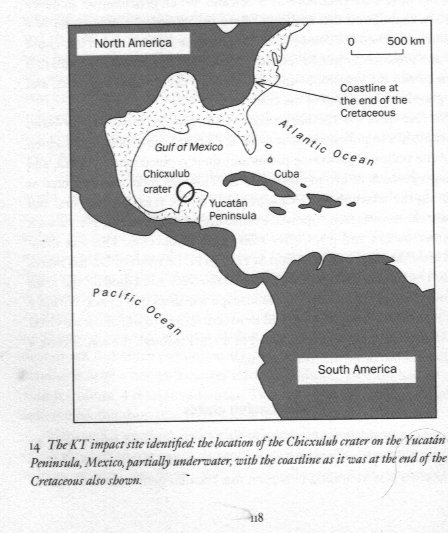
The Chicxelub meteorite impacted into the proto Caribbean, which was larger then. It penetrated up tp 19 km into the crust, driving molten rock down into the mantle. Today it has a 3 ring structure, the outer ring being 195 km across. So the majority of its energy was extended driving deep into the earth and melting the rock to suevite (A breccia formed by shock metamorphism whose angular fragments are set in a glassy matrix).
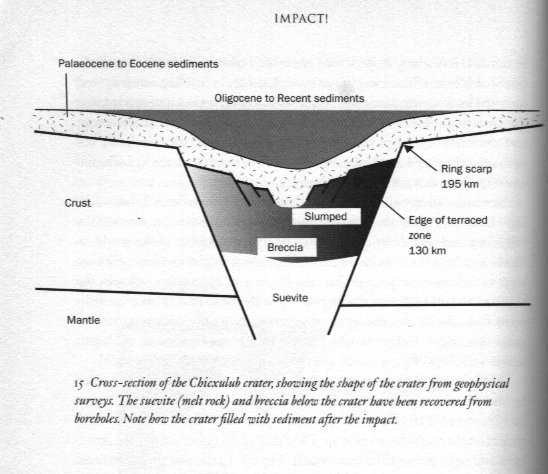
-
Some further figures The estimated mass of the Chixelub metoeroid is between 1015 and 1017 kg say 1016 The estimated speed of this sized asteroid is 2 x10⁴ m/s Thus its kinetic energy is (1016 x2 x2 x108) / 2J =2 x1024 Joules So the meteroid had enough energy to heat the atmousphere up to these levels.
-
The back of my envelope says Mass of atmousphere 5 x 10¹⁸ kg 475 J / oF/kg Temp rise from 100F to 400F (temps averaged a little higher in the Cretaceous) Total energy required = 5x 1018 x 300 x 475 = 7 x 10²³ Joules.
-
This is a fair question. But, as always, the wider world is more complicated than our simplifications. Even Philosophers have to agree what theey are talking about before they can have a useful discussion about 'Truth'. Let us start into it by agreeing the difference between a hypothesis and a theory. What do you mean by these terms and also accuracy ? Also I think gravity is far to weighty an example ans as yet, far from a finished hypothesis. So let me offer some simpler ones, and if you must invoke Newton, then how about the wave/particle duality of light ? Back along Newton's corpuscular hypothesis held sway as 'the truth'. Then Huygens proposed the wave hypothesis. Both hypotheses predicted the same result, for every effect. Then Young showed that the deflection from the normal at a boundary was in the opposite sense for the two hypotheses. Ahaa a test. Young's analysis proved correct upon observation and 'the truth' shifted to the wave camp. Hey brother/sister, my clock has stopped working. Perhaps the battery is flat (low voltage). Well it worked when I first put it in so the voltage must be correct. Yeah but the voltages changes with time, and as you use the battery. So what is 'the truth ' with regards to the battery voltage ?
-
In what way do you think energy will cause a battery to fail ? Here's a challenge. I have just weighed a standard C cell at 71 grammes say 70 to make the math easy. How much energy do you say you need to add to 'destroy' it ? Please provide a figure, since you think it can be done. I will then tell you how to add more than that amount of energy without destuction, and then take destroy the battery by taking away said amount of energy.
-
This is nonsense as it is physically impossible to apply a force to the rope greater than required to break it. By definition. In the practical real world the real world breaking force will be greater than 100kg for statistical reasons. But statistical reasons don't enter into our consideration of circuits. I gave you a graph of the characteristics of a general voltage source. What do you think would be the correct circuit equation to describe it? It is important to use observable quantities.