studiot
Senior Members
-
Joined
-
Last visited
Everything posted by studiot
-
Many thanks +1. What an Idiot I be. The messages are white on black and have been going on for some months now. I just was quick enough to catch it before it disappeared this time.
-
Can anyone tell me the meaning this this strange message when often but not always pops up briefly when I log in ? I have arrowed the message on the screeshot. It shows the notifications bell plus the words " you have 5 personal messages " - the actual number varies. But as can be seen from the top there is only one message listed and it is not a personal one. I have never been able to find the alleged sender either . Who or what is C-19 ? Thanks.

-
John is quite correct to highlight threshold current (not maximum current) as the important parameter. +1 Threshold current is the minimum current at which lazing starts. Threshold current increases with increasing temperature. Laser diode characteristics are normally given at a case temperature of 25oC. Increasing temperature creates heat which increases case temperature so ther possibility of thermal runaway or at least degrading should be considered. Considering where you live and your requirements this could be more difficult as running the laser current too low on cold nights will increase the risk of laser dropout. Since absolute temperature is an absolute maximum you need to run the device between a current suitably above threshold for your minimum temperature but as far below you maximum current as you can, consistent with the requirement that the top level will be determined by your maximum ambient + 5oC (and you live in a hot area). Without further details of your requirement, but guessing from your other thread that you want the laser to sweep to and fro for a year I really can't be more specific on diodes. But I would like to note that lasers are inherenttly dangerous things so you need to consider safety in the illuminated area. Also note that laser diodes require a current controlled drive, not a voltage drive.
-
In English and in French we have letters, words, phrases, clauses, sentences and paragraphs, in order of complexity. That is we build up more and more complicated structures by combining simpler ones. In mathematics we really only have two basic building blocks; the symbol and the expression. Expressions possess several subtypes such as equations, statements of combination (like linear combination) and so forth. If an equation is roughly equivalent to a full sentence, then linked or simultaneous equations are equivalent to several sentences with a common link ie a paragraph. So ax + by + cz is not an equation but is a statement of combination of 3 different variables, combined to form one unit. each constant may be a different number, so the 'operation' (multiplication by a, b or c) carried out on each variable is different, but still linear in itself by our definition. But considered as a whole we have that if we multiply the whole by another number, say 2, we obtain 2[ ax + by + cz ] = 2ax + 2by + 2cz = (a+a)x + (b+b)y + (c+c) = (ax + by + cz) + (ax + by + cz) or twice our 'considered as a whole' combination. So if we condense this and say C = ax + by + cz then 2C = C + C So C is a linear combination. The point of my square brackets (did you nitice them ?) is that if we can show that [some expression] + [some expression] = 2 [some expression] Then the combination is linear. Next time we will explore the significance of this in relation to all those very important areas of applied maths I mentioned. L(ψ+ϕ)=L(ψ)+L(ϕ)
-
No it's the plus sign. So far we have only scratched the surface of 'linear'. We have only dealt with expressions that are linear in one single variable. The plus sign is how we combine variables or other mathematical objects (which may or may not be linear in themselves) To form expressions that are called linear combinations. Look back at KJW's expression - it contains a plus sign. Linear combinations have the form ax + by + cz + ...... where x, y, z are variables and a, b, c are constants. This is the underlying reason why linear mathematics is so wide, rich and varied. It covers maths from differential and integral calculus, differntial equations, matrices, fourier methods, linear simultaneous equations, and just so much more. We are off to the seaside for the rest of today so I will produce the next sheet tonight or tomorrow morning. Keep smiling.
-
Thank you. Yes indeed I misspelled 'to fast' it should have been too fast. As in many subjects, we distinguish between Pure Maths and Applied Maths. The pure subject is all about the theory of that subject, for its own sake. This is regardless of whether this theory is of any use or not. The applied subject takes that theory and uses it to study, analyse explain and predict phenomena in the real world to create things. For example the theory of structures is applied maths. For the next page we will need to know and understand a few technical terms The difference between an equation and an expression. The mathematical form of something. What functions , operators, mappings are. What a polynomial is. Please indicate if you are unsure of any of these so I can expand the explanation for this as I go along.
-
Paul died around 65 AD The first Christian Emperor converted 312 AD. This was the start of the Holy Roman Church. Prior to that I understand that Christians were persecuted on and off by the Roman Empire and survived as widely distributed small groups, I suppose you could call 'churches'. I also understand that those early Christians are described in sociological terms as 'primitive communists' , rather like some small isolated sects to this day. I also note, addressing the thread title, that even up to the end of the 19th century, most geologists were spurred on in an effort to scientifically prove God. An endeavour in which they discovered many things but spectacularly failed in their stated objective.
-
Great so we can carry on with the program in this fashion. Rather than worry about Chaos theory, which has little or nothing to do with Quantum theory, can I point out that there is something else basic in the post from KJW that I keep referring back to, that I have yet to mention. I will leave you for the moment to try to figure out what this or you can wait for the next sheet where I will introduce it. It's also good that you are beginning to tie together statements from others within this framework I am building for you. There is a huge area of Mathematics called Linear Mathematics; it is even more important in Applied Mathematics.
-
Clearly your recovery is pretty much complete. Welcome back. +1
-
Well I don't usually respond to this member as responses are never acknowledged, but I don't see this question as an ethical security issue. Windows has always done the logging noted in the OP, provided a text file and deletion facilities and the user has always had the ability to control the level of logging. No special 'spy software' is rrequired, nor would I recommend it.
-
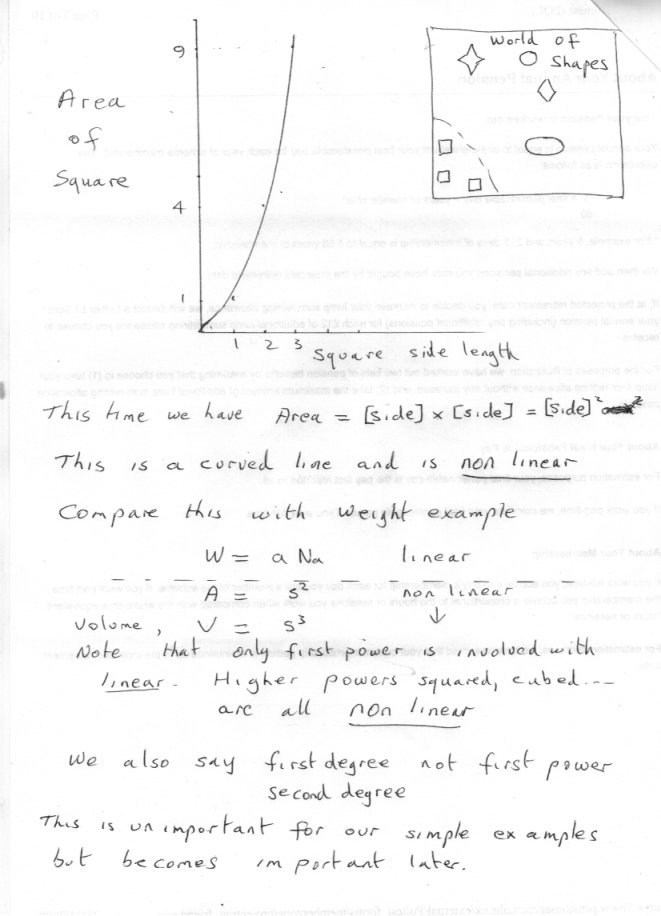
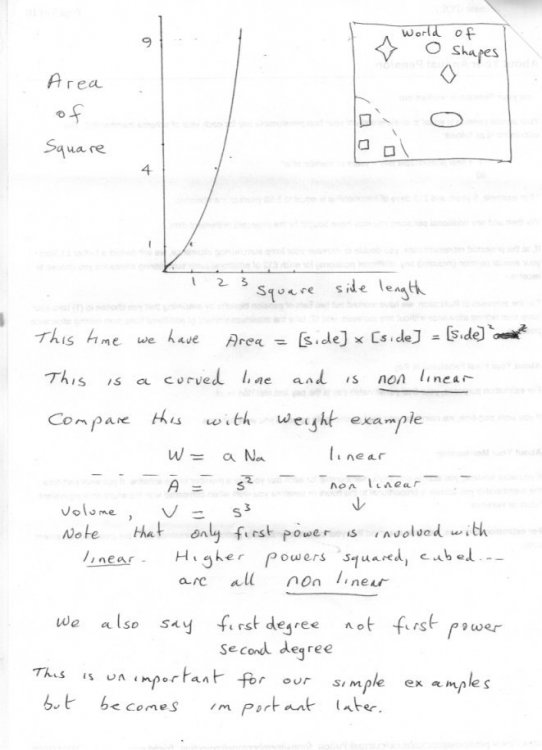
Good that you have this sorted, is the pace better now ? So onto the next bit, here we see how non linearity arises quite naturally in a simple way. Keeping to my idea of worlds, we change from the world of material objects (fruit) to the world of abstract or theoretical objects, shapes. Out selection this time are simple squares and we consider the area of these squares, not as the number of squares increases but as the size as measured by length of side increases. When we plot the relationship between area and length of side the graph is found to be a curved line. This is defined as non linear since it is not a straight line. Comparing our linear apple equation with the formula for area we then find a new way of denoting linear and non linear. This new way involves looking at the powers of the variables involved, and new terminology is introduced ready for future use. So linear equationsa are of the first degree non linear equations are of the second, third, fourth or whatever degree, so long as it is greater than first.
-
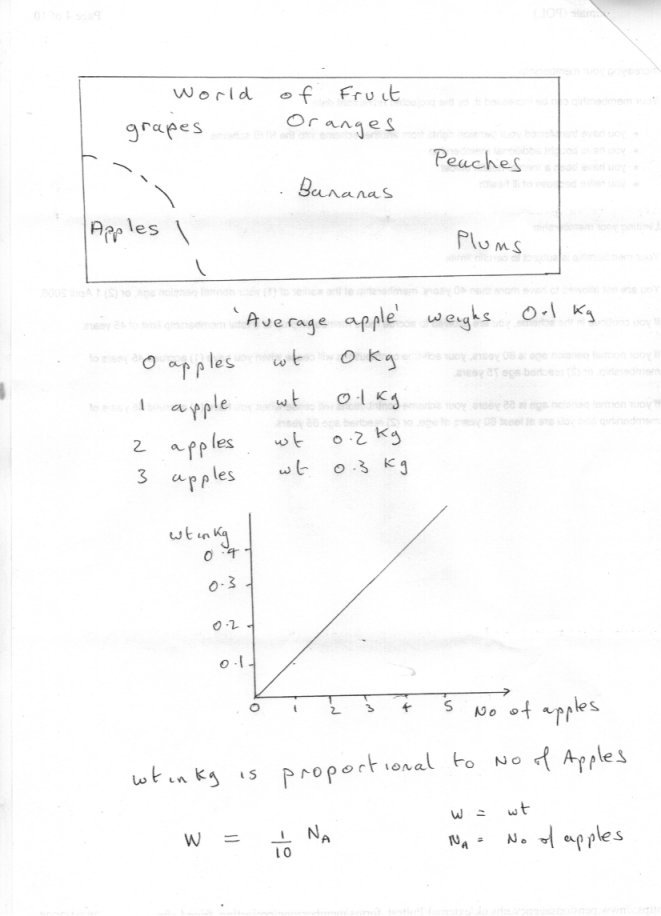
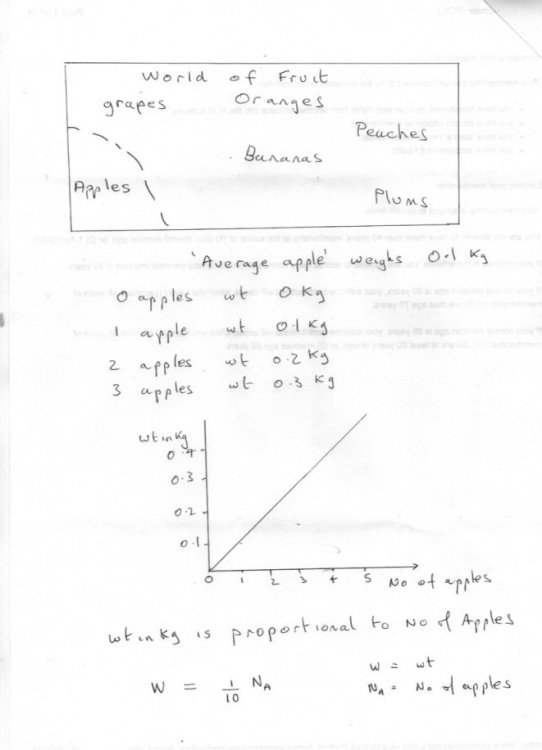
Perhaps I have been trying to go to fast. Remember that we are working our way towards the formula the @KJW gave for linearity ? I like apples because the great man, Newton, liked them and I have already introduced the counting idea using them. Remember I said that one important idea is to draw a boundary between the subject of interest and the rest of the universe ? Well the box in the first picture attached does just that. The boundary is the dashed line. The subject of interest, also called the system, is a collection of apples. Note that my world is just 'The World of Fruit'. This is meant to illustrate that the whole arrangement is just an imaginary way of organising real things and that I can limit the 'world' to something useful. Working now just on my subject of interest - the collection of all apples. This collection allows me to create the imaginary 'average apple' that I can use to represent every apple. Ley us say for convenience that this average apple weighs 0.1 kilogrammes I have tabulated the weight of several different numbers of these apples. And then plotted a schoolboy graph of the weight of apples against number of apples so I can read off the weight of any number of apples. We say two things about this graph. That the weight of apples is proportional to the number of apples and I have given a simple formula, which we can examine in more detail next time. We also say that the the relationship between weight and numbers of apples is Linear. This relationship is the simplest form of linear and the plot or graph is a straight line. A linear relationship is one of proportionality and has the equation or formula of a constant (1/10 in this case) times one of the two related variables. How are we doing ? Yes, but I think you will find that the original statement referred to changes in the observed system, not the observer.
-
Well as I have no idea who or what they are I really don't have a choice. As to leonardo, what Maths is he responsible for ?, apart from a few extensions to Euclid ?
-
'the kid' doesn't appear to have come back or I would have refrained from commenting on your post so as not to confuse him. But we can certainly expand the discussion if you like. For your information Newton originally invented the calculus of finite differences, before going on to the differential calculus of a single continuous variable. For my money, he was also the greatest genius that ever lived because not only did he largely invent mathematical physics he had to invent the mathematics as well. Others who came after always then largely had the benefit of sufficient mathematics to work with.
-
I'm glad you worked that out for yourself. Well done. Tell me, do pictures help you understand ? It may do and it may not. @joigus already told you that. An example of a measurement that makes no changes would be to count the apples on a tree. Whilst I like genady's fishy example, I think it quickly sowed it was too complicated so I will stick with apples.
-
I agree with joigus, a very interesting viewpoint. That is more like the old Eise we know and love. +1 I have always had a great respect for Smullyan, and I sadly left his excellent book about Godel on a train a few years ago. But I'm sorry his dualist story I find rather contrived, though I agree that there is more than a mechanistic meat machine to human ( and perhaps other) thought.
-
I think you mean what effects ? The impoetant thing to remember is that we define linearity and evrything else is non linear. I will do the next bit after lunch.
-
You really should get out and about more. 'differential' is both a noun and an adjective much used in technical subjects and generally some sort of difference, which can be very large. This has little or nothing to do with infinitesimals. Perhaps you should look in the fields of automotive engineering, medicine, hydroelectric engineering, clean room engineering and many more besides.
-
A perfect fluid is one with no turbulence and no viscosity.
-
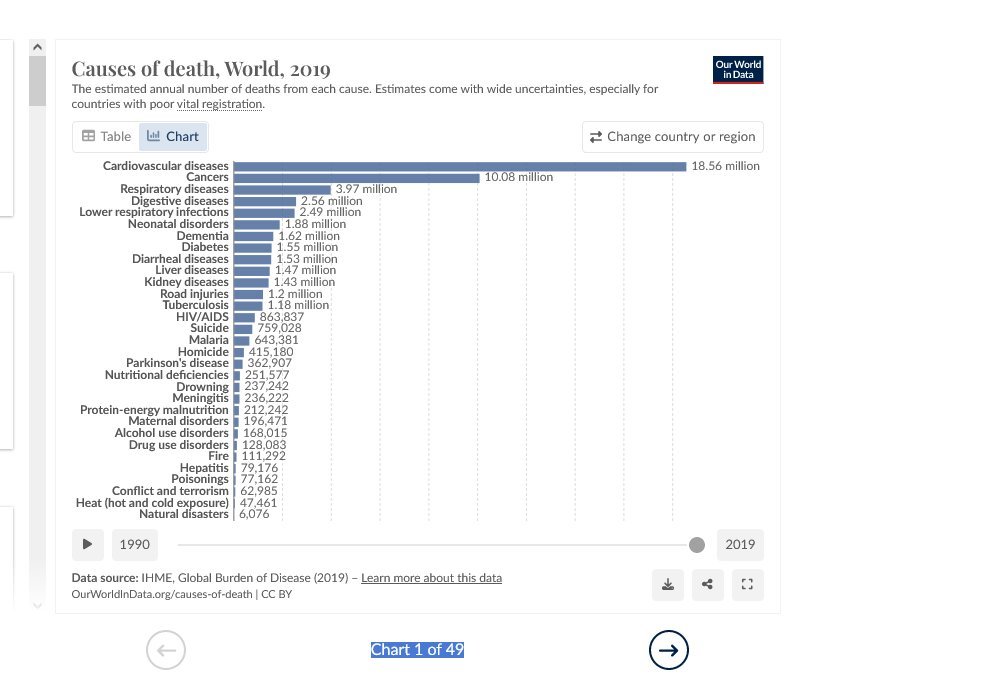
What about It ? Hve you done no work on it wither from a physics or statistical or even medical point of view ? You first post seems to me to be more like a blog, summarising other people's blogs. 5,500 deaths ? Let us put that in context of the 8 billion or so people on the planet, that's almost 1 in 2 million. How does this compare with other causes of death ? https://ourworldindata.org/causes-of-death That's just slightly less than the bottom line of the longest list I could quickly find 'Natural Disasters'.
-
And I am weak in my French, although my time at the lycee Francois Villion in Paris helped me immensely with my schoolboy French. But I think both of us are intelligent, after all you have mastered at least French and English, n'est ce pas ? I do not think the world (universe) tells us anything as that would imply it was deliberately trying to communicate with us. Certainly it interacts with us an we interact with it. In doing so the interaction influences us and quantum theory is still debating how much we influence it. We learn not to put out hand into the fire. The passage from Dicke I posted has more to say on this. But in your statement you have done something very scientific. A very important theoretical scientific techique is to theoretically separate the 'subject of interest' into two parts and draw a line or boundary between them. Then to examine and study whatever passes across that boundary. You have drawn the boundary between us and the rest of the universe. Well done. You have mentioned non linearity twice in the last post and before that so let us look more deeply into the subject of linearity and non linearity. Not only do I agree with you, but I like the sentiment with which you posted something intended to be helpful. +1 But there is much more to linearity and linear Maths and linear Science than this so let us see how we get there. Essentialy linear means ' arranged in a (sensibly straight) line' Luc do you understand what I mean when I say 'sensibly straight' ? For example in particle physics the particles in a linear accelerator travel in a straight line whereas those in a cyclotron travel in a circle or spiral (ie a curved line). If I take the numbers 1, 2, 3, 4, 5, 6, 7, 8 , 9, 10, 11, 12, they are arranged in a straight line or linear order. But if I look at a clock face those same numbers are arranged around a circle so something is different. I have stuff to do now, but I will expand on this in my next post, where we will find the simplest of (schoolboy maths is non linear) Did I mention that we define 'linear' and declare that everything else is non linear. This is much much simpler than the other way round.
-
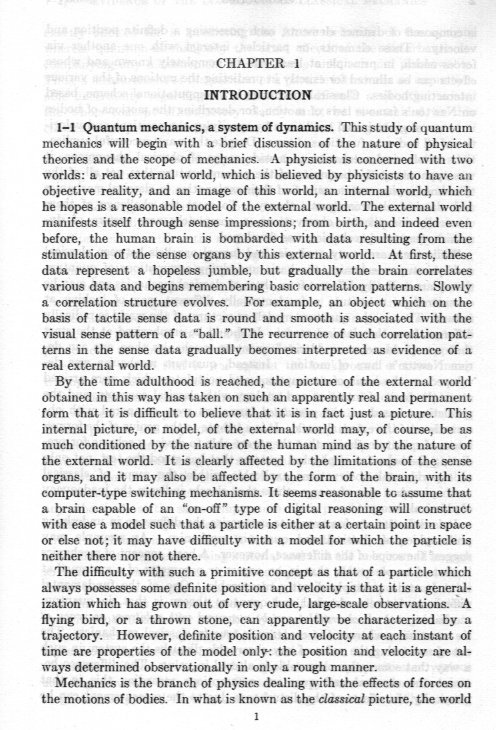
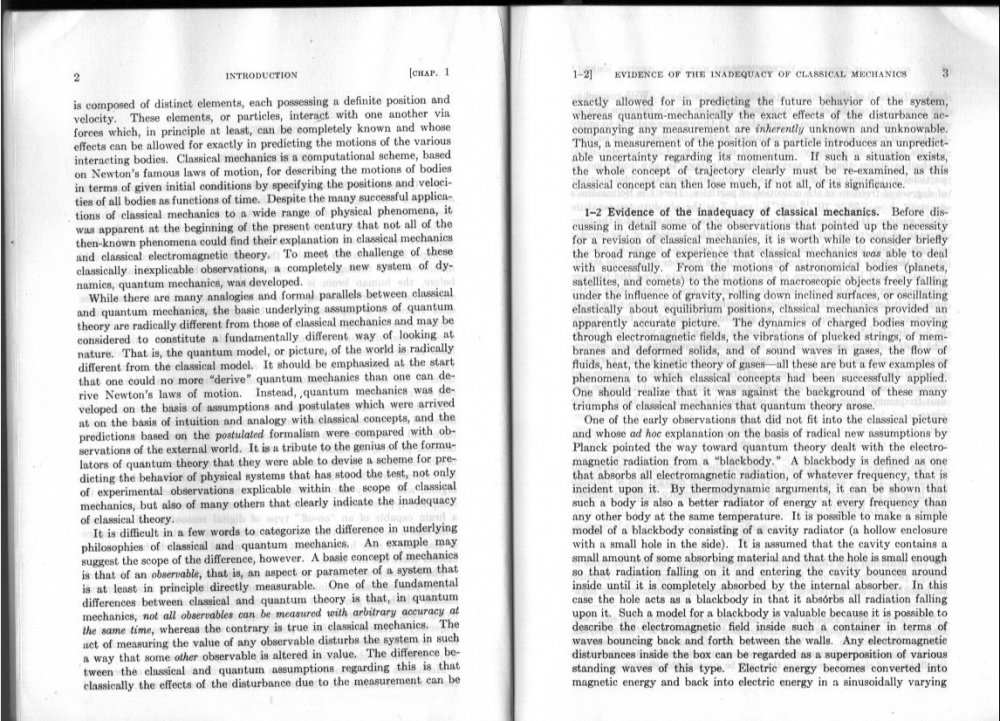
Other feature ? Other than what ? Here is some important ones. Firstly the photoelectric effect Classically there should be no threshold frequency to this effect. Yet observationally it is very sharply defined, as required by QM basic tenet that energy can only be accepted in certain quanta. So if the incoming photon does not have enough energy for the electron to transition to participate in a current, there is no current. In the Bohr atom and subsequent models, QM overcomes the classical problem of why an electron accelerating in the electrostatic field of the nucleus does not radiate its energy and fall into the nucleus. QM explains why the nucleus holds together (shell theory) Qm explains radioactive elements and radioactivity. QM explains observed spectra. QM explains band theory, metallic and semiconductor bonding and results in the non linear Konig Penny equation. These are all huge gains in our knowledge of how our world works. There are many other more specialist details but I note a discussion between @Luc Turpin and @Genady about 'our world' The core of the two major modern theories in Physics, relativity and QM were done and dusted and ironed out during the first half of the 20th century. This allowed many applications and also refinements and technology improvements to be made during the second half. Here is a very clear explanation of 'our world' from just after this half way point from two Princeton Professors, Dicke and Witke This clarity about Our world and physics (models) should also be of interest to @mar_mar In their book there is consider help transitioning from a classical mechanics to a quantum mechanics viewpoint. Also included is a whole chapter on the 'correspondence principle', using an interesting view of going backwards from QM to classical as a limit of very simple cases.
-
Why small? That is not always so.
-
Yes you are right. +1 Thanks for all the extra detail. But please remember tha many of these equations are 'linearised' (approximated linearly) in order to be able to solve them. Even special relativity employs a linearised quadratic for this. It's an inequality.
-
Good question, especially if you actually know what linear means ? Vector spaces are the backbone of linear mathematics. I already mentioned a while back that with the Schrodinger equation (which is linear) we are working in the vector space of square integrable functions of class C∞ However the relativistic version of Schrodinger is non linear ( Dirac equation, Klein Gordon equation etc) https://en.wikipedia.org/wiki/Nonlinear_Dirac_equation This bears out Seth's comment that combining linear operators may result in a non linear equation. +1 It should also be remembered that of the famous Four Laws (of Thermodynamcs) , only the First Law is linear and even has q and w as incomplete differentials. Back to Luc, Heisenberg's Uncertainty Principle is not even an equation - It is an inequality like the Second Law of Thermodynamics. Pauli Matrices are linear.