
studiot
Senior Members
-
Joined
-
Last visited
Everything posted by studiot
-
You have stated that you are not a mathematician, but neither are you a scientist. So why do you claim such absolute knowledge of what scientists agree on ? Where is you evidence ? Furthermore you were the one who introduced the term measurement, so it is your responsibility to define it for the purposes of this thread. Without that, discussion cannot proceed. You have already ignored the moderator's warning about the rules and this seems to be your style of discussion. Good night.
-
Good summary +1
-
Have you actually read 'On the Origin of Species' ? Darwin didn't actually coin the phrase 'survival of the fittest' Spencer did in 1864. In any event, the situation is vastly more comploicated than the one sided view you have presented. Sticking with 'survival...' this refers to changes in the environment and an organisms response/reaction to it not necessarily the environment itself. This make a huge difference and, for instance, accounts for how and why mammals outsurvived dinosaurs following Chixelub.
-
Whislt I don't agree that there is a 'measurement' problem, only an obscuration and obfuscation problem by those who don't understand it. When folks in Science and Technology want to solve a problem, they don't tackle the biggest one they can find first. They start with a (simple) model and try it out on a simple problem, preferably one with an already known solution. When they can match their model to this they move on through increasingly difficult problems, possibly refing the model and may be even replacing the their model with a better one as the go. I offered you the opportunity to do this with your grand hypothesis at the outset but you declined.
-
If I was asked to state the 'philosophy' of QM in less than 10 words I would say something like Quantum Mechanics is about minimising energy. (6 words) If I want to make it more mathematical I might say Quantum Mechanics represents the Principle of Least Energy (8 words)
-
We are talking about what you chose to write, not what you want to pretend you didn't Suxh as And apparantly something called Quantum Darwinism ( is A quantum of Solace next on the fiction list ?) And QM and geology
-
This theory doesn't attempt to replace any existing bog-standard science, such as chemistry or the phase transitions of matter. These are not outstanding scientific or philosophical problems. The only thing this theory says about this is that if it was physically necessary for the existence of conscious life that silicon, hydrogen and carbon combine with oxygen to form respectively a solid, a liquid and a gas, then it was guaranteed to happen, regardless of how improbable. This has little or nothing to do with chemistry itself. That's a no then But I asked you specifically about another science, Chemistry, which when I studied it at university was all about how and why certain chemical reactions occur. Yes of course there are many others but to suggest that they only do so to support the existence oc conscious life is nonsensical. Further I commented about mathematics since you told me that when I asked you about mathematics, Yet you included that nonsensical preaching about a subject you clearly know little about. So that is two sciences you have 'rubbished' by offerring metaphysical woo in their place, which is most definitely not a science at all.
-
So perhaps you can use your "interpretation" to tell me how and why silicon, hydrogen and carbon combine with oxygen to form respectively a solid, a liquid and a gas ? I suppose you could have referred to this drivel from your article when asked for some mathematics. But even the christian bible contains more proper mathematics than this offering, which as far as I can tell, contains exactly zero mathematics.
-
So where is the maths that offer me something I can go and measure ?
-
What on earth do you mean by this ? Both Darwin and Einstein were human and so it is no suprise that they both 'got something wrong' at times.
-
1) Wave functions are, by definition, solutions of the wave equation. There is no other choice. Perhaps joigus means where is choice of wave eqaution (which there is). 2) No hidden variables are needed and the wave function again cannot be 'hidden' by definition. 3) Solutions can be complex, but we only want the real part. 3) The way to introduce probabilistic maths into this is to introduce a 'statistical weighting function', This has to be a function of a real variable, and again cannot be hidden.
-
The probabilistic nature od QM is not truly random in that the outcomes are not truly independent, the condition for a random variable. At all times the wave function 'probability' must obey the normalisation condition. This means that any change (motion) must affect the entire function, not just its value at a coordinate point. This leads you back to my mist analogy.
-
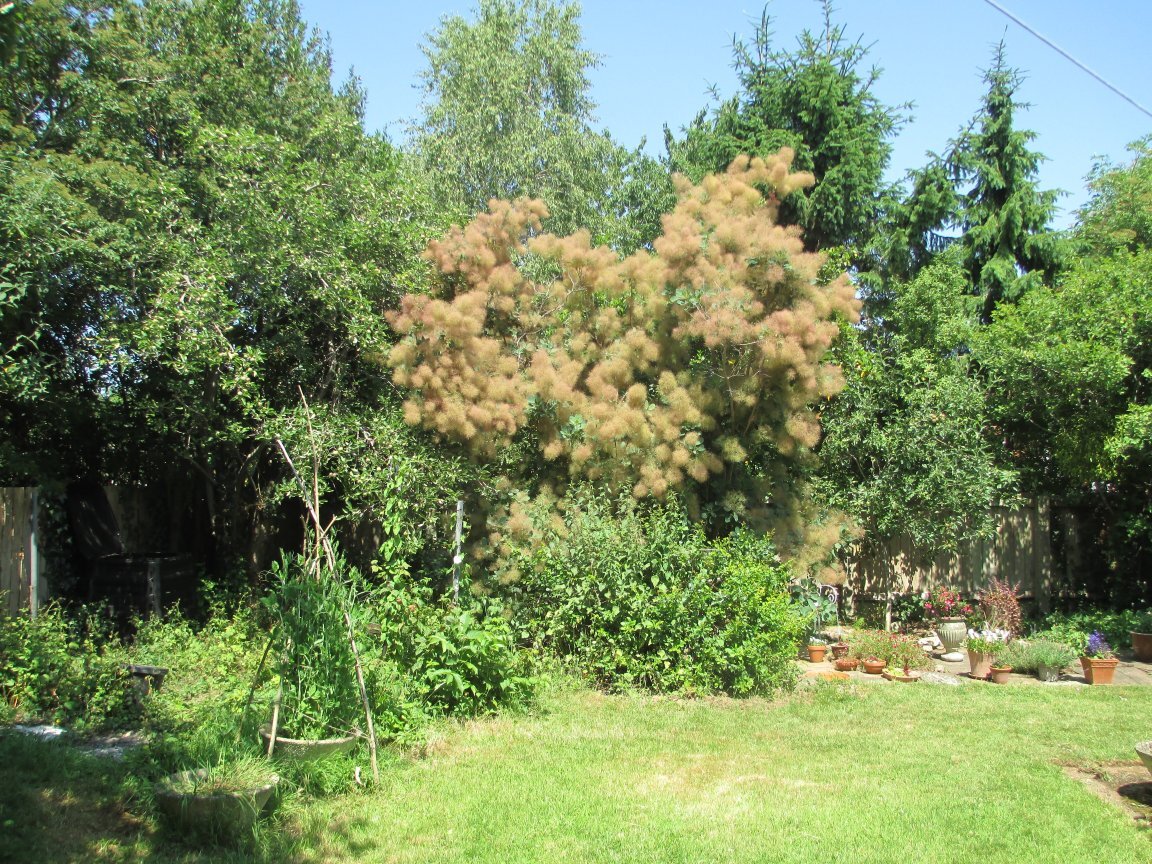
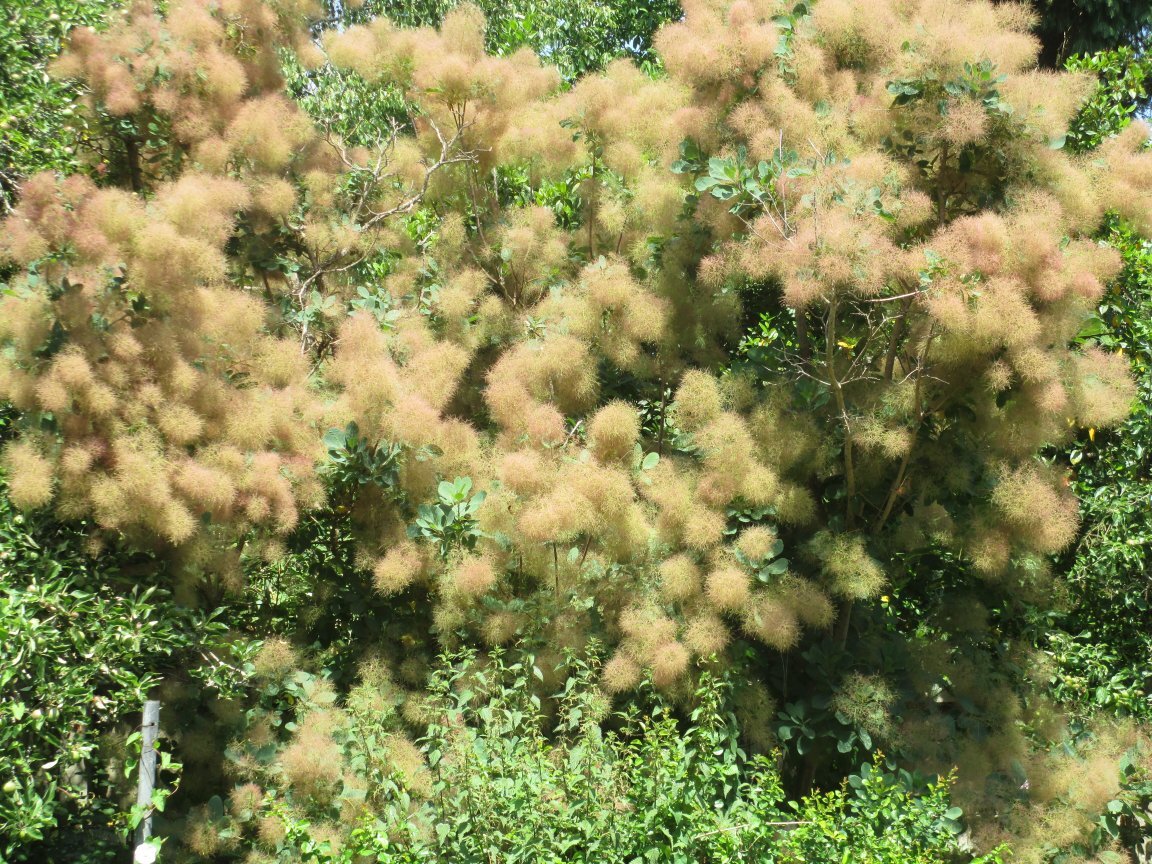
My smoke tree is particularly fine this year.
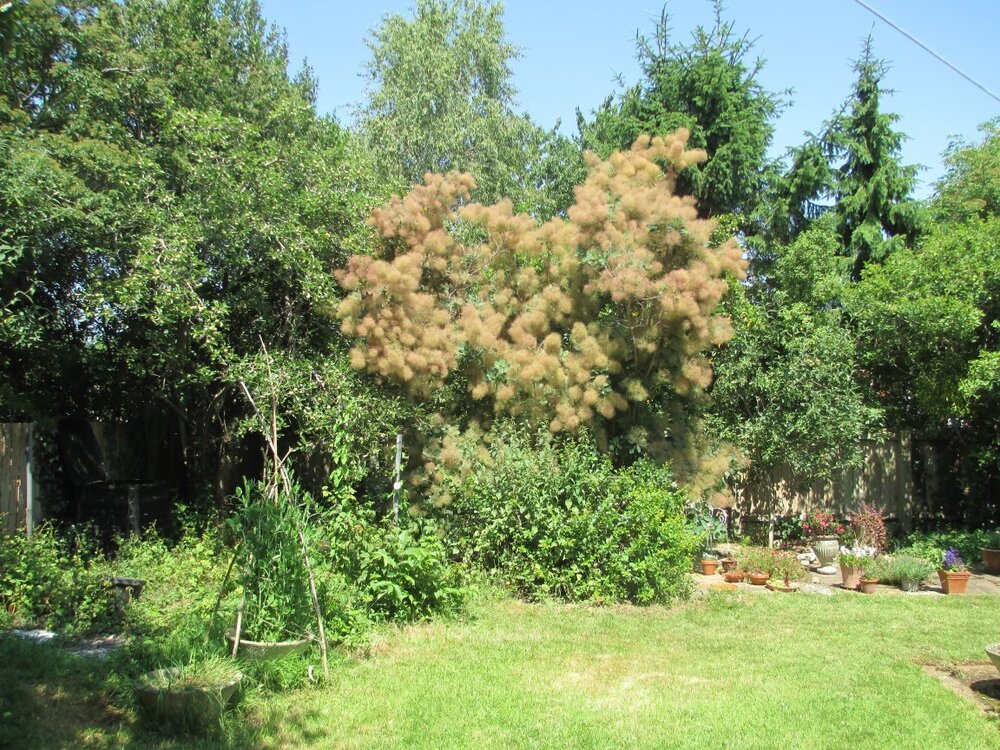
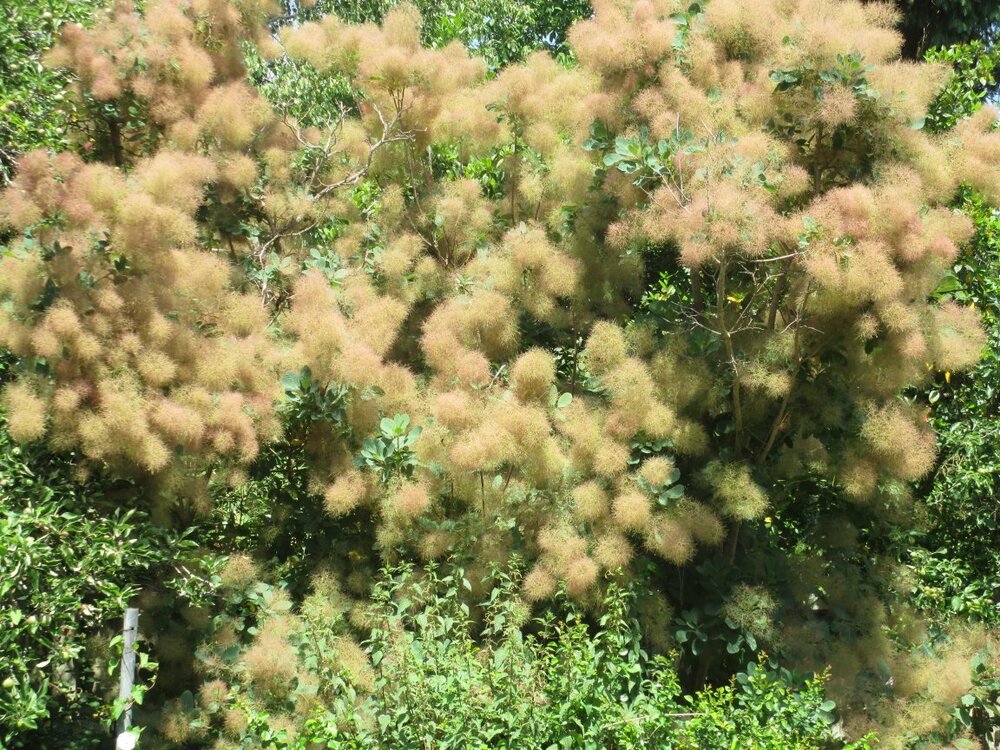
-
careful here. 'measurable has a different specific meaning from observable in mathematics, esp in respect of Hilbert spaces. I quite agree. But again some care is needed as you also need a physical mechanism to pass from one state to another. That mechanism must have defining or describing (mathematical0 statements. What they cannot be is a statement of the form that the system passes from state A to state B etc by some random jump process that take zero time and/or passes directly from one point in space to another without passing through the intervening points. Unfortunately, this is exactly what you see if your model involves taking successive 'snapshots' of the position of a 'point particle' , say an electron in an orbital. The way I see it (physically) is the electron cloud or density picture that is built up is not a patchwork of jumps but more like a mist in front of you,, which thins and thickens in patches, as you watch. That is in accordance with the fact that the wave function occupies the entire region under consideration, rather as the mist occupies the entire region around you.
-
I agree that is a very real danger and leads to a very real fear. One of the reasons I asked you what field of Science was involved is because one way towards overcoming this lies in the correspondence pages of respected journals, for instance the journals of professional institutions. Obviously a suitable journal would have to be selected. Your friend could then write a 'letter to the editor' giving brief outline details, perhaps suggesting what new understanding the idea could lead to. This would then establish his or her right to be the first to come up with it. Over to you. Here is a true story of the discovery of the microscope by a non scientist, which lead to the very deep scientific idea by a self confessed dreamer. When a cloth mechant called van Leeuwenhoek needed to examine the quality of his cloth he taught himself to grind strong lenses. This also led to him discovering the microscope and microbes. A writer, called Jonathan Swift, heard about this and penned this thought which actually is incredibly deep, scientifically. Little fleas have smaller fleas Upon their backs to bitem. And these small fleas have lesser fleas and so on ad infinitum
-
A point function is one that has one and only one value at any point in the coordinate system. quantiles ae not points. A point is specified by the coordinate system, the value is specified by the function. Pretty basic really. But in QM you cannot identify a specific point and assign a specifc value to it. By specific I mean exact. You can do one or the other.
-
Actually you are correct there is a difference between probability and probability density that is often forgotten and folks just use the word probability. As i undeerstand matters that is because of the way QM is formulated so we have probability is a point function which is a map from the sample space to an interval between zero and 1 of the reals. Locality is not involved. On the other had there is no such thing as a point function in QM. probability density is the (classical) probability of the Event E lying between say x and (x + dx) for one axis, suitably adjusted for the normalisation condition.
-
Thank you, but you don't need need a Markov , or any other, chain to state the probability of a single event. However you do need to state unequivocally what you mean by the probability of event E is, for the three cases P(E) = 0 P() = 1 0 < P(E) < 1 since depending upon the type of classic probability you are using these cases, at least, will be different.Possibly the best council in the whole bible. Yet not something cannot be appreciated by the non religeous or that even needs religeon. Interestingly the sermon on the mount was almost word for word the same as the teaching by Loa Tsu in the tai ching many years beofre.swansont has already asked for examples and so I am asking for them as well. At the moment you are just piling generality upon generalitywithout the detailed support these claims require. I would have thought it would have been wise to start with a statement of which of the the three classic types of probability, as taught for UK state school exams, you are referring to and also giving a specific example from QM that runs contrary to it or them.I wonder what sort of AI might have been involved this this 1000 time overcharging BBC NewsWoman charged £4,586 for two-hour car park stay in SloughIt took three weeks for the mum to receive a refund for the accidental overcharge. I note that the human organisation failed to correct the error promptly until pushed by the BBC.New stuff to me. +1 One thing about the Bible is that you always learn something new everytime your ead it in the way I suggestedWell if it is one idea, it rather depends which science it appertains to. Some science such as Astrophysics have little or no meaning without maths. In some other sciences such as geology you can establish a whole lot without mathematics. One man's meat is literally another's poison.If neither of you are scientific persons how do you know this idea is scientific ? Since you have just joined, you (or your 'friend') may not realise that members may only have one account by the rules.
Important Information
We have placed cookies on your device to help make this website better. You can adjust your cookie settings, otherwise we'll assume you're okay to continue.