studiot
Senior Members
-
Joined
-
Last visited
Everything posted by studiot
-
There are lots of ways to achieve a crisp exterior to potatoes when cooking them. Results depend upon the variety, age and condition of the tuber, including its water content. If you want good results with shallow frying you are best to parboil or par microwave them first. The European method of making chips uses this method for both deep and shallow frying. I think the most important thing is that the final operation should be intense heating of the potato whether roasting, baking or frying. If you obtain the crisp external coating too soon in the cooking sequence you will either end up with a part cooked interior or have to turn the heat down and I find the crisp exterior goes soft - You often find this in restaurents that have kept roast potatoes warm (hot) too long. It should be noted that it is possible to produce the crisp exterior even if the potatoes are floating in water (gravy), this is done in the traditional Lancashire hotpot dish for instance. I find that 'scallops' are thus the best shape for shallow frying. Some commercial chips (fries) are made from extruded precooked and reconstituted potato. On the issue of supermarket supply, I find it is always worth removing vegetables from their plastic bags (even the perforated bags) as soon as possible as the seat in the bags initiating deterioration. Carrots seem particularly prone to this and also some supermarkets seem to treat them particularly harshly so they start going black on the outside within a day or two. It should be noted that the washing process also involves som form of mechanical scrubbing.
-
nice +1
-
The point is that one of Tesla's false claims relates directly to your proposition. What makes you think space has no properties ? This is just false, and Tesla of all poeple as an electrical engineer should have known better. Empty or free space has a measurable electromagnetic impedance of about 377 Ohms.
-
+1
-
Hello Timothy, I can see you have much work to do explaining your ideas since you are using different definitions for common scientific words from (the rest of) the scientific community. Radical though he may have been Einstein did not do this. In particular do you actually know what the scientific definitions of 'fractal' and 'dimension' are ? You state "Einstein's assumption of a static 3 dimensional space....." Did you know that significant investigation into the mathematics and science of multi dimensional space was started before Einstein and received an impetus when his theory of special relativity came out ? In particular various multidimensional spaces were studied intensively with the result that 2 dimensions are insufficient, 4 and more dimensions offer additional phenomenon that are not observed leaving only 3 dimensional space as being the appropriate number. Significant Mathematical material was developed by Sommerville, Eddington, Hausdorf, Abbot amongst others at this time and the work has continued to this day because it is not yet 'finished' - if it ever will be. It is worth noting that modern (and slightly earlier) mathematicians have even added significantly to Euclid's massive epic. We can discuss these comments if you like, which could save you a lot of heartache in the future. I am sorry to be so negative as you appear sincere in your efforts.
-
We would need sufficient information to begin to answer this question. Impedance ? Acoustic impedance ? Radiation impedance? Electromagnetic impedance ? Impedance between the surface and something else ? Yes it may be possible to detect an intervening object depending upon the details ( a lot more of them) . Capacitive coupling comes to mind. Over to you.
-
You have yet to demonstrate there will be a freeze - thaw.
-
Since this is worrying you. Here is something to think about. Actually, no this is not possible. It is not possible becasue you have a length (and width and height) in space. You are not a point. Try to imagaine what would happen if you were a sausage and you said the sausage moves 3 units North, the two units West. Where is the sausage now ? Now ask the same question if you cut a slice from the middle of the sausage and moved it those idatances where is it now ? This second operation are what most people mean by time-travel, which is not the equivalent of space travel. Why not ?
-
Maxwell, Stokes and others worked all this out in great detail in the early to mid 1800s. But they rejected these mechanical models is unsatisfactory for a variety of reasons, and finally devised experiments to disporove aether models once and for all. How much less satisfactory do you think we now find them 150 years alter, armed with our greater knowledge and many, more refined experiments ?
-
Well you should not doubt it. Tensional forces from any source always aid the degradation due to chemical weathering, for instance by causing joints which allow the acid solvents to penetrate deeply into the body of the rock. Anyway as you say, your observations were side observations, and my comments were equally quick responses. I propose to do some reading up on the mechanical models I dubbed interesting and will report back when I have found more out.
-
Indeed I am just adding to my own observation that engineering predated science by perhaps thousands of years. Noelithic engineers had no science.
-
I'm glad you are beginning to do some thinking about it. Because your ice/water interface must have moved on many metres in that one second, depending upon the interface speed you take. If this does not happen then you will not have the required water for the hydroturbine to operate. It cannot do so in a slush. Also if you have used all the solar energy in your 100m strip for thawing the ice, how are you going to find the power to pump stuff around ? Finally all this area of solar collector, pipeline, pumps, controls, turbines, output electricl gear and storage must weigh millions of tonnes. How are you going to get it all there ?
-
Yes I wondered about some of the wording in the available extracts. For instance the idea of plates 'drifting' around the globe harps back to the theory of continental drift. As regards to 'damage', that may not be the best word but deformation does not tell the whole story either. Crustal (and other) rocks can and do continually degrade by various natural processes as well as specific event such as plate boundary activity.
-
What known science did the first neolithic engineer to build a clapper bridge 'apply' ?
-
No ridicule, but I'm pretty sure I didn't say your second line as you have rephrased it. I'm also pretty sure you fully understand the difference between power and energy. So what I said was that the solar energy incident on that area over a period of one second was eactly the amount you need to thaw a cubic metre of ice, if you could collect all of it and add it all to that ice. I was temporarily ignoring the inefficiencies of collection, distribution, storage etc and simply asking how you would transfer that amount of energy into a block of ice in one second, since you would need to do the same again with the next block of ice in the next second and so on. Given my own knowledge of this sort of thing from deicing of bridge structures I am doubting the practicality of that operation.
-
You could make an argument the other way round since engineering is by far the older discipline. In other words scientists are a particular type of engineer. However engineers sometimes 'do' science - when they want to find or try something out. Equally scientists sometimes do engineering when they want a particular piece of apparatus that does not already exist. When I cook the dinner I act as a chef not a scientist or an engineer. Which simply prooves that humans are more versatile than artificial categorisation.
-
Thank you @beecee that is enough to get the gist of it. Turkish - When I tried to follow your link the first time I saw mention of the Univesity of Istambul and examples in Turkey. The idea that the subducting plate is drawn ever more steeply downwards and eventually breks off has been around for quite some time. Ted Nield details the evidence for this in his 2007 book Supercontinent. The mechanical model of the dashpot, pulley and tension connections is new to me at least and interesting to consider. I wonder how many such situations there are (were) around the globe ? Thank you for a good response and an interesting article now I understand what it is all about. +1
-
So let me get this straight. You are envisaging using the entire output from a 100m wide strip, one quarter of the way round the martian globe to melt the ice in one metre of the pipeline ?
-
Yes, sorry. Quoting you instead of the OP was my mistake.
-
Unfortunately this article is subscription only. I would like to see at least a diagram in case something is lost in the translation from Turkish.
-
As an obviously competent engineer I am disappointed with the obviously politician's brush off when pressed for hard detail, more especially as you invited comment. Here is the problem I am trying to reconcile. You have mentioned several different pipe sizes, and somewhere a square metre of cross section. So let us consider 1 m2 section of pipe 1 metre long, at the frozen stage. This has a volume of 1 cubic metre. Ignoring, for the moment, the small difference in density between ice and water, this has a mass of 103 kg So to calculate the approximate energy reuqirement to raise this from ice at -4 C to water at +1 C ie to melt it we require 103(4*2050 + 334000 + 4200) = 3.464 105 x 103 Joules per m3 Now the rate of insolation on the mars is 590 w/m2 or 5.9 x 10² J/m2 per second So it requires ( 3.464 x 10⁸ ) / (5.9 x 10² ) = 6 x 10⁵ square metres of martian surface to receive this energy every second multiplied by the rate of movement of the ice/water interface as this was calculated on a 1m/s basis and assuming perfect energy conversion.
-
Sadly you are still not answering my question(s)
-
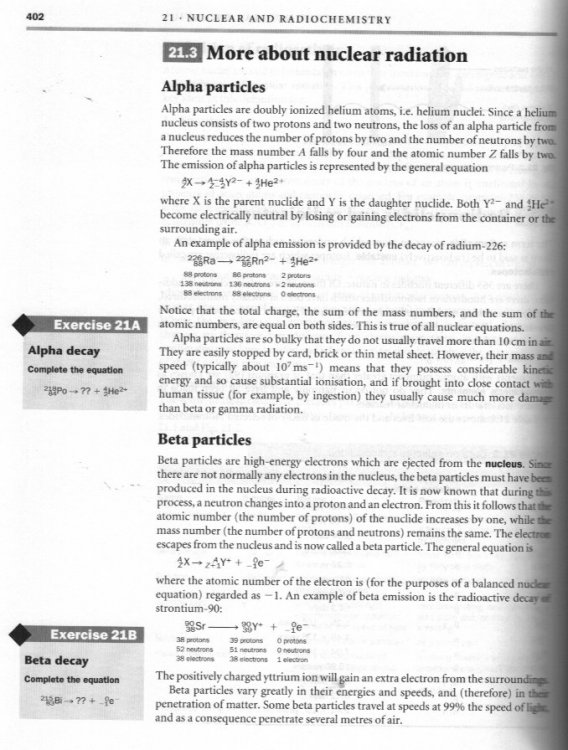
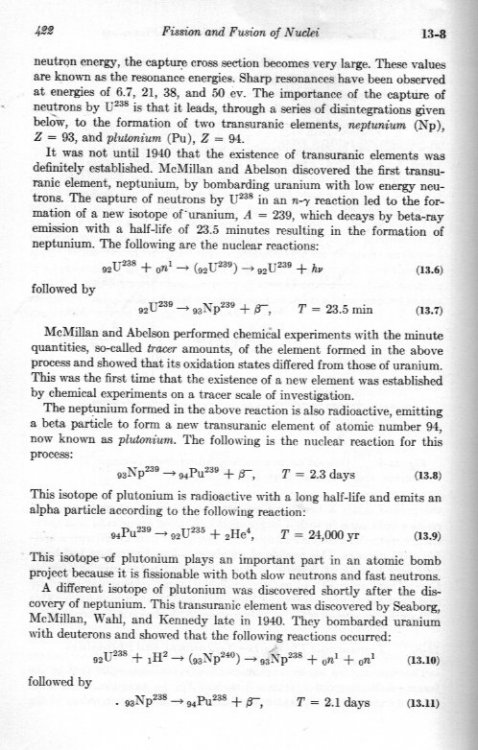
You are asking this question of the Physicists here. In most Physcis textbooks the authors are not to worried about charge so the equations presented do not generally observe conservation of charge. So the equations presented often have a beta minus or alpha positive charge on one side, but no charge on the other. So these equations do not balance in respect of charge. For example Chemists are more careful so here is an extract from a Chemistry textbooks that explains this in detail, balancing the charges as well. And yes the equations now balance for charge. Some reactants and/or products are now shown charged (eg as ions or whatever) Another way to compare is to understand that Physicists are talking about nuclear reactions and so use the chemical symbols to represent the nucleus, which always carries a positve charge equal to the atom ic number. Chemists use the same symbols to represent the electrically neutral atom so must always display the charge to refer to an ion. Does this help ?
-
Well perhaps you are not the only one being unclear since this post of yours describes exactly what is worrying me and I thought I had stated in my last post. Someone seems to have perhaps understood it, although your answer suggested that you did not catch it. Do you think that either Martian conditions allow either freezing or thawing at 18m/s ? That is driving along at 40mph. What sort of heat transfer coefficients are you envisaging for the pipline and what about the energy flows to accomplish this ?
-
Article about Tokomaks in Britain and America Interestingly set in the business section, not the science section of the BBC. However it does offer some useful up to date facts and figures. https://www.bbc.co.uk/news/business-56843149