studiot
Senior Members
-
Joined
-
Last visited
Everything posted by studiot
-
I am not sure how much you will find about vectors in Bondi's book, but the Einstein train experiments chapter is worth thinking about. Here is another train experiment which shows some interesting things. A man holding two bricks is travelling in a glass train. (Glass so he can see and be seen) He holds them side by side, one just inside the carriage and one just outside by the window. As he passes another man standing on a station platform he drops them both together. It is illuminating to consider what each man sees about the paths of the two bricks.
-
I have that beef about the UK Inland Revenue and tax forms.
-
Thank you it is useful to be able to compare data standards. One thing immediately stands out from that. When do you become 'unvaccinated' after the one or two shots ? The UK is managing boosters for about six months and two weeks. But many mean fully vaccinated = after the booster.
-
It should be noted that data from all countries/regions contains considerable hidden unknowns. Also the methods used for recording the data are different in different countries, making comparison a bit tricky. The UK defines death from covid as "Death within 28 days of a positive covid test" It defines infection rates as "recorded by a positive covid test", not as presenting with covid symptoms But only a minor % of the population undergoes routine testing. Most only test if the have symptoms. Also what is meant by 'fully vaccinated' has never been clear.
-
Actually I was a bit overdramatic there because you can still install an electric AGA, its just the gas ones at the moment. Interestingly folks come from all over the world (even Oz) to visit the splendid country kitchen showrooms near me. You can see not only AGA, but many other European and American manufacturers rages there. Some of these are absolutely enormous. We sometimes take our visitors there as it provides a good half day out.
-
Shape is a very difficult concept to tie down. I don't know of any way to define it without involving boundaries. So far as we know, the Universe has no boundaries.
-
I wasn't asking for myself, but thanks for your links. I was gently referring to the invariance of 4 dimensional distance in spacetime. Distance or length in 4 dimensions is the invariant '4 squares quantity' No one measures it lengthened or shortened. 3 dimensional distance is measured as shortened by many observers (but not all) And , of course time is then measured as lengthened. But I'm sure you know all this. My point is that many others mix up which distance they are foreshortening.
-
If you weren't persistently so rudely aggressive towards others, I might be inclined to resume conversation with you.
-
I did have a chuckle about the large negative spike in the green (death) graph. Reincarnation and Resuscitation Rules OK ?
-
You may wish to expand on this statement as i think it is easily capapble of misinterpretation.
-
Good to hear back from you. There is certainly a measure of truth in what you are saying. The equations of Einstein are not wrong, but they are not totally right either. Indeed he changed them a few times himself, in acknowledgement of this. Further he made some incorrect predictions. You are correct in wondering about the interpretation of the Mathematics, dimensions etc. Spacetime is only a (mathematical) model. It is not the real thing. Its equations are not wrong, but being a model its equations also require certain results that do not appear in reality. There is a (much) less mathematical discussion in progress about this right now, including ssome excellent links to Einstein's incorrect predictions about length contraction.
-
And also the method of observation, as pointed out by Penrose and Terrell. Observation can be direct, as in Penrode and Terrell, or indirect ie deduced from other observations and or calculations. Furthermore different observers have different interactions with a given object so it should not be suprising that they deduce different observations. I would say that is the philosophy of Relativity for you. I would completely agree with the rest of your post however.
-
What is frightening is just how fast this variant is getting around the world. Yesterday 61 persons on two flights from SA into Amsterdam tested positive on arrival.
-
No I didn't say they were a risk. I said the government chose to ban baxi bermuda style back boilers as 'inefficient'. And yes they are planning to ban the AGA and gas boilers in new build properties. I also said that the inflammable cladding that they did not ban, led to major tragedy. Or alternatively control issues. And yes the salesmen of this world claim that storage cures all known ills. But the reality is rather different. We can discuss this at length for the benfit of others if you like. As a member of 'the trade', surely you realise that all gas burners are less than 100% efficient in that you receive less than 100% of the combustion heat. However heat pumps deliver heat out using work in and can deliver well over 100% ( up to 400% depending upon conditions) heat out equivalent using the work in as the base.
-
Why no ? If you don't put in you won't get out. The more I 'want' is exactly what you wrote following this, say you did not understand and offering what you didn't understand. (2) says that spacetime is not reality Hopefully that is simple enough. If it is not reality then I offered a comment on what it is. Spacetime is a working model of reality. This is just as Engineers have working models of say beams structures. These models may be actual physical models or they may be mathematical models (often on a computer these days). But just as the Engineers models of beams have characteristics that do not act in the same way as all real beams (For instance plane sections remain plane on bending and the span to depth ratio is much greater then 50 to 1 or that stress is proportioanal to distance from the neutral axis) So Spacetime constrains the orientation of linked events because it involves the use of coordinate systems, just as drawing a triangle by coordinates on graph paper fixes the orientation of the triangle in a way that drawing the same triangle by scribing the lengths of the three sides does not. So (3) says that Spacetime does something that reality does not. Does this help ?
-
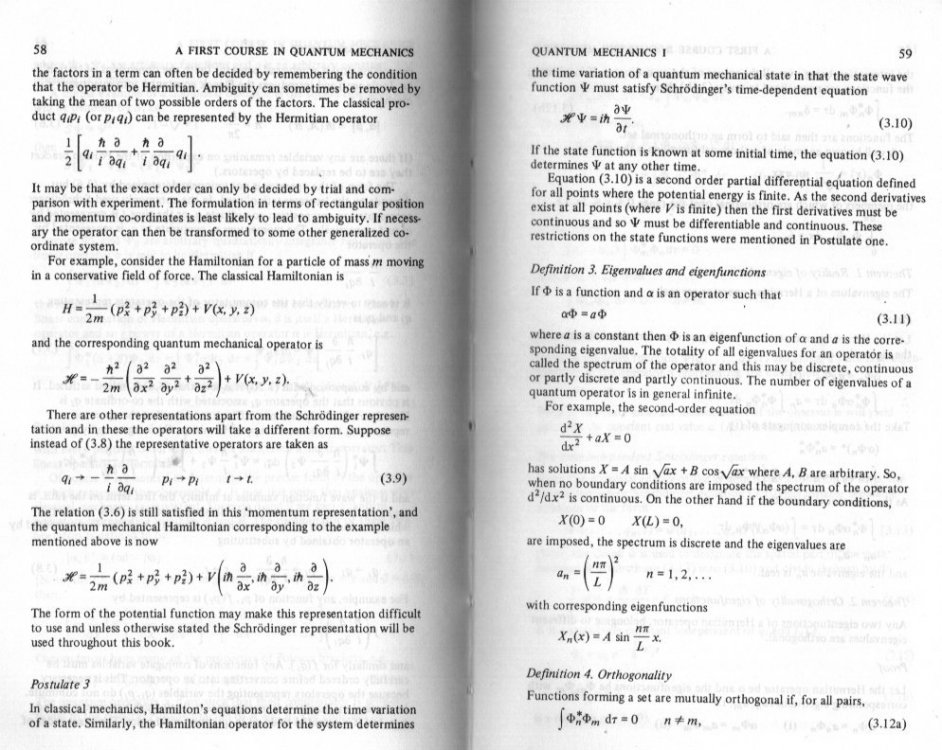
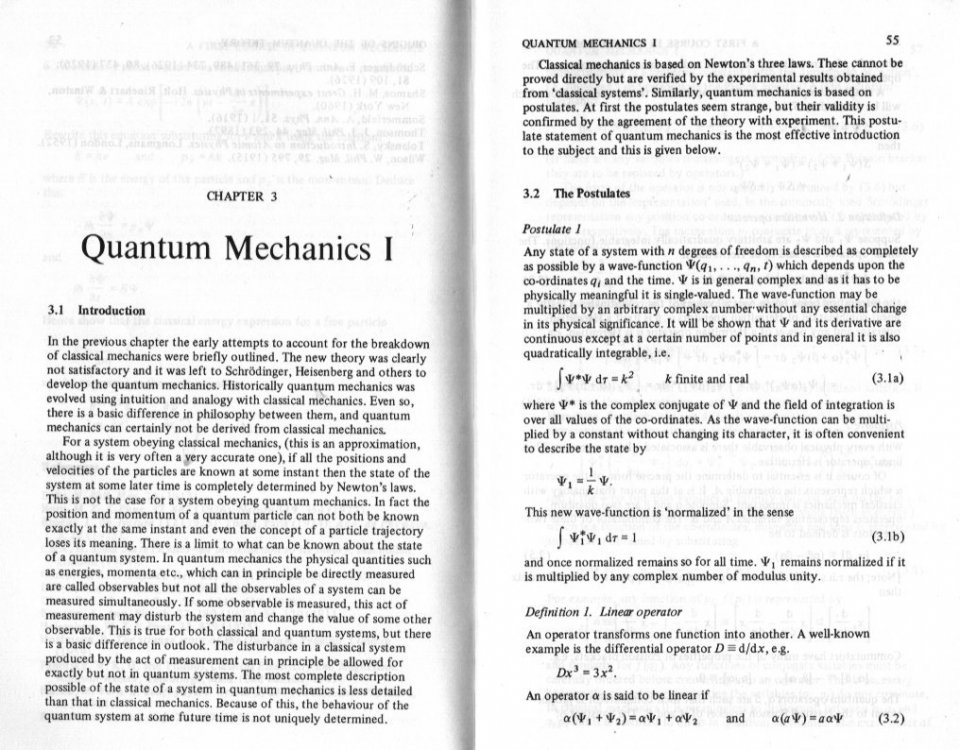
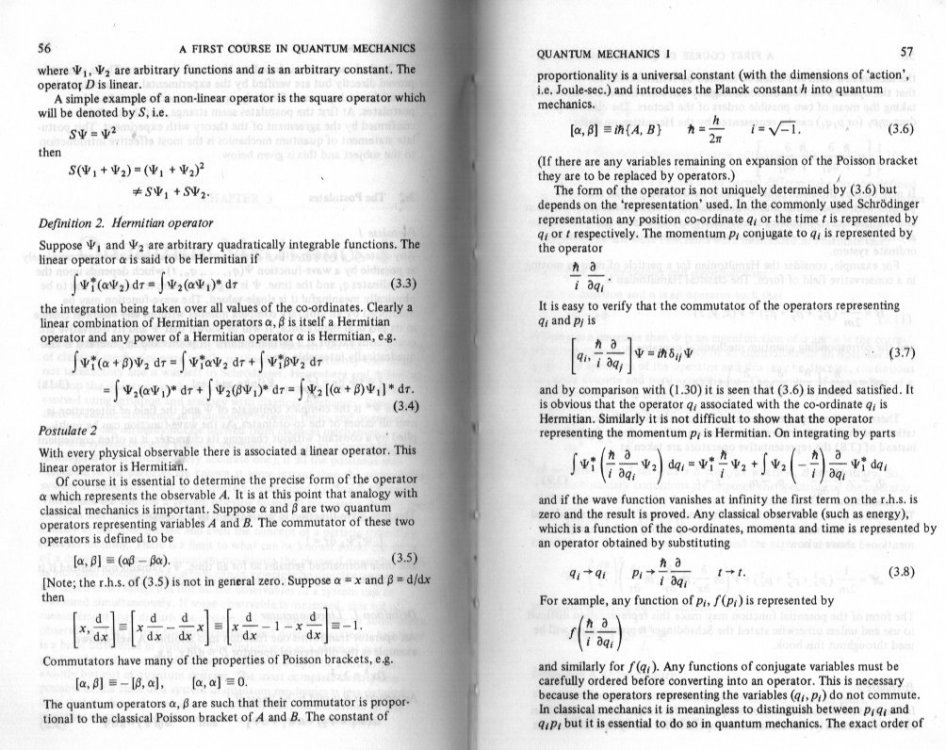
Since you have made some attempt to answer my comment this time I will offer some more help. It's clear that you have copy/pasted the expressions in question from a book or other source which should have provided proper background for the questions and the answers already provided. I don't know what resources you have access to but you are reaching a long way into theoretical physics/applied maths here. This subject really belongs in one of those two sub forums, not Analysis and Calculus. Anyway these three attachments should provide a good solid background for both your questions as they compares classical and quantum momenta and operators.
-
I think if you want folks to participate you will need to put more in yourself. I don't see much acknowledgement in the form of chat about my input here.
-
Thank you for observing the purpose of this thread which was to relate exchange exeriences involving heat pumps, for the benefit of all. A very interesting contribution, probably more in line with the commercial calculations I posted in the previous post. +1 I'm gald you have a good experience of instantaneous gas water heaters. Mine was nothing but trouble from installation in 1989 to replacement in 2016 and never met its advertised specifications. A few minor corrections to your post are in order however. Firstly I did not call the systms twaddle. I said that a lot of twaddle is being talked about them - I might have added "In order to sell them like a car salesman promised the Sun the Moon and The Stars". Secondly my experience of maintenance is that heat pump maintenance is far cheaper than hi tech domestic gas boilers. Since heat pumps are actually also somewhat hi tech there are old fashioned systems lo tech gas systems, such as I enjoyed in my previous house, that were indeed cheaper to maintain. Sadly our glorious government had chosen to declare these illegal, in preference to highly flammable building cladding, leading to significant loss of life and untold misery in the UK. A couple of points perhaps not made explicitly before. My heat pump system suffers from the same difficulty experience by the previous instantaneous gas boiler. It cannot provide both domestic hot water and central heating at the same time. Also in the UK domestic situation there is no use for the 'cooling output' as you put it. I can well see a use in Brisbane, where there is a much warmer climate.
-
[math]{s^2} = {x^2} + {y^2} + {z^2} + {\left[ {ict} \right]^2} = {\left( {{x_1}} \right)^2} + {\left( {{x_2}} \right)^2} + {\left( {{x_3}} \right)^2} + {\left( {{x_4}} \right)^2} = {x_\mu }{x_\mu }[/math] My apologies something went seriously qwrong with the LATex aftr inputting. Correcting the quote is the only way I can see to put it right.
-
Thanks for the additional sane information. +1
-
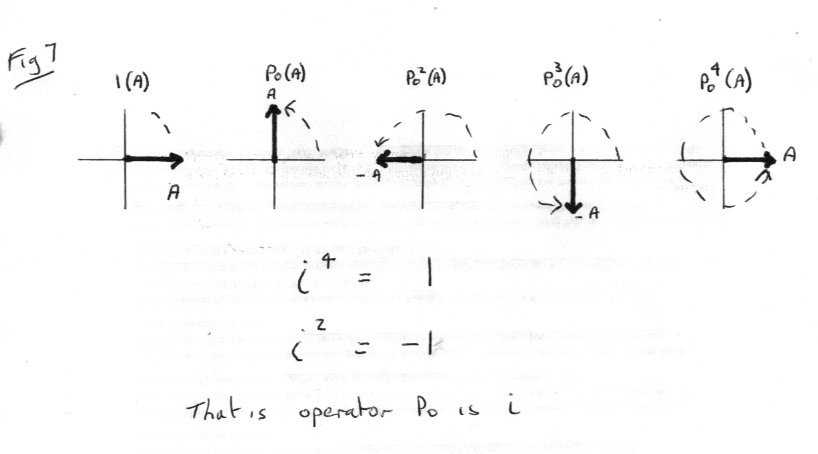
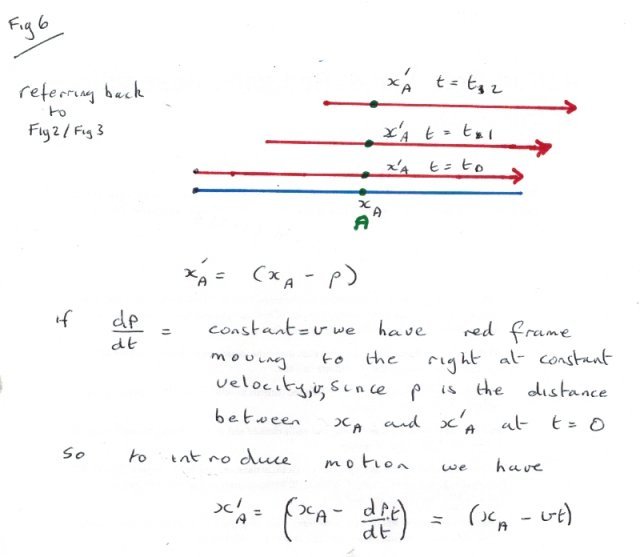
I a bit suprised there are no more questions, but to press on We have established that Minkowski spacetime is no more than a model or description of the background graph paper we are working on. As such all the axes have to be in the same units to be able to construct vectors in it. But to construct Minkowski spacetime and the motion in it we need two more things. Firstly our model or graph is 4 dimensional, but 'rigid body' motion is one dimensional in that it follows one line, although it may be set in 1,2, 3 or 4 dimensions. Clasically Fig 6 gives us this one dimensional motion and it is often convenient to reduce that motion to take place along the x axis alone, at least as a simplified study. Esentially we are extending the static shift of axes, shown in figs 2 and 3, to become an instantaneous shift, constant at any one instant. Thus fig 6 shows that the constant p becomes a variable as time progresses and introduces time as a variable indirectly via the velocity. This leads to the equation xA' = (xA - vt) which we will need to progress on to einstinian relativity. Because we are trying to develop this from geometry, we want to preserve the relationship that the inner (scalar) product of vectors we have to scale the time axis of our four dimensional graph paper by multiplying it by a suitable constant, having suitable units. This is because to be able to form an inner product all axes have to be in the same units, as previously discussed. Einstein's second Postulate for relativity is that this constant is c (Note this is similar to using v in Fig6) However by itself multiplying by c is not enough as we exist in 3 spatial dimensions and we do not want the t axis to point along any of them. That is we want the t axis to point Perpendicular to the line of any one dimension, Perpendicular to the plane of the paper and Perpendicular to the block of 3 D So we introduce i as an operator that performs these functions. i is best defined as in Fig 7 This gives us the necessary features. The scalar or inner product of out coordinates (regardes as vectors) then becomes {s^2} = {x^2} + {y^2} + {z^2} + {\left[ {ict} \right]^2} = {\left( {{x_1}} \right)^2} + {\left( {{x_2}} \right)^2} + {\left( {{x_3}} \right)^2} + {\left( {{x_4}} \right)^2} = {x_\mu }{x_\mu }s2=x2+y2+z2+[ict]2=(x1)2+(x2)2+(x3)2+(x4)2=xμxμ Where I have taken the opportunity to show the beginnings of Einstein's summation convention. Where a suffix appears twice as in (x_submu) (x_submu) it represents a summation of the all the xs and mu is a (dummy) index we 'understand' to run from 1 through 4 (in this case). So {x_\mu }xμ is the vector (4 vector in this case) given by {x_\mu } = \left( {{x_1},{x_2},{x_3},{x_4}} \right)xμ=(x1,x2,x3,x4) This notation is the beginnings of Tensor notation you may see scatterd about a lot in Physics but not used so much in Engineering. It is not necessary to use tensors, you can do just as well using matrices and we are, of course, just using ordinary algebra spiced with a touch of calculus. (If you prefer matrices, as I do, there is a good book Einstein in Matrix Form, Gunter Ludyk, SpringerGraduate Texts in Physics.) This combination of two quantities with different units to form 4 vector in a Minkowski vector space can be extended to kinetic energy and momentum, which when combined by multiplying the energy by i/c gives the full famous equation of Einstein of offered as E = mc2 . Returning to a single space dimension and time we are now in a position to derive the Fitzgerald contraction, which was an empirical obervation, from geometry and a bit of algebra, where is becomes a proper mathematical property of the Minkowski spacetime continuum. we call the Lorenz transformation. So if we have a system S' (with coordinates x', ict') moving along the x axis in system S (with coordinates x, ict) with a constant velocity v we have the invariant inner product {s^2} = {x^2} + {\left[ {ict} \right]^2} = x{'^2} + {\left[ {ict'} \right]^2}s2=x2+[ict]2=x′2+[ict′]2 or {s^2} = {x^2} - {c^2}{t^2} = x{'^2} - {c^2}t{'^2}s2=x2−c2t2=x′2−c2t′2 Some derivations make this equation Einstein's second Postulate, but we have derived it from geometry (Einstein derived it in yet another more complicated way) We will also need the equation from fig 6 I said we would need We now introduce the further constraint that the origins in time must match when S' is alongside S as it passes. That is t = t' = o This means that x = vt when x' =0 and x' = -vt when x = 0 Because there is only one relative velocity v, which is common to both systems S and S', apart from the opposite sign for opposite direction. So taking our expression from fig 6 we have x' = \gamma \left( {x - vt} \right)x′=γ(x−vt) and x = \gamma '\left( {x' + vt'} \right)x=γ′(x′+vt′) Where the gammas are yet to be determined expressions. Eliminating x' between the we find t' = \left[ {t - \frac{x}{v}\left( {1 - \frac{1}{{\gamma \gamma '}}} \right)} \right]t′=[t−xv(1−1γγ′)] Putting our expressions for x' and t' in terms of x and t we find {x^2}\left[ {1 - {\gamma ^2} + \frac{{{\gamma ^2}{c^2}}}{{{v^2}}}{{\left( {1 - \frac{1}{{\gamma \gamma }}} \right)}^2}} \right] + 2xt\left[ {{\gamma ^2}v - \frac{{{c^2}{\gamma ^2}}}{v}\left( {1 - \frac{1}{{\gamma \gamma '}}} \right)} \right] + {t^2}\left[ {{c^2}\left( {{\gamma ^2} - 1} \right) - {\gamma ^2}{v^2}} \right] = 0x2[1−γ2+γ2c2v2(1−1γγ)2]+2xt[γ2v−c2γ2v(1−1γγ′)]+t2[c2(γ2−1)−γ2v2]=0 Now this must be true for all values of x and t so is an identity, not just an equation. This means that each of the summed terms must separately be zero, so the coefficients of x2, xt and t2 vanish separately. Thus equating the coefficient of t2 to zero gives \gamma = \frac{1}{{\sqrt {1 - \frac{{{v^2}}}{{{c^2}}}} }}γ=11−v2c2√ Which hopefully you will recognise as the gamma in the Lorenz transformation. and using the others gives \gamma = \gamma ' Of course there are other possible solutions to the question. So many authors will stress that any solution must reduce from einstinian relativity to Galilean/Newtonian at low relative velocites. We have actually gone the other way building on Newton to reach Einstein. It is pleasing to see Maths and Physics fitting so well together and complementing each other. If you are still with me we can talk about frames and why we call them frames and what we can expect to 'see', measure and calculate in any frame.
-
Your second equation is incomplete. i is a constant, hbar is a constant, and nabla (del) is an operator, which needs something to operate on. You have not provided anything for it to oeprate on.
-
Let us return to some facts and Science in this thread. The OP was about sex from a gentic point of view, and perhaps only for humans. However Nature most definitely offers more than binary sexual genetic activity as perfectly normal. This website is semi technical. https://www.micropia.nl/dossiercontent/microworld/en/11/?ph=1 Would anyone like to tell me how to 'sex' a single cell organism ?
-
Yes thank you, I realise whom you were quoting. But I am disappointed that you chose to label such people as defective humans. Seems an obnoxious term to me. At least you acknowledged that they are humans. However I wonder if there are any humans truly without any defects at all? Or do all humans have some defect or other ?
-
I didn't call it anything. But please enlighten me. Why do you call it a birth defect ? Birth has nothing to do with a situation that occurred long before birth.