
studiot
Senior Members
-
Joined
-
Last visited
Everything posted by studiot
-
Yes this is perfectly true. But it is not an answer to Seth's question, which you quoted as you were responding to. I read Seth's 'neolithic technology' as the (ecologically good) use of leaves. This has actually nothing to do with hydroponics, unless you count the manufacture of what we used to call 'liquid manure'. I don't know if the trade name liquinure is still going. Ye, but I've never seen anyone till a forest. Ploughing or digging in green manure is quite different.
-
Keep digging +1
-
I am more than happy to learn something from anyone with more knowledge of biological classification than I have, my classification scheme is strictly of the common or gardening variery. So I call tomatoes salad veg, although they are actually fruit. +1
-
The question is asking you to solve the given differential equation for which the pdf = f(E,t) is a solution. I know less than nothing about python, but since the question asks for computer code, is it asking for a numerical solution ? I note part 1a specifically asks for an analytical integral. It is also worth noting that any solution is likely to be an exponential, since the second derivative is an exponential.
-
Great idea +1. It is worth distinguishing different types of vegetable material. I thought fungi go for the woody parts mostly. Moulds and smaller organisms go for the softer material. Some plants are all soft material, (perhaps roots apart). I was taught to use mustard as 'green manure'. This is planted before the desired crop and dug in green and whole not long before replanting. The practice is coming back into fashion with farmers as a soil conditioner. it prevents leaving bare earth to suffer soid leaching. But many plants have woody parts, stems, branches, spikes, needles etc. Some leaves also have a waxy coating or other thick coating which makes them doubly hard to rot down. It is not only nitrogen that counts. Pine needles create a very acid layer which suppresses most other plants and acidifies the soil when they eventually rot. Pine needle leaf mould is not good to add to most domestic or agricultural soils. Vegetable production especially needs less acidity, which is why we traditionally lime the soil. Yes they can take longer than say carrot tops or grass cuttings, about the same time as straw for instance. However a small amount of nitrogen loss is often not a problem, except to nitrogen greedy plants like rhubarb or asparagus. And the fact that they take longer makes them an ideal weed suppression mulch. Some use straw. Traditionally straw performs this function in strawberry beds as well as keeping the berries off the gorund. Not sure why they would argue with Seth's statement ?
-
Thanks good point.
-
I have found when using either the quote function from the input toolbar or the quote function for a previous post or part of one that you need to exit the editor's setting by hitting return a few times untl your cursor is a few lines clear of the quoted passage. I also find that doing this to separate several quotes is a good idea as sometimes the limits overlay each other.
-
Yes I'm aware of that, but Einstein was still pretty general. He used 'pulses' or flashes of light not continuous waves. That could just as easily have been pulses of 'superfast lentil pudding', for all the bearing it had on his argument. (pun intended). It was the pulses that were important. And, of course, I think you deal with pulses of laser light today? No offence to tar but I think he is trying to run before he can walk. Bondi's (excellent) book is aimed at folks in his situation. But it still requires careful reading as with any serious subject. Here is the preface explaining his approach, if you haven't seen it.
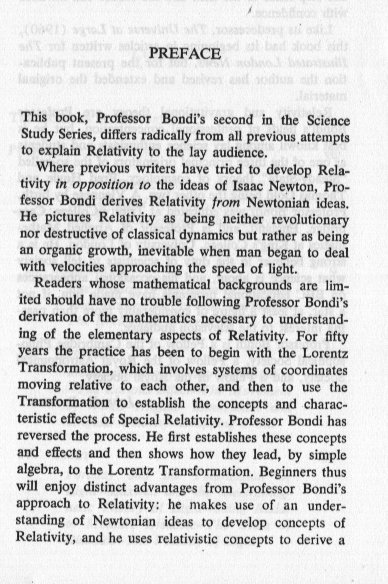
-
I think talking (arguing) about photons is pointless in Relativity. Photons are only part of light's story anyway. Einstein in his original paper went to great lengths to avoid (do without) the actual mechanism of light and its propagation. He was well aware of the difficulties about the nature of light faced by physicists of that time. His derivation would still hold good if light were actually found to be something else entirely. These days we tend to shorcut this because we know much more about the nature of light. But focusing on light is not the way to Relativity IMHO. (pun intended)
-
Partly depends on the chemistry of the fuel. Hydrazine is particularly bad as it produces oxides of nitrogen. Here is a NASA video - warning it's over 20 minutes long.
-
Hello, Will. I hope you read the rules of Quantum Mechanics better than you read the rules of this site. Advertising your site or youtube channel is strictly forbidden. I suggest you post a suitably complete summary before a moderator trips over this post and bans you.
-
I'm sure it could be very helpful to you to complete this post as I am waiting for you to tell me what you are confused about with Bondi's book. Sorting this out could be much more productive than challenging swansont. Edit I see you have referred several times to 'the river analogy' since you first mentioned the pages in Bondi's book. You did not confirm that I found the correct ones, please do so or refer to the correct ones as the case may be. Please also note that the scanned pages I posted are not an analogy and they are not Einstinian Physics either. They are just plain and simple old Newtonian Physics.
-
No one is mocking you or your device. The description/specification has changed as this thread has progress. For instance it started off trailing electric cables, but was the promoted to a self contained battery. Initially no mention of recycling the matter ejected from the rocket, this was introduced later in response to a question. For your information , my example, although lurid, was made to conform to the information originally supplied about the workings of the device. Not the claims about thrust and local experts being baffled and so forth. Just this description below. Chucking turkeys out of the window indeed constitutes a matter stream. As you say, ejecting this stream indeed results in a reaction force against the end wall. Again as you say, destroying a % of the streaming birds in flight reduces the mass of the stream and therefore the energy and momentum of the stream which eventually strikes the wall opposite. So the reaction force from the wall opposite (which is rigidly connnected to the start wall) is lower than the reaction force on the start wall. (I tried to make distinguishing easier by using West and East walls.) So it is a perfectly good model to analyse. I have no idea how you actual device works, other than it is different from mine. But I would observe that there are many ways to achieve or prevent motion by redistributing mass within a body, where the necessary reaction is 'hidden'. Often the hidden reaction force is the friction with the supports or ground it stands on. Wheels will spin instead of providing drive in the absence of friction. Nature has a more clever way in the locomotion of a caterpiller, as small children love emulating. Here there is a combination of friction and an increase in distributed normal reaction but moving that reaction from one place to another. I try to teach cyclists to reduce the reactions produced by bumps in the road by simply moving their body weight first backwards whilst teh front wheel goes over and the fowards whilst the back wheel goes over. But the fact remains you have made some factually inaccurate statements about the mechanics of the situation. The most glaring is claiming the operation to be a result of a kinetic energy balance. It is obvious that since you have the ability to supply as much or as little KE from sources external to your 'system' via your electricity supply or via some chemical process, that this is not the reason. Reaction forces come from change of momentum and can be linked numerically to the rate of change of momentum of something. So others here were quite correct to pursue this avenue of enquiry.
-
Mthematically that is more or less true. I would be grateful if folks would allow me to know just a little bit of basic Mathematics. It is, after all, my subject. Whatever is proposed has to be in accordance with the mathematical rules of 'addition' and 'multiplication'. Both are 'binary operations' that follow specific rules of set and group theory. There is nothing that requires either of the operands to be numbers, or that restricts either from being a number. In Mathematics the unit of the quantity is regarded as a multiplier for the number. Equally we could regard the number as a multiplier for the unit as Capiert has proposed. Regarding either as an operand in an 'addition' between the two does not make sense. However regarding their multiplicative combination as an operand in an addition with another similar (but not necessarily identical) multiplicative combination can make sense in appropriate circumstance. It does not always make sense. I quickly dashed off a couple of examples yesterday to try to help. I am sorry they were so derided as they are correct within the rules of arithmetic I have just described. I can now improve on those examples. Firstly the decimal system itself. Consider the 'number' :- 1234. Children used to be taught that this comprised 1 off of thousands + 2 off of hundreds + 3 off of tens + 4 off of units or 1x(1000) + 2x(100) + 3x(10) + 4x(1) Which is arithmetically correct and conforms to Capiert's original proposition. 1234 could be written in a different way using the Roman (Latin) scheme with different bases.
-
We recently discussed this video and its rights and wrongs here
-
So what is 100 + 1 ? It's the same placeholder idea, as is £, s, p
-
Have you never come a cross aman whose height is 6' 3" ?
-
It's not an analogy it genuinely shows the characteristics first laid out. Some of those are indeed that momentum analysis is the best way forward. It also shows, IMHO, that the OP omitted the crossways analysis by tring to use a perpendicularity condition. But I'm sure you and exchemist know that.
-
I couldn't afford the contract with Gimli
-
Unless, like me, you have 3 feet. You need the 1 to go with the egg since there are 3 feet in a yard. Or is it 2.4 pints ? Trust the Scots
-
During the discussion (and as a result of it) the original design of this device seems to have changed several times. So here is the Christmas version of my understanding of the original proposed mechanism. Imagine a large Xmas fair hall. On the East wall is an oven ready turkey booth. Unfortunately something has gone wrong with the electrically driven conveyor and packing machine. So instead of being brought up in a steady stream, packed and stacked, the turkeys arrive and are flung out of the window towards the west wall. On the South wall there is a shooting gallery. The elf here thinks the stream of flying turkeys is great fun and has taken to blasting them out of the air to smithereens. However she has to reload between shots and in that time three turkey pass by, impacting the west wall and falling to the ground. So the number of turkeys impacting the West wall is 3/4 the number leaving the East wall. In other times I would tell the story about flying beer bottles and a mad bartender as more fun.
-
I thought you didn't understand it.
-
Yes of course he's right. The best way to think about it to to understand the word 'units'. A unit is 1 whole of anything. Even easier to think in terms of something that only comes in whole numbers for example eggs. So the unit is a single egg or 1egg. 5 eggs The 5 and the eggs are separate. So we have 5 x 1_egg. Similarly 5 metres is really 5 x 1_metre
-
I was working round to the vibration idea as I wondered if this KE reducer was suspended from the case by the diagonal lines in the diagram. And while yes momentum analysis is a good way of analysing the sytem I think the OP's problem is answering the questions The momentum of what ? The energy of what ? The KE is only the KE of the 'rocket' exhaust, not the system. The momentum is only the momentum of the rocket exhaust. But the rocket exhaust by itslef is a different system. It is so common for people to try to change systems in mid analysis and then wonder why things don't add up. It took long enough for the OP to admit that the system needed energy input (the electrical cables) or energy stored in another form eg chemical.
-
+1 +1