studiot
Senior Members
-
Joined
-
Last visited
Everything posted by studiot
-
Don't give and certainly don't count trees. Did you do the simple sums I suggested ? How about this one ? Say you bought £1,000 to invest for three years so you bought some shares in a company. In the first year the value increased 30%. In the second year the value increased another 10% In the third year the value increased another 50% Based on these figures what would you expect the value to be after another 2 years. Well you would need a (geomtric) average increase for the first three years and project that average forwards two more years. So in the first year the 1,000 increase by 1.3 to 1300 In the second year this increased to 1.1(1300) In the third year this increased to (1.5)(1.1)(1300) or (1.5)(1.1)(1.3)(1000) So the geometric mean is the cube root of (1.5)(1.1)(1.3) and this represents the yearly expected increase based on those figures It is the number that if you kept multiplying by would keep the same average increase in the future.
-
Firstly let me say that you can do a great deal of statistics without knowing or doing any calculus. Calculus is a calculating tool (hence its name) for many other disciplines and its principles need to be learned separate from and previous to the applications. So sorry there are no 'shortcuts' for staticians. You can save a great deal of time and effort however by passing over the clever detail and tricks that someone intending to work out a lot of calculus will need. You only need to understand what is going on. Calculus is mostly used in the proofs of formulae in its statistical applications and your teachers will probably say things like The average value of a function in the interval a to b is given by the integral of the function divided by (b-a). So you will need to know what an integral is. But you will not need to calculate it, just how to use the formula. From that point of view calculus is divided into two parts the differential calculus and the integral calculus, with the latter being more important in statistics.
-
Taking an average is choosing or calculating one number to stand for a whole bunch of data. One sort of average is a statistical mean. There are three common types of 'mean' in use. 1) The most common is the arithemtic mean and is used when we add things together. It answers the question If all the numbers we added together had the same value individually, what would that value be. Suppose we had a rectangle with sides A and B, So the perimeter = 2A +2B. The arithmetic mean answers the question what number C represents a square with the same perimeter [math]C = \frac{{A + B}}{2}[/math] So the square with the same perimeter is the square with sides [math]C = \frac{{A + B}}{2}[/math] Where the primeter = 4C 2) The geometric mean is used when we have the result of numbers being multiplied together, instead of being added. It is eqaul to the nth root of n numbers being so multiplied. The most usual place to find this one used to be in finance where you wanted to know an average rate of return on an iaccumulating investment, where the return rate might vary from year to year. More recently such geomtric means have become important in population growth studies, where the growth equations are similar and involve multiplication of numbers. The geometric example that follows from the rectangle square example works if you ask for the area of the square that equals the area of the given rectangle. That is the rectangle has the same area as a square of sides = geometric mean of A and B which is [math]\sqrt {AB} [/math] 3) The harmonic mean is also used iin finance. It is known that the 3 means appear in the order Arithmetic Mean >= Geometric Mean >= Harmonic Mean [math]\frac{{A + B}}{2} \ge \sqrt {AB} \ge \frac{{2AB}}{{A + B}}[/math] With equality only occurring when A = B you can check these with the square - rectangle example putting A = 2 and B=4 and then A = 2 and B = 2
-
+1 to Markus for pointing out that the full definition of exponents needs to work for any number. and I agree that the definition you have found is absolutely crap. However it is more usual to introduce exponents by not saying the number of multiplications performed but the number of '2s' multiplied together. You don't then need to go into that long series involving 1. The exponenent n is the number of original number multiplied together. For example One two on its own = 2 = 21 = 2 Two twos multiplied together = 2 x 2 = 22 = 4 note this is only one multiplication Three twos multiplied together = 2 x 2 x 2 = 23 = 8 note this is only two multiplications and so on. So the number of multiplications is always one less than the numer of 2s You can then go on to find out what 20 and 2-1 mean and finally fractional and decimal exponents
-
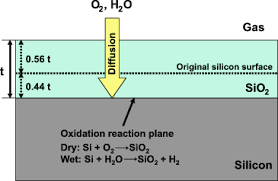
Agreed. It also oxidises readily.
-
Interesting bit of intricate modern machining of hard workpieces made from hard substances such as silicon nitride and boron nitride as well as more ordinary metals. But I didn't see any kitchen worktops made of silicon. Do you actually mean resin bonded artificial stone which can contain up to 95% silica aka quartz ?
-
Well you learn something every day. +1 I have never come across this material. Have you any links ?
-
Are you sure you don't mean slilcone, not silicon ? https://www.primasil.com/explore-silicone/
-
That would be equivalent to claiming that because there are two streams in an electrolyte, the external wiring is unnecessary to make the cell work. I agree that two streams are necessary but there is a whole lot more to it than that. I would observe that exchemist's reference looks at the microscale and disregards the macroscale circuit. Equally Kraus' conventional discussion looks at the macroscale and disregards the microscale. A further comment neither of these address the question of 'Where does the energy come from ?'. A good place to start would be global meteorology. I say this because it was in the same period of development that the mechanism for moving large quantities of energy from the tropics towards the poles is due to a handful of giant cumulus cloud structures at any one time and the internal mechanism of these clouds is most interesting and strangely relevent. Sarah Dry Waters of the World (2019) Chapter 5 Hot Towers page 147 ff.
-
Nexfin appear to be a new venture capital company, run by 3 investment bankers in London. You could try emailing one of them from this link and asking for a link to download the software from https://www.nexfin.org.uk/meet-the-team/
-
Shrug. If I thought the 10 pages from Professor Kraus, Director of the Radio Astronomy Observatory Taine could be condensed I would have already don this. Interestingly, I don't see a reference to Andreas Neuber, the author of my reference ot the rel humidity work in your link either. Hello trevor. There seems to be a deal of bad feeling spilling over from some other forums and you have posted some rather outlandish statements in other threads here. I do not wish to get involved in such matters. But I will just say that the post of yours I have just quoted is the only sensible one I can attribute to you. You do need to understand further some of the statements in it though. The electrosphere is conductive at D C. Above it the ionosphere is also conductive but at radio frequencies. In his book, Electromagnetics, Kraus deals with the electrical engineering of this pages 98 to 103 and pages 211 to 214. Some of the material comes from the work of Maynard Hill (sorry @exchemist I missed the Hill bit) https://www.jhuapl.edu/Content/techdigest/pdf/V05-N02/05-02-Hill_Electro.pdf
-
No I don't think so. For a start that machine requires large continuous metallic conductors AKA wires in the sky. Last time I looked I didn't see any. Secondly you quite rightly identified upward movement as well as downward movement. Again I don't see this in the machine. But many thanks for bringing this gadget to my attention. I had not heard of it before. If you listen to others, you can learn somthing new every day. +1 The Maynard model I referred to is the result of many measurements of the electric field at various altitudes and is used in the flying industry for calibrating navigation equiment. It is a capacitive model. It also has both upward and downward movement of particles. It was the result of a geat deal of research in the decades mid 1940s to mid 1960s.
-
There are too many pages to reproduce here (10) but if you let me have an email address by PM (I usually recommend setting up a special gmail account for this) I can let you have a copy of the current electro-physics explanation due to Maynard.
-
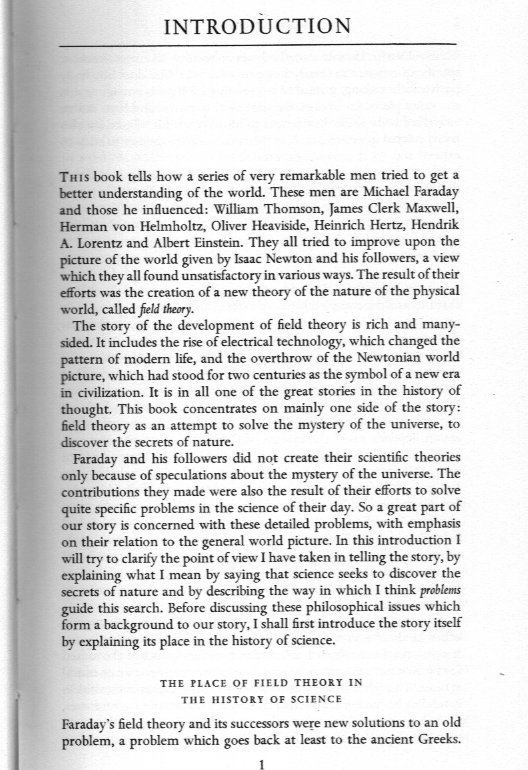
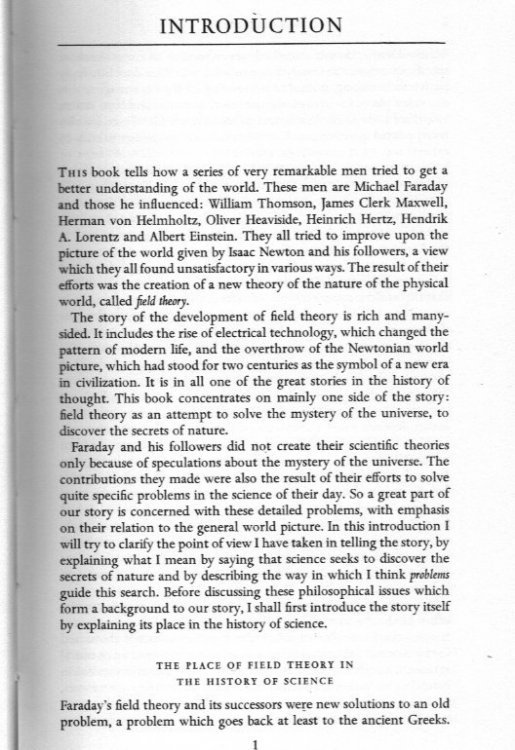
Not quite. Farady was the one who introduced the idea of 'Lines of Force' and grouped them together into a 'Field'. Faraday was the archetypal experimenter. He came to his theory after meticulous repeats of the experiments of Oerstead and Ampere adding many of his own. The field theory did not come all at once, he had several false starts before he came to his final version. At this point he asked Maxwell to rewrite it as a mathemtical theory, a job he himself was incapable of. Faraday's field theory did not require a medium, this came after out of Maxwell's excellent rewriting. One thing that came out of Maxwell's maths was that the Field could support waves., that appeared to have the same characteristics as light waves. But at that time (the mid 19th century) the only waves known all required a pre-existing medium to propagate in. So it was not suprising that they proposed an aether with some rather special properties. Maxwell himself was a staunch supporter of the aether and spent much of his prodigous effort trying to make the concept work. So all his work was written in assumption that a Field requires a medium. The subsequent work described in this book leads on to the modern Quantum Field where we are to day. Back with the fact that some fields need a medium and some do not. Berkson : Fields of Force.
-
I have not posted in this thread before as exchemist and seth were doing a grand job of sorting out the sign conventions and the lax wording in your book. I think it is worth noting that 7 + 15 = 22. I will just add a comment on sign conventions here as some just take this in ther stride and never have a problem , whereas others stumble over the issues. The first Law of Thermodynamics is one of at least half a dozen cases in Physical Science where two separate and independent sign conventions are simultaneously in play, with sometimes confusing results. The first is the case of positive and negative numebrs combined with addition and subtraction in arithmetic. I have seen at least one Professor of Maths get his sums wrong as a result. Then we have your example from the first law. Chemists use ΔU = q + w Physicists use ΔU = q - w (engineers use this too) Both are correct in their own way. I think the Chemists' version is more logical because on the the right hand side refers to energies crossing the system boundary. Everything that goes in is regarded as positive and everything that comes out is regarded as negative and all you have to do is add them up. This becomes even more useful when there are (lots) more terms on the RHS for electrical work etc etc. This does mean we have to adopt 'work done on the system' as our variable w. However Thermodynamics was developed in the days of steam and other machinery. And the purpose of machinery is to do work. Since the machine constitutes the system in most cases and work is the desired output, it makes sense to adopt the convention that w is 'work done by the system'. Equally you add heat in the form of coal to a steam engine to get that output work. So q is regarded as heat added to the system. So the Physicist's first law has to be written differently to take account of the mixed up sign conventions on its RHS. Other scientific examples you might encounter include In Electricity the sign conventions for voltage and current have the opposite sense In Optics there are various sign conventions for lenses and mirrors, in addition to the cartesian conventions for spatial layout. In Mechanics there are again paired sign conventions for loads, deflections and so on, particularly in Beam theory. I used to find it worthwhile to make a note or add a note page at the bginning of any new tech book about its sign conventions to clarify what sign conventions are used in that book. The best books even do this for you at their beginning. This saves worry when you see in one book it says +w and in another it says -w.
-
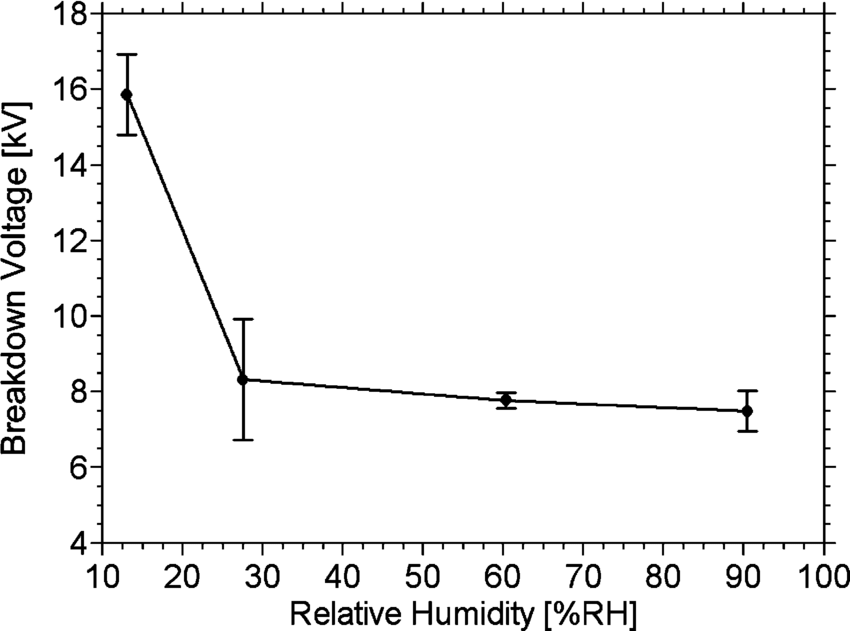
I'm sure this graph is relevent. https://www.researchgate.net/figure/Breakdown-voltage-in-air-versus-relative-humidity-with-an-alumina-surface-Electrode_fig17_3165903
-
Do you have any idea who first introduced the idea of a Field into Physics, or what he meant by it ? I'll give you a clue it was not Newton. Newtonian gravity was not a Field theory - Newton did not deal in Fields. It is true that we have since incorporated or recast newtonian gravity into Field theory.
-
It seems like you (studiot) have a mental block, refusing to reason to the conclusion. TheVat agrees with me that there has to be something physical corresponding to the mathematical field. Whilst I can't see why you have quoted the Vat but replied to me I can only say that it is your loss not mine. These definitions are not mine, just the ones in general use by the scientific and technical community at large. So if you must imagine or guess your own then carry on and expect a great many such communication difficulties.
-
Are you going to listen ? Or are you just going to continue trotting out your misconceptions ? A space is a container for whatever I want to put in it. Common spaces include vector spaces, coordinate spaces, phase spaces, topological spaces....... the list goes on and on. Usually a space contains at least one set of objects, and a set of rules. So a vector space contains a set of vectors, a set of coefficients, a set of rules, perhaps a set or sets of the results of those rules. Listen and learn and you will find your discussion with others so much more rewarding. You are often partly right in what you say, but you are missing out on so much. For example This is known as a sufficient but not necessary condition. Yes that is one way for us to observe the particle behaving lik A. However there exists at least one other way, quite independent of the particle or even the existence oft he particle. If we set up the observation to observe only A that then is what we may or may not observe. But when we do it clearly implies the existence of the particle and its action as A. The real fun in quantum or any other theory starts when we do not observe A.
-
https://www.bbc.co.uk/news/uk-scotland-63402811 Just look how low this dam is.
-
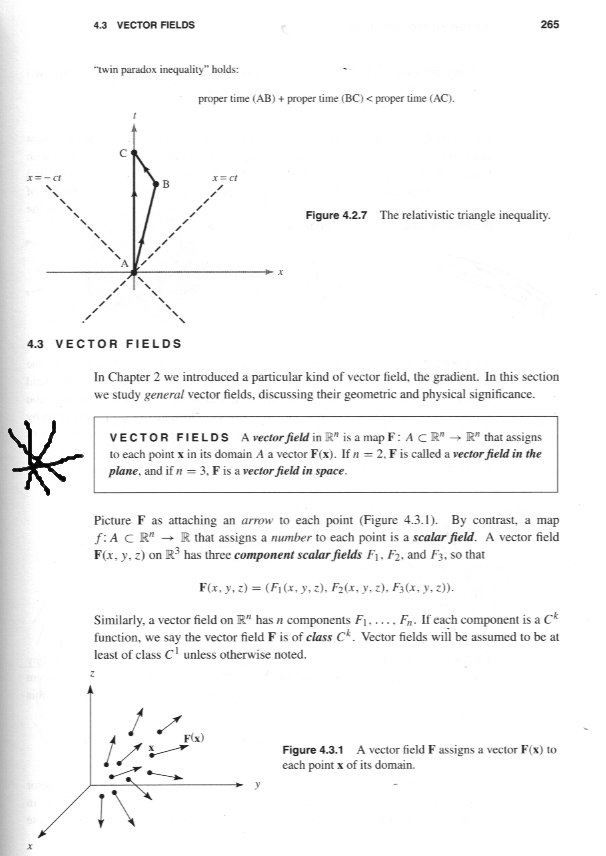
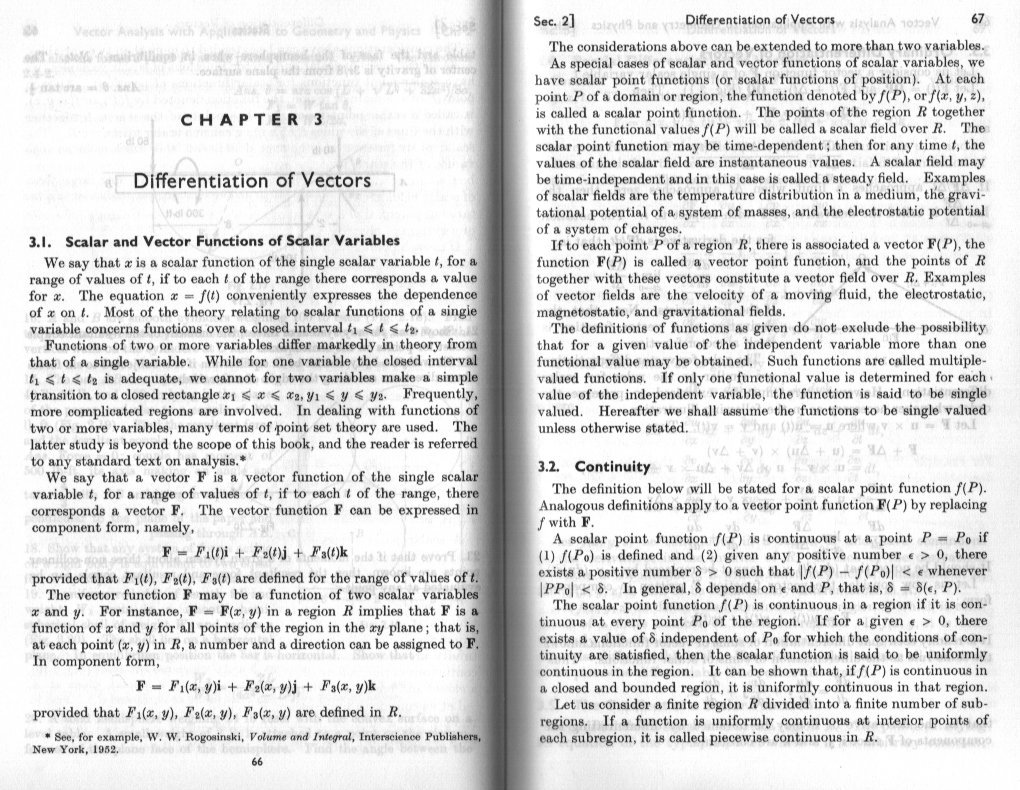
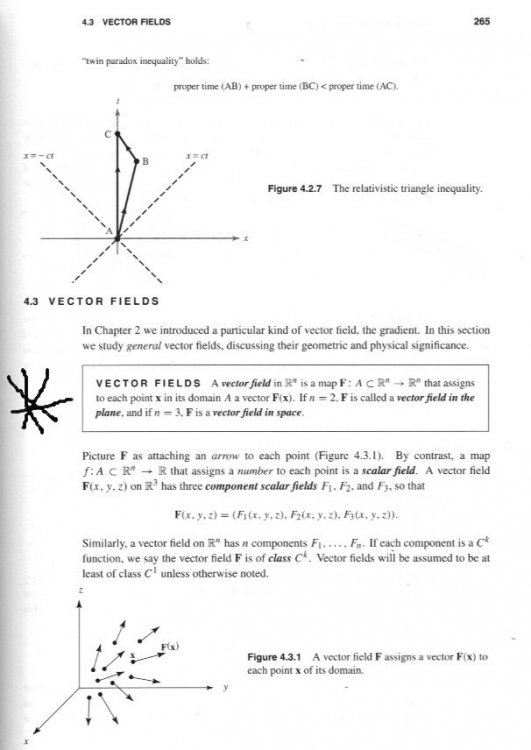
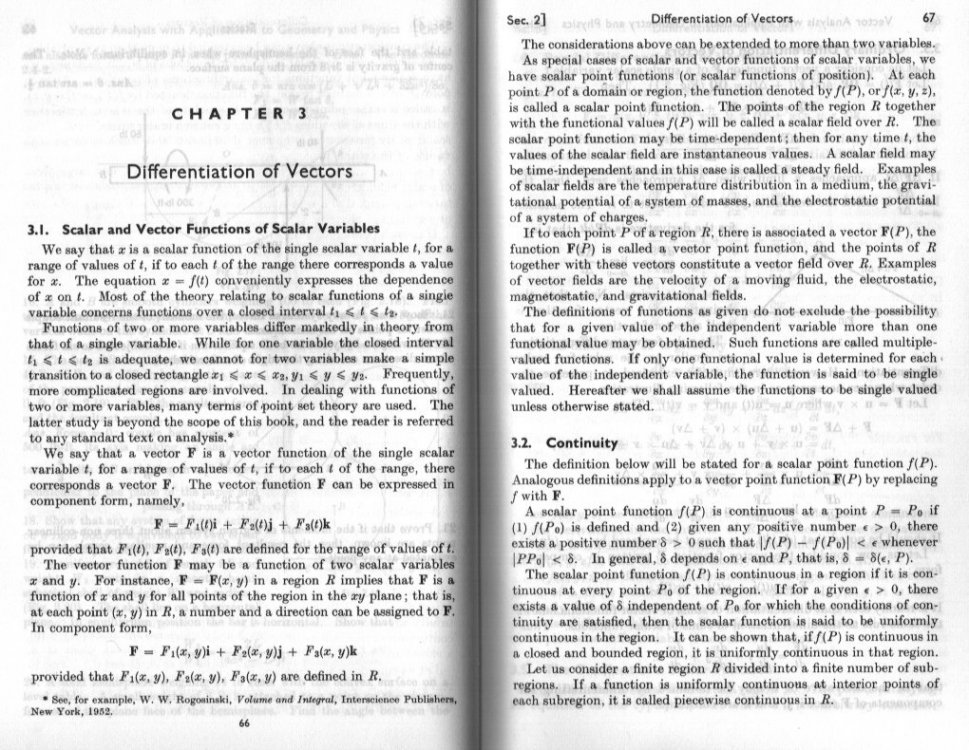
1) I thought the definition of 'space' would need clarifying at some point. You need to understand something they never teach you at school. The 'space' defined by the position is different from the 'space' that encodes the quantity itself. When explaining this further I like to illustrate it with a piece of graph paper and the addition of vectors by a vector triangle or parallelogram. 2) This he said-she said argument could go on indefinitely. So hereare two treatments of how to implement this mathematically. Both are fully compatible with each other and explain what others have been saying, including sensei's compound scalar fields. The first come from Marsden and Tromba Vector Calculus The second from Schwartz, Green and Rutledge Vector Analysis
-
I too have been trying to introduce a measure of levity to this discussion. Around 150 years of exacting spectroscopic measurements and the development of the corresponding quantum theory would say otherwise. Spectroscopic theory is about the most complete and accurate that we posses.
-
Really ? I find the rudeness of the dismissal the most suprising part in your reply to someone who has offered sources of genuine help for your consideration. And this is not even your thread. You clearly do not understand the most fundamental point about entanglement at all. The entangled properties are set for both particles at the moment of entanglement. In order to create entanglement you require very close proximity - not spooky action at a distance. But once set it does not matter how far they diverge, anyone who measure one automatically knows the other. I'm a little hydrogen atom, You're a little hydrogen atom I've got one electron You've got one electron Let's get spin entangled and form a hydrogen molecule. At this point we know that one electron is spin up and the other is spin down But we don't know which is which until we observe one of them. Thanks to joigus +1 for trying to explain my sine example and providing another example.
-
You didn't reply to my last post, but I will try this anyway. Consider the equation sinx = 0.866... No one is suprised when we say that the solution to this equation is x = 60o or x = 120o or x = 420o or a further infinity of solutions. So are all these solutions in superposition or entangled, and just waiting to be selected or observed ?
-
I'd say this is the key to your misunderstanding I am taking this as a reference to the mathematical definition of a Field as a set with two binary operations obeying the 10 Field Axioms, F1 - F10. Two of the axioms refer to algebraic closure with I take to be the formal statement of the words in your quote I have emboldened. I'm sure you can appreciat that this is a far cry from the Physics definition (taken from a book of vector calculus) Note the mathematical description of the scalar field may be more or less complicated than the mathematical description of some vector field. for example (in 2D to make it easy) Scalar field S(x,y) where r is a constant such that x2 + y2 = r2 Vector field u(x,y) = (y,x) (Note I would be interested to see sensei break this down to two or more scalar fields)