
studiot
Senior Members
-
Joined
-
Last visited
Everything posted by studiot
-
I must point out that the key point of the discussion is about determinism/nondeterminism of the future Interesting point, but don't we use 'hindcasting' to check/test hypotheses ?
-
Not really since not one of them have achieved their objective. SR is correct within its domain of applicability. Some have tried to extend it beyond that and have found that it does not necessarily work beyond its domain of applicability. This is just plain wrong. A good history of the century of what he calls "The Battle of General Relativity" was written by Professor Ferriera in 2014. Even Einstein himself though one thing, then another then yet another during that time. Lambda, for instance was not originally included. Einstein added it later then withdrew it. But today's (Astro)Physicists have found a f=definited use /reason for it.
-
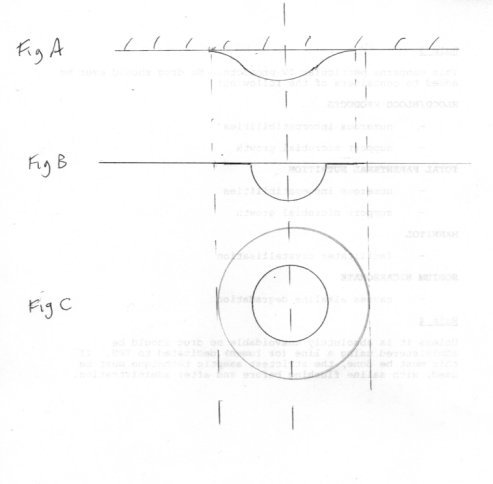
This is not a simple standard school problem so it would be helpful to tell us the context in which it set. As said the contact angle at the ceiling must be zero. So you then need a 'hump' shaped line that flattens out to parallel to the horizontal at both sides. As in Fig A. Rotating this line will produce a domed hat like an inverted ww1 or ww2 tommie's hat with a dome and a wide flat brim. This is modelled as in Fig B. You can reduce this to a one dimensional solution by assuming radial symmetry. This would be expected by the action of surface tension. This is shown in Fig C. You have identified the important features of this problem, including the fact that the brim plays a crucial role in maintaining the adhesion since it contains little or no water (weight) but presents an large surface area to the atmousphere to press against. As a first estimate I would suggest that surface tension holds the droplet together but does not hold the droplet against gravity. A more sophisticated model would include the change in surface energy cause by the droplet breaking away, which could be incorporated in the virtual work equation below. Your force balance can be conveniently solved by the theorem of virtual work, either using a differential virtual vertical displacement or a differential virtual increase in the weight of the drop. I don't think Young's formula will help you here, but it was a good idea. The weight of the drop is derivable from the geometry and in particular the surface area. This is then an extremal (maximisation) problem which could be attacked by good old trial and error or by the calculus of variations if you are seeking an analytical solution.
-
Or they will never complete a game. If you can go back even a short time, then that prior state must be fully determined by the state shortly prior to that, and so on... Hence if we can go back a little and retain determinism, then we can go back all the way to the beginning. Of course there's no evidence of this short term determinism. For one, it presumes a meaningful state of a system, which is a counterfactual, and few interpretations of QM support counterfactuals. I grokked that you didn't grok what I said so I will rephrase it. I meant to clarify what definition of determinism was in play. This asked whether determinism refers to a single event (eg your robots playing RPS) or goes back some indeterminate distance down a causal chain of events. FYI my mathematical comment observes the fact that a chain of probabilities (eg a chain of event each with a probability) does not in general converge to zero but to a definite value and is therefore deterministic, even though we do not know the individual probabilities involved. Probabilities trees are even more complicated.
-
If that is really your point, why didn't you say so in the first place (first post ?)
-
You put a lot of effort into this reply to only two participants. So how about you reply to some of the many other participants ? Incidentally I thought this a good point Though what do you mean about it not being an action ? Also have you heard of reflexes and involuntary actions or the many action we carry out all the time without thinking about them at all, such as breathing and walking (can you normally feel the ground when you walk?)
-
Well why not show it then ? Re this second quote and 'predictability v determinism'. The mathematics of continued products would disagree with you. There are two figures of speech (that I know of) involving elbows in the English language. Both are robust but quite inoffensive. Howevr the German' Lebensraum' has connotations that might offend some members. So I am trying to ignore it.
-
Interesting question +1 This is also an interesting question +1 I would say the mathematics of continued products.
-
I look forward to your report. Please note I am not expert in this - it was only a memory from long ago so I was gratified to find out that my memory had not failed me. So I am having to do some fast thinking on the hoof to answer your excellent questions and if you come up with something new I would be glad to hear about it.
-
How does this affect the issue raised by the thread ?
-
Water has very strong Van Der Waals forces. Hydrophobic particles are not influenced by these. That leaves momentum/KE exchange for the buffeting.
-
On a slightly different tack here is an interesting modern pdf about this issue, from a fractal invariant maths and a neuroscience point of view, from Oxford university.
-
Basically I agree with pretty well all you have said here. I would just stress that there are many types of invariants (see my answer to StringJunky below) invariants are not functions, there is no' invariant function', as there is a 'constant function' in maths. Invariants are a property of certain types of functions or transformations. Yes Invariants are a property of certain types of functions or transformations. As such they are the foundation of the modern way that relativity is viewed. But not all invariants work the same way. For instance the fractal invariant or the scale invariant is an invariant of geometry that does not related to a coordinate frame like relativity. There is an interesting modern view of fractal invariants in Neural Nets and the Brain from Oxford University (in pdf) that I am about to post in that long runningargument over artificial consciousness. https://academic.oup.com/cercor/article/33/8/4574/6713293
-
I checked an my memory of long ago was correct. I thought brownian motion was where I had first heard of lycopodium powder.
-
I didn't say it was and I agree that one of the main uses of the term invariant is the comparison of something between different coordinate systems or frames. I tried to avoid some of the more esoteric uses and offer a solid physical one. The physics of tha lamp oscillation is form invariant between the frames. But that form include a coefficient which is constant, but that constant has a different value is different in every frame, so the constant itself is not invariant. I was also trying not to point the finger at individuals but since you are commenting on Markus, I think he was to enthusiastic when he wrote this. all circumstance ? No any more than the spring constant has the same value under all circunstances. It too is constant under a ( more limited) specific set of circumnstances in that it is constant over a range of extensions of the spring. Anyway if you don't like that example try analysing the oft quoted 'constant AC voltage'. Or perhaps the example I gave before, which has nothing to do with coordinate systems or frames. My freezer keeps a constant temperature, but this temperature is not invariant as I am at liberty to turn the temperature maintained up or down. Or a final one Most of physics can be described by differential equations. We obtain 'solutions' to these DEs by integrating them. But integration includes an arbitrary constant of intgration, which is not therefore invariant. Of course we can eliminate the constant if we work by difference as in the definite integral or in the case of relativity coordinate differences. These words have a lot of work to do.
-
https://www.facebook.com/watch/?v=323855678960326
-
I'm sorry I don't follow. As the lamp is osscillating up and down its travel distance lies at right angles to its motion as part of the train so it is unaffected by relativity. But as part of the train its receeding motion affects the observer's perception of the period of the oscillation in accordance with relativity. So its period will appear to increase (as Markus says). But its period depends on the spring constant Since the period increases k must decrease. So it is a different spring constant.
-
Another good comment and viewpoint. I think that the fact that it will decay to a proton etc and not a raspberry pie is determined, but that when it will happen is not.
-
So with all that latitude we should all be more careful how we use the word in technical discussions.
-
The only way I would use that would be to mean to establish a base temperature to measure from. Otherwise knows as 'benchmarking' in modern parlance. There is no cause and effect relationship in play. Keep the questions coming because they are showing good things and just how deceptively complex the subject whicha t first sight seems to simple and clear cut, really is.
-
Here is a counter example to (1) Lycopodium powder. This was once used to demonstrate brownian motion, where the hydrophobic powder particles definitely do not clump together.
-
So it is not constant in all cases ? Nor is it an invariant of the system.
-
Both good thoughts, hopefully my response will add some clarification. There is a cause and effect connection to determinism so if we can consider the very last cause before the effect Joigus comment of how far back can we go along the chain of cause and effect is pertinent. Does determinism require the whole chain, just part of it, or just the immediate precedent ? When I said that humanity has never known enough to determine everything, I wasn't thinking of (only) data and the idea that if we knew the state variables of every particle at some time we could calculate the evolution or future history of the universe. I was thinking rather of our knowledge of the laws we would use to calculate this. And my counter example from the cuurent time would be dark matter and dark energy, not quantum theory (though obviously qm is not discounted) Isn't fixed another word for determined ?
-
There is more than one meaning to 'determined' ?
-
My answer to the first one is not necessarily, but you need to tell us your answer and why you think that since this looks like homework to me.