
John Cuthber
Resident Experts
-
Joined
-
Last visited
Everything posted by John Cuthber
-
No.
-
It is a theoretical implementation. I haven't actually done it.
-
No That's "rubbing your hands together on a cold day". Fusion is a bit more complicated. You are unlikely to have "cracked" something when you have to ask what it is.
-
As far as I can tell, there's only one topic there.
-
Something like this would be the obvious way. https://en.wikipedia.org/wiki/Laser_scanning But it hardly matters how I'd do it. The fact remains. The point exists and it has all those numbers associated with it And it would do so even if there was nobody else in the world.
-
The point 1 inch east of the tip of my nose has a set of 3 Cartesian coordinates based on an origin at the corner where the floor meets the door. It also has a set of three polar coordinates, altitude, latitude and longitude. So that point has, in fact, 6 numbers. That's before we look at things like a magnetic or gravitational field (and their first, second and nth derivatives). So you are wrong. You should stop now, because this is a science site and you are not doing science.
-
If you are making alcohol for drinking, you certainly don't need vacuum distillation- not bothering to add the most expensive and unnecessary bit makes things cheaper. (Buying a 3d printer etc is unlikely to make things cheaper) If you are making high purity alcohol for lab use then... you still don't need a vacuum still.
-
A geometric mean is the best measure of central trend for a log normal distribution. https://en.wikipedia.org/wiki/Log-normal_distribution#Occurrence_and_applications
-
Where Does Holy Water Come From? Peckham Spring? https://en.wikipedia.org/wiki/Mother_Nature's_Son_(Only_Fools_and_Horses)
-
I'm still trying to get an answer to this. I am not allowed to distill beer in the UK; I don't have a license to do so. But the people who make whisky make it by distilling beer. They typically make beer that's stronger than the usual version. About 7 to 10 % https://www.theguardian.com/science/blog/2010/aug/23/science-art-whisky-making but whisky is made by distilling beer. I have made beer and wine. Did you somehow imagine that I thought that you made beer by distillation? That's not what I said, is it? Just in case you wondered about my credentials; I'm an enthusiastic drinker of spirits and have visited distilleries in 3 different countries. One of them, I was there working And my dad worked in a brewery for decades. Gakusei, next time, before you assume I am wrong about the processes, you might want to check that you have read what I said properly. ..because it is already distilled.. So, if it's distillation that matters, brandy will be the same... So, once again, it seem you are wrong. Confident, but wrong.
-
And that's without the "antidote" effect of the ethanol. The data above show that beer- which is essentially what moonshine is distilled from contains at most 27 mg of methanol per litre. 2.5 ounces is about 70 grams or 70,000 mg. So, ignoring the fact that ethanol acts as an antidote, you would need to extract the methanol from 70,000/28 = 2500 litres of beer to get enough methanol to kill you. Does your still hold 2500 litres of wash? If not then there simply isn't enough methanol in the whole thing to kill you. here's one I have a cavalier attitude to things that are far too small to be important. But, as I already pointed out, there's other junk in there which you don't want to drink. So "topping and tailing" is a good idea.
-
Yeast does not make significant methanol. Methanol is formed from pectin (though the yield is poor). There's very little pectin in grain. So, once again, where is this purported methanol in moonshine coming from? I had a look on the net and found this https://www.ijstr.org/final-print/feb2020/Simultaneous-Gas-Chromatographic-Quantitation-Of-Ethanol-And-Methanol-From-Beer.pdf which says According to published information on alcoholic fermentation congeners detected in various alcoholic beverages, methanol levels are as follows; beer (1-27 mg/L), wine (8-151 mg/L), fortified wine (125-329 mg/L), brandy (176-4766 mg/L), whiskey (6-328 mg/L), rum (6- 131 mg/L), and vodka (0-170 mg/L). If a litre of weak (3% ABV) beer contains 27mg of methanol and 30 ml of ethanol then, unless you screw up the distillation, the moonshine will contain a thousand times more ethanol than methanol. The ethanol would kill you long before the methanol would. The wine has more methanol, but also more ethanol, so , again, it's not the methanol that will kill you. Were they chemists?
-
Formates aren't particularly toxic https://www.fishersci.com/store/msds?partNumber=S648500&productDescription=SODIUM+FORMATE+CERTIFIED+500G&vendorId=VN00033897&countryCode=US&language=en I suspect that the problem is that formic acid is produced within the eye and causes local damage, but I'm not sure
-
Only superficially (Though it will burn if you get it hot enough. The rules about the ends of names aren't reliable. Most metals (apart from the ancient ones like iron and copper) have names ending "ium". But helium isn't a metal. The "inert" gases have names ending "on" (except helium) but silicon isn't an inert gas and nor is boron.
-
Silicon is interesting, but brittle. I'm not sure it would be practical in the kitchen.
-
because the correct reaction is H2 + CuSO4 ---> H2SO4+ Cu? And, in principle, that works. In practice you ned a catalyst like platinum.
-
How do you know that? In particular, how do you "know" that methanol (which shouldn't be there) comes off first even though acetaldehyde has a lower boiling point? https://en.wikipedia.org/wiki/Methanol_toxicity says Methanol poisoning can be treated with fomepizole, or if unavailable, ethanol may be used.[7][13][14] Both drugs act to reduce the action of alcohol dehydrogenase on methanol by means of competitive inhibition. Ethanol, the active ingredient in alcoholic beverages, acts as a competitive inhibitor by more effectively binding and saturating the alcohol dehydrogenase enzyme in the liver, thus blocking the binding of methanol. Methanol is excreted by the kidneys without being converted into the very toxic metabolites formaldehyde and formic acid. Alcohol dehydrogenase instead enzymatically converts ethanol to acetaldehyde, a much less toxic organic The mechanism is comparable for glycol, where the ethanol keeps the enzyme too busy to make oxalic acid. That's sensible; you get rid of a lot of rubbish that way
-
That appears to be the answer to the question where does the methanol go to. An interesting question in its own right, but not the one I asked. There's not much pectin in grain, potatoes or most grapes. There's a bit of low boiling crap in most wash- commonly acetaldehyde. The density of ethanol and methanol are pretty damned similar; about 0.79 You can't really see a change in density- only a change in refractive index and ethanol and methanol are pretty similar on that score 1.36 vs 1.33 . If there's any methanol present in the distillate then it must have been present in the wash. If drinking that wash won't kill you due to methanol poisoning then the same is true of the product. So any of the millions of "homemade wine" recipes will give you a product that , when distilled, won't contain enough methanol to kill you. One of the most effective antidotes to methanol poisoning is ethanol. The only ways to get methanol poisoning from moonshine involve being fundamentally stupid. You can either selectively collect the distillate with the wrong boiling range (and throw away the actual ethanol which would save you) or you can start with something like industrial meths which contains a lot of methanol. The thing about methanol in moonshine is that it's mainly a bogey man set up by law enforcement to protect alcohol duty revenue. I am not going to comment on any practical knowledge I may have about methanol tasting sweet but ethanol tasting bitter.
-
I have a feeling I have seen that particular word salad elsewhere. It didn't go down well with scientists.
-
The most likely explanation is simply that they are clueless.
-
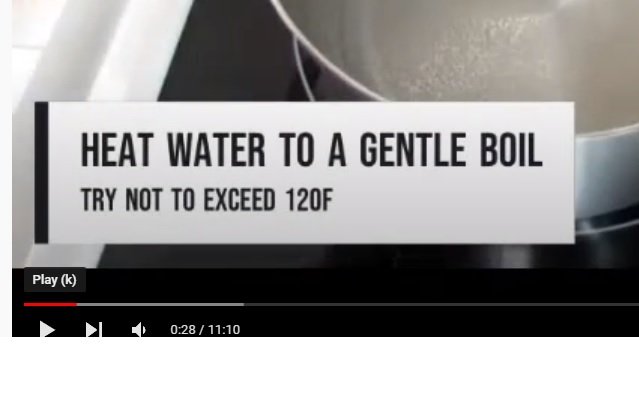
The real question is why they think you can boil something at 120 F. That, together with the impossible yield and the nutrient poor recipe, suggests to me that you should not seek guidance from that site.
-
And where would the methanol come from? That's what I thought.
-
About 95% of the population don't live in the USA. In the UK I can make pretty much as much wine and beer as I want, but I can't legally distill (including "freeze distillation") or sell it. So, I can tell you that the recipe needs nitrogen and phosphorus. Diammonium phosphate is traditional. I can also tell you (because I'm a scientist) that anyone who thinks you get 9 jars of "moonshine" from a gallon of sugar and bread-yeast is either nuts or has a very weak drink.
-
Moonshine...
-
Titanium dioxide, which is a very popular white pigment, absorbs UV rather well. https://www.researchgate.net/figure/UV-Vis-Diffuse-reflectance-spectrum-of-bare-TiO-2-nanoparticles_fig6_320324473 Plain cellulose (and therefore, cotton) doesn't absorb near UV but it does scatter or reflect it. https://www.researchgate.net/figure/UV-Vis-diffuse-reflectance-spectra-of-pure-cellulose-a-cellulose-film-with-stamen-like_fig3_319232616