swansont
Moderators
-
Joined
-
Last visited
Everything posted by swansont
-
! Moderator Note Please don’t hijack other discussions to talk about your own ideas.
-
Then show the GR calculation and point out the disagreement. Einstein’s elevator is an example of the equivalence principle, part of GR. It says light bends in an elevator accelerating at 1g, whether due to an external force or due to gravity. You deny this will occur. Incorrect. You are assuming the field is due to a body where the field varies. That’s an additional constraint the you have added. The gradient isn’t zero for constant g. Why do you think that it would be? Work it the other way. If the field is constant (g), then integrate over a distance (h) to find the potential. It will be gh. The potential energy will be mgh. These equations should look familiar.
-
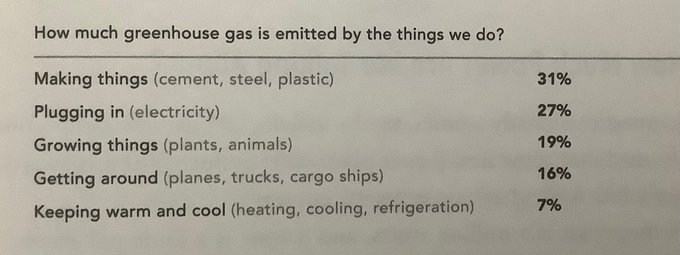
This is from the recent book by Bill Gates. It suggests where the tall tent-poles can be found.
-
! Moderator Note You have at least one thread on this topic.
-
There is no single scientific method. Sometimes the observation/experiment comes before the hypothesis. Sometimes it’s after. Sometimes you can do an independent experiment. Sometimes you can’t. That would be a topic for discussion in speculations
-
Yes, it is. Do the math. Of course it does. But you previously said that it required a change in g. You probably shouldn’t tell me what I agree to. I see you used Newtonian physics. Why is that permitted in your treatment? You’re complaining that it gives inexact results. At what level of precision is Pound-Rebka inexact? Yes, I already pointed this out. “quickly” is quantifiable. The point is, the result obtained is the same as if you did a full GR treatment. It gives the same answer, because if you expand the GR equation in powers of r, they used the first term, as the others are small and can be ignored. (Just like 1/2 mv^2 can be extracted from the relativistic KE equation) I pointed to one already. I don’t see the point, other than as a distraction from the example I gave. g=0, so there is no gravitational acceleration, as I mentioned. So, no comment on Einstein’s elevator?
-
Parents bought a Time-Life book series on science, which had a lot of neat stuff in it, and we went to the natural history museum (the State Museum) in Albany NY and the science museum in Schenectady. Also nature programs; I remember a program on Louis and Mary Leakey and Olduvai Gorge that was fascinating to me. Started my interest in paleontology. The push toward physics was mostly my next door neighbors; the father was an electrical engineer, and his son (~5 years older than me) loved to tinker and experiment, and would include me.
-
So list what, exactly, they got wrong. And explain why knowing the specifics of how the virus got out would have made an impact on how the world responded to it; please stop dodging this question.
-
Things (in this case, laws of physics) don't change over time. They look the same at time T, and time T+t A closed system is a thermodynamic term, and unless you're doing cosmology you're probably tacitly assuming an inertial frame. An accelerating frame is not inertial. (and gravitational waves are emitted only under some accelerations)
-
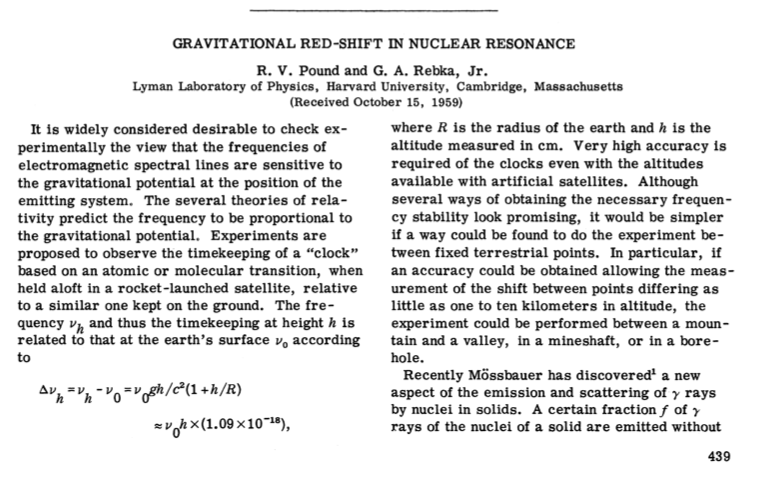
No, it's a claim from GR. Take the GR equation and expand it. The first term is the contribution from constant g. Regardless, the problem with Newton was with light, not gravity. GR reduces to Newtonian gravity when gravity is weak, which is the case here, so the results have to agree. The time dilation varies with the gravitational potential, and is going to be gh/c^2 whether g is constant of varies with r. GM/r is the gravitational potential (it's what shows up in the Schwarzchild radius equation, which is relativistic) and the time dilation is the potential divided by c^2 g = GM/r^2 so GM/r = gr But over the height of a few tens of meters g is only going to vary by less than a part in 10^10, so this difference in g can safely be ignored in a result that's only good to 10% (as was Pound-Rebka) or 1%, as in the case of the later Pound-Snider experiment. You're only going to have to worry about the variation of g when you go to higher altitudes, such as in Vessot's gravity probe A experiment. You can see that Pound and Rebka assume constant g If there was no time dilation in constant g, then the frequency of light would not change with height, and this would violate conservation of energy, which is very much in conflict with mainstream physics Also, the “no light deflection in constant g” is in direct opposition to the Einstein elevator example of the equivalence principle
-
! Moderator Note Posting to advertise your site is against the rules.
-
No, you’re misreading them. And the exact result and the approximation are equal at the level of precision of the experiment. They would differ if you carried the calculation out to a higher precision. You’re the one saying that if g were constant there would be no time dilation, and you’re quoting a source that confirms you are incorrect. A constant g does predict time dilation varying with h.
-
What? You have this backwards. A low-precision doesn’t force you to use an approximation. It allows you to, because any difference in their results requires more precision than you can measure. Meaning that the difference between the two calculations lies somewhere out past the ~10^-16 precision that was measured. Trivially confirmable, too, if you’d bother to investigate (i.e. work through the algebra) IOW, the effect is because of h, not because of the change in g. Because the potential varies as r, but g varies as r^2
-
Conservation of energy stems from the time translation symmetry of the laws of physics. But one has to remember that conservation only applies to a single inertial frame of reference.
-
Lots of them You can punch numbers into a calculator. What’s your point? (also you should show your work in more detail. you only have one significant digit with .009; where did that come from and why isn’t there more precision?)
-
The difference between the equations is well below the precision of the measurement, but the more important issue is you’re claiming a different result.
-
The claim that there is no time dilation with constant g is inconsistent with GR. Thus, your claims are inconsistent with GR and can’t be based on it. GR claims a frequency shift of gh/c^2, i.e. it varies with h, and you claim it’s constant. There is no gravity inside of the shell. g=0; it’s trivially constant, but it’s not the general case.
-
So much for your earlier claim that this is consistent with GR. Can you derive the time dilation effect without using GR, and making it consistent with this claim? i.e. that there is no time dilation with constant g. Can you predict the Pound-Rebka experimental results? Yes, and there are Newtonian forces acting on the car that make it do this. There is no force on the straw. You can't make a stronger straw and have it resist the bending, because the effect is not dependent on the straw; the straw doesn't actually bend. The light does. In Newtonian terms, if I fall, it's because there is an acceleration that is the mechanism (gravity in this case), and thereby a force. If you can't tie your effect back to this concept, then how is it consistent with Newtonian physics (in the regime where Newtonian physics is valid)?
-
! Moderator Note Discussion of aliens has been split https://www.scienceforums.net/topic/124844-aliens-from-space-split-from-time-to-talk-about-ufos-or-now-as-the-military-calls-them-uaps/
-
What is the evidence that time is a substance, like matter is, or even non-matter but with physical properties, like photons? What properties does it have? i.e. how do you detect time, or time particles (I guess we would call them chronons) When measured locally.
-
! Moderator Note We established that UFO ≠ aliens in the other thread, and so to backslide into equating them is problem. I'e split this off so folks can discuss actual evidence for aliens visiting earth ,and not cross-contaminate the other discussion. So feel free to list some of the evidence from that video, because "ooh, go watch this video" won't suffice, per rule 2.7 That's an incredibly vague description, so as to be basically useless. What is the actual isotopic breakdown? (some science to discuss, rather than a soundbite) "Whoever made this material created it at the atomic level, working with individual isotopes, and not just elements." doesn't really get much leverage from someone with a background in biology and medicine.
-
I was asking for the causal mechanism (i.e. how time dilation is a force), not an explanation of what you were deriving. I was just thinking of the case where one has a constant gravitational acceleration, and the fractional frequency shift is gh/c^2, so g is right there in the equation, as my thought for why I would be unsurprised that time dilation might have a correlation with another effect that depends on g. It seems it would be trivial to rearrange the equation. The general description is that time dilation depends on the gravitational potential. So basically you're surprised that the gravitational potential depends on gravity and that you could parameterize some other effect that depends on gravity. OK.
-
No, this doesn’t follow. We did not get into this situation because fossil fuels and other polluting actions were more expensive, we got here because they were the cheapest and/or easiest option. If you lack the means, you are generally forced into course of action that pollutes. Money gives you other options. Yes, precisely. That requires that a carbon tax be implemented. The countries doing the most damage (USA, China) don’t have a carbon tax.
-
Really? Provide a link to the post. No, I didn’t say it was obvious. I said it would be unsurprising.
-
Since time dilation and deflection of light are both effects that derive from GR, it seems unsurprising that they would be correlated. Effects based on time dilation being the cause, and gravity as refraction. No, you don’t get a new thread.