
Janus
Resident Experts
-
Joined
-
Last visited
Everything posted by Janus
-
In order to reach LEO, a fully loaded shuttle needs all the fuel in that large external tank, plus two solid fuel boosters. As I pointed out in an earlier post, you need about 2.2 km/sec of delta v to enter a trans-lunar orbit from LEO. Even if the entirety of the cargo capacity of the shuttle was extra fuel, the SSME's wouldn't be capable of getting the shuttle up to this speed. Once at the Moon, your shuttle would be moving ~ 0.8 km/sec slower than the Moon, and would need to do another burn in order to be able match speeds and enter orbit around it. Then to return, another burn is needed to re-enter another trans-lunar orbit in order to get back to Earth. Once back, the shuttle will be moving at ~2.2 km/sec more than LEO orbital speed. The shuttle can't hit the atmosphere at this speed, so it will need to do another burn to shed enough for re-entry. So, this works out to at least 6 km/sec total delta v for the trip. This jumps the fuel requirements to 2.8 times the mass of the empty shuttle. Adding a lander would increase this fuel requirement. (some thing the equivalent of the Apollo LEM, would require ~20% more fuel. A good part of the Shuttle's mass is there for re-entry and landing, and would be dead weight as far as the majority of the trip is concerned, so you'd be burning a lot of fuel to get something to the Moon that is of no use when you get there.
-
Those circular rings in the image were a choice made by the artist. He could have easily chosen to use a rectangular grid instead.
-
Halc's original statement dealt with the difficulty of even putting a craft into orbit "near" the Sun. Let's take the Parker Solar probe, on its closest approach it is ~7 million km from the Sun in a highly elliptical orbit. This took several orbits and 7 gravitational assists from Venus to achieve. But let's look at its first perihelion, which was at ~22 million km. What would it have taken to circularize the orbit at that distance? A delta V of ~ 56.6 km/sec. This is 5 times the escape velocity from Earth's surface. Now, given a typical launch vehicle engine, it would take roughly 11 kg of fuel for every kg of payload to reach escape velocity. For 56.6 km/sec, that jumps to 232245 kg per kg of payload.
-
The mass of the oxygen used per person for a trip to the Moon and back is pretty insignificant. compared to the mass of the person themselves. The real savings in not sending a person is in the mass of the person themselves, not in the oxygen they would use.
-
From Earth orbit, escape velocity from the Sun is ~ 42 km/sec. The Earth in it orbit is already moving at ~30 km/sec, so it would only take roughly 12 more km/sec in delta V to escape the Sun. However, to "drop" an object into a close pass around the Sun, you first have to shed most of the Earth's orbital velocity. Then if you want to insert it into a circular orbit at that distance, you'll have to shed a good part of the velocity it picked up falling in towards the Sun.
-
From the normal LEO orbit for the Space shuttle, you would need ~ 2.2 km/sec additional delta V to attain a Moon intercept trajectory (~1 km/sec less than needed to attain escape velocity). Using the SSMEs, this would require ~ 50,000 kg of additional propellant, which is about 7% of the mass of propellant in the main external tank at launch. The shuttle cargo capacity is 24,000 kg. So, even if you were to fit an additional fuel tank into the cargo hold, you'd come up short. Now, if you were to put up a secondary fuel tank in a separate launch, and had the Shuttle meet up with it in orbit, you might, with some retrofitting, be able to attach it to the shuttle in much the same way as the external tank was, and give you that extra needed fuel. Of course, this just gets you to the Moon. If you want to come back and put the shuttle into the proper re-entry trajectory on return, you'll need to up this fuel requirement considerably.
-
The graviton would be a quantum of gravitational radiation ( gravitational waves), playing the same role that photons do for electromagnetic radiation. Virtual photons act as the mediator for electromagnetic forces.( Which they also do with a black hole. Thus a black hole can have a electric charge and field, even though photons cannot escape the event horizon of a black hole.) So, in the same way, Virtual gravitons would act as the mediator for the gravitational force giving the Black hole a gravitational field even though no actual gravitons leave the EH. *
-
Others have already basically answered your question in that it takes fuel to accelerate the fuel you'll use during the acceleration. mathematically it works out to MR= edV/Ve MR = the mass ration (payload+fuel)/payload dV is the total change in velocity Ve is the exhaust velocity As far as fuel usage goes, accelerating up to 2V is no different than accelerating up to V, then decelerating back to 0. Before we ever reach the point of sending a generation ship out to the stars, we will likely already have spent a good deal of time learning how to build and maintain artificial environments in the form of orbital space colonies in our own system. This is turn means we will already have populations more attuned to this type of life. It will be these people that crew these generation ships.
-
If Relativity were not true, then the Kinetic energy of the Muons would have to follow Newtonian rules, and the measured energies of the Muons are not large enough. Example: For a muon traveling at 0.98c, Relativity gives a time dilation factor of ~0.2, meaning, for the muon to reach the detector within its lifetime under Newtonian conditions it would have to travel ~5 times as fast or at 4.9c. However, The KE of the muon moving at that speed under Newtonian rules would be almost 3 times greater than that predicted by Relativity and moving at 0.98c, and more importantly, Almost 3 times that measured in the experiments.
-
The issue would be how would you make that bomb focus all it's released energy towards accelerating the probe? The closest example we have in this respect is an underground nuclear bomb test from 1957. The bomb was placed at the bottom of a shaft with a iron cap. When the bomb was detonated, it blew the cap off. Estimates have put the speed of the cap at 5 times the escape velocity from the Earth. Now, given the size of the cap and the density of Iron, you can get an estimate of how much KE it had. If you then take that KE and apply it to something with the mass of a cellphone, you can get its equivalent speed. It works out to ~ 2% of light speed. And this was using a nuclear devise many times more powerful than the Hiroshima bomb. To reach 50% of c, it would have had to had more than 625 times more energy than that (At this velocity you'd need to use the relativistic KE formula to get an accurate value)
-
The gravity "slingshot" uses the planet's gravity to alter the trajectory in such a matter that part of the planet's momentum/orbital velocity is transferred to the craft. The theoretical maximum gain from such a maneuver is twice the orbital velocity of the planet. However, this would require placing the craft ahead of the planet in it's orbit, at just the right spot and at rest with respect to the Sun. In practice, this is not practical ( and you'd likely end up wasting more fuel trying to do so than you'd save with the slingshot). In practice, you will always end up in a scenario where you get a smaller boost. This is further complicated by the fact that if you have a final destination in mind, you are limited as to which types of trajectory/boost you can use. My calculations using fission was assuming 100% efficiency as far as the released energy being converted into propulsion. Using a bomb would waste a good percentage of the energy and be less efficient. Also, it is important not to confuse thrust with engine efficiency. For example, Chemical rockets tend to be high thrust and lower efficiency, while ION engines are low thrust and high efficiency. Higher exhaust velocity equals greater delta v for the fuel used, but lower exhaust velocities give you better thrust for the energy used.
-
Nuclear fission converts ~ 0.1% of the mass into energy. If all of that energy was convert into KE for the remaining mass (acting as the reaction mass), then you might get a exhaust velocity of ~.045c. So let's say that you want to reach 10% of c.(43 yrs to Alpha Centauri). Using the rocket equation gives us an answer of needing over 8kg of fissile fuel per kg of payload you want to get to Alpha C. If you want the trip to end with you being at rest with respect to your destination, this jumps to 75 kg of fuel per kg of payload. This is impractical. Fusion is the better option since it converts a larger percentage of the mass into energy, thus giving you a higher exhaust velocity, which decreases the fuel to payload ratio needed to reach any given velocity.
-
It is important to distinguish between the acceleration of each object involved and the total closing rate between the two objects. When you drop an object near the Earth, it accelerates towards the Earth at a rate that is solely dependent on its distance from the center of the Earth and the mass of the Earth. Simultaneously, the Earth accelerates towards the object at a rate that is determined by the same distance, and the mass of the object. For the everyday type of objects you are likely to drop, the Earth out-masses them by so many magnitudes that its acceleration is imperceptibly small, and can be ignored for all practical purposes, meaning we can treat the acceleration of the object towards the Earth and the closing rate between the two as being one and same. As you move to larger and larger objects, the acceleration of the Earth starts to make up a greater proportion of the closing rate, and at some point cannot be ignored( where this point is depends on how accurate you need your solution to be) So all objects dropped from a given height from the Earth do accelerate at the same rate regardless of their mass, but the Earth's acceleration towards them does change according to their mass.
-
So I did a bit of research, and it turns out that the Sámi, which are the indigenous people of the Nordic countries, are basically indistinguishable from the Inuit. This map show the present homeland of the Sámi (Sámpi) https://en.wikipedia.org/wiki/Sámi#/media/File:LocationSapmi.png Here is a map showing the regions my genes come from(Which matches what I know from my family tree)The small Northern regions show some overlap with the Sámi regions, and I know my ancestors were from the Northern parts of those regions So it is not a stretch to assume that the 2% tagged as Inuit is Sámi, and with that bit of info, the results make a bit more sense.
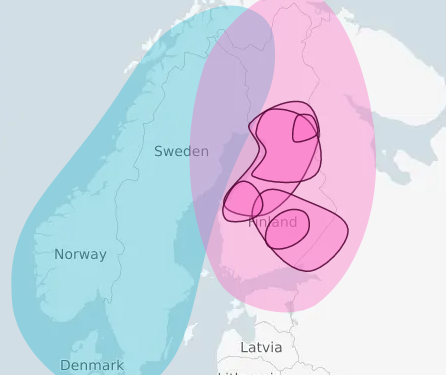
-
TIL, after receiving the results from my DNA test, that I am apparently 2% Inuit. This initially took me a bit off guard, as I have a pretty good grasp of my ancestry, and there seemed to be little to no chance of that. Then I remembered something that I saw once dealing with halpogroups and migrations. There is a Q halpogroup which migrated across Siberia to the Bering Strait and then to the Americas. But there was also one part of that group which branched off and headed East, In the general direction of the Nordic countries. I'm guessing that some of that group found its way to Finland, where the vast majority of my ancestry is from, and contributed a bit to that ancestry. So, while I have no Inuit in my ancestry, I do share a genetic marker with the Inuit.
-
Three words: Relativity of simultaneity. For the cosmic ray, the white dwarf would not be of uniform temperature. In the astronomers frame, as the ray enters one side of the star, the opposite side will be, at that moment, at the same temperature. But for the cosmic ray, the events of the opposite sides being the same temp would not be simultaneous. The exit point would already be cooler than the entry point at the moment of initial contact. The star cools at a slower rate as a whole, but since the exit point had a "head start" the Temp there will be much lower when the cosmic ray exits than you would get by just taking the entry point temp an subtracting the rate of cooling times the time it took to cross the star.
-
Scattering and absorption doesn't mean that the light energy energy goes away. For example, our atmosphere scatters Sunlight, largely in the blue end of the spectrum. We see that blue light as coming from all parts of the sky. Scattered light from a distant object would also aririve, just not directly from the object. Likewise, with absorption, the dust will reach thermal equilibrium and radiate energy at the rate it is receiving it. In the case of interstellar gas, in the infrared or radio frequencies. In addition, light coming from a distant object which has had light scattered or absorbed won't be dimmed equally in all frequencies, but would instead show absorption bands in its spectrum. And since some electromagnetic frequencies are more subject to scattering/absorption than others, Observations are made over a wide range(visible, infrared, radio...) to get a picture of what is happening.
-
By "higher" I simply meant an an "extra" dimension. Again, you don't need one. You just need for the rules of geometry to not be Euclidean. The trampoline is an analogy of non-Euclidean geometry that is just simpler to visualize.
-
It's a common misconception that you'd need a "higher" dimension (four spatial dimensions) for a a 3D universe to "curve into". All you need is a universe that does not adhere to Euclidean rules of geometry, but is rather non-Euclidean. While non-Euclidean geometry is often modeled as a plane projected onto a surface of a sphere or other 3D object, that's not what is "really" happening. This is just a way for us to more easily visualize Non-Euclidean geometry. Here is an animation I did that gives a way to visualize the trampoline example in 3D: That being said, we do live in a 4D universe. Space-time is three spatial and one time dimension.
-
In fact, according to a recent poll, in the US, a solid majority of people see the term "woke" in a positive light. It is only a vocal minority that tries to paint it as being negative. Again, that media exposure on transgender rights is driven by the fact that there are group and political bodies that are working to take those rights away. For example, I am of Finnish decent. As such, I am part of a small minority in the US (~0.2% of the population). Yet you don't hear about a push for "Finnish rights" in the media, for the very basic reason that there is no major attempt right now to take rights away from Finnish-Americans. ( Though this was not always the case)
-
The media exposure is only there due to the people who are making such a big fuss about it. People that. in my opinion, are blowing an issue way out of proportion. Just because the local news does a story about the guy claiming that the "sky is falling", doesn't mean that there is any credence to his claim.
-
In addition to swansot's comment, putting a spy satellite that high would make it pretty useless as its image resolution would not be very good. Generally, they would be put into much lower polar orbits. So the Earth rotates under it, allowing it to observe pretty much any point on the surface over time. The particular orbit in the image is a Sun synchronous one. This means that as the satellite passes over a particular point of the Earth's surface, it is being lit the same by the Sun. This assures that differences in images between successive passes aren't due to different lighting angles from the Sun.
-
But that's not an excuse for succumbing to those instincts. One would think, as rational beings, we should be able to overcome them.
-
Frankly, I'm a bit confused as to why people have turned this into so much of an issue. 1. I doubt that trans athletes are prevalent enough to make that huge of an impact. 2. In the end, we are talking about an activity that is recreational/entertainment in nature. I mean, this reminds of of the folks who complained about the College football season being suspended during the pandemic, as they seemed to feel that their not being able to crowd into a stadium to watch the sport of their choice was the end of the world.
-
I really don't think that's a useful way of looking at it. Consider this, The orbital speed of a geostationary satellite is 6.6 times that of the equatorial speed at the surface. But a geostationary satellite stays in exactly the same position relative to any point on the ground at all times, so in effect, its "ground speed" is zero.