
Genady
Senior Members
-
Joined
Everything posted by Genady
-
Yes, but, (1) I'm interested in the breakdown of not only my posts, but some posts of other members, and (2) the reactions are often spread over time and don't appear as one count in the notification. Seeing who voted positively has two advantages: (1) members often post a one-line comment just to let know that they up-voted some post; this would be not needed, (2) as an extreme example, if JohnPBailey has upvoted my post, I would check what is wrong about it. So, the data are there. It is only a matter of displaying some of them.
-
Having two separate counts, certainly. Seeing who positively marked, depends.
-
I am really glad that a "soul" who thinks this way is not eternal and immortal. -1
-
OK. How about having two separate counts? Seeing who pos repped?
-
I think it would be useful, helpful, and meaningful to have separate counts for positive and negative reactions on a post, rather than their sum. Also, to see lists of users who gave these positive and negative marks.
-
Good waste management services. Also, regulating packaging, single-use items, etc., i.e., what makes litter. People litter less in areas which are clean and more where it is already littered. But they will litter anyway.
-
I'm talking about time coordinate that appears in a space-time metric.
-
Apology accepted. Perhaps I should've clarified that the "point" I've mentioned is a "point in time".
-
I said nothing about before BB, nothing about starting of space, and didn't imply "tiny" or "outside".
-
I said nothing about nowhere. I said nothing about the size, either.
-
Space existed at the time of BB (the "~10-43" point). The BB has happened everywhere in that space.
-
Alan Guth has it put this way:
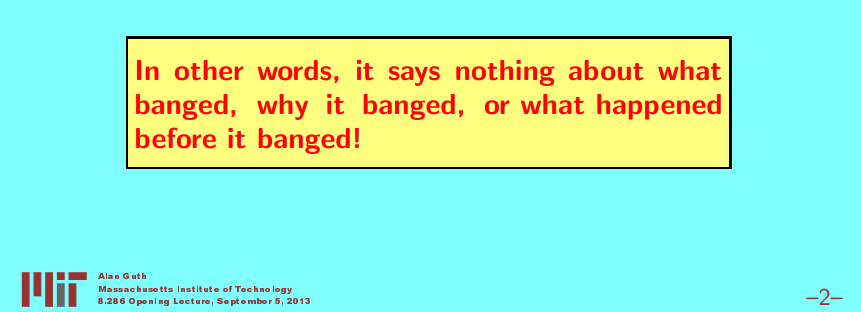
-
What I tried to point out was that AFAIK people don't hallucinate about things in which they don't believe.
-
Since you are not a believer, the voices in your head would not be those of God but rather of your neighbors, FBI, maybe aliens (if you believe in them), etc.
-
I guess we could call a nuclear DNA, 'software', and all the rest involved in the process, 'hardware'. (Ignoring for simplicity mitochondria and various microbes which are absolutely necessary for the organism to develop and to function and which have DNA of their own.)
-
Sure, it does. Of course, it can. There is no issue with these.
-
This is right. The weight is electrical grounding. No questions here.
-
Yes, all mass could be grounded by mass. The question is answered. Case closed.
-
I don't see that opponent around anyway...
-
I don't know how difficult it is for a none-mathematician to understand mathematical induction, but I don't think they would have any use of it.
-
which brings us to the infamous thread of a year ago: A reverse panspermia - Evolution, Morphology and Exobiology - Science Forums
-
DNA by itself is not useful. You need a right "machinery" (environment) to run this code to produce an organism.
-
At 58 yo? Re: I have been around literally forever. - General Philosophy - Science Forums
-
And yet most people say that biology is simpler than math (or maths), pick a biology rather than math class, and run away or faint just at a sight of an equation. Math uncovers a simplicity hidden under a complex appearance.
-
Sorry, but being both mathematician and biologist by formal training, I call both statements bs.