
joigus
Senior Members
-
Joined
Everything posted by joigus
-
Rotation speed of galaxies stars plotted against distance to galactic centre. It's explained in link provided by exchemist. Left-hand means "on the left side".
-
Don't use Star Wars as your source for science, please. You might end up thinking you can hear explosions in outer space, or travel at superluminal speed. There's no reason I can think of that we cannot have Figrin D'an and the Modal Nodes some day. But don't hold your breath.
-
A good place to start is trying to understand the virial theorem. Also, having a good understanding of physics beyond the standard model. The standard model is a pre-requisite for the latter. For starters, are you familiar with the fact that for gravitational systems the average kinetic energy is minus a half the average potential energy? If this thread goes well you could be on track to a Nobel Prize, who knows.
-
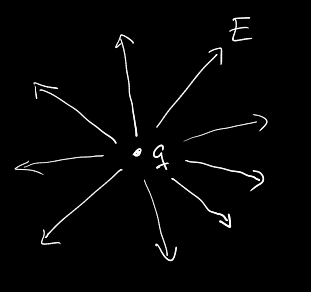
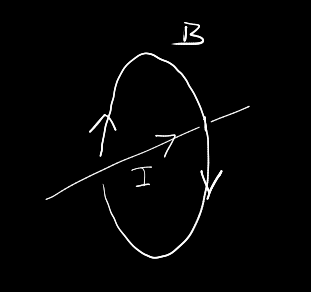
That would imply power losses are somehow being retreived after they've been lost to the thermal degrees of freedom, which I'm going to venture cannot be solved by cleverly arranging field lines. This is not how field lines work in EM. The source of the E (electric) field is electric charge. It is polar, which means that the electric field lines come from the charge and diverge towards infinity, becoming more and more "rare". The source of the B (magnetic) field, on the other hand, is axial and circulates around the axis defining the current. It also becomes more and more "rare" the farther away we go, but with a different power law. Something like this: This, plus how a changing E produces a B, and how a changing B produces an E, is the essence of Maxwell's equations.
-
Context is essential, yes, as everyone has said. As a further example, 1+1=0 is false in standard arithmetic, but it is true in mod-2 modular arithmetic. And @studiot's example of Russell's paradox is an example in which one seems to be led to the conclusion that some statements can both be true and not true. Of course, what happens is that the context, or the axioms/premises must be re-examined.
-
I don't think the distinction between generalist and specialist can be unambiguously drawn in a scenario of just 2 or 3 species. The lines get blurred, I think, precisely because the distinction is only precisely defined if/when there are plenty of resources. After all, the specialist's motto is something like "from all these so and so many resources I can only exploit this particular one". With only resources A and B, the specialist and the generalist cannot be told apart. That's what my common sense dictates anyway. I hope it makes sense. So you're right to say, I think, It's kind of like trying to define the pressure of a collectivity of two molecules!
-
Let's assume the tiger escaped from a zoo in Johannesburg...
-
I see your point. My take is that specialist vs generalist occurs in a direction with respect to the evolutionary tree, while a taxon vs another taxon occurs along a different direction. What I mean is any specialist in a given taxon has a cousin that is a generalist. It stands to reason that the more species there are, the more likely it is that a genetically-close generalist is there to fill the gap. There is no doubt that diversity is bound to take a blow any time a catastrophic event happens. Swarms of specialists will fall, and along with them relatively closely interdependent sub-niches. Conceivably, it's the generalist cousins that remain there to plant the seeds of the future biodiversity.
-
Yes, but see how dangerously close to a tautology we get? The default condition is whatever can sustain biota that will keep that condition. It's like the puddle suggested by @studiot. That was a brilliant analogy btw. Yes, I think this has to do with biodiversity being very low back during those eons --see last point by @StringJunky. Higher biodiversity will conceivable smooth out these patterns of variations. That's probably why we see those sharp banded-iron formations corresponding to the GOE. It's been speculated (but very plausibly so) that they must correspond to pulses of massive death of aerobic/anaerobic organisms and their re-births. It's like the oscillating pattern of daisy world, but with generations of aerobic/anaerobic prokaryotes playing the role of the black/white daisies, and oxygen abundance in the interstices of their bacterial mats (rather than the atmosphere) playing the role of the albedo. Well, perhaps the oversimplified way I've come to look at it. I agree with this. In fact, I've thought for some time that we usually focus too much on particular episodes just because of the particularly dramatic footprint they left behind, but the reason why we divide at all Earth time into these periods is because towards the end of each one of them, something had to give (biologically speaking) under one kind of stress or another, be it biological, cosmic, or geologically driven, or all of them together.
-
This is more or less what I meant when I said, Photosynthesis by cyanobacteria leading to the GOE no doubt came from mutations in prokaryotes, which is a genetic event, but catastrophic nonetheless. As @StringJunky said, all bets are off then. It's like the Earth setting the course to a whole new "Gaia deal" so to speak. What I fail to see is the presence of an immutable condition defining the stasis. In the case of thermodynamics, it's the equation(s) of state. In the case of living organisms, it's parameters such as pH, osmotic pressure, temperature... What on Earth (pun intended) is the go-back-to condition that defines Gaia? Agreed.
-
I did look for the journal directly on Beall's. Apparently the problem has become so bad that we have lists of lists now. I must confess I became aware of it relatively recently, although I had been suspecting of the existence of dodgy publications like these for quite some time. Reviews of Modern Physics Journal of Modern Physics...? It's a little bit on the nose, isn't it? I suppose Abidas got off to a bad start too...
-
So what does it predict? Btw, Journal of Modern Physics appears to have been classified as predatory here, https://predatoryjournals.org/news/f/list-of-all-scirp-predatory-publications
-
Sonic waves? Sound consists of longitudinal pressure waves, while matter waves are essentially complex, and gauge fields satisfy transversalities (perpendicular to the direction of propagation). Matter fields and gauge fields simply cannot be longitudinal waves in a vacuum. Never mind gravity. Electrostatics is a very restrictive regime. Electrodynamics is what you should aim for. It's not the Planck scale of space and time that gives rise to h, G, and c. The implication is in the other direction.
-
Now seriously, what's the solution to EFE --and the energy-momentum distribution corresponding to it-- that does what you claim in such a colourful way? One thing is pastry, and quite a different thing is gravity. x-posted with @Phi for All
-
I think it's everybody's legs that you're pulling, not space.
-
(my emphasis) New?!! Does Спутник-1 ring a bell? The last fad from 1957, I suppose.
-
Indeed. The daisy-world model is fine to the effects of understanding basic processes of feedback operating during periods of relative stasis, or very slow variation of environmental factors. Lotka-Volterra models, IMO, do a very similar job without necessarily identifying the mechanism responsible for the feedback. Constant reproductive rates and constant coefficients of competition/predation, etc do the job of implementing these immovable conditions. When something catastrophic happens --whether cosmic, in the form of an asteroid, or internal, in the form of, e.g., an unpredictable mutation-- from the POV of the mathematician modelling it-- you would have to assume time-dependent coefficients that implement this catastrophic behaviour. Otherwise it's equilibrium solutions or oscillatory ones as long as the differential-equation model is valid.
-
Do you want to understand how DNA works in simple terms? Is that what you want? The "share" part is a bit confusing, as @zapatos pointed out. Do you mean "pass down"? There are chunks of DNA we share with all prokaryotes, even more that we share with vertebrates, still more that we share with other mammals, etc. Is that it?
-
Yes, thank you. It's true that it's usually stated that the Earth is a closed system. This might be true if you are calculating, say, primary production over a series of years, for which the flux of matter is irrelevant. Certainly not in the long run. I hope you agree with this.
-
I don't know, to be honest. I suppose whether you work on marine biology or epigenetics, it is of little consequence to your work. The discipline I would assume it is likely to influence more is evolutionary biology. But again, I don't really know. I figure it would be difficult to evaluate the actual level of impact on scientists' minds. This people say over and over, but is not true. @exchemist seems to agree with me in this point. Mind you, I'm sure he knows volumes more than I do about these matters. Here's my point: Is that of little consequence? I don't know. I do know it has been argued that fluxes of cosmic rays due to relatively close supernova explosions might have been responsible for certain extintion events. so I wouldn't bet my bottom euro on it being totally inconsequential. Is the Earth to a good approximation a closed system for long periods of time? Probably yes. But it is an approximation. It is certainly true that the Earth was not a closed system during the late heavy bombardment, when even whole chunks of the Moon might have rained upon "us". It wasn't either 65 mya, when the Chicxulub crater formed and swept away all the dinos, AFAWK. At times like those, the Earth certainly opened the gates, and dramatically so.
-
Thanks, MigL. It was a closer shave than it seems now though. If Guéhi's header had gone in... I'm glad for the political consequences in Spain in terms of inducing a certain feeling of unity. This will last a couple of weeks, I reckon. I know very little about hockey though. Have TML been finalists many times with little to show for it? Something similar can be said for Netherlands in the World Cup.
-
Vance's views on Ukraine could change tomorrow. After all, his views on Trump seem to have changed overnight in a manner of speaking. Meanwhile, identity politics can only be addressed by picking a VP that embodies it. We've seen it before in a different version. They're going for a demographics of males in their 30-somethings to 40-somethings who feel they'be been left aside by identity politics for too long now. I could be wrong, as politics is not my thing, let alone American politics...
-
This is pretty much like searchable and non-searchable at the same time. Which is basically Swansont's point.
-
Agreed. One has to be quite far away from equilibrium for anything "interesting" happening. @exchemist has made a point that's always been on the back of my mind as a considerable objection, or at least an obstacle, to the Gaia hypothesis, which is the one about homeostasis. Geological processes generally are one-directional and relentless, so it seems difficult to see them as part of a global flow of inter-dependent feedback mechanisms that would lead to this stasis (quite distinct from thermodynamic equilibrium, as you justly point out) that homeostasis represents. Also, @studiot added this careful distinction between closed and isolated systems which, whether or not is crucial here, could be important. For example, the Earth continually receives an influx of particles from space, although it reflects basically just light. This makes the Earth a system that's neither closed (energy) nor isolated (matter), strictly speaking. But these processes are perhaps slow in comparison to typically life-related cycles. Can the same be said about geo-processes like weathering or recycling of material in subduction zones? I wonder. I wonder as well whether the fact that the Gaia hypothesis has been given considerable creedence may be because some processes are faster, while other (geological, cosmic) are far slower and act more as a background that's fixed or periodic of much higher period for the purposes of the bio-processes to adjust. Does any of that make sense, even if it's a tad vague?
-
Yep. I was minding my own business when all of a sudden I thought, 'I gotta find me some peace. Hey, I know, what better way to do it than engaging in a conversation with Dim?' No. You cannot press me into watching that video. You either make the point here or let it go. Those are the rules of this game as I understand them.