
joigus
Senior Members
-
Joined
Everything posted by joigus
-
I find it a tad peculiar that the multiplets of the standard model are obtained[???] (correctly AFAICT) from this 3-parameter group that only acts on the frequency-time plane. Really? How does the E,t plane "know" about parity? The multiplets displayed there are sure those of the standard model. And the fact that electrons are called "negatons" doesn't bother me too much. But where do these "boxes" come from? From this group whose only motivation is to generalise and unify Fourier and Laplace transforms, as well as other reparametrizations of the phase? I suppose Wick rotations can be found accommodation there too... I don't know. I've been looking at the more readable page on LCT's, https://en.wikipedia.org/wiki/Linear_canonical_transformation And everything seems nice and dandy until we get to this table with the claim, "a" theory? What theory? This suspiciously sounds like a non-properly-curated addendum to the previous wikipedia article by some people intent on self-promotion. I could be totally off-base, but I find the last paragraph of the wikipedia article very suspicious even though the table is that of the SM. They haven't shown to me to any degree of accuracy or plausibility that the table can be proven from the representations of the LCT. Besides, the LCT is 3-parameter group. The standard model, OTOH, is what SU(3)xSU(2)LxU(1) --> 8+3+1 internal + spin Only counting the compact-group (quantised) degrees of freedom. It doesn't add up in my mind. How did you come across this? What is you interest? Can you tell me more?
-
I don't think so. AAMOF, ideas like "we live in a simulation" or panspermia sound to me dangerously close to trying to revive the idea of an intelligent creator, but with an aura of scientism about it. All of them (and the ones to come) equally vulnerable to the infinite-regression argument: Who simulated the simulators?, and Who seeded the seeders? etc.
-
That's from Life of Brian, if I'm not mistaken. I testify to the fact that the teleological argument has been receiving some attention lately. More of a cardiac massage, IMO.
-
On my part, it's OK. Those aren't bad questions necessarily. Any imprecision is understandable on account of the difficulty of the subject. IMO Mordred's answer was spot on and succinct. I have little to add to what he said. You seem to be bothered by the presence of fields in the geometry though, and that's fair enough. In pure geometry we don't have this arrowy structure we call fields. On top of that they have an algebra of creation and annihilation, and they are complex (have an imaginary part). Those are quantum fields and they seem to go beyond the scope of geometry. Does space-time emanate from the field, or is it the other way? Nobody knows. Maybe there was an eternal inflation scenario, as some models say, and scalar fields gave shape to everything else. It's, as Mordred said, speculation. Highly educated, yes, but speculation after all.
-
I suppose what @MigL means is that differential geometry is no longer applicable. There is no point closer, and closer, and closer still to a given point. There might be "quantifiable relationships between distinct objects" but not of a geometric nature. Or there might be no distinction of objects. Or... I suppose when you say "objects" you mean points? Maybe the quantifiable relationships are something like entanglement, but that's not really geometry.
-
No, we can't. Modern humans diverged into their different phenotypical varieties, if you will, about 70,000 ya. while, https://www.ncbi.nlm.nih.gov/pmc/articles/PMC9374477/#:~:text=The divergence time between the,camel was different from the around 6 million years ago¹ African and Asian elephants diverged from a common ancestor around 6 million years ago¹ and are two distinct species that differ in many physical attributes². For example, Asians have small round ears and twin-domed heads while Africans have large ears and rounded heads².Apr 25, 2023 Modern humans are in fact genetically closer together than most other species. One of the few species that are much tighter together than us is the cheetah. Have you heard of the 70,000 year old bottleneck due to the Toba eruption? Cheetahs are eve much closer together than us because their bottleneck happened only 10,000 ya. All this info you can find on the internet. You only have to bother doing so.
-
No. They tend to be female. Can you be constantly wrong in a little less inflammatory way?
-
I was joking. I'd share a beer with you two too. Certainly possible. I prefer to think in terms of how the character of Muhammad has been construed through time. Like what influential people that came after him did with his figure, as well as the early offshoots of Christianity at the time he is supposed to have lived. Don't forget it was Waraqa ibn Nawfal, a Nestorian priest (Christian), who authorised him as a prophet.
-
That I find highly illogical. I think you got the song wrong. This would have made a lot more sense, https://www.youtube.com/watch?v=hFDcoX7s6rE
-
I haven't, but I'm very interested in anything you might have to say about it. Not to say I'm not enjoying the discussion on local realism and the concept of reality. (As well as the ongoing intellectual feud between Moontanman and Dim.)
-
Yeah, hunter-gatherers are the problem. Sigh
-
I shy away from worldviews (try to), even though sometimes I can't help getting tangled in them. There are too many obstacles, some of them really thick, to acquire any kind of a vantage point. And the individual perspective is only too limited. I see a piece of landscape from where I stand. That's all. Besides, there are already too many Manichaeans out there, preaching with too loud a voice. I don't want to be that person. I must side with Genady here, but as a dream perhaps. That some day mathematics, logic, and similar tools of analysis can tell us what this or that pattern does in the great scheme of things. As for the rest, such tools will hopefully tell us why and what in the world cannot be understood on account of logical/semantic incompleteness. Mathematics is so... dispassionate. Atheism is not a worldview, btw, as far as I can discern. It's more of a 'what do you mean by that' attitude the way I understand it.
-
Also, \( \nu \) in \( E = h\nu \) is the Greek letter nu, while \( v \) in DeBroglie's relation \( \lambda=h/mv \) is the Latin letter v. Could that be related to your problem? IOW, one is the frequency in Hertzs, while the other is the speed.
-
I'm no expert here, but feedback mechanisms in biology are so frequent that I think pointing to the presence/absence of a certain chemical as the cause of an illness (or of any other process for that matter) is probably not the way to go.
-
It's Sagan, of course. And after that, Sagan. The poetry, the music, the absolutely unfettered passion for understanding it all that cannot be muffled in any way. The Cosmos is all that is, or was, or ever will be... And I was immediately and unconditionally engaged for the rest of my life. As to the rest of them, I can't help but feel they've been built as marketing products in a way, probably through no fault of their own. I agree with exchemist that Hossenfelder means business more than any of the others. Sorry for the mixed metaphor.
-
Agreed. A couple of disgruntled shepherds throwings stones could have startled the pilot just enough to do it. And discontent there is in Iran, as pointed out. But no need for a plot here, and most likely an accident. That doesn't mean the Israelies haven't uncorked a bottle or two. Agreed. I'm sure the next in line is not going to make much of a difference, turban-wearing or not. I'm pessimistic about your last wish though, however much I agree. Any hose-pipes I envision are political. And most problems in the Middle East are cultural and deeply rooted in people's minds, not political.
-
What @MigL is referring to is Planck's scale. If you want to probe space-time at scales roughly 10-43 seconds (10-35 m is another way to characterise it), you make black holes. So it doesn't quite make sense to discriminate between points, mesure distances, angles, speeds. There would be no geometry proper. And I agree also with @Genady that the big bang is not a point, of course. A picture that I find particularly attractive is that of conformal symmetry, which is a universe in which there is scale invariance. In a conformally-invariant universe, there's no difference between big and small in a way. AAMOF, we know when temperatures are very high, conformal symmetry is more and more accurate. The universe would look very much like Maxwell's equations with no sources. Perhaps scale invariance is a spontaneously broken symmetry?
-
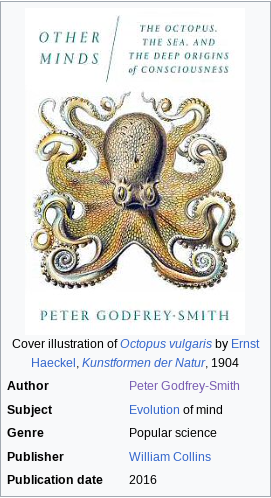
@TheVat, @CharonY. Aaah. My friend has just answered. It was Peter Godfrey-Smith. A philosopher of science rather. And he is Australian. Sorry I must have thrown you off.
-
It could have been E. O. Wilson... I know his topic of expertise was ants. I don't remember him as making a big deal out of cephalopods. They're all Greeks to me now LOL. I'm getting old. I've just whatsapped my friend. See if he can remind me and it rings a bell to any of you.
-
We know observationally, actually. The surface of last scattering has still not disappeared behind the kinematic horizon. The fact that there are features not totally explained by the standard cosmological model doesn't mean that we must throw everything away. All of them photons. All of them subject to extreme redshift when close to c as receding velocity. So your point is moot.
-
Very interesting points. I don't seem to remember (or successfully google up) the name of a very influencial biologist (American/Australian/British...?) who called for more attention to cephalopods, and proposed to study them as models of radically different body plans that could be the basis of intelligent multicellular life other than mammalian. I'm sure you know who I'm talking about... Very interesting topic btw.
-
There are at least two reasons why this isn't true. One of them is that long enough ago (which is automatically implied by "far enough away" as you should understand if you want to do cosmology and astrophysics) the universe was opaque to radiation. A little farther beyond it was opaque to neutrinos even. And also there's a kinematic horizon, as Swansont explained. Photons from so long ago and so far away get redshifted into total invisibility. 🤣
-
There are gauge bosons (particles mediating the interactions) that acquire mass via the Higgs mechanism though. The W and Z bosons of the weak interaction are the famous example, because they were the first particles for which the Higgs-Kibble-Anderson-etc mechanism was proposed. Back in the '60s it was known they shouldn't be fundamentally massive on account of a very important symmetry --called the gauge symmetry-- being broken if they were. They must be acquiring mass from something that's dragging them. Another field. Thereby the Higgs. People knew they must be massive in practice, as the weak interaction is short-ranged. So it's kind of peculiar that some of these mediating particles (gluons and photons) don't acquire mass via the Higgs mechanism, while others (Ws and Zs) do. At least I find it so. I think that's a very good question, btw.
-
Not really. A gravitational orbit plus a dissipative environment will be a possible model to account for closing spiral orbits, as @exchemist has pointed out. It just doesn't seem to do what you claim it does. I would relax about getting credit for this idea for the time being.
-
The acceleration of a rotating body is towards the centre of attraction. It's called centripetal acceleration. Tangential acceleration would require a completely different force field. Have you seen @Ghideon's picture? Do you know why he drew the acceleration the way he did?