
joigus
Senior Members
-
Joined
Everything posted by joigus
-
Still not making any sense. Are you fielding questions now? What is this, a press conference?
-
This doesn't make any sense.
-
You've been explained, quite correctly I think, what a theory is as we understand it in science. Can you make a prediction? Or explain the workings of thermal engines? After all yours is a theory of everything.
-
Clever. But, the way in which you sub-divide the side of the square is divergent, as, \[ \frac{1}{2} + \frac{1}{3} + \frac{1}{4} + \frac{1}{5} + \cdots \] is the well-known harmonic series which is divergent. So, \[ \left( 1 + \frac{1}{2} + \frac{1}{3} + \frac{1}{4} + \frac{1}{5} + \cdots \right)^{2} \] cannot possibly give you a convergent series, I would say. This is compounded with the fact that what you have on your RHS is an infinite series of infinite series. Sometimes it happens that a divergent series can be useful because it can be regularised, or made sense of in some clever way. Euler was a master at this. Have you tried to discuss it with a professional mathematician? By the way, that would be an identity, not an equation. Otherwise, what is the unknown to solve for?
-
You need the mathematical counterpart to your... erm... theory. A fitting name for it would be "calculus of platitudes".
-
You're going all over the place with this. Young's experiment works better with monochromatic light. And trajectories split at the double-slit piece, not in the observer's eye. Newton's experiment of splitting light by their frequencies (energy of the photons) can be explained classically and does not demonstrate quantum mechanics. And, btw, I don't know of any single case in the history of science when a paradox was solved by throwing another paradox at it. Do you?
-
Perhaps Phi is referring to a more disruptive behaviour. Something that really interferes with the flow of the discussion. Not, eg, just not saying 'hello' properly or paying your respects, or other pleasantries. Well at least those are the only red points I myself have come to think are appropriate.
-
On the other hand, some of us have been quite stirred by @Markus Hanke's comments on non-linearity's potential to generate unexpected behaviours, when boundary conditions, global properties, etc may play a part in bringing about those. I came a bit late to those comments and they've sent me into a whirlpool of thinking about how unusual it is for someone who's been trained in solving differential equations to extend these techniques to include: 1) The topological nature of the manifold itself in which one is solving the PDE. 2) The seemingly open-ended nature of how to deal with the sources and how simplification of those in order to make them tractable might make it impossible to capture properties of realistic solutions when the context is non-linear. It's rarely the case in general mathematical courses in ODE or PDE (linear or non-linear) that part of the problem itself is phrased like, Oh, I almost forgot, as part of your assignment, you have to guess whether the problem is in R4 or maybe in some non-trivial topological space. That makes the problem insanely hard to solve.
-
Yes, exactly. But it's beside the point anyway. Thank you again. I would never say, ie, a proton running away from me is being redshifted!
-
Thank you, Mordred. That v is the cosmological Hubble flow. What I was referring to was the peculiar velocity. dr/dt-H0d https://en.wikipedia.org/wiki/Peculiar_velocity I just wanted to engage @DanMP. I wanted them to explain in more detail what they mean exactly by "neutrinos slowing down". Are they slowing down wrt the galactic rest frame? Ie, is their peculiar velocity slowing down? I don't think it is. I said something incorrect, btw, I said "red-shift" which is applied to light, not to neutrinos, although they do have a De Broglie wavelenth. I suppose your comments on momentum previously referred to something like that?:
-
I like this analogy. Anyway, the pathogen seems to be enjoying some time off for the time being.
-
That wasn't the point. The point was "relic", as in "relic neutrinos" says nothing about how strongly coupled they are to themselves or to other types of matter. "Relic" just means they were produce at some point during the big bang, and are still there. Then there's "something else". Oh, well... Of course DM could be something else. That leaves the question relic vs sterile intact. In fact, if I'm not mistaken, all sterile neutrinos would have to be relic, as later in the life of the universe it's just too late for them to be produced in any amounts. My "nothing more" wasn't about the kinematics. It was about the nature of the neutrinos. They are slowed down with respect to what? Do you mean their peculiar velocity? (their velocity with respect to the co-moving frame?) That doesn't sound right, but I would have to think about it. They would certainly be red-shifted. Velocity in cosmology is a bit tricky. Are you sure swansont didn't say "red-shifted"?
-
You need a mechanism to explain why those excess neutrinos are there, and why they are decoupled from the rest of the matter. The attribute "relic" only says that they are remnant from the big bang. Nothing more. So what you said is a bit like saying "maybe the murderer is any old person, instead of that particular suspect" in a murder case. You see...
-
Was this of any help at all?
-
Plants react to light by means of certain chemicals like phototropins and such. They are a certain kind of proteins. That's how plants know in what direction to tilt when light comes from a very particular direction, as well as when to trigger growth, if I remember correctly. Maybe this is a topic more for the likes of @CharonY? Some animals have eyes that are only barely sensitive to light's direction and intensity, and not much else. Animals with more developed eyes, like most vertebrates, except a few which live underground or in complete darkness for some reason or another, have eyes that are a dioptric apparatus, which maps object points into image points consistently (preserving geometric relations for neighbouring points and therefore allowing the mapping of objects with spatial extension). (Dioptric is optical jargon for "lens". Catoptric is optical jargon for "mirror".) Plants have neither dioptric nor catoptric systems. So I suppose what I mean is, if we could say in some sense that a plant "sees" something, it would be a very different way of seeing than ours. Something like "hmm, there's light in that direction, let's tilt and grow". But light is what it is. As everybody's telling you: photons, quanta of the electromagnetic field.
-
There. +1 from me. I hadn't seen this. What good are algorithms? I think I've watched all of his online talks on YT, and the algorithm can't figure this out? My favourite Dennett tool is the intuition pump. It's the thought experiment of the philosophical world. He has a whole book devoted to this concept, as I'm sure you know.
-
You mean photon, not proton, right? Or is that your speculation, that light is made up of protons instead of photons? As I understand, the brain very heavily post-processes every signal that comes in to give you these "sensorially consistent" perceptions of pain, sound, spatial extension, colour, love and what have you. Other people more knowledgeable than me will elaborate on that, I'm sure.
-
Presentism? We tend to see ourselves as morally superior to our ancestors. If any of us had been born in, say, 70 AD, we probably would look upon slavery as a hard, but inevitable fact of life. It is only through undefatigable rational discourse that we get rid of these things. ¯\_(ツ)_/¯ And, again, the Bible has many levels, different addenda (Christianity), and reflects social reality in the Middle East through the major part of both the Bronze and the Iron Age, which is a quite long period of time. God is a human construct. It changes (its/his/her/their) view because people making it up change theirs about what "God thinks". Doesn't it make a lot more sense that way?
-
Absolutely agree.
-
In @iNow's last comment is the potential for your mind to finally put this matter to rest. Or... you can go back to Star Trek. Science fiction at least tries to give you an appearance of rationality.
-
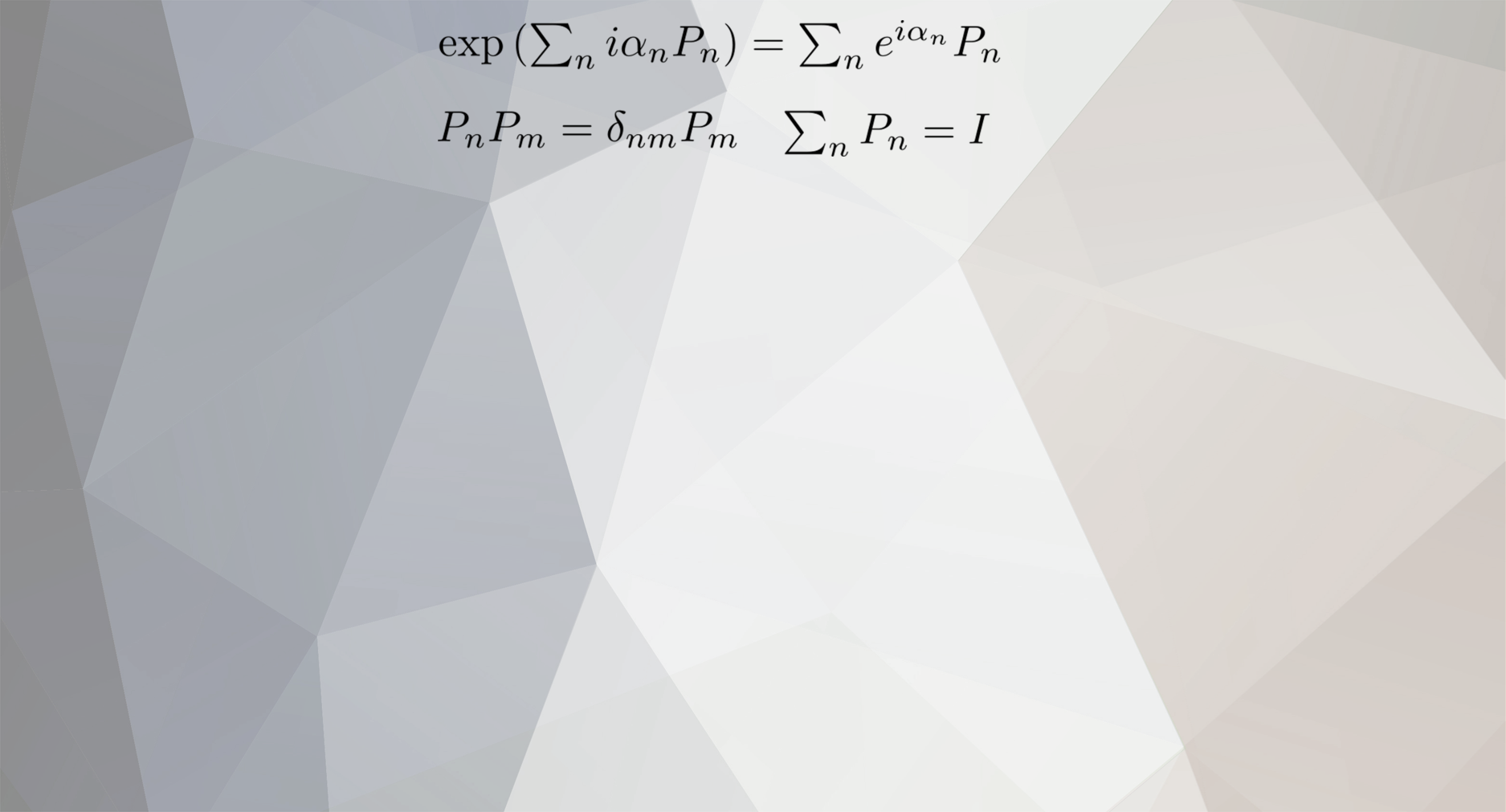
Ok. I don't see how that can signify a directional derivative. I assume you mean a derivative with respect to a matrix when evaluated at a particular matrix value? I'm no one-trick pony, I'm very familiar with derivatives with respect to a matrix (something that only makes sense when the function to differentiate is diagonal in the chosen matrix variable, which yes, happens to be the case if you're differentiating with respect to the Hamiltonian itself, which is trivial, or any of the spectral projectors, which renders the corresponding eigenvalue times the projector). But what I'm absolutely sure of is that, provided the coefficients are finally evaluated as the corresponding numerical functions of the Hamiltonian eigenvalues \( \lambda_{j} \), their values can be no other than, \( e^{-it\lambda_{j}} \) The calculation produces, \[ U=\sum_{j=1}^{d}e^{-it\lambda_{j}}\left|j\right\rangle \left\langle j\right| \] (assuming \( \hbar=1 \). This is in keeping with the more general result of spectral analysis (for certain kind of operators, compact, etc) that, provided a certain observable \( Q \) admits the spectral expansion, \[ Q=\sum_{q\in\sigma\left(Q\right)}q\left|q\right\rangle \left\langle q\right| \] then, for "any" (again, "good enough"=compact) \( f\left( Q \right) \) we must have, \[ f\left(Q\right)=\sum_{q\in\sigma\left(Q\right)}f\left(q\right)\left|q\right\rangle \left\langle q\right| \] So the least I can say is that the notation is unnecessarily confusing. If those exponentials have the meaning of certain matrix directional derivatives and are expressed as \( e^{\lambda_j t} \), while evaluated as numbers they are \( e^{-i\lambda_j t} \) (as they surely are by the calculation you suggest I'm more familiar with), then that's notational mayhem, IMO. And I'm sorry this discussion is drifting farther and farther apart as per OP.
-
Matthew 19:23-26 American Standard Version (ASV) Apparently it's not advisable to be rich in any case.
-
I'm getting the impression that you are a Christian believer.
-
You forgot a -i in the exponent, Mordred. You are under arrest for violating unitarity. 🤣
-
God can't handle money.