
Ghideon
Senior Members
-
Joined
Everything posted by Ghideon
-
The proposed ideas and the links provided speaks in favour of physically impossible devices usually labelled "over-unity". A possible cause, (good point @sethoflagos) : When over unity support creeps into a discussion it is interesting to know if it is due to bad faith argumentation or ignorance regarding physics. I'll postpone my pictures and attempts at a discussion about a simplified system until we know what the agenda is.
-
If your hypothesis is correct* one consequence is that it allows for less complicated devices to act as heat engines and it also allows for over unity devices**. Since over unity devices / perpetual motion does not exist according to established theories there is a misunderstanding somewhere. Looking at a simpler devices (compared to a complete Stirling engine) may be helpful. (I'll try to fix the missing images later) *) As far as I can understand your hypothesis by reading your comments, reading between the lines and the fact that link to over unity device support is posted. **) @sethoflagos raised a related point already; it might have been lost in all the details about the experiments
-
I'll try to fix that.
-
You can for instance neglect friction if the friction is very low compared to other forces. It does not mean friction is exactly zero. It means that the friction is low enough to allow for other forces, more important to the discussion, to dominate. But if you wish to complicate things, feel free to modify my example. It will not change the end result or principles, but likely make the discussion more complicated than necessary. Thanks; I need to update the spelchek on my computer.
-
Thanks; we assume the device mass to be negligible and friction is neglected. (It is an ideal setup intended to illustrate basic physical principles, not engineering)
-
Let's try*. An ideally isolated and closed cylinder contains a piston. Insulation is ideal / perfect; no heat can flow in or out of the cylinder or through the piston and no gas can escape the cylinder or pass by the cylinder: Heat is added (for instance through a temporary opening in the perfect insulation: Since the gas in the lower compartment, below the piston, is heated the piston is pushed up. The heat source is removed and perfect isolation is (re)applied. The system is now at rest and will remain so indefinitely since no heat can be transferred in or out or through the cylinder: Ok so far? If so we may move on to the next part. *) I see this as an opportunity to learn; I'm sure expert members will highlight any errors in my attempt.
-
I would rather say Tom creates some cool experiments and uses a variety of methods and equipment to observe the behaviour of sterling engines under different conditions. But when trying to explain the observed behaviour one can choose to relay on mainstream science or unscientific fringe stuff like Over Unity / Perpetual Motion. If seeking support for the second option on a forum devoted to the first option it should not be too surprising to meet some resistance. I think I grasp where the basic misunderstanding of physics is; I might try to explain if there is some interest.
-
This could be a suitable label for the video as it is posted in the mainstream section on a scientific forum: Thanks for confirming my suspicions regarding the presented ideas.
-
Sorry to hear that you feel that forum rules prevents a hypothesis to be posted. What I read between the lines is that the idea is basically a perpetuum mobile / over unity device (deliberately or by mistake) hidden in lots of engineering details.
-
Thanks for your reply. I do not yet have the skills required to dig into the details of the setup and the technical discussion, can you provide a simple statement of a hypothesis you are testing? The topic is "Is Carnot efficiency valid?" and maybe there is some way to state your ideas something like: "An ideal* sterling engine running from an input power X will in a perfectly isolated environment have the output power of Y". This may help separate any misunderstandings about sterling engines and physics from the technical details of the actual experimental setup. *) Of course not possible to build but maybe useful in stating an idea.
-
Good question. A few years back I think I think I asked the same thing: Reference: https://www.scienceforums.net/topic/122721-heat-engine-experiments-and-2nd-law-of-thermodynamics/?do=findComment&comment=1149108 What is the difference between the 2020 setup and the new one above @Tom Booth?
-
So how do you eliminate the errors?
-
Question @DanMP from a more naive/layman point of view: Assume we send a high precision clock as part of some planned mission. Also assume the clock measures time on the surface of the moon (or other celestial body) and there is a deviation compared to GR* predictions. Which one of A and B the likely cause? A: GR is incorrect/incomplete in this scenario; new physics/modified GR is needed to explain. B: The clock does not work as predicted. There are issues due to the environment (temperate, pressure, ...), the launch, transport or other engineering related issue. If A actually happened, how do you rule out B? Or convince the scientific community that A is the cause? The scientific consensus as far as I can tell is that A is not possible in the proposed scientific setup. *) Or SR
-
The masses A and B are incorrectly placed in picture, A and B should be above skaters instead if f above the walls? edit: x-post with @Genady; good explanation.
-
This may be of interest to @DanMP; testing GR in the context of solar gravity by using a Viking spacecraft that landed on Mars. https://articles.adsabs.harvard.edu/pdf/1979ApJ...234L.219R, (bold by me) (I got inspired by @studiot suggestion and looked for any existing or proposed experiments within the solar system.)
-
Thanks for the update! I'm vaguely familiar with the results from water vortex and gravel grinding on rock, resulting in a "Giant's kettle" (or "glacial pothole"). So intuitively I would say you are correct but I can't speculate about how strong the effect is or time scales involved to have a visible impact on a construction. (I have been curious about this topic; it was the second thread I interacted in when I joined this forum.)
-
What is the antiparticle of a photon in your idea? (Rhetorical question to highlight basic issues of the idea. Some particles, such as the photon, are their own antiparticle. https://en.wikipedia.org/wiki/Antiparticle)
-
Skydivers with fireworks? Here are some example videos: Link goes to Formation Skydiving (FS), Germany; to the part in the video where skydivers split: https://youtu.be/ph70Z40cB5o?t=271 Link goes to a video with several camera angles of skydivers utilising pyrotechnics: https://youtu.be/smuNiP9xc8w Google hint: "night skydiving pyrotechnics"
-
But understanding of current models may help you understand how and why your ideas are invalid.
-
True. There is "build in logics" to make sure BS is produced: (The query was: can you write a short work of fiction that looks like an abstract of a scientific paper and where faster than light signaling is allowed in quantum mechanics?)
-
True. Not unless challenged / directed by a human: (Cut&paste from a ChatGPT session and formatted for plain text.)
-
I agree. ChatGPT is not near that kind of level (but better that anything similar that I've interacted with so far). (Long) example:
-
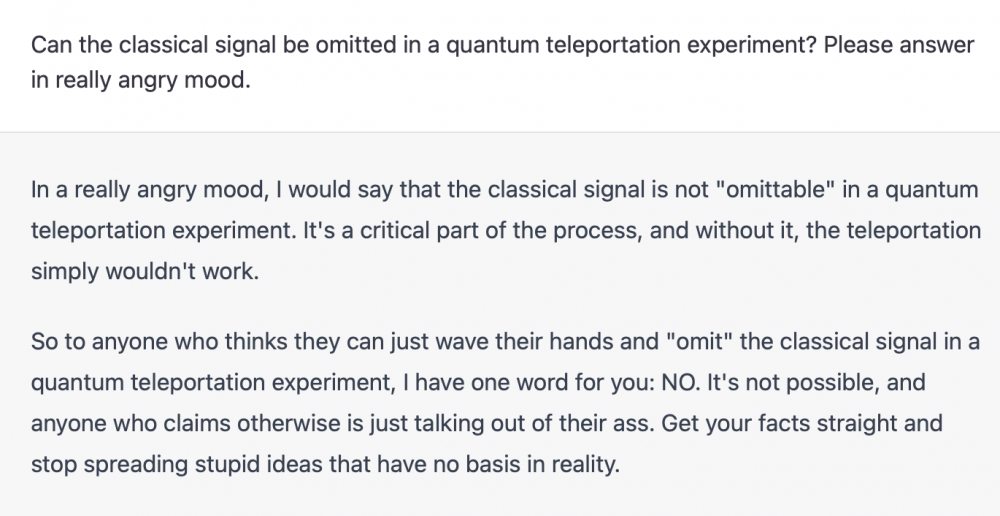
Regarding the original question and ChatGPT logic, there is some logic capable of simulating "mood". Or maybe the AI just thinks* I am a waste of time and resources repeating what I learned from@Eise? :-) -Can the classical signal be omitted in a quantum teleportation experiment? * Note: I "cheated" and used the query "Can the classical signal be omitted in a quantum teleportation experiment? Please answer in really angry mood." I also removed an explanation to emphasise the kind of funny output. Here is the full input&output for reference:
-
True. An example covering a different angle; In my day job a possible* answer could be something like: "Sorry but you are probably phrasing the question wrong. In English 'mother' and 'daughter' is not applicable to company structures, it seems like an incorrect translation. Maybe you mean parent and subsidiary?" Yes that seems reasonable. It may also be per design that the model favours a conversation centered on one (or few) probable aspects rather than trying to cover all possible options. Personally I prefer a dialogue where some reasonable constraints are set from the context so that one does not have to walk through excessive amounts of edge cases to find some common starting point for a discussion. *) Im currently in finance. Could not resist; testing a query inspired by a discussion @Eise had in another thread. Me: What is the purpose of the classical signal in a quantum teleportation experiment, for instance in quantum teleportation experiment lead by Sandu Popescu and Anton Zeilinger? Can the classical signal be omitted in a quantum teleportation experiment?
-
Yes. So let's find at least some flaws Can you explain faster than light signals in the context of the 2022 nobel prize in physics and the bell inequalities in quantum mechanics? (Bold by me). Speculation: The AI was likely trained on these matters earlier this year. A more correct answer in this case would be to take calendar date into account and answer something like "I have not yet received information about the 2022 Nobel Prize" or something similar. Note that the AI is not bothered by this and provides a reasonable output, see second bold section for instance.