

Ghideon
Senior Members
-
Joined
Everything posted by Ghideon
-
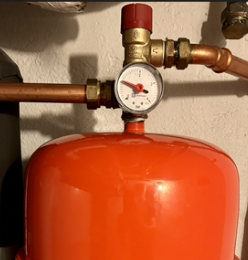
Here is the solution in my current house, it has a standard closed heating system. There is a tank with a pressurised bladder which allows for expansion: The pressure can be adjusted by adding air through a valve and/or by adding water to the closed system. Valve for adding air: Any overpressure is vented through an emergency valve (see top picture)

-
In case @tmdarkmatter is interested in common misconceptions and confusions and to get some insight in established models this paper may be helpful: "Expanding Confusion: common misconceptions of cosmological horizons and the superluminal expansion of the Universe" https://arxiv.org/abs/astro-ph/0310808 (Thanks to @joigus comment I remembered the paper and the possible connection to this thread.)
-
If there were any truth in your claims then modern weapons and warfare would easily include this kind of weather control already. What does this logic reasoning tell you about your idea?
-
My intuitive answer would be that CHATGPT and similar could be implemented on a Turing Machine. But here are some thoughts; hopefully others may add some insights. Assumptions that as far as I know are sound in this context: 1: CHATGPT and similar systems are build from components that can be realised by Turing machines. 2: The architecture of CHATGPT (and others) is based on distributed components and interacting concurrent computational resources. 3: Frequent changes occur through intentional updates and upgrades, unintentional failures, user interaction etc. There are other computational models than Turing, for instance Hewitt's Actor model of computation. Short description* Question: Is the Actor model of computation more suitable than Turing machine for a large distributed system such as CHATGPT? I don't not know; assume for this discussion that the answer is "yes" and move on to one of Hewitt's claims* This could mean that there may be more to @studiot's initial question than I initially thought (hence my late answer in this thread). Your thoughts? *) https://arxiv.org/pdf/1008.1459.pdf. (I chose to not go into details about the differences between the models and their applicability in this post)
-
Splunk allows for different approaches such as: Using a Forwarding Agent installed on a server Utilizing HTTP-based Event Collection for data transmission Employing a Logging Driver for Container Platforms Leveraging Add-ons or Serverless Functions to onboard logs More information is required to provide specific help. Once you have gathered the necessary information, it may be better to follow @Phi for All's advice. If that fails, the Splunkbase and Splunk community are quite active, as far as I know. I believe there are a limited number of active members here interested in these matters. (Note: I have integrated Splunk with other service providers in the past but not with AWS; I can only provide some general advice.)
-
No private meetings needed. The robustness of scientific methods enables independent researchers to reach the same conclusions.
-
Trying an alternative just for fun:Google returns references to the paper "Graviton to Photon Conversion via Parametric Resonance" by Robert Brandenberger, Paola C. M. Delgado, Alexander Ganz, Chunshan Lin, first version submitted to arXiv on 18 May 2022.Thanks! I did not think of repeating the query.Interesting, I wonder what causes differences. I just tried: (ChatGPT 4, Mar 23 Version)Thanks for your reply! I think I need to clarify; I'm speaking about a polarised debate on global level. Discussion here on the forum is quite objective. I'll continue to follow this topic. A basic example: some jurisdictions have rules about giving financial product advice. How will such rules be modified when tools such as ChatGPT are available and in use in regulated areas? I do not know but I'm curios. (I'm currently on an assignment in the financial industry) I had not seen the Hofstadter text before, I'll look more into what he as to say.I just wanted to say that I find this topic to be one of the most interesting discussions lately, and I'm closely following the debate. However, I'm having trouble formulating a substantial contribution. One observation I'd like to make is that generative AI seems to have ignited an increasingly polarized debate between its proponents and opponents, potentially more so than many previous applications of computer science. Do you share my observation, or do you have a different perspective?I prefer a different approach; having one separate email adress per online registration*. I prefer similar (or identical) user name for different sites and the ability to drop an email adress if it is misused. I notice that some sites allow for the user to enter username or email adress, maybe such an option will be available in this forum. Example screen shot from a random internet service: *) there are automated services for this to reduce any overhead or administration
 Hello, I'm unable to find* a prof. Hal Puthoff using search engines, can you provide some reference to relevant work for this topic? *) I found other titels and similar names but no professor.Thanks for the reply. I think your 'halt' is an excellent way to show what I think of but I lack the mathematic knowledge to express, +1. My reasoning: The outcome when step-by-step instructions is running in a CPU could as far as I know be expressed mathematically using boolean algebra and circuit logics. This includes the 'Null' or 'NOP'* instruction. But an instruction that requires an external interrupt does not necessary have any upper limit for how long it takes for the interrupt to occur. When the time is unbounded a "step" seems different from a mathematical perspective. I think my question is related to this statement: I'm curious what kind of mathematical functions are required and if/how that depends on the types of instructions and level of abstraction (CPU, Machine code, higher level) and if these functions are what OP described. *) No operationSince this is speculations, what is your reasoning and arguments for making this claim? (The answer according to established models is "No, it is not correct to say that coldness flows into warmness when something cools down. ")I'm not sure I follow the idea, maybe you can you define "step"? On a low level (interactions for a CPU) @studiot's halt* example could mean that the CPU will wait for an external interrupt. Are these signals part of your steps? *) I use HLT (x86) hereThere is a function available by clicking "more options" for a post (may be different between devices and browsers) : This windows appear and the direct link is presented: Here is the result when using your post above: edit: x-post with @iNow
 The opening question was "According to mainstream physics: Is heat "destroyed" in a heat engine?". Do you want the answer as stated by current mainstream physics of today? Or do you want the answer as it was in mainstream physics at some specific time in the past? (Or other alternative?). Since many historical references are brought up, can you clarify?



Important Information
We have placed cookies on your device to help make this website better. You can adjust your cookie settings, otherwise we'll assume you're okay to continue.
Account
Navigation
Search
Configure browser push notifications
Chrome (Android)
- Tap the lock icon next to the address bar.
- Tap Permissions → Notifications.
- Adjust your preference.
Chrome (Desktop)
- Click the padlock icon in the address bar.
- Select Site settings.
- Find Notifications and adjust your preference.
Safari (iOS 16.4+)
- Ensure the site is installed via Add to Home Screen.
- Open Settings App → Notifications.
- Find your app name and adjust your preference.
Safari (macOS)
- Go to Safari → Preferences.
- Click the Websites tab.
- Select Notifications in the sidebar.
- Find this website and adjust your preference.
Edge (Android)
- Tap the lock icon next to the address bar.
- Tap Permissions.
- Find Notifications and adjust your preference.
Edge (Desktop)
- Click the padlock icon in the address bar.
- Click Permissions for this site.
- Find Notifications and adjust your preference.
Firefox (Android)
- Go to Settings → Site permissions.
- Tap Notifications.
- Find this site in the list and adjust your preference.
Firefox (Desktop)
- Open Firefox Settings.
- Search for Notifications.
- Find this site in the list and adjust your preference.