exchemist
Senior Members
-
Joined
-
Last visited
Everything posted by exchemist
-
I had to look up the Armstrong Limit, so I've learnt something as a result of your post. So thanks for that. 🙂 But this limit is, specifically, the pressure at which water, not any other liquid, boils at 37C, which is the temperature of the human body. The relevance of the Armstrong Limit is solely to do with the survival of human beings at high altitude without a pressure suit. It does not tell you anything about other fluids, or about boiling at other temperatures. Also, you get no energy from something boiling. You have to put energy in, in order to make it boil, because the Latent Heat of Vaporisation has to be supplied to enable the change of state to occur. What will happen when a liquid subjected to low pressure boils is that the liquid will become colder than the surroundings, as it extracts the necessary Latent Heat input from its environment. So I'm afraid this idea won't work. The First Law of Thermodynamics tells you "there is no free lunch".
-
Excellent! I see this company does this sort of thing in general. Good for them - makes a change to treat your customers, or potential customers, as if they can think. Respect!
-
Cities are attractive, especially to young people, because of the variety they offer and the social life. If you are not sure yet what you want to spend your life doing, the city offers you the chance to try one thing and change if you find something better. Also it offers you the chance to meet more people like yourself, or more people who are very different, if that's what you are looking for. And it offers a variety of entertainment. Rural life, all too often, has very few types of job available, very few like-minded people to socialise with, and nowhere to go for fun. QED. Of course when you are older and settled, rural life may have much to commend it. You may have a family and have stopped going out for socialising, you may value the peace and quiet, fresh air and walking, etc. In the UK we find the older people often want to move out of the city when they retire: as they slow down, they look for a gentler pace of life. Not me, though. I'm staying in London.
-
I'm not entirely sure I follow all this. But as a rule city housing is expensive because the land it stands on is expensive, due to its location - in the city. People want to live in cities, so demand is high and prices rise in response. What your question comes down to, it seems to me, is why it is that people want so much to live in cities. It is partly the variety of jobs available - many of them well-paid - and partly the amenities of cities, I guess: the bars, cafes and restaurants, the entertainment, the night life, the culture (theatres, concert halls, museums, art galleries) etc. Small town and rural life is often thought dull by comparison, especially to the young - who may also be looking for partners and therefore want to be where there are lots of similar aged people in the same position. People have tended to move to the cites for such reasons for centuries. (The story of Dick Whittington relates to a mayor of London from the c.14th, I gather.) There are many newspaper articles at the moment speculating whether the advent of the internet and the pandemic may have changed the attractiveness of cities, since desk workers have learned how to work effectively remotely. But it seems to me that most of the reasons I have listed will still apply, even post-pandemic.
-
Your belief in purpose is not a scientific belief, so you won't get much help from asking about purpose in a science thread. What is the "purpose" of a shark? Or a mosquito? It makes little sense, scientifically, to ask such a question. There is no "evolutionary intention". Evolution favours traits that permit reproduction, and traits that do that will depend on the environment the organism is in. And that's about it, really. Religion may consider Mankind has a purpose, but this is not an idea that is supported by science. Not quite. Evolution preferentially selects features that give reproductive advantage. That is the driver of evolutionary change.
-
You must be joking. You look like a spammer to me.
-
Perhaps if you could explain a bit about the route that you have seen described as "associatively dissociative, we could suggest an alternative description that does not seem so self-contradictory. I tried googling this term in relation to fuel cells and could not find it. The closest thing I found was something about dissociative adsorption of oxygen.
-
Something in that. I recall reading an article about the psychology of conspiracy theorists which said it was a general mindset rather than a fixation on one topic. Believers in one thus tend to go in for many. It may the same with cold fusion: people who just want conventional science to be wrong, for reasons of their own, or who want there to be an easy source of energy - and they latch onto cold fusion. But it seems to be quite a little cottage industry, with groups all over the place, conferences, and even this "E-CAT" bloke Andrea Rossi (who I think may have actually done time for fraud) who has claimed for years to have a machine that exploits "LENR", and somehow dodges ever having to pony up and show the world it works. https://en.wikipedia.org/wiki/Andrea_Rossi_(entrepreneur)
-
What the article does not touch on is that cold fusion has spawned a "zombie science" that continues to this day. If you google LENR (for low energy nuclear reaction), you will get pages of references to groups, self-published papers and even conferences that continue to tend the flame of Fleischmann and Pons, in the hope of limitless cheap energy. It seems impossible to kill this off - and I suppose we should not worry too much. Time will eventually do that if, as seems certain, there is nothing in the idea. But I find myself wondering if it was always like this with dead ends in science, or whether the internet somehow artificially prolongs the life of dud ideas nowadays. P.S. I enjoyed the mixed metaphor about the exploding or, rather, not exploding, goose. 😊
-
You mean, neither claims to heal physical ailments, I presume. Yes, I think that's right. Or is that not what you mean?
-
I think a distinction can be drawn between religion and pseudoscience. Astrology and crystal healing are pseudoscience, in that they make claims about observable physical phenomena, based on theories for which there is no evidence and which conflict with science. Attacking pseudoscience is fair enough, I would say, for anyone with a scientific education. Religion, at least in its more reasonable manifestations, is something different from pseudoscience. It is mainly a guide for living one's life, inspired by stories and ideas that don't make testable physical claims. However one can certainly dismiss these ideas and stories, and anyone in a liberal democracy is free to do that. Your objection seems to be that figures who rely on the support of the wider public tend to refrain from ridiculing religion. That's a pragmatic choice they make, so as not to alienate believers. It is not forced on them. In fact, the same applies to pseudoscience, in that a politician who ridicules crystal-healing, or homeopathy, risks losing the crystal healers' vote or the homeopath vote. (I recall the elder Bush made the error of saying how much he disliked broccoli, causing consternation in his campaign that he had lost the broccoli farmers' vote!) So I don't really see that "fairness" comes into it.
-
Haven't we just had an economic crash, bigger than anything in the last 300 years? That seems to be what the papers have been telling us.
-
Thanks for the link to the paper, which satisfies my curiosity. Agree we should not pursue the topic of H bonds further here, interesting though I find it.
-
Yes, I agree, I don't think I would expect bore width to affect pitch. As I understand it, that will be a function of tube length, as you say. What the article I linked seems to say is that width affects the degree to which various harmonics are excited, which alters the character of the tone rather than its pitch.
-
Bloody hell, a gas radio! And it's not April 1st any more, either. I'll have to look that up!
-
There is an informative, though very long, article here about the physics of organ pipes that may be relevant: https://www.academia.edu/24411933/The_Physics_of_Organ_Pipes Buried in this is a bit about the effect of width of the pipe. It seems that a wide pipe is effective at resonating for the lower harmonics only, while a narrower one allows higher harmonics to resonate more and thus sounds brighter. So yes, a softer or mellower tone will be produced by a wider bore, but it may sound rather dull.
-
Most of the (electric) fridges I've seen have a water drain to remove condensation from the cold panel (evaporator). This is typically connected to an exterior evaporating trough at the back, warmed by the heat exchanger (condenser) that rejects the heat. It's not a lot of moisture, obviously, but there is a little. And there is certainly warmth. Perhaps it could be primarily an effect of warmth, combined with the natural damp in the walls, or something. P.S. On the subject of gas fridges, I remember someone's girlfriend being conned into thinking that, for caravans, one could have a gas television.😊
-
That table seems to agree with my understanding of the strength of H bonds, i.e. up to ~ 10kcal/mol or so. Did you ever find the organic chemistry example you were talking about, of a much stronger one?
-
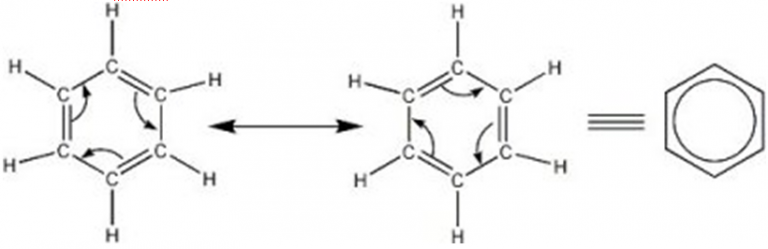
Do you understand the principle of resonance structures, e.g. in benzene? Here is how it works: Now try to apply something similar to the structure you have been given. Can you do that?
-
That's interesting and I fully admit I am pretty rusty on a lot of this stuff. I had in mind as typical H bond strengths of the order of 5-10kcal/mol (showing my age). Can you give examples of much stronger ones?
-
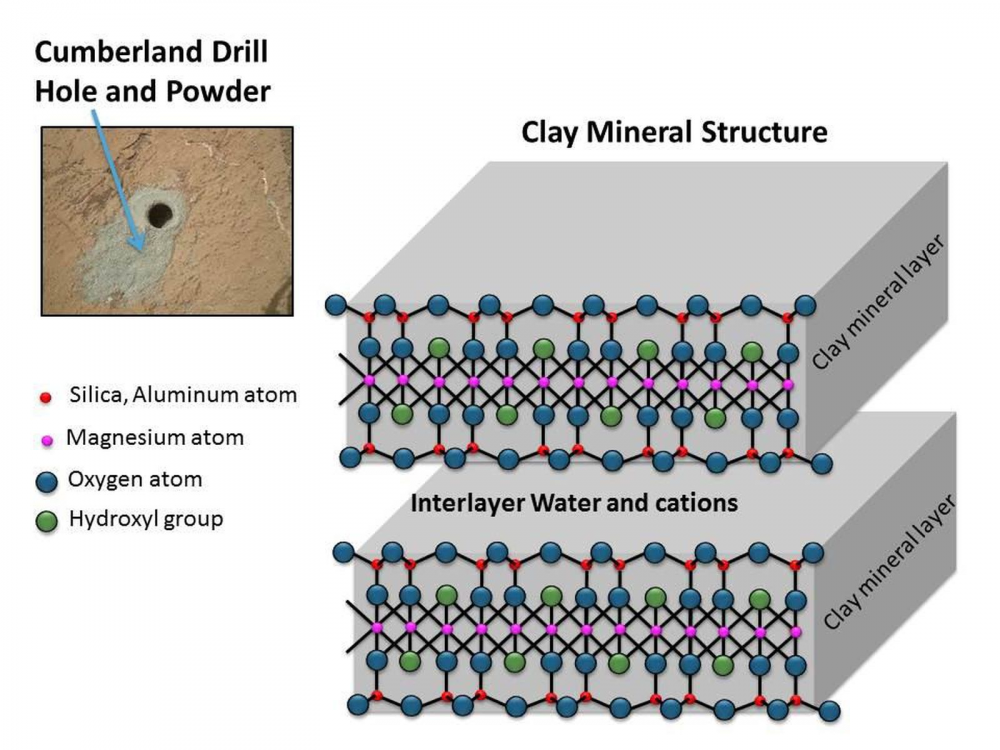
I'm not a mineralogist, but I can try to add a bit to what others have said, based on what I have quickly been able to read up.😉 Clays are made up of tiny crystals of "clay minerals" and water. The water is hydrogen-bonded to the surface of the crystals, which means it is attached by bonds that are about a tenth the strength of a full "normal" chemical bond. A crystal of dry clay mineral will tend to absorb water until there is a hydrogen bonded film of water all along its surface. Clay minerals are made of sandwiches of sheets of silicate tetrahedra, which have a -ve charge, with metal ions in between that have a +ve charge, thus making the whole sandwich electrically neutral, and then water molecules in between one sandwich and the next. (Though some are Danish open sandwiches with only one layer of silicate "bread" under the metal ions and nothing on the top.) Because they have a sheet structure, these minerals easily cleave along the lines of the sheets, as mica does. What you end up with is a lot of microscopic, flat, very thin flakes of clay mineral, with water in between. It is the water that makes clay plastic, enabling you to mould it, as it allows the flat flakes to slide past one another. In terms of chemical bonding, you have covalent bonding within and between the silicate tetrahedra, ionic bonding between the sheets of tetrahedra and the metal ions in the sandwich, and finally hydrogen bonding of water molecules along the outside of the sheets. So clays are chemically quite complicated things, dull though they may look from the outside. So when you ask if clay is uniform or homogenous, it depends on at what level you mean. Macroscopically it is, but at the molecular level it is made of two distinct phases, a solid mineral and liquid water - albeit much of the water is hydrogen bonded to the mineral so that it does not behave entirely like a liquid. Moulding the clay does nothing to this structure. However, drying or firing the clay will drive off most of the water, shrinking the clay and hardening it by allowing the layers to link together directly instead of being kept apart by a layer of water. Here's a diagram I found which may help visualise it:
-
Addressing your point about credibility of a smoothy containing CaCO3, this is certainly possible if it is dispersed in colloidal form. In my former work in the lubricants industry, we used to put "overbased" detergents in engine oils. These contained sometimes quite high amounts of colloidal CaCO3, which was useful to neutralise the acids formed by the combustion of the fuel, thereby avoiding corrosion of the cylinder liners in the engine. The CaCO3 was bound inside "micelles" of detergent molecules, forming a sort of cage around each sub-micron particle of what was effectively chalk, allowing it to remain suspended in the oil almost indefinitely. I believe the same idea is used in medicines such as "milk of magnesia", which is used for heartburn - though the suspended material in that case is Mg(OH)2 rather than CaCO3. However I have no idea what substance is used to stabilise the suspension in these cases.
-
Scattering. Visible light tends to be scattered by tiny droplets in the air, whereas radio waves are not because their wavelength is far longer than the dimensions of the droplets. But I can't immediately see why simple humidity, i.e. without any condensed droplets, would weaken a LIDAR signal.
-
Nice flamebait attempt. 😁 Speaking as one who is not a "religion fanatic", but was brought up Christian, my understanding is it is so called because Christians believe the sacrifice of Christ on the cross atoned for the collective sins of mankind and made a new contract with God. The word "good" is used in its now obsolete sense of holy.
-
This is rather unclear. Can you rephrase?