

Eise
Senior Members
-
Joined
-
Last visited
Everything posted by Eise
-
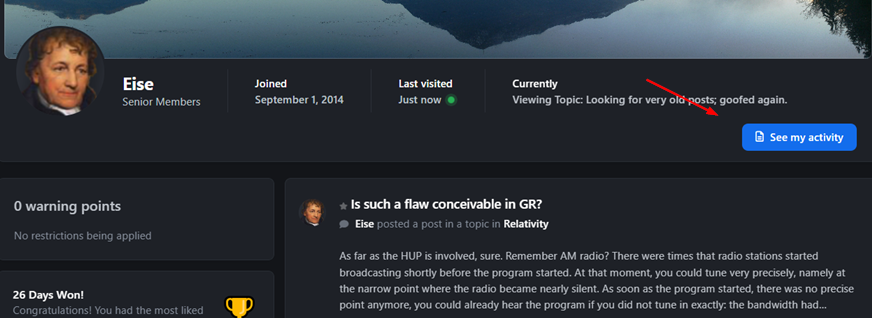
Easy workaround: click on your avatar, you get (example of my account: And click the button. Works for others too, only with another text on the button:

-
As far as the HUP is involved, sure. Remember AM radio? There were times that radio stations started broadcasting shortly before the program started. At that moment, you could tune very precisely, namely at the narrow point where the radio became nearly silent. As soon as the program started, there was no precise point anymore, you could already hear the program if you did not tune in exactly: the bandwidth had increased, because the frequency was not precise anymore. The extreme case were very short pulses: lightning. One could hear that over more or less all AM bands, so the frequencies were extremely spread out. I am wondering about the unequality Studiot mentioned: compare with 'Küpfmüller's uncertainty principle (1924)': delta f . delta t > 1/2 Replace f with E/h and you get: delta E . delta t > h/2 Pretty close to the HUP, isn't it? Basic knowledge for radio amateurs, I would say.
-
I think you should make clearer what the differences between philosophy of consciousness and science of consciousness are. Science should always take a 'third party' viewpoint. It looks at its object of interest from a neutral view point, i.e. knowledge it gathers, must be valid for other observers too. This, per definition excludes the 'me' and 'you' perspective, exactly the perspectives where consciousness is most 'visible'. So how you define consciousness is a methodological restriction to which all science is necessary subjected. Your definition, 'the awareness suggested by an organism's observed behavioral responses to stimuli', is so to speak a proxy for science to investigate consciousness. Dennett suggests another approach: heterophenomenology, which opens a door at least to the 'you perspective'. And do not forget one of my disclaimers: There is no such thing as philosophy-free science; there is only science whose philosophical baggage is taken on board without examination. Philosophy speaks with many voices, you pick out just one: and nowhere I mentioned an 'etheral, overriding sense of self that comprise our individuality'. Sure: there must be an evolutionary advantage for this complexity of behaviour. But what is interesting is that this seems to lead necessarily to consciousness,in the first and second party perspective. At least it is difficult to see how a (human) animal can anticipate what will or might happen in its environment, and even more, can see what might happen dependent on its own possible actions, and then select its action dependent on the most advantageous action without being aware of itself. Really? The kidneys do this too, it is 'chemical substances cancelling'. But with the kidneys we can safely take the third party perspective: here this perspective is not a crutch to approach the object of research. Eh? Well this is highly speculative. And why should I perceive this? Nothing in the purely scientific approach suggest that perception by 'I' plays a role, because it is excluded from the beginning, as an methodologically limitation of science. Unless one takes first- and second party perspectives seriously, one is far away from an explanation of consciousness. Heterophenomenology is an Ansatz to break this barrier.
-
OK, I must make this more precise: the neural processes that give rise to consciousness are complicated. And I do not see what your operational definition of consciousness contributes to the discussion: First I would suggest to add as a rule of thumb: the bigger the spectrum of possible actions, the better capability to foresee possible futures dependent on one's own actions (from elephants taking a detour because they know there will be a place to drink, to human animals building the LHC) etc, the more conscious an animal is. So yes, the complexer the spectrum of possible actions is, the complexer the physical system must be to generate such behaviour. Second you are missing the first person perspective. I know I am aware, and because I can talk and coordinate actions with other individuals of my species, who also say they are aware, I attribute consciousness to them too. So what is missing: Metzinger, The Ego Tunnel But exactly that is what must be explained, if you want to explain consciousness. The kidneys strive for homeostasis too, but they produce waste and lead it to the organs that can get rid of it in the external world. So the question is why does the brain 'produces thoughts and behaviours', and not, as an example, body waste. And that exactly is what need to be explained: what is special about the brain that it can 'produce thoughts and behaviours'?* I cannot deny that some hierarchy between thalamus and cortex can play a role, I don't know enough about such matters, but I am sure that this Ansatz, how correct it may be, is never enough to explain consciousness. *If you want to be consistent with your definition of consciousness, you should only say 'behaviour'.
-
A dangerous endeavor. 'Essentialism' , IMHO, is a wrong track when dealing with such a complicated phenomenon as consciousness. Do not take the analogy too far. I only want to show that some overall principle does not explain anything. A computer chip tries the whole time not to get an overall charge under changing inputs, and does it by the physical means it has: but it is exactly the complexity of how these processes are running that make the chip useful in a computer. Not that it evens out input and output currents. To say it cryptically: the essence of the computer chip lies in its complexity. Without understanding the complexity, you do not understand the workings of the computer chip at all. Same with the brain: without understanding the complexity, you do not understand the workings of the brain at all. And this difference exactly is what we must understand. Not what the brain has in common with other organs.
-
Didn't you notice that I said 'extremely reductionist'. And that I said: To add: my position here is reductionist too: but to explain consciousness with such a global concept as homeostasis, is an example of 'nothing-buttery' ('nothing-but-ism'). The explanation of consciousness might lie in the mechanism how the brain arrives (or stays) in homeostasis. The most extreme case of nothing-buttery is of course to say we are nothing but hydrogen, oxygen, carbon, and some other elements put together. So I mix this elements in a vat (pun intended...) and exclaim 'Ecce homo'!. Does the liver, reaching for homeostasis, also produces conscious behaviour? I noticed that you did not react on my analogy of the workings of a microchip. You can be sure that a microchip really strives for getting the input currents and the output currents equal. But it explains nothing: a light bulb does that too. Without taking into account all the layers of how the components of a microchip work together, you explain nothing. Same with homeostasis. The rest of your reaction is just a repetition of what you said in your postings before. As a philosopher, I completely agree. But I would invite you to deliver reactions on the content of a thread. If you really have something to say, or to ask, you are welcome. I wonder if you ever contributed to a topic, or only do some chitchat in your postings. This is a discussion platform.
-
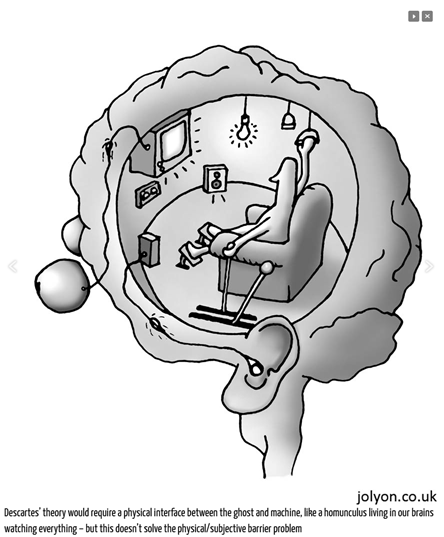
OK, I chime in. Your position seems extremely reductionist to me. Striving for homeostasis is more or less what all organs do, so it does not explain much. As theVat, I also think you have dualist 'residues' in your thinking. Trying to locate consciousness in a part of the brain can be such a residue. Where is consciousness located? There where efferent neural paths meet afferent paths? Isn't there the control room of the homunculus? Are you sure your ideas are not another version of Dennett's 'Cartesian theater'? I have nothing against reductionism, but surely against its 'Greedy variant'. As an analogy: would you explain the workings of a microchip with its striving for equaling out input currents with output currents? (But it does, otherwise it would not work.) No, close to the lowest level, a microchip is transistors, then flip-flops, then logical gates, then adders and subtractors, functional subsystems etc, until you have a full blown computer that is programmable. It will not be much different (except maybe much more complex...) for the brain and the mind.
-
Stop it, please.
-
A bad joke, yes. Better improve the quality of your posts. Only ask serious questions; take the answers seriously Only react on topics you have some expertise, Stop posting internet memes If you like humor, we have at least 2 threads for that: one general in the lounge, and one in politics And if you have only (your kind of) humor to share here, I suggest you look for another forum If you just go on like this, I'll request the administrators to close your account. This is a serious discussion platform.
-
Wow. Speaking words of wisdom... +1
-
It is in the wrong subforum, I think. This is politics. It's no fun at all, and I fully agree with the text. What could help against this 'loop'? I am not sure. Every action from 'the higher elites' to limit Trump's actions, would stimulate protests. It could be one step to a civil war (you may call me a pessimist...). And don't even imagine to impeach him. Maybe it is also too much for certain republicans (you may call me an optimist...). But no, that would be a huge step to a civil war. The only thing I can think of to stress again and again that the economy gets worse and worse, and people feel it in their pockets. E.g, one could say that 'just buy two dolls for your child, instead of 30." You may call me a cynic... Even that is already in the loop. But a +1 anyway, not because it is funny, it is not; but is a very good description of the situation.
-
I very much second exchemist's advice. Without the mathematical background needed (calculus, linear algebra, group theory), and basic knowledge of classical mechanics (Newtonian mechanics, especially in the Lagrangian and Hamiltonian formulation) you will not get very far in quantum mechanics. So yes, start with a book about the history of quantum mechanics. I liked Jim Baggot's The Quantum Story: A history in 40 moments very much. But you can take any quantum history book, just be sure to scan it on how much is explained mathematically. See if you could possibly understand it (many books have a 'further reading' section, that can be helpful). If you take any modern plain textbook, you will miss how and why quantum physicists got their ideas. Quantum physics is, so to speak, presented as a ready made building (only the deepest underground floors, and the highest floors are not quite ready yet...). You should 'spiral in' on the real substance of QM: from easy, to more and more advanced. Popular science books are OK, but you must realise that you only get the gist of QM. Often analogies are used to describe it, but analogies are not the real stuff. They give an impression of what QM is, not how it really works. A step closer you could get with Giancarlo Ghirardi's Sneaking a Look at God's Cards: Unraveling the Mysteries of Quantum Mechanics. It tries to give an overview of QM, with not too much mathematics, but minimising misguiding analogies. Another way, if you are highly motivated, is Leonard Susskind's 'Theoretical Minimum' series. It builds up from the ground, also of the mathematics needed. You should start studying (just 'reading' is not enough) Classical Mechanics', and only then study the 'Quantum Mechanics' volume. And then you can go on with Quantum Field Theory, AFAIK the most modern formulation of QM. Avoid the two Brians: Brian Greene and Brian Cox. They only entertain you with QM. They will not give you any real insight in QM. Sean Carroll is also not too bad, but you should be aware that he does not distinguish clearly enough between 'real QM' and interpretations of it. But the Brians are worse in this respect. And then there is an interesting website of Gerard 't Hooft: https://goodtheorist.science/index.html. Be sure to read this small foreword. HTH
-
Well, if circa 300,000 years is 'just after the big bang', then yes. The Cosmic Microwave Background (CMB) is the 'light' that exists in the universe since it was not opaque anymore. Just lookup Olbers' Paradox: your question is exactly the opposite of it, i.e. seen from the source of light, instead of the observer.
-
No, it is not. Rational thinking means you can give arguments that support your viewpoint. But 'support' is a broader category than 'logically stringent'. I think you've got enough examples here in this thread.
-
Thanks! Works.
-
Something that disturbs me: if I look at 'unread' content, and I click on the 'time link' left below, I get the first page of the thread, not the latest postings. Together with the slow rendering of Latex it takes pretty much longer before I get to the last page of a thread. Another small quirk: when I want to mark all posts as 'read', I get this:

-
Oh, look, one click less!

-
Hey! Capt'n, you did it! Thanks a lot!
-
I don't see the sense behind these icons either. I prefer the kind of layout we had: subforums just as a listing. Is this something that can be changed?
-
April, 1st?
-
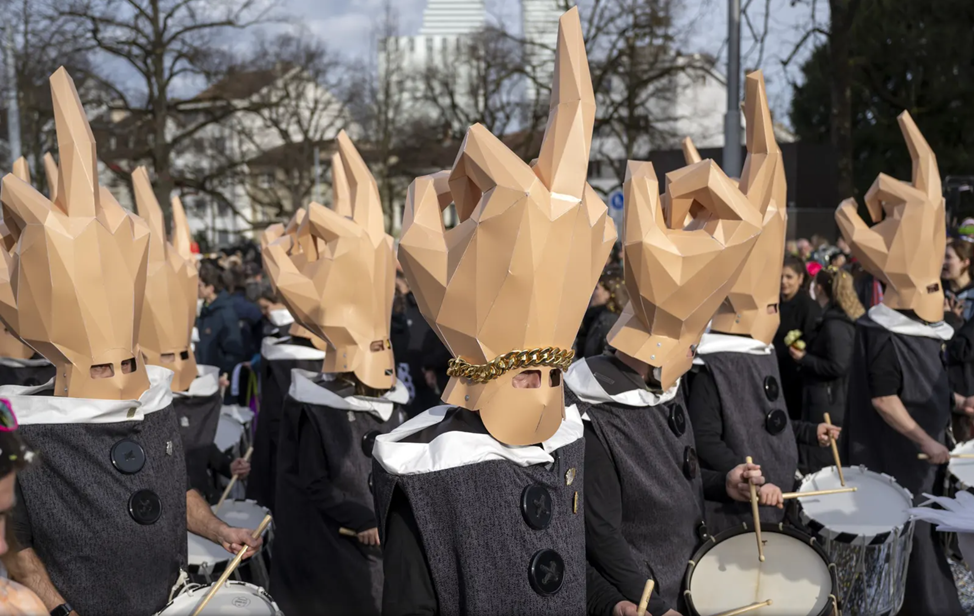
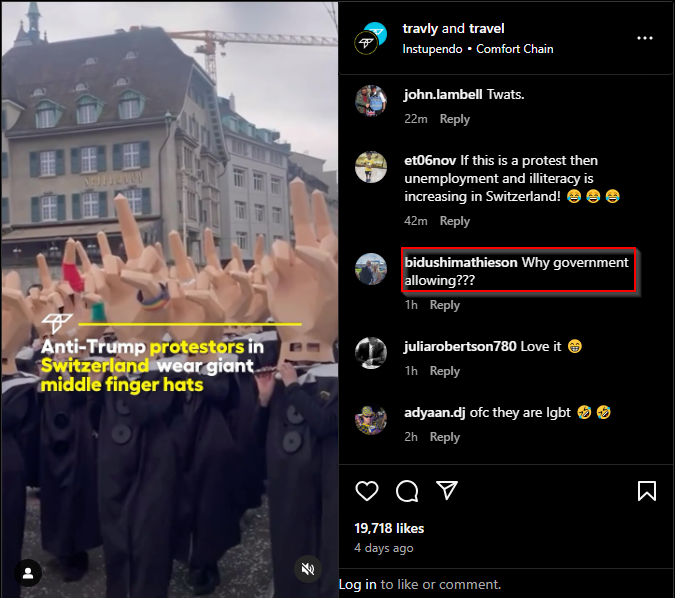
And now it was 'Fastnacht' in Switzerland. And it shows how just a small video/picture can lead to fake news: It was posted at Instagram, commented with 'protest against Trump': Link to the video. But the group itself meant it as a satire about our modern discussion culture. There was no reference to Trump at all. And yes, why does the government allow this? In the first place there is the "jester's freedom". And in the second place: because we have freedom of speech.
-
@gee: just to ask. Did you read Schopenhauer, 'The World As Will and Representation'?
-
And they lost the dinosaurs...

-
Nope. Since the fall of the Iron Curtain, and Thatcher and Reagan started economic deregulations, which opened the door for greedy capitalism. Might have some merit, yes. But my knowledge about economics is not deep enough to start a discussion about it.
-
And you don't know what an algorithm is.
