

Eise
Senior Members
-
Joined
-
Last visited
Everything posted by Eise
-
I think Joigus made an excellent job here. Not giving the absolute, technical correct explanation, but trying to pickup from the estimated level where the questioner stands. Joigus presented the Einstein Equation, which really has (kind of) the form he presents. On one side stands a mathematical description of the curvature of spacetime ("Geometry"), and on the other side the possible sources of that curvature ("Matter"). Maybe one could say that "Geometry = Gravity" is a postulate of general relativity, but is definitely not the Einstein Equation itself.
-
You must distinguish between the many different contributions E made to physics. But I assume you mean relativity: special- and general relativity. For special relativity, the time was ripe for its discovery. Several physicists before (Fitzgerald, Lorentz, Poincaré, and several others) already guessed the correct formulas. It was even Poincaré that called the Lorentz transformations that way. But Fitzgerald and Lorentz used more or less ad hoc assumptions to derive them, e.g to explain the null result of the Michelson-Morley experiment. Poincaré's views already circled around the concept of 'relativity', but could not overcome the idea that there is no absolute frame of reference (i.e. a frame that is in absolute rest). E had some help of friends, but their role was more or less that of a 'resonance board'. Explaining his views and problems, E came at the solution himself. It is different in general relativity. E saw an inconsistency between his own theory of special relativity and Newton's law of gravity. He discovered after a few years that he needed descriptions of curved spaces, and asked his old friend Marcel Grossman how curved spaces could be described mathematically, and it was he who introduced E to differential geometry, of which E found that it was 'notoriously difficult'. in 1915, E got stuck, and visited David Hilbert, a specialist in differential geometry. After their discussion E found the solution in a few weeks, at more or less the same time as Hilbert found it too. But Hilbert later said, humorously, 'Every street boy in Göttingen knows more about differential geometry than Einstein: but Einstein had the physical intuitions that led him to the right formulation of the problem'. There are articles in Wikipedia about the development of the 2 RTs: - https://en.wikipedia.org/wiki/History_of_special_relativity - https://en.wikipedia.org/wiki/History_of_general_relativity
-
No, no, this is not the way it works. Say you are mining real, physical gold. That also costs a lot of energy (and labour). If you can't earn those costs back with the gold you are selling on the market, you would consider to close the mine. With Bitcoin it is the same: your mining costs energy, infrastructure (especially powerful computers). But then, if you have created a new Bitcoin, you go to the market with it. If your costs were $15'000, and the Bitcoin is worth $20'000 at the moment you have earned $5'000. But if the Bitcoin is $10'000, you have to accept a loss. And you might consider to 'close the mine', i.e. do not 'calculate' Bitcoins anymore. Or did you clear that point up already? I did not read every posting.
-
More or less. But I think I should wait for MPMin's reaction. You see, if you introduce too technical details, there is the risk of a 'conceptual overload'. Either MPMin understands what I mean, or (s)he asks more detailed questions him (her?) self. You see, sometimes my toes curve, not due to space curvature, but because I see that a curious beginner gets confronted with all kinds of technical details that he cannot see through. So this is a didactic principle of mine: try to connect as much as possible to the level of understanding that the questioner has. This risk is exactly shown here. You and Swansont get in a detailed discussion, that might just demotivate the questioner. I would always try to avoid that. And if the technical discussion is interesting enough, one could start a new thread. In the end, MPMin wanted to know if the (none)-infinity of the universe has something to with its (none-)flatness. I think I did sufficiently reacted on that question. Exactly.
-
No. 'Flat' means that e.g. parallel lines stay parallel, no matter how far you compare their distance between them. Best example is two light beams. When these do not converge or diverge, the universe is flat. It is difficult to imagine how a positive curved universe can be infinite because it is closed in itself, like the surface of a sphere. But with negative curvature and flat space that problem does not arise. Just take care that the universe seems to be flat on average. Locally, due to mass and energy, the flat universe can be curved.
-
Recently Ethan Siegel has an article about it: starts with a bang.
-
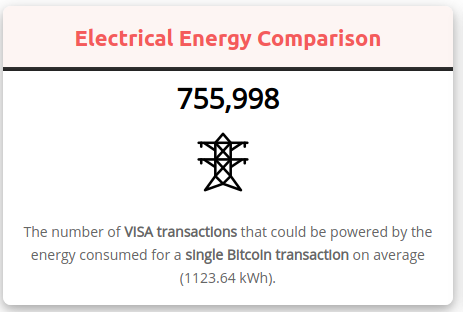
I am not a CC expert either, but I picked up, that also financial transactions cost a lot of energy. AFAIK this is because enough of the delocalised blockchains must confirm the transaction before it is definite. Googling I found this comparison: From here.
-
Yep. It is called gravitational redshift.
-
This makes no sense. We know 'Newton' is not valid for velocities that are comparable with light speed. So at one side you apply 'Newton' (E = 1/2mv^2), on the other side you apply relativity by saying that the speed of light is speed limit. You need to use relativity from the beginning, and then you will see that a proton accelerated to 7 TeV flies just a tiny fraction slower than c.
-
In addition to MigL comment on time dilation: at the event horizon of a black hole time dilation for an observer on a big distance goes to infinity. That means the frequency of an EM wave goes to zero, and the remote observer will not see any EM radiation.
-
See it this way: getting out of a gravitational field costs energy. Objects with mass lose kinetic energy, which means they slow down. Light also has energy, but it is not dependent on its speed, because it always has the same speed. But the energy of light is related to its frequency. So light 'loses frequency', which means its frequency goes down, i.e. it becomes redder. Now imagine a light beam with less energy than needed to get out of the gravity field. It would have no energy anymore, which for a wave simply means it does not exist anymore. At the event horizon EM radiation just has not enough energy to escape. Physically maybe not completely correct, but it might help to develop your 'physical intuition'... It is true, using daily intuitions it is impossible to understand modern physics. Throwing away physical theories because it does not fit your intuitions is the worst you can do. (In fact, it is one of the strongest motivations of so many 'crackpot theories' that are also posted on this forum).
-
Ethan Siegel in 'Start with a Bang': Why You Should Doubt ‘New Physics’ From The Latest Muon g-2 Results It throws doubt about the correctness of the theoretical calculation of the value of g-2. So there might not be a discrepancy between experiment and theory, because the calculation is not rock solid. But hey, how many articles appeared with new physics explaining neutrinos traveling faster than light? Hundreds? But it was an experimental error. This time I set my bets on a wrong calculation.
-
Of course, I forgive you: even stronger, anyone can correct my English. Wasn't it you who said you wanted to know English perfectly, at least on your deathbed? As long as the stream of the discussion is not disturbed, any correction is welcome. You know, there are so many ways that the same, or nearly the same (especially in none English ears) sounds can be written in English. My favourite is the [i:]: peace piece pee release receive retrieve But life, live, and yes, lose and loose are difficult too to remember. But I try to improove! The one about the police is also an eye-opener. The astonishment of the American police officer is great to see! That is one question further. The question as asked, takes a kind of "we all know what we mean by 'justice'" as starting point. But yes, if you want to get to the presupposition of the question, that one should be answered too. You slowly are getting a philosophical inclination MigL... Good to see!
-
Don't expect too much from me... Ethics never was a main topic for me. I would say, as any sensible person, just the risk of giving capital punishment to an innocent should be reason enough to refrain from it. And AFAIK deterrence seldom works. So I think incarceration might be the best solution, in the first place simply because we put somebody away who has proven to be dangerous, in the second place we, i.e. society must attach consequences to people who do not want to play by the rules. However, if a society does not take the chance to rehabilitate the offender, it is not much use. Just putting somebody in jail, specially when it is overfilled, you create offenders and possibly more radical ones too. In this respect, it seems to me that there is a huge difference between prisons here in Europe, and in the USA. Most of the times rehabilitation is the aim. Therefore we might take some risks, letting out somebody who will still act criminally (which hurts extremely when its is murder on innocent people), but I think a lot more crimes are committed by ex-inmates who were radicalised by their life in prison. To get a glimpse of the difference between the USA and Scandinavia, there is a short series about 'the Norden'. This is the episode about prisons (the others are just as interesting): https://www.youtube.com/watch?v=HfEsz812Q1I To get back at capital punishment: there are also examples of murderers who felt much remorse about their killing, and ended up meeting the family of the victim, or became meditators, even meditation teachers to their fellow inmates. These are pretty extreme examples of course, but just killing a criminal, or putting him/her in jail purely as punishment I find useless, and not something a civilised society should do. Punishment yes, but for the betterment of offender and society. A loose-loose is the last we want, no?
-
Then the world is absurd. See a ball and feathers falling in vacuum:
-
Wow, 'sphere of existence'... Where can I find that sphere? I did not say that daydreaming or its interpretations do not exist. I said that their existence is different from that of physical objects, because when there were no humans (or other similar conscious entities), there would not be daydreaming.
-
Janus is right, it was an argument from Galileo against the Aristotelian view on falling objects. In Aristotelian physics, an object twice as heavy as another, falls twice as fast. Galileo's argument works against that viewpoint, but not against Newton's, in which all objects fall with the same velocity (or better acceleration), independent on their mass, and therefore independent on their weight in the same gravitation field. So you are physically and historically wrong. Just to add, Galileo is the first person known, who said that all objects fall the same way, independent of their mass.
-
Sigh. Are you intentionally misunderstanding me? What when there is no Queen of Britain? Then there are no balancing policies of her either. They do not depend on me, or you, but definitely on HM Elizabeth. Electrons on the other hand, would continue to exist even if no human would be there to detect them. So different kind of things exist in different ways. That is my whole point. There is no general EXISTENCE, except if you use such wavy definitions that I used as a reaction on Alex Mercer's post . Existence is not an attribute, as being white, or being rich, etc.
-
I fully agree, but you are not reacting on what I actually said. And you have not refuted anything, you have just contradicted some view without a single argument. Just look at it this way: if something, principally, cannot play a role in our lives, can you then say it exists? And then I am not looking at historical accidents. E.g. a photon produced by a star in a galaxy billions light years away, arriving at one of its planets surely does not play a role in our lives. But photons definitely effect our lives very much (how else could you read this?). So photons exist, even if we happen not to observe them because they do not reach us. Your view seems exactly what I warned about: to reduce the meaning of 'existence' to one category (physical existence in this case). But I mentioned many more. If we take your view, 'existence' meaning 'existing independently', then a whole lot of 'things' we normally see as existing, wouldn't: holes, shadows, juridical laws, laws of nature, institutions, thoughts, feelings. None of these exist independently. If I were Descartes, I would say, yes, namely the mind. But I am not. ('Res extensa' i.e. everything that takes place in space vs 'res cogitans', the mind). I just reacted to Studiot's question, which was about time. But surely you are right that much what applies to time, also applies to space. A possible answer to your question could be 'mathematical truths'. But that, as said, is a complete new topic in itself. I do not want to go there now.
-
Sure, for many 'things' existence means 'existing in time'. But there are a few exceptions, which I think I mentioned already: mathematical truths, laws of nature to name just two. And as said, time itself.
-
Sorry, I am too lazy to look up the exact place where you made the link. But I think only for some categories existence and time are related. Surely for physical processes, but it becomes difficult when you think about laws of nature, and then that which I left out: mathematics. And then think about time itself. There you could get in a definitional loop. (And if this does not fit to your link, then please refer to it, or say it again, maybe a little bit different after my exposé.)
-
'Existence' is a word with 9 letters. And if you want to know about the concept behind the word, I think I showed that it depends on the context: existence of what? If you want a general definition you would get something like 'something exists if it can play a role in somebody's life'. And here you see something else: 'existence' is the substantivation of the verb 'to exist'. So the existence of what are you interested in? To give again another example: space and time. One could call them the 'stage' on which causal processes occur (Pity that Markus is away now, he surely had to say something about it from the viewpoint of general relativity...). But they themselves do not exist in the same way as physical objects or processes exist in space and time. Space does not punch a ball, neither does time. Asking for THE general, meaning of EXISTENCE, leads to nothing other than all kind of philosophical apories, getting people confused. And if you insist on one meaning, it will lead to some bad metaphysics.
-
Yes, pity isn't it? Because the context in which somebody declares the existence of something is essential. 'Things' (the quotes are there to do a warm-up for what is coming...) exist in totally different ways, depending on the kind of 'things' we are talking about. So let's try a few examples, with my comments. Existence of a ball This would fall under what I would call physical existence. It means that a ball can exist independently from its immediate surroundings, and can play a role in causal relationships. It can be moved by another physical object, and it's movement can move other objects Existence of rain Rain is an example of a process. One could defend, a bit exaggerated, that if the above description of 'existence' is the only correct one, then rain does not exist: what exists are water drops (physical objects), falling down from clouds. But I think this comparison shows at least a difference with the previous one: without some physically existing things, processes cannot exist. Existence of a hole Holes cannot exist independently. E.g. if you have a cannon ball, you can completely remove all its surroundings, and it is still a cannon ball (fire it up to the sky with more than escape velocity, and it will further exist in vacuum). Remove the complete surroundings of a hole, and there is no hole anymore. 'Holes' are more or less a byproduct of what we conceive as normal. Say we have a golf ball, rolling over the lawn. The hole in which it drops is on one side very real: in the end, dropping is a physical process. But physically it is better described as the absence of supporting ground, as it is around the hole. Having the hole under the ball, the ball van continue its natural movement, which is following gravity. Existence of the one Ring One could say it has narrative existence. In cases of stories, e.g. one can even reach some kind of objective existence in these stories. One can answer questions about an imaginary object, and the answer can be right or wrong. "Does the one Ring of Sauron has a jewel in it?" If you read the Lord of the Rings, you know it hasn't. Does the Ring exist? Well, not physically, in our physical world. But it definitely exists in the context of the story. Existence of rules and laws Does there exist a law that you should drive on the right side of the road? In many countries (sorry Studiot ;-)), yes. But such 'human laws' exist in the sense that people made it, and act accordingly (and might be fined if they do not). Existence of laws of nature That is pity enough a very tough one. It is clear (otherwise science would not be possible) that there exist (!) regularities in nature. However the laws of nature are our formulations of these regularities. And we can be wrong about these formulations. But one could say they exist, at least in the sense that scientists discuss about them, technicians apply them, and describe at least partially the observations and experiments we have done. Existence of other cultural phenomena Does science exist? Science, from the viewpoint of 'existence', is a meaningful conglomerate of all the above. I think we could make this list longer and longer (I left out mathematics, that would become a topic in itself). But moral of the story is: there is no general concept of 'existence'. But in our daily life, using the concept, it often is pretty clear what we mean, and is not problematic at all. Seeing the concept 'existence' as something having a well defined meaning, leads to all kind of philosophical diseases. I think I have said nothing revolutionary in this post, but a lot of the confusion in such kinds of 'fundamental questions' arise because the seemingly simple structure of language put a spell on our way of thinking: in this case 'one word - one concept'). Philosophy is a way to free us from these kind of spells. Just having a philosophical opinion (or better an opinion about a philosophical subject) doesn't help a bit in reaching intellectual clarity. Psst... I think it is your Avatar...
-
That would be the same as arguing physics is BS, because there are so many crackpot theories (see our Speculations section). One should look what professional, academic philosophers have to say about 'existence', not at philosophical 'hip shots' of people who are not knowledgeable about what philosophy has to say about the topic.
-
Hi Markus, This is regrettable for us. I will miss your expert knowledge on relativity, your honesty, and your nearly endless friendly reactions, even on the most weird ideas that are posted here. This friendliness is already a clear sign that you are on the right track. I also like very much that you showed us all that there is no contradiction between the spiritual path you are going, and a scientific world view. And not to forget, your openness on your autism, and your setting straight some misunderstandings about being on the autistic spectrum from your own experience. Somehow I nearly feel like I found a kind of friend, possibly I am not the only one that feels that way. I take it as a sign that you are progressing on your path, you are not the first Buddhist I encounter (in real life and on the internet) that gives me such a feeling. So it is an empirical statement . I like the idea of sending you a 'post card' So here is mine: I've been camping here on my own for nearly 2 weeks (in 1991, but went there a few other times), on the Great Blasket Island at the end of the Dingle peninsula; between the two unroofed houses a bit right from the centre of the picture. I wish you all the best, and hope very much get further on your path. A deep 'gasho' for you from me. I hope we will meet again, here, or even once in real life. Who knows? Eise