
Eise
Senior Members
-
Joined
-
Last visited
Everything posted by Eise
-
'Binary numbers' do not exist, neither do 'decimal numbers'. Numbers exist, but we can use different notations for them. Take the number 153, in decimal notation. This means: (1 x 100) + (5 x 10) + (3 x 1). With exponents you could write it as: (1 x 10²) + (5 x 10¹) + (3 x 10⁰). So the number is expressed as sums of multiples of powers of 10. So the base number is 10. In binary, 153 is written as 10011001, which means: (1 x 2⁷) + (0 x 2⁶) + (0 x 2⁵) +(1 x 2⁴) +(1 x 2³) + (0 x 2²) + (0 x 2¹) +(1 x 2⁰) Which is in decimal: (1 x 128) + (0 x 64) + (0 x 32)+ (1 x 16) + (1 x 8 ) + (0 x 4)+ (0 x 2) + (1 x 1) = 153. Every number can be written in every base.
-
By scientists, not by science. But the questions are still philosophical, and a training in philosophy definitely helps. I don't care who does the philosophising, as long as it is 'quality philosophy': well argued positions, well informed about the subject (physics in this case), but also well informed about the philosophical relevant areas to avoid overhauled positions, faulty logic, etc. Most of the present-day well-known academicians doing philosophy of physics have double PhDs, both in physics and in philosophy. To exaggerate a little, Krauss, with no extended education in philosophy, is critisising Aristotle, but none of today's academicians doing philosophy of physics. You can use citations to strengthen your point, by citing experts in the field, i.e. valid arguments from authority. I just wanted to show that Mencken is not such an authority. Depends on the purpose. If it is to ridicule philosophy, then sure, you can use such bonmots. If you want to make valid argumentative points, no, not so much. What is your purpose? But then you equate everybody who thinks he is philosophical with philosophy as it is done in academia. You know physics is bullshit? Just read the crackpot postings here. I cannot help it that there are many specialists here in different sciences that can correct wrong positions, but it seems that I am the only one here who studied philosophy as a main subject. And my time is limited; as you probably noticed, I am not posting very much at the moment. Maybe when I am retired, in a couple of years... Yes, but you should not mistake 'playing philosophy' for 'academic philosophy'. But not today's philosophy. And what was Aristotle doing? language analysis grammar logic biology physics philosophy Isn't it a bit funny, just because everything was called 'philosophy' in those days, that modern physics has taken the place of philosophy in the domain of fundamental questions? Just to add a citation by Sean Carroll:
-
Not quite: 'philosophy' was just the name of every activity that wanted to understand the world. (Was Newton a philosopher? His main work is titled 'Philosophiæ Naturalis Principia Mathematica'.) It is our understanding of the musings of Aristotle that he was active at disciplines that we now distinguish: during my physics study in the context of the history of physics I learned about his 'laws of falling bodies', during my philosophy study I learned about Aristotle's logic (syllogisms, categories, etc), and I assume he would also appear in the history of biology. There are some overlappings, e.g. Aristotle's concept of causality that is interesting for the history of philosophy and physics alike. It is clear to us nowadays that to make methodologically justified statements about nature, you must study nature, not just sit behind your desk and start thinking. However, if you encounter problems, there may come a point where you have to think about the fundamentals of your methods or other assumptions, like in the early years of quantum physics. And that discussion is not over yet, but has shifted. E.g. the question if String Theory is still science, or just mathematically advanced metaphysics. And what about the Multiverse: proponents of some version of the Multiverse generally affirm that there is no causal connection between the different parallel universes. So the hypotheses about the Multiverse cannot be empirically tested. Is that still science? These are philosophical questions. In modern days, no, not so much. Genady is partially right: To simplify: if the topic is nature, it is physics; if the topic is methods and general assumptions behind physics then it is philosophy. And in this sense there are at least periods in which physics needs philosophy, even if it are physicists themselves who are doing the philosophising. But physics does not need music or sports; physicists might, but they are not special in this respect. There are a few reasons, why you got this impression. First, the irony, or even sarcasm, of one of these was just too much. As a science fan, you could get the impression that you are plainly stupid. (If you remember, I also asked him to tone down. To no avail, as he was even banned.) This made it impossible for you to take his points seriously. AFAIR his point was that the selfunderstanding of science (a philosophical topic!) of many scientists is poor, but you read somehow that he implied that science in general is wrong. But the second point lies clearly with you: your utter ignorance about modern philosophy, just picking a few bonmots (some nearly 100 years old) that fit to your prejudices. Here I have a few others by Mencken: Do you really want to call him in the witness stand? Philosophy is not science. In the natural sciences there is always an arbiter: nature itself. Philosophy is essentially reflecting on our thinking. But as the thinking changes, due to developments in science and society, the reflecting will change as well. Grappling with these assumptions is the scientific methodology, which is a part of philosophy. This is a caricature of philosophy. No doubt that Feynman heard these kind of questions, but the way he talks about them, I assume these were questions by 'would-be philosophers', i.e. fellow students who wanted to spread some 'deepities'. You do not find such questions when you look into the 'philosophy of physics' department. Yes, I notice you are pretty good informed about the contents of modern physics and astronomy. But, as you say you are not well-informed about what philosophy is presently doing. So why all these attacks on a discipline you simply don't know, and just take some bonmots, that support your prejudices? Forgot to add, there are physicists, who are much better aware about philosophy, a small list: Lee Smolin Sean Carroll Carlo Rovelli Albert Einstein From the latter:
-
Well, beecee, I hope you are doing well in your followup crusade against philosophy. I find it interesting that you, Krauss, Degrasse Tyson are heavily critisising philosophy, where it is clear to me that you and your scientific heroes have no idea what is actually done in modern academic philosophy. Don't understand me wrong: I have read several books of Krauss, and these are great in explaining modern physics and astronomy for the lay people; and I extremely like the Degrasse Tyson's work in the public understanding of science. However I also recognise without a shadow of doubt that they are fighting a straw man here: philosophy as it was thousands years ago, or hundred years ago. Should I condemn physics as stupid because Aristotle said that F = mv? 2500 years ago? Or astronomers that thought the cosmos is static and exist just out of the stars we see in the Milky Way, not much more than 100 years ago? Of course not, but that is exactly what you are doing when they, and you, are critisising philosophy: as if philosophy has not progressed in those thousands or most recent 100 years (Russel, anybody?). If you say that philosophy has still no answers to the most fundamental questions it asks since thousands of years, then I can only react that physics and astronomy have not either. True, we know much more, and cosmologists can describe the history of the universe until about 10⁻²³ seconds, but the original question 'where everything comes from' is not answered. Even Krauss does not know the answer. So if you would say, e.g., that philosophy still has not answered the thousands of years old question if we have free will, I would say 'maybe not, but we understand the problem much better'. The same as in cosmology: we understand much more about the origins of the universe, but we do not have the definitive answer. You are using different critera for the progress of science and philosophy. In trying to understand and accept the present scientific difficulties in answering this question, one is, eh... philosophising. Thereby: every science has its philosophical assumptions. See my present disclaimer ('There is no such thing as philosophy-free science; there is only science whose philosophical baggage is taken on board without examination.') Grappling with these assumptions is philosophy (at least of one of its subdisciplines). Doing unfounded assertions about philosophy is just bad philosophy. (Yes, when a scientist reflects about the status of his science, he is doing philosophy, not science.) Feynman shows a nice example of the ambiguity of scientists about philosophy: on one side, he finds it completely useless ("What is 'talking'"), on the other side you have his reaction on the question of what magnetism 'really' is (I think even you have shared the youtube of that interview here in these fora); there he is clearly taken a well argued philosophical stance, i.e. he is philosophising. Recently I have been reading What is real? The unfinished quest for the meaning of quantum physics by Adam Becker (Astrophysicist and philosopher). Its historical description shows clearly how heavily influenced the discussions between the 'quantum pioneers' by philosophical stances, and when it is about quantum fundamentals, it still is. With that it also shows clearly how important history of science and philosophy of science are, even for physicists. E.g. it shows how devastating the 'Copenhagen creed' was for an open discussion on the fundamentals of quantum physics, even so much, that you could forget your career, if you showed interest in fundamental questions (e.g. John Bell, working at CERN, helping in calculations for its accellerator/collider, but 'doing work on fundamentals on Sundays' Bell's theorem belongs to this 'Sunday's work'; he even warned Alain Aspect not to strive for doing entanglement experiments, unless he was tenured, (which he luckily was)). Read this book, maybe you get a bit more respect for philosophy and history of science. You will also see that the author himself is not the only one that has both studied physics and philosophy (often in that chronological order). All less talented than Krauss? In cosmology, sure. In philosophy? Definitely not.
-
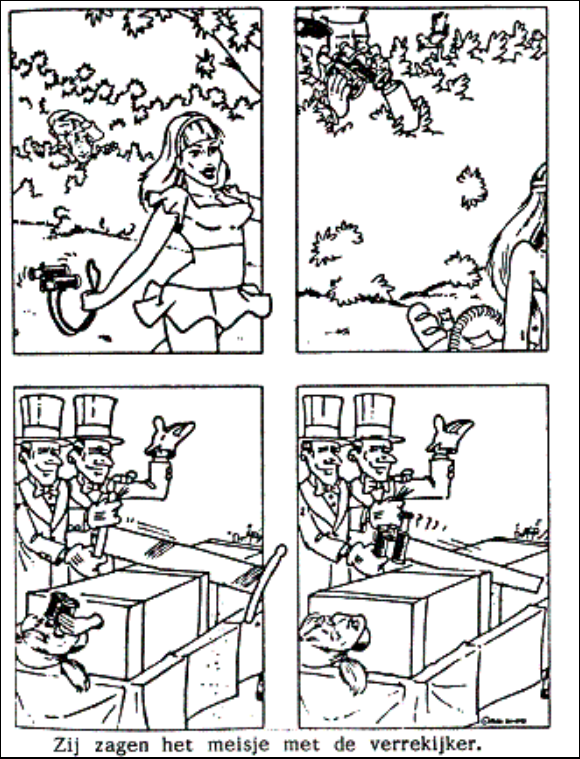
"I Vitelli dei Romani sono belli." The meaning depends on which language it is written in: Italian or Latin: Italian: The Romans' calves are beautiful. Latin: Go, Vitellius, at the Roman god's sound of war. Another interesting kind of ambiguity. Same with: "Cane nero magna bella persica!" The black dog eats a nice peach Sing, o Nero, the great Persian wars!
-
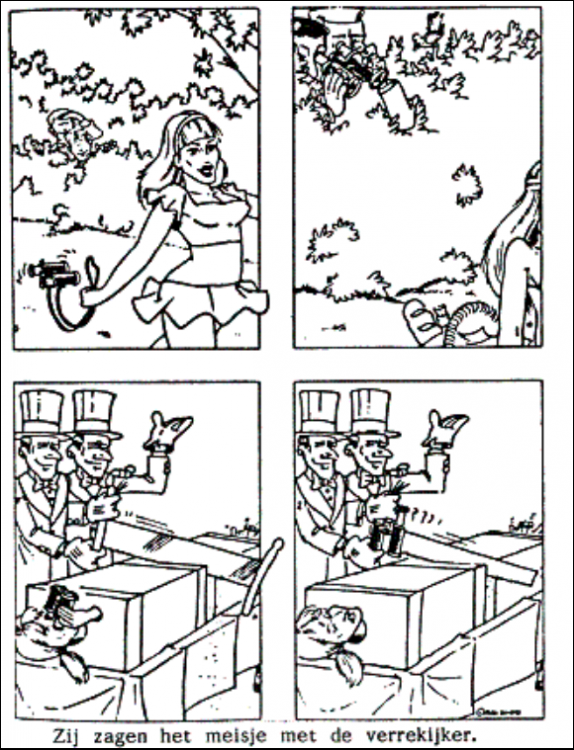
Yep. Funny isn't it? The words are different, but they work semantically exactly the same: "Zagen": present tense of 'to saw', past tense of 'to see' "Met': 'with', with (!) the same ambiguities as in English. You have a talent for Dutch!
-
I assume you've got the correct four meanings... Yes, It works in Dutch too.
-
Example I once read about AI in the domain of language understanding. It has 4 (at least?) meanings: "They saw the girl with the binoculars."
-
There have been done several experiments that show that 'experienced time' must not agree with 'real time'. E.g. with brain surgery they have done experiments where the brain area that reacts on touch of the fingers and the fingers themselves were triggered at the same time. Which order would you expect, was reported by the conscious subject? Yes, the tickling of the fingers was reported to have occurred before the tickling of the corresponding brain area.
-
I like that. Just to add: there is also no single time. And to the topic in general: I recently read somewhere this interesting bonmot: the brain is hallucinating constantly, the senses filter out which hallucination fits best for our survival.
-
In 1976 I visited a talk about lasers, for interested laypeople. One of the applications of lasers that were presented was nuclear fusion. I remember the presenter told that in fact the only problem that had to be resolved was to fire the lasers at exactly the right time, to avoid that the pellet would be thrown out of the mid-point of the lasers. That is 46 years ago... Just to add another anecdote to Moontanman's. I think when we had invested all the money in durable energy sources and develop technologies that use less energy, instead of nuclear fusion (including Tokamak and other methods), we would have solved our CO2 emission problems...
-
"About the quadrant. How one should make the hour lines in the quadrants" https://en.wikipedia.org/wiki/Quadrant_(instrument)
-
Yes, that is the first problem. So any question or answer on this topic should clarify first which definition of free will one is using. I think measuring free will without treating a human as a subject, but as object only, will never succeed. Compare it with 'meaning'. From the physical properties of ink, it is not possible to derive the meaning of the sentence that it forms. To assess if somebody acted from free will, you need to know her motivations and reasoning. You did not make your definition of free will explicit. What you say here fits to the 'libertarian' definition of free will, or even stronger, a dualistic definition. Something like 'the soul interferes with the physics of the brain'. Same holds for this: I agree that this can be true for certain definitions of free will, as the one you were using above. Personally I think we should adhere to the daily use and experience of free will, but only to an empirical notion of it. Why do people say they did something freely, or just the opposite, were coerced to it? The compatibilist notion of free will comes closest: somebody acts according her free will, if she acts according her own motivations, and not those of somebody else. However, such a definition only works in a deterministic universe. This guarantees that my motivations and actions can be related. Don't throw randomness in it, because then this relation is disturbed. Also, to anticipate the results of your actions, the world better functions in a regular, and therefore predictable way, which can also be guaranteed by determinism. So determinism is a necessary condition that free will can exist; there simply is no contradiction between determinism and having free will. Ah, I know you are joking, but the remark is interesting. It presupposes that a cat can limit your free will. But how can a cat limit something you would not have at all in the first place? I would prefer to say that there are different discourses: you won't find meaning, consciousness, or free will if you only study quarks, electrons, molecules, or whatever. That is because they simply do not exist in that discourse. But they exist in a discourse about choices, beliefs, feelings, ethics, laws, etc etc. The second discourse is not invalidated by the first.
-
@mistermack: You made up your mind, I made up mine.
-
What do we really know of Luke? Next to nothing. But historians assume that the author of the gospel of Luke and Acts are the same. No. It is taking the text 'as is'. The strategy of mythicists with text fragments very often is: It cannot be true, so it is a falsification the author did not mean what he wrote And then again Flavius mentions the execution of James: You know that different versions of the Testimonium Flavianum have been found? Some of them are shorter, and missing the obvious insertion by Christian scribes. You are preoccupied by 'your own book'. Surely you think the same of me, so let's end this fruitless discussion. Textual analysis shows that the author very probably is the same. See my link above.
-
Sigh... Here we go again. You do know the difference between the articles 'a' and 'the' I hope. Further, James was also called 'the brother of Christ' in Flavius Josephus Antiquities of the Jews. And I hope you know 'Cephas' is the disciple Peter. Expectations? Whose? Yours? Carrier's? The Pauline epistles are letters to churches he grounded, and meant to react on all kind of problems and theological questions that arose there. He was spreading his variation of believe what was Jesus' aim: not just reinstate the laws of Jews to them, but to prepare for the apocalypse also for the gentiles. This point was probably that which Paul quarreled about with Peter and James. I do not assume 'your book' is a scholarly work based on classical text analysis, put in the historical context in that time. Basically, you are just saying "I don't like it, so it is not true". I am not a Christian, but assuming he existed, makes a much better understanding of the development of early Christianity: the change in character of the gospels the later they are written, the bending of the story of Jesus' birth to fit the prophecies in the old Testament, the mentioning of John the baptist (also mentioned in non-Christian sources), and the mentioning of Jesus (or 'Christ') in a few non-Christian sources (including his crucifixion). So instead of taking the texts as they come to us, compare them, set them in historical context, you base your opinion on a psychological 'analysis' of Paul's character? There go many suppositions in such a stance. Above I wrote what the epistles of Paul were meant for. You find out by reading the texts, and analysing them in their context.
-
Yes, I was one of the participants, arguing strongly that Jesus more probably existed than not. I am missing reference here to the fact that Paul mentions meeting Peter and Jesus' brother James (in a letter that is considered genuine), and that James is also mentioned by a few (two, if I correctly remember) historians in the Roman age. There is also the strange fact that according to one gospel Jesus was simply born in Nazareth, but in Luke there is the complicated history where Joseph and Maria had to go from Nazareth to Bethlehem, obvious bending history to get it in sync with the prediction that said the Messiah would be born in Bethlehem. Such a bending would not be necessary if the story was a myth from the beginning. Most classical historians agree that the evidence hints at a real existence of Jesus. But 'hints' does not mean 'proves'. Read e.g. Bart Ehrman, Did Jesus really exist?. But the picture of who Jesus really was, is very different from how he is pictured by (modern) Christianity. He seems to have been an apocalyptic preacher, expecting to see the 'youngest day' (the Apocalypse) on Earth (not in heaven!) in his own lifetime, or at least very soon. I will not repeat every argument here, there are many posts of me in that thread.
-
I hope you see that you exactly make my point: as I said earlier that it makes no difference if a traffic jam consists of horse cards, diesel or gas cars, for a computer it makes no functional (or logical) difference if it implemented in a completely different way. I happen to work, as most of us, with computers that are transistor based, not gear based, but to write my programs I do not need any knowledge of the computer's physical principles. So another way of seeing this, is that emergent properties have some independence of its physical substrate. No question, a physical substrate is absolutely necessary, but there are many cases where different kinds of substrates can do the job. I do not exactly get your example of day and night. Not knowing the cause of a phenomenon does not mean it is emergent. It is essential that the emergent phenomena arise from their components, mostly many of them (molecules for the Gas Laws, neurons for mental phenomena, vehicles for traffic jams, etc). Definitely.
-
Yes, you may. Your introduction from this other 'natural kind', D2O makes your world view more precise. None, if you ask it in this way. But I would say, based on the regularities we see (perihelion precession e.g.), we know there must be at least some mathematical explanation. It is 'just' a theoretical insight that differential geometry does the trick.
-
You can only see if a phenomenon is emergent, when you can explain it from simpler constituents. My hunge with the Schrödinger equation is that it is not emergent, given that physicists already do not not agree if it is just a calculation algorithm, or is ontic. The Schrödinger equation already 'lies deeper' then our direct experience. E.g. we cannot observe its phase. We can only observe that it describes our observations statistically correctly. Well, since we know it we can derive the Gas Laws from statistical mechanics, we know they are emergent. (But, btw, I understand swansont's doubts that it is a good example of emergency, because the effects of more or less bouncing particles in a bottle can be linked to the macroscopic pretty directly; I like my example of the traffic jam better). Do you mean 'light' and 'darkness', or your seeing of them. (Hopefully Koti is not around... ) I nowhere implied that! Of course, my expectation is that we live in 'natural world' through and through. If somebody would not accept natural explanations, he is simply enforced to introduce new metaphysical entities, like souls, or God. So yes, I am interested in neurology, to a certain level, but for certain questions we do not have to know much about it. That's fine. It surely will pop again when some newbie starts a new thread, saying 'We are determined so we have no free will!'. Then the great free will defender will do his work again (if he is not too stressed at that moment...). No, you did not understand me me correctly. I only said it is possible to describe phenomena at a higher level than its composite parts, not that our understanding of the phenomena incredibly increases when we know how they are rooted in more fundamental parts. The other way round: there are things we, as humans, simply cannot understand at its fundamental level. I do not need quantum physics when I write programs for my databases, but the workings of computers is only understandable from quantum theoretical technology (PNP layers, and so). (Here you see an interesting example 'the other way round'. First there were the 'quantum discoveries', then the question 'what could you do with it', build a transistor, put millions of them together, et voila, a computer!).
-
Trying to challenge me? I think we can talk about emergence when following condition applies: The phenomena can be described without knowing or needing from what they exactly emerge. A few examples: the gas laws of Boyle and Gay-Lussac: without knowing that gas is made of flying around particles these laws cna be fixed empirically (but not explained, of course, then we have to get to statistical mechanics, assuming smallest particles bouncing around) One of my favourite examples: traffic jams. These can be mathematically described without knowing if we are talking about horse cards, diesel or gas cars And yes, of course, free will. The problem of free will and determinism can be decided without reference to the brain, neurons and neurotransmitters. Just take determinism for granted, and ask if in a determined world free will is possible. That simply means that neurologists have nothing to add, if you take determinism for granted. The exact details are of no importance. About time as an emergent phenomenon I have nothing to say: ask Carlo Rovelli, or Lee Smolin... It is of course highly speculative. But a fact is that all our established theories can work very well without knowing if time is emergent or not. Wow, 4 weeks later. Sorry....
-
Sorry for neglecting the forum for such a long time. It is a stressful time (corona (homeoffice) and stress at work), and I seldom have the peace to do more 'thinking' for this forum. Here an observation about this topic: I wonder if it is really so astonishing that math is so effective describing the world around us. In my opinion we need only two aspects of nature to more or less guarantee that we can use math to describe it: regularities in natural phenomena, to begin with simple phenomena like the yearly rising of the Nile, sun sets etc. I cannot imagine a regularity that cannot described mathematically. If somebody can, please give an example. the existence of 'natural kinds', like water molecules. Simply said, if you acquired knowledge about one water molecule, you know it is valid for all water molecules. Life would would be impossible without these. So just add the smallest bit of anthropic reasoning (if above aspects of nature would not be the case, no observers could exist) and your are done. No?
-
What Studiot is aiming at, is that a space-time diagram is not a plot, but a map. However, you cannot put time into a drawn map. So it makes sense to use time multiplied by a velocity to get a distance. 'c' is used because we already know from relativity the importance of 'space-time distance', which is similar to the normal 3-D distance in space, but not the same: instead of the 'space version' of Pythagoras (s2 = x2 + y2 + z2 ) we have s2 = x2 + y2 + z2 - (ct)2, or in just one space dimension s2 = x2 - (ct)2, which means that distances are distorted compared to a normal map of Euclidian space. Still, it can be use to create a mechanical device that transforms distances in space.time correctly (see e.g. the space-time globe).
-
Just too late to edit it. Read: There is no 'given time of the universe' in a block universe.
-
Yes, for the simple reason that the space-time distance between two events is the same for all observers. However, there are many combinations of x, y, z, and t that give the same space-time distance. What the values of the coordinates are depends on the movement of the observer relative the train. So asking what the length of the train is without knowing how the observer moves relative to the train, is impossible. BTW, that you did not know about this space-time distance, tells me you do not understand what is meant with the 'block universe'. And if you have a wrong picture of it, your conclusions will be wrong too. Otherwise you would also not say something like this: There is no 'given time of the universe' is a block universe.