

Eise
Senior Members
-
Joined
-
Last visited
Everything posted by Eise
-
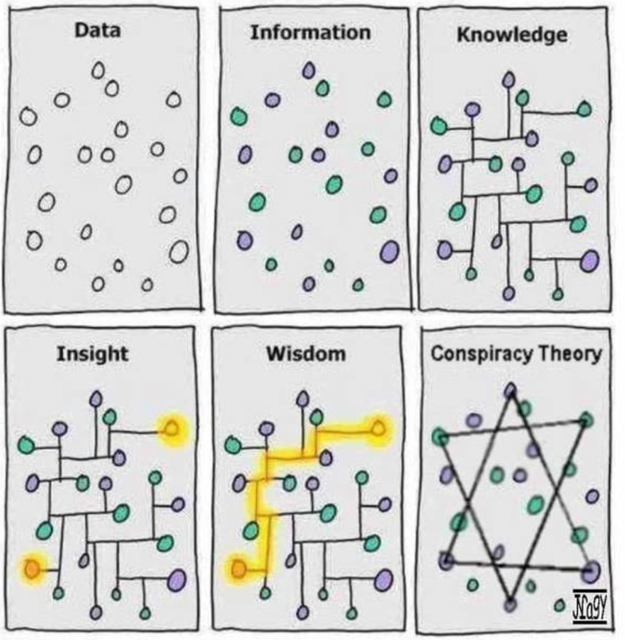
Also +1. And then I wanted to know from where you got that, and found one, that I am afraid, is even more realistic:
-
Sigh... Again you are interpreting Zeilinger wrong. And, framed by your interpretation, even @joigus gets it wrong here: No, you are reading it 'backwards'. Read precisely what Zeilinger is saying: Superdeterminism would be (reshuffling above sentence): That would mean that reality (even in the far past) has a very essential influence on our deciding which measurement to perform. Read closely, so that you see the difference. If necessary, repeat in your own words, so that we can check that you really understand that you read the original sentence backwards. In Zeilinger's own words, in its own paragraph about superdeterminism (calling it 'total determinism'): Bold by me. I mentioned that already here: And this is what the 'quasar-driven' experiment is about. Not about the choice of locality on one side, and realism on the other. Again, bangstrom, in their technical meanings as used in CHSH, not in what you would like to see as realism (non-locality implies non-realism). Zeilinger and co are very clear in their article: it is about closing the free-choice loophole, not about locality or realism. Just in case you do not notice: I boldface words in my own texts, that use these words as they are meant in their precise meanings as used by all QM authors, especially CHSH. Nope. Correlation (consistently, not accidentally) means that the events share a common history. And that is the moment that the entangled particle were produced.
-
Yep. Read, and understand the paragraph after the one where your citation comes from. Your claim is false. And as @Ghideon clearly has shown to you, in none of the explanations the motivation 'non-locality' is mentioned. 'Local realism', yes, but in its technical meaning: locality and realism, as two distinct assumptions on which CHSH is based. You are subsuming 'locality' under 'realism', which is simply not the way these are used for CHSH. And still you have not been able to cite even one recent text, where a QM specialist argues that we must give up on locality. Yes, you'll find popular science books in which such is stated, and, even worse, standard QM text books that say such things (read the Coleman article again, and try to understand it!). If you need that simplification, then I am glad for you. Close reading of Zeilinger's book, would have solved this from the beginning. And what do you mean with 'realism' this time? And what concept of realism your are meaning here? It cannot be the one of CHSH. Aha, so not what is the basis of CHSH. I would say "Shut up and calculate". Read Susskind's book, and it is all explained in mathematical detail. There is a better word: correlation! OMG! Two cars colliding is a single event. Two measurements are two events. Two measurements that are space-like separated do not have the same timely order in all inertial frames. This comparison is BS. OK, by me. Psssst.... @joigus uses 'realism' in the same meaning as CHSH does. Not your obfuscating meaning.
-
Nope. You cannot read. Or intentionally interpret it wrong. He is very clear about it, that his stance is another one than 'most physicists' (in 2010), again the same citation: In clear text for you: it is not possible to speak about all properties of a particle, or a pair of entangled particles, before they are measured. That is what is meant by realism. And if we give up on realism, we do not have to give up on locality. And QM does not need none-localism. This has nothing to do with locality and/or realism. This is to make the freedom-of-choice loophole (AKA superdetermism) less probable. By using quasars 7.8 Billion lightyears from here, and in opposite direction, it would mean that already 7.8 billion years ago it was determined in which direction the polarizers would be set. From here: Why going on a side track? We are not discussing superdeterminism here.
-
I once saw a fireball (big meteor), and I was sure I could hear it at the same time. A friend of mine noticed that this would be impossible: fireballs are still somewhere 50-100 km high in the atmosphere, so the sound would take much longer to reach my ears. Many years later, I read about a possible explanation: it seems that microwaves are capable to move dry hair slightly, and it is the 'fizzling' of the hair you can hear. As I had quite long hair in those days, this might be an explanation. But to be honest, I also am open to the suggestion that it was just an illusion.
-
Because, obviously, most specialists on fundamentals of QM today say that of the two different assumptions behind Bell like inequalities, locality and realism, the most tend to give up on realism. I am not interested in QM of 50 years ago. Because @joigus, and @MigL quite convincingly explain why. Because of the no-communication theorem. Because Bell's theorem only says it is impossible to simulate entanglement with classically devices. With classically working devices, but only then, you would need FTL communication. Using QM, you do not need FTL signals to explain entanglement. A blatant lie. Your out of context citation of Zeilinger: And the next paragraph in Zeilinger's book: Italics by me. We are full circle. Groundhog Day: you are caught in a loop, bangstrom.
-
Yes. You bend their words, I read what they really are saying. I read the text as a whole, and do not pick out citations that fit me best. Only after you redefined realism to contain locality. Zeilinger and your IBM lady are very clear: 2 distinct assumptions flow into the CHSH inequality: realism and locality. In this whole thread you were defending that we should give up on locality. And now you are saying that instead we should give up on realism??
-
Addition: Your IBM video: 2022 Nope. They showed that at least one of both, locality or realism is not valid. All my bulleted authors above say, or tend to, give up on realism, especially Zeilinger himself. Exactly. Especially, they say nothing about a signal. You are arguing in ill faith. Where CHSC clearly distinguish between the two assumptions, locality and realism, you are suddenly talking about 'locality' and 'local realism'. It was already explained to you ad nauseam that in CHSC 'local realism' means 'locality' and 'realism'.
-
Right. The only thing @bangstrom does is repeating points that he made already; evading questions; redefining words; suggesting his knowledge of QM is uptodate, where yours and Swansont's is not (on the brink of being insulting); cite text passages out of context or not relevant; and obfuscating with new formulations that have simply no content ('effect of correlation'). He is not seriously interested to learn something. He cannot confess he is wrong, either because he doesn't want to lose his face, or because he is ideologically attached to the idea of non-locality. He is just trolling around.
-
WHAT? Swansont showed it: Joigus mentioned it several times. And in Susskind's Quantum Mechanics; the theoretical minimum you find it on page 166. And here you find it on Wikipedia. So refresh your memory: Or show where the formula indicates a signal between the particles. It is called the singlet state, and QM shows it can be created. In that you shifted the meaning away from how it is used in the CHSH inequality. For you, realism includes locality. For CHSH it doesn't. Here you are redefining it: That simply is not what CHSH is about. It clearly distinguishes the two assumptions on which it is based: locality on one side, realism on the other side.
-
Wrong as wrong can be. Susskind derives it in his book. She says that only 2 assumptions flow into the CHSH inequality locality and realism. And she says literally: Nope. Not instantly. They even had to ensure that the entangled photons were delayed, so that the conventional signal arrive at Bob first. So quantum teleportation is slower than FTL. Troll.
-
Ha! That must be it. Maybe somebody forgot to pay the bill for the address registration? Something like that was my most probable guess. Pity that my networking colleagues didn't think about an ICANN Lookup. Thanks!
-
Exactly, that's why I posted it.
-
Hi administrators, For 3 days I could not reach these forums. As I see no postings telling us what happened, must I assume it was not a problem at science forums itself? I could not connect from my work, and neither from my home. The error suggested that the URL could not be resolved. Was this a local problem? Swiss? European? Or was it really some problem with the URL registration? I was already desparately trying to find somebody I could contact to find out what was going wrong (WHOIS, trying to find out the email address of one of the moderators). SF is one of my daily mental vitamins. Glad to see y'all back again! Eise PS My, lucky enough very small conspiracy theory module, thought already that it concerned my posting about trackers... PPS At least there seems to be a time gap:

-
Psst... It is faster than thought...
-
Because I have problems with my stone age old Ubuntu, and with that, with the installed browsers, I sometimes have to change from Opera to Firefox. I nearly always use Opera, but using Firefox, with my add-ons, I saw there are quite a few trackers on scienceforums: Is this just in the forum software package, i.e. unremovable? Or is it part of a sponsoring contract? If possible, I of course would like them removed. Otherwise, I assume we have to accept this. I have "do not track" set, but AFAIK it just sends a request not to be tracked, it does not block trackers.

-
I think Swansont asked for a QM derivation, not for citations: Which of "not an article about QM" you did not understand? In the hope I correctly understand Swansont's Ansatz, he is doing the following. He gives you the formula which rolls out of the math of QM. I hope you recognise it. Joigus also mentioned it (I think even a few times). The importance of the formula in this context is that it does not contain a dependency of the distance between the measurements, i.e. it is valid even if the measurements are space-like separated. So your task is to show the formula wrong. QM. Just QM. Your citation contains no description of the question 'locality or realism'. I think it also contains nothing Swansont would disagree with. So this article might be a correct description of entanglement, but it is not relevant. The IBM lady you have called as witness, disagrees with you. The video is less than 50 years old... Because, from a classical view, the results are outrageous. Two of the fundamental assumptions of classical physics are challenged, locality and realism (in the technical sense of those words, not of your vague interpretations of them, see CHSH). There obviously were physicists that trusted QM so much, that they did not find it necessary to do such experiments, e.g. Feynman. He was not interested in Clauser's experiment. And Zeilinger's experiments also lead the way to applications of entanglement: quantum cryptography, quantum teleportation and quantum computing. You did read the articles on the Nobel prize website, didn't you? But of course you did not understand them. Hm. Reminds me of a posting here...
-
And another foot shot. From the same article: Italics and bold by me. You redefined 'realism', so that it contains 'locality'. But your IBM speaker clearly distinguishes in a very technical way between the two, namely as the only two assumptions of the CHSH inequality. You've made clear for all of us: You cannot understand the argumentative arc of texts And related, you cite pieces of texts that seem to support you viewpoint, but in fact the text as a whole does not You are not able to refer to a modern article (less than 50 years old, if you know what I mean) of a respectable physicist that defends that of the two, locality and realism (in their technical sense, not in your unjustified interpretation of it), we have to give up on locality You do not understand how we use special relativity to argue that there is no direction in the correlation of Alice's and Bob's measurements You do not even understand special relativity And last but not least, you simply do not understand quantum mechanics. I think we should close the thread. Because of Joigus' mental health 😉, and my ability to express my free will (didn't I say I am out?) 😟, and because of this: And I found this elaborate extension of it:
-
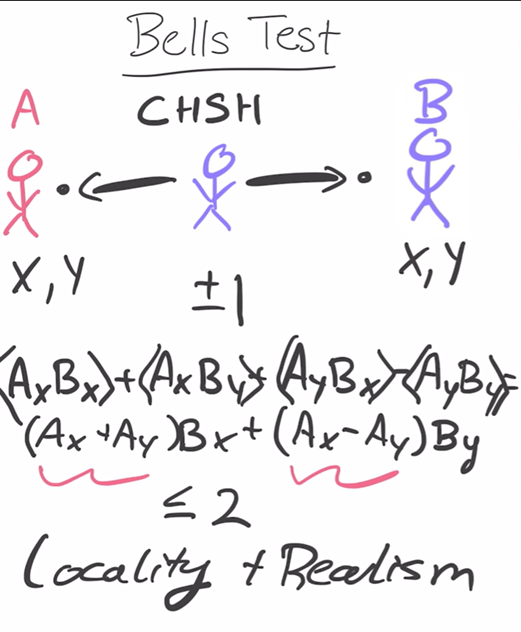
No need anymore to comment on this. But then, we see how you bend what is said, even in your video. At 7:55 she says that the only two assumptions that went into the CHSH inequality are locality and realism. See the screenshot I made from the video. So it is locality or realism (or both) that we must give up. And to repeat: later on she says "The way that most scientists have interpreted this, is that we have to give up on the idea of realism".
-
Fully agree with Joigus. You just showed that you do not understand one single word that MigL, Joigus and I said when considering relativity in such entanglement experiments. And Joigus made such a beautiful drawing, exactly showing what I meant (+1). You are nearing the troll-zone. Instead of sticking to your viewpoint, try to understand what here is said. Please do.
-
It is really amusing to see how you shoot yourself in the foot again and again. At about 10:05: It is not garbage, in the end even a lot of physicists thought we have to give up on locality. See my citation of Zeilinger from his Dance of the photons. But his book is from 2010. Now 12 years later, in 'your video', above is said. So it seems the consensus is moving in the other direction. Your counter argument against my relativity however, is garbage, as @joigusalso noted. I did. In my opinion (maybe Swansont, Joigus, and MigL would not agree, that's why I say 'opinion') that in QM, more specifically the wave function, we have reached the limit of our our capacity to know and understand nature. In a Kantian way, one could say that we encountered the limit behind which the thing-in-itself (Ding-an-sich) is hiding. I have a hunge (even more vague than 'opinion'), that there will be no new experiments that will close some of the remaining interpretations (MWI, superdeterminism (of which Sabine Hossenfelder is a fan), counterfactual definiteness). But more Zeilingers will stand up, and will design more unbelievable applications of entanglement. And who knows, some day my hunge and opinion turn out to be wrong? Can you tell us, why you are so attached to the idea of non-locality? Or what you have against loosening our conception of realism? You see, the moon really is there, even if we do not look up. But we cannot observe the wave function. It is only at this very deep level we must loosen our concept of realism, not in our daily life.
-
OK, so we assume that in the reference frame of Alice, the source of entangled particles exactly in the middle, and Bob on the other side; nobody is moving against each other. So if Alice and Bob find a correlation between their measurements, it is impossible to say who was first. That is already problematic for you: in which direction is the signal/information/communication/effect/action/interaction going? The situation is exactly symmetrical. Now observer1 flies with great speed from Alice to Bob. He will see that one of them was before the other, and could conclude that one sent a signal to the other. Observer2 flies in the opposite direction, from Bob to Alice, and so concludes exactly the opposite, she will say that the other one was first. If Observer1 and 2 know their relativity, they will recognise that the events are space-like separated, and the correlation must be caused by an event that exists in the respective light cones of Alice and Bob. And lo and behold, there is a one single source of entangled particles in the light cones of both. So the reason of the correlation lies in the past that Alice and Bob share. Like a pair of shoes... There is no signal/information/communication/effect/action/interaction needed to explain this correlation. I have a dejà vu. Another dejà vu... Bell did not do these kind of experiments. I assume you mean Zeilinger. You know, one of the three that got a Nobel prize.
-
It seems that you also do not understand special relativity. There is no preferred frame of reference. So in space-like separated events, there will be an observer for whom Alice's measurement occurred before Bob's, and also an observer for whom Bob's measurement was before Alice's. The frames of reference of the source, or of Alice or Bob simply are not preferred frames of reference, because there are none. I thought MigL was very clear about it, and I also brought this point when I referred to this Geneva experiment the first time, but it seems you do not understand it.
-
Bell is, pity enough, dead, so he did not get a Nobel prize. You mean Clauser, Aspect, and Zeilinger. And Zeilinger himself says in the book you introduced here in the discussion, that he thinks that of our presuppositions, we have to give up on reality, not on locality. Others, see my list of authors, take an even stronger position. QM is local. And do you realise you really did not answer Swansont's question? You are talking around it, without answering the question. Bullshit. Don't ever say this again. Or better show us where Joigus and Swansont are not uptodate, and you are. Addition: For what it is worth, the publication years of the sources of my 'authority list': Coleman:1994 Kracklauer: 2002 Zeilinger: 2010 Susskind: 2015 Gell-Man: 2016 Hossenfelder: 2020
-
But nothing on Bob's side shows him that the particle has an entangled partner. OK, if you really need reading help, I am not such a bad guy. - - - - - - Nearly all physicists agree that the experiments have shown that either locality or realism, or both, must be given up. Most physicists think that we must give up on locality. That is exactly what Einstein meant, and called 'spooky'. It seems weird that when one measures one particle, it immediately influences the other one. - - - - - - But take care! In the next paragraph, Zeilinger speaks for himself, not for 'most physicists'. And there he clearly says, that he thinks we should drop realism, not locality.