studiot
Senior Members
-
Joined
-
Last visited
Everything posted by studiot
-
We most certainly can. I posted the mathematics of this a couple of years ago, last time this was asked. I will try to find it for you, when I have time.
-
No erosion. +1 Such as ? Did you really mean to say that or something else ? What process of logic leads to that conclusion ? How does this square with the gravitational theory of accretion ? Even today impactors bypass the Moon and head for Earth. We have just been treated to the regular meteor showers by the perseids https://science.nasa.gov/solar-system/meteors-meteorites/perseids/
-
Good start, although you need a good answer if they already have it. You'd be suprised how much of their time you can waste with unexpected responses like yours or mine. I do like to put as big a spoke as possible into their machinations.
-
But it certainly stimulated further discussion.
-
I usually have a nice chat with those nice people from Microsoft, British Telecom, British gas, etc whcih runs along the lines of Them "We're from British Bullshit dot com abbout you router, pc, telephone......" Me "Oh good when's the engineer coming to fix it?" Them " Uh What" Me " your are calling to make an appointment to fix the fault right? It's over week since I reported it." yada yada
-
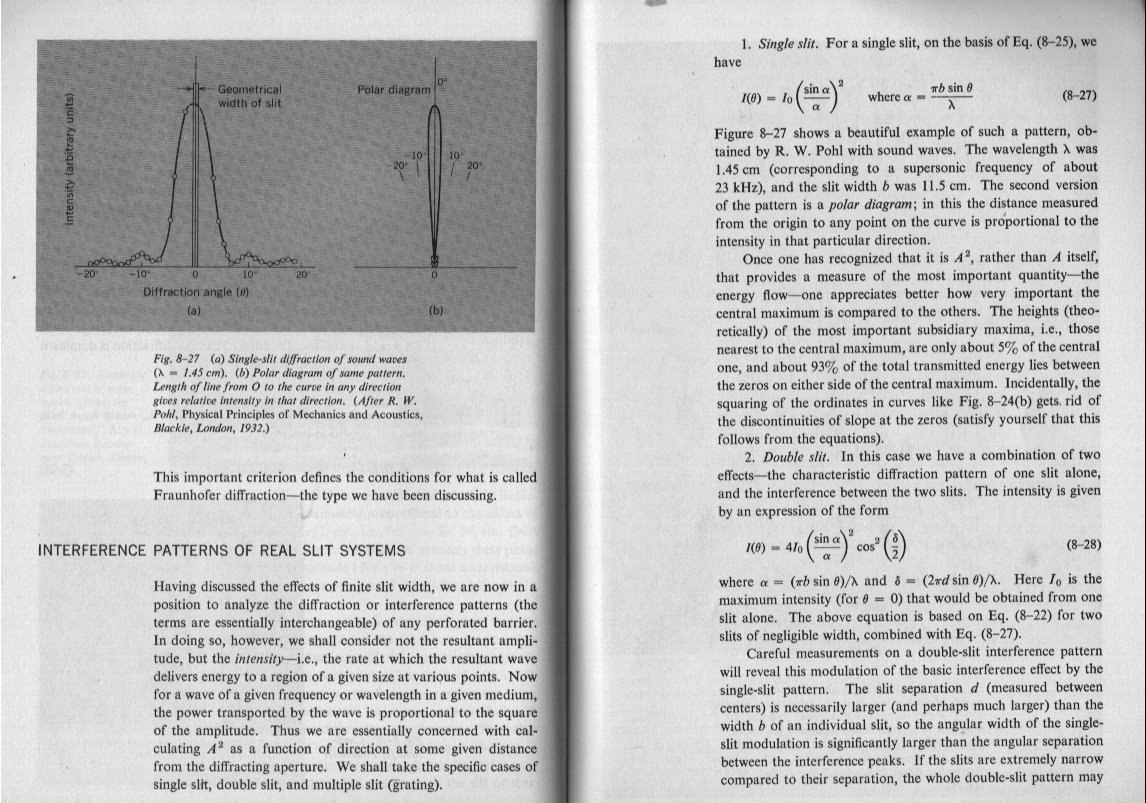
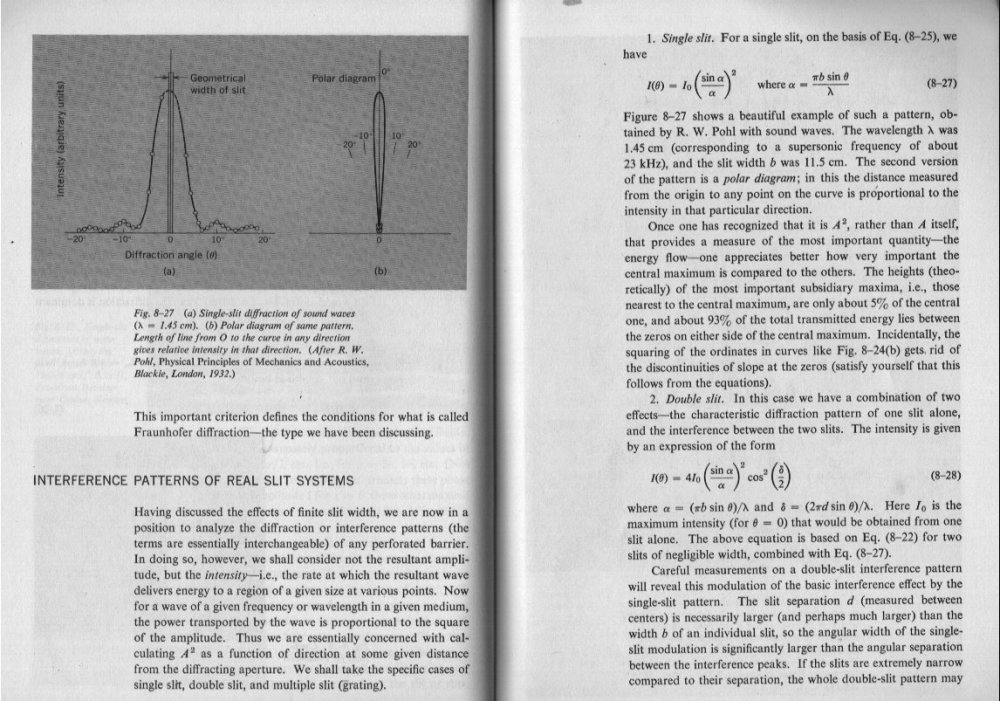
Thanks for that. There is a simpler version in Appendix appendix C p465 of Elmore and Heald 'Physics of Waves' but along similar lines. @Michael McMahon ou could profit from viewing things from an energy flow POV. Here is a short extract from A P French's Vibrations and Waves (MIT) I would be interested in any elaboration on this.
-
This is a Science discussion site and technically 'renewable energy' is a contradiction in terms since it contravenes the laws of thermodynamics. All ' higher' forms of energy degrade to heat with deployment.
-
Yes there are several alternate hypotheses. Each one has its own difficulties to overcome and proponents that prefer to ignore these. Whilst this is true for some elements, there is about four times the % of Titanium and 10 times the % Magnesium on the Moon and 5 times the Sodium on Earth. Core or not, the Moon has no magnetising dipole field like Earth. Yet some of the rocks brought back by Apollo are found to be magnetised. The large object hypothesis need to explain where the object came from and how it came to collide with the Earth. It also need to explain how, if it was the precursor of the Moon, the Moon has ended up with its present composition. Forecasting is as uncertain as hindcasting. The Sun is not due to got to the next stage for another 8 billion years, nearly twice the current age of the Earth and Moon. The alleged impact must have occurred early in Earth's history, particularly the gob theory.
-
I agree entirely with the underlined statement so you can well imagine my frustration having a one sided discussion with you. I also agree that the above post is the first time what you have said is mostly in accord with engineering electrical theory. Pity you were not listening when I told you exactly this back on page 1 and so did not ask to take this further.
-
Doesn't the HUP also apply to calculations, whether or not they are for a real experiment ?
-
You may be suprised to learn that in the UK the modern idiom is to allow, nay encourage children to run around chattering and shouting in a (public) library. They even provide toys etc for this purpose. How to bring up kids who have no idea how to behave in public ?
-
Now here's the thing. You have cobbled together some standard electrical equipment and may or may not have hit upon an unusual, but useful configuration. However it should be noted that all the equipment you are using was conceived , designed and built strictly according to conventional electrical theory. Consequently they can be expected to perform according to that theory, and the original manufacturers will have tested to show that this is the case. Your diagrams and words here are at variance with each other and with your sundry videos. When asked about this, I'm sorry to say, you don't listen properly and expend a lot of effort answering questions that were not asked, whilst missing important ones that were.
-
Not all the research. But yes it is a plausible hypothesis. To have volcanic activity, trigerred or not you have to have buried molten rock. What evidence is the for buried molten rock on the moon ? Are you suggesting that the Earth was reduced to a molten ball after it had already cooled suffieiently to solidify on the surface at least ? Theres not going to be a crater on Earth on account of 4 billion years of tectonic activity and movement. Gravity favours accretion. It doesn't favour accretion into locally proximal lumps. The large lumps grow at the expense of the small ones. This favours the alternative hypothesis of the Moon and Earth forming at the the same time, over the chip off the old block hypothesis.
-
If it's all about responses, where did all that human creativity come from ? Why did Ugg wonder what lay over the horizon ? Why did Newton think about the apple or Kekule about the serpent ? Where did Beethoven's 9th come from or Wordsworth's daffodils or Coleridge's Mariner ? What inspired Bosch or Michaelangelo or Monet ?
-
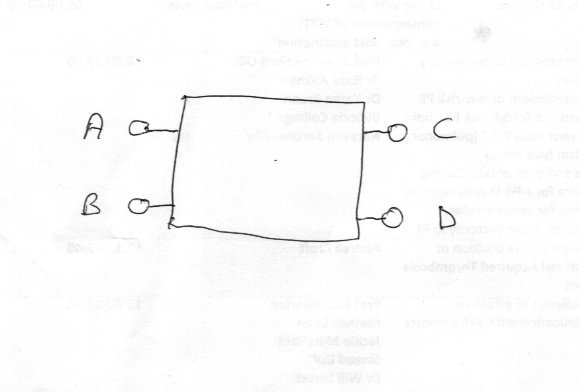
I am mechanical by nature meaning everything to me has a mechanical aspect. My only understanding is that when a magnetic field interacts with a dia material the material induces a magnetic field of its own with oppositional fields. The mechanical aspect of that for me is when I described two cogged gears working together. Well here is a simple mechanical test for you. I said If you take a rod of a material and suspend it freely in a magnetic field. From the point of view of the object. A paramagnetic or a ferromagnetic rod will align its long axis parallel to the field A diamagnetic rod will align its long axis across the field (Faraday 1845) From the point of view of the field. The field in the vicinity of the rod will change. For most materials this will not be by very much. The magnetic field in the vicinity of a diamagnetic rod is decreased slightly, perhaps 0.001% - 0.1 % The magnetic field in the vicinity of a paramagnetic rod is increased, perhaps 0.001% - 0.1 % The magnetic field in the vicinity of a ferromagnetic rod is increased by up to 100 times or 10,000% Not sure what you mean by shorted. Did you leave the shorting wire in place and add a resistor ? Here is a useful device for describing things called black box theory. Very useful in circuit theroy but it also appears in mechancal theory. If A-B are the terminals of the primary of your transformer and C-D are the secondary, please indicate what these are connected to. The whole pint of Black Box theory is that for this purpose it does not matter what is inside the box, only its connections to the outside world. For your information the connection and layout information is commonly called the circuit topology. Thank you. Now I owe you an apology as I have found it in your second post. I think in the original post it was marked 'demo'. When you connect the motors, the first is a standard 120 volt motor and the second is a 12 volt motor connected in series across the 120 volts line (phase you call it correctly). I do not, therefore find it suprising that both motors will still run as the bulk of the drop will appear across the moter with the higher impedance (the 120V motor).
-
I'm at a complete loss to understand the point you are trying to make or what its relevance to this thread might be.
-
Hello John John and weelcome since I see you joined 2 hours ago. I also see your favourite subject is optics. Perhaps you would like ti fill ou a bit more so we can set the correct levels for discussion ? I thought your first post in the microscopy thread was very perceptive. But this curent thread suggests you are just starting optics as your terminology is somewhat adrift. There are many models of light, each suitable for a particular purpose. The photonic model is best suited to matters other than illumination (except for laser diode lamps). For illumination we tend to use other models whcih are rather simpler to handle. To illuminate something means to shine a light on it. It does not mean that the something emits photons itself, but that it reflects at least some of the light we shine on it. If that something emits light of its own accord we say that or that it is a source of light, not that it is illuminated. This is an important distinction in optical theory.
-
That's a lot of energy. The edge mountain ranges/escarpments are 3km high and tens of thousands of km long, normally associated with the sort of energy of whole plate movement/interaction. It may be that this energy could be supplied continuously over a long period, by the 'vortex' of roiling magma, as figs 2 and 6 imply. The question arises. The original craton material predates this activity and was stable for hundreds of millions of years. The material of the elevated plateau remains unchanged by process. The edge margin mountains should be heavily metamorphosed versions of this original material, not for instance solidified magma alone. A purely erosional hypothesis would mean that the edge material should be original craton material. I have been trying to determine the rocks in both places and wil let you know what I dig up. It is a great pity that no one else seems interested in this, the only truly scientific thread around.
-
If you don't wish to co operate I can't help you further. Sorry.
-
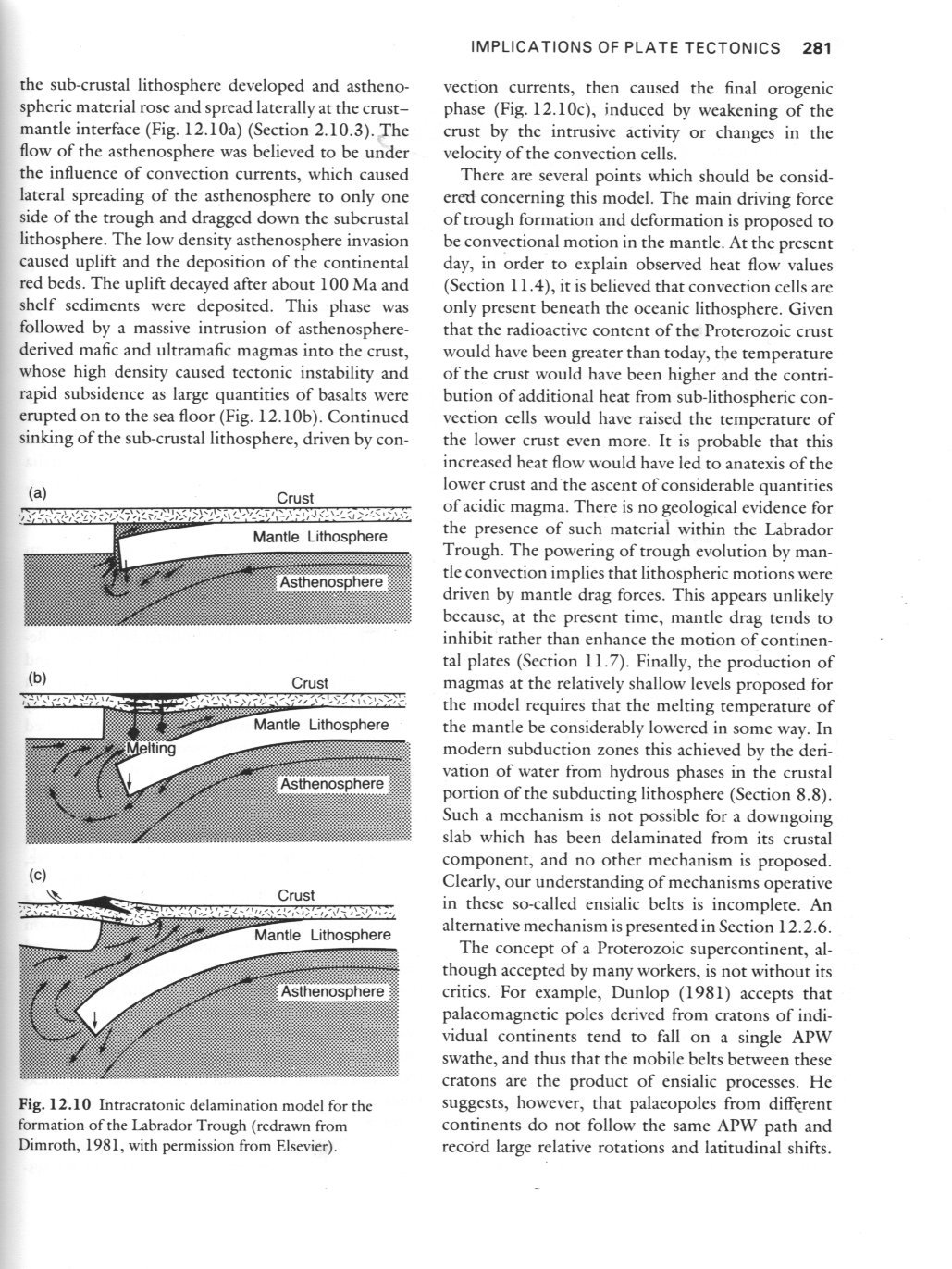
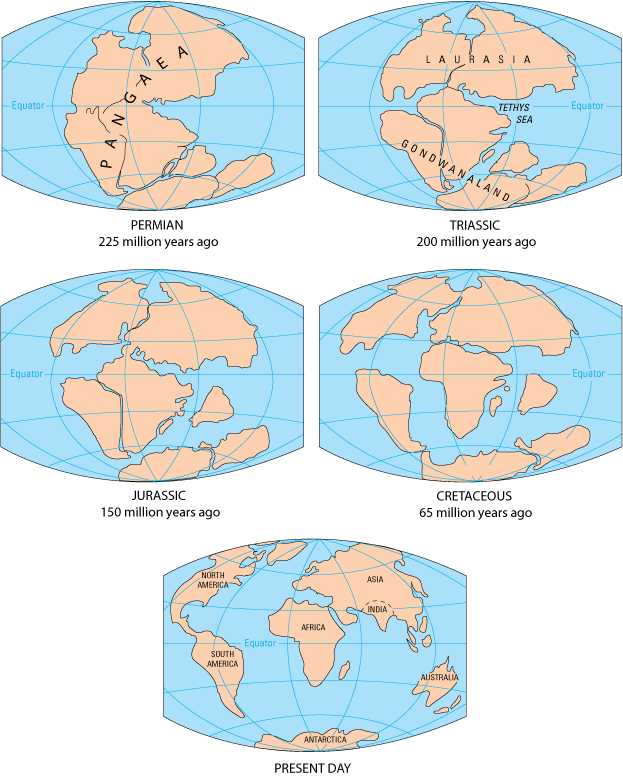
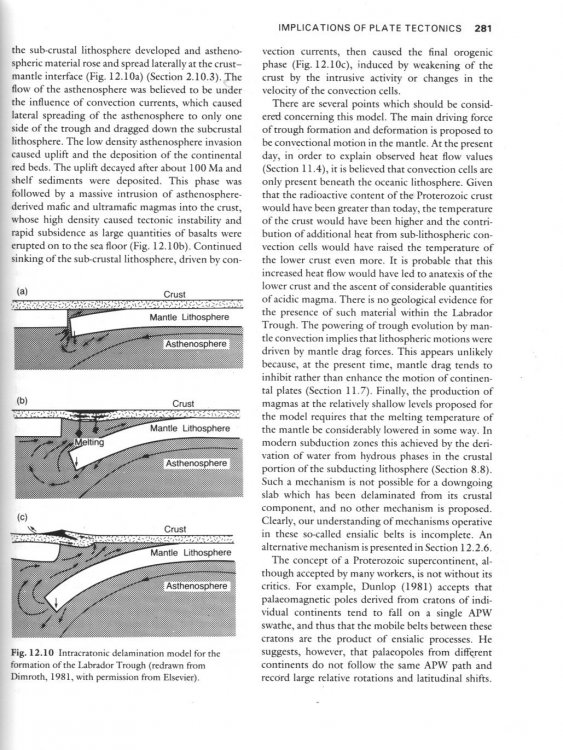
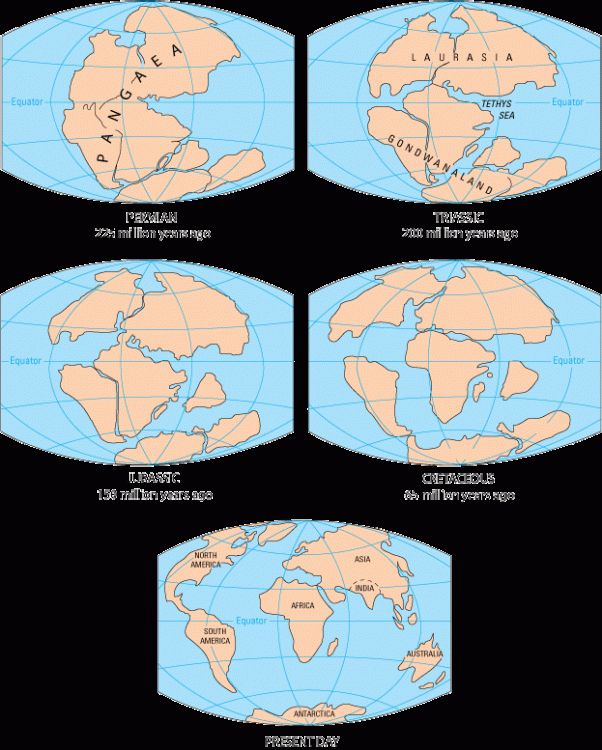
Thank you once again for pointing to a most interesting and thought provoking investigation. The idea of continental delamination but rising hot magma was originally proposed by P Bird in 1979 as an explanation of the Labrador trough. Here is a reference to this http://peterbird.name/publications/1979_delamination/1979_delamination.htm This was extended in 1981 by Dimroth as in this diagram. As discussion (references later) has since caused this approach to be discarded as no one has been able to make the necessary heat flows add up. See the discussion also in the scan. Further explanations are also introduced and discussed. The scan is from my copy of Global Tectonics by Kearey and Vine 2n ed I note that there is now a 3rd ed with nearly 200 extra pages. A (free) pdf is available here https://www.geokniga.org/bookfiles/geokniga-global-tectonics.pdf warning it is 66MB The conventional explanation, based on the Wilson cycle of breakup of continental crust (cratons) is greatly expand and firmly entrenched in the £rd ed. But it really is an excellent text as it examines the conditions of tectonic process as applied to the real earth geology and geography, including the mineralogical and rheological environments. A final picture towards our next exchange from Wikipedia. The real earth examples in the Nature article all relate to the breakup of the last supercontinent, Panges. So we need to go back about 200Mya and start there, because the examples did not all occur at the same time but over a period of about 200Mya to 50 Mya.
-
I really think it would be a good idea to try to focus your question. Take a look at this website and see if this is what you are really asking about. Then ask a few more detailed questions. https://www.cloudflare.com/en-gb/learning/ddos/glossary/open-systems-interconnection-model-osi/ Please note the statement Layer 7 The application layer. I am also going to say +1 for encouragement as this is a much more reasonable thread than some of your earlier ones and much more in tune with ScienceForums. We can actually help you with this one rather than argue.
-
Here is another viewpoint, but covering the whole globe. I note the Indian and african examples the raised upland is 'protected' from eroding rainfall by the escarpment mountains. https://orca.cardiff.ac.uk/id/eprint/56857/1/Blenkinsop%2C Moore - 2013 - Tectonic Geomorphology of Passive Margins and Continental Hinterlands.pdf
-
This is a good topic for you to do some experimentation on your own. For instance you seem to be suggesting that a steel ball felt heavier than a piece of wood. Take a short length of wood etcf eg a rule Spread out one hand and lay the rule across all the fingers of that hand. Now low some fingers, one at a time. Does the ruler feel any different as you do this ? One thing to remember is that our brain/nervous system receives an enormous amount of sense data. All our sense data is filtered so that only some reaches the brain. For instance can you feel the pressure of the ground on your feet ?
-
You want a 5 year course in computer engineering put into a nutshell on a discussion forum ? From your question paragraph you seem to be leaning towards hardware. Are you aware of the distinction between hardware and software or the layer model of computers ?
-
That was not 'my perception' at all. Please go back and read carefully what I wrote. You actually asked a question along the lines of 'What happened to the magnetic field ?' I answered this question. So please stop saying I have since answered another of your questions, which answer you have again ignored. Now here are two questions of mine What is you understanding of a diamagnetic material ? All materials, without exception, are diamagnetic. In some materials paramagnetism or its stronger cousin ferromagnetism swamp this diamagnetic effect. The interaction between a magnetic field and a material object can be viewed or classified according to the effect on the material object or the effect on the magnetic field. Both of these views must obviously 'match up'. The dia, para and ferro classification was introduced by Faraday's original work, when they had no means of probing the magentic field so he went for the effects on the material object. Later workersdeveloped means of probing the field and the so they are usually now described in terms of the effects on the magnetic field. But, of course they match up. Secondly can you explain what you mean by this ? Finally I don't know who removed the link in your original post but I can't find it now so have to rely on memory of that original bunch of videos you linked to.